


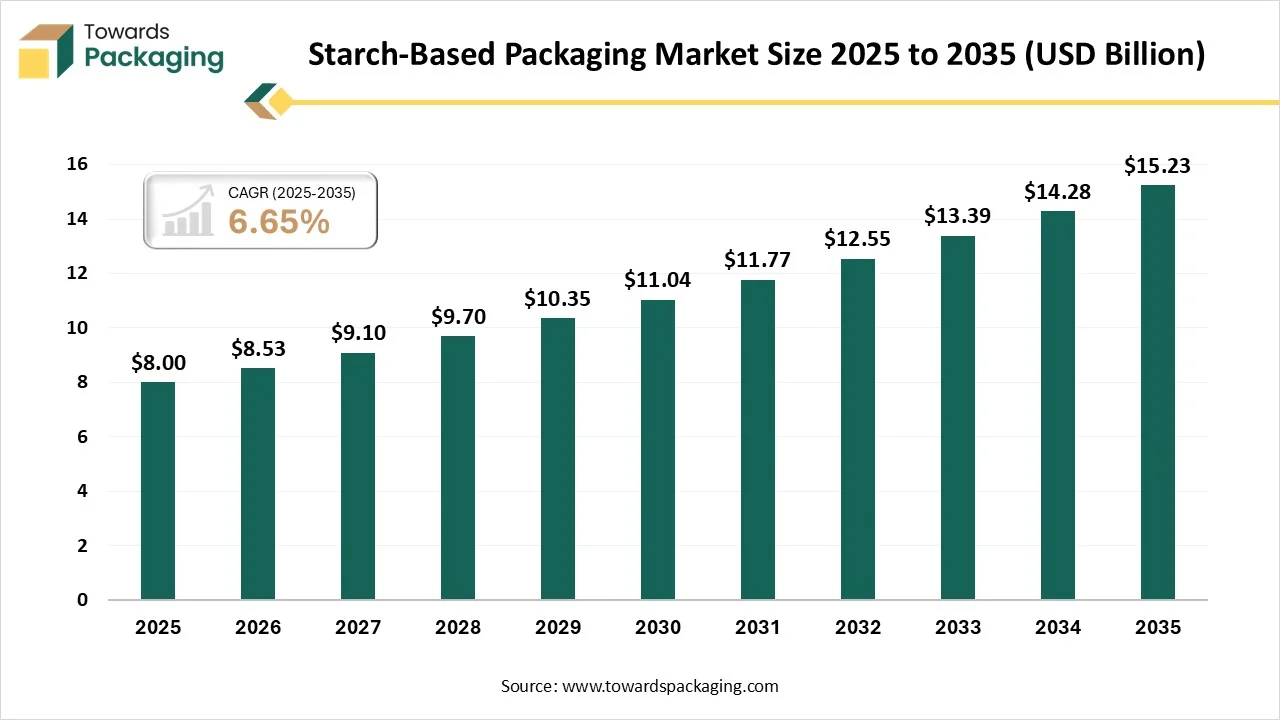
The starch-based packaging market is projected to grow from USD 8.53 billion in 2026 to USD 15.23 billion by 2035, registering a CAGR of 6.65% during the forecast period from 2026 to 2035. The report provides comprehensive insights into market size, detailed segment data by material type, packaging type, and end-use industries, along with regional analysis across key global markets. It also includes company profiles, competitive landscape evaluation, value chain analysis, trade statistics, and detailed information on manufacturers and suppliers, helping stakeholders understand market dynamics and emerging opportunities.
Starch-based packaging points to packaging materials initially created from natural starches like potato, corn, or wheat. Such starches are being processed into biopolymer or bioplastics films, which can be molded into different creations like wraps, bags, or containers. Alike conventional plastics that come from starch-based packaging, which is biodegradable, renewable, and even compostable. It is crafted to break down naturally in the surrounding environment, particularly during a certain period, which lowers landfill waste and pollution.
The future of bio-based food packaging is meant for main development, which is driven by developing materials, applications, nanotechnology uses, assistive policies, and the encouragement towards a circular economy model. Cutting-edge biomaterials that include composites, biodegradable polymers, and edible films have constantly developed with enhanced regular characteristics, such as improved barrier results and antimicrobial activity. Nanotechnology plays an updated role by allowing the incorporation of nanofibers and nanoparticles to develop mechanical power, gas barrier properties, and active packaging factors like controlled release stabilizers. Such advances expand the shelf life of food products while tracking sustainability.
The involvement of Response Surface Methodology and Artificial Neural Networks is stimulating the refining of starch-based films. Alongside the AI models, it works brilliantly in predicting the crucial spots prior to the physical tests. The unification of pH-sensitive indicators and AI assistance is a valuable advancement in the market. This advancement contributes to the environment and promotes sustainability.
The films & wraps segment dominated the starch-based packaging market in 2025, as it is receiving attention in the packaging sector for many different reasons. Initially, they are sourced from renewable resources, which makes them a more sustainable choice compared to petroleum-based plastics. Secondly, such films decompose much quicker when they meet the environment, often in months. For the food sector, starch-based films serve perfect barrier properties, which makes them perfect for covering sensitive food products. They supply protection from oxygen and moisture, which ensures that food stays fresh for a longer time.
The bags and pouches segment is projected to experience the fastest CAGR during the forecast period. These are created from natural materials that are biodegradable, which means they can decompose naturally in the environment without causing any pollution. Like regular plastic bags, starch-based bags and pouches are being planned to break down quickly, which releases their nutrients into the surrounding environment and avoids the cost of waste, which results in landfills. The biodegradability of starch-based bags and pouches relies on the number of elements, which include humidity, temperature, and the availability of microorganisms in the environment.
The food & beverages segment dominated the starch-based packaging market in 2025, as starch is a perfect source of biodegradable material for food packaging, which comes from corn, wheat, rice, and potatoes. It is widely deployed as a sustainable alternative to plastics for food packaging. Additionally, different foods such as vegetables, fruits, dry products, and snacks can be packaged by using starch as a biodegradable film. Montmorillonite 9MMT) nano-clay has been suggested as a promising nanoscale filler for biodegradable packaging. Therefore, the usage of MMT in food packaging can be attributed to its high stability, lower costs, and high level of smoothness. Starch is being sourced from plants, which can come from tubers, roots, legumes, and cereals that count them necessary availability, biodegradability, and annual return of nature.
The e-commerce segment is expected to experience the fastest CAGR during the forecast period. In industry and retail, it provides protective mailer bags and fillers. Hospitality organizations are using corn starch packaging to substitute single-use products in their daily applications. Bio-plastic packaging has received significant headways in the e-commerce industry. With the growth of online shopping, the urge for packaging materials that are both reliable and sustainable has developed aggressively. Bioplastics, which has its eco-friendly elements, has developed as an important solution for e-commerce organizations.
Europe dominated the starch-based packaging market in 2025 because this packaging material is witnessing main development, which is being driven by growing consumer awareness and the move towards sustainable packaging solutions. The industry’s growth is initially fueled by many factors, including the growing demand for eco-friendly packaging materials, user choice for greener products, and government regulations that promote sustainability. The European Union’s strong regulations link plastic usage to waste management. Like the European method for plastics in a circular economy, it has further fast -tracked the urge for starch-based materials.
The technological developments in starch-based technology, which include the growth of updated bioplastics, starches, and the composites that offer enhanced flexibility, strength, and water resistance, are also investing in market development. Furthermore, main funding in research and development has allowed the making of more reliable and inventive starch-dependent packaging materials.
How is the Starch-Based Packaging Market Growing in Germany?
Germany’s starch-based packaging is developing as a significant industry within the huge sustainable packaging sector. It is driven by growing eco-friendly awareness, user choice, and regulatory pressures for environmentally friendly products, as this market is meant for constant growth over the next year. Starch-based materials, which come mainly from wheat, cassava, and corn, serve as biodegradable alternatives to regular plastics, which match Germany's rigid waste management circular economy initiatives and policies.
Asia Pacific starch-based packaging market is witnessing a major move driven by developing eco-friendly issues and strong regulatory frameworks. Governments across crucial economies are using policies that match sustainable materials, spurring producers to accept biodegradable alternatives over regular plastics. Such a regulatory push, connected with growing user alertness about plastic pollution, is developing and growing in demand from sectors such as agriculture, packaging, and consumer goods. The transformation is being further assisted by developments in bioplastic manufacturing technologies, which are lowering costs and improving the material outcome, making them more attention-grabbing for large-scale industrial uses.
Why is India using Starch-Based Packaging Market Importantly?
The fast growth of online retail has developed the demand for sustainable shipping materials, which include starch-based void fillers, protective cushioning, and mailers. Strong enforcement of EPR compulsions that are effective from 2025 is changing the implementation of complaint traceable starch-based flexible packaging across the retail industry. Furthermore, India has completely banned single-use plastics and has encouraged producers and food delivery companies to use biodegradable alternatives like corn starch containers and bags.
| Country/Region | Standard Code | Certification Required | Home Compostable | Official Label | In-Effect Since |
| European Union | EN13432 | Yes | Partially | OK Compost (TUV Austria) | 2000 |
| China | GB/T 38082-2019 | Yes | No | Green Degradable Logo | 2019 |
| United States | ASTM D6400 / D6868 | Yes | No | BPI Certification | 2004 |
| Australia | AS 4736 / AS 5810 | Yes | Yes | Seedling Logo | 2015 |
| Japan | JBPA Biomass LA | Yes | No | Biomass LA Logo | 2020 |
North America’s contribution so far has been its popular corn production, used as a comprehensive raw material. The remarkable R&D initiative respects the regional regulations and adds value to the starch-related materials and films. While the innovation and well-known leaders' interest is serving excellence in the agricultural films, food service and flexible packaging.
Mexico's Interest in the Starch-Based Packaging Industry
The bio-based film dominance and transitions of sustainable alternatives are enough to describe the interest of Mexico in this market. The rising awareness of the hazardous impact of plastic pollution on the individual and the ecosystem paves the way for sustainable opportunities, followed by the strict environmental laws. The use of prickly pear cactus introduced biodegradable plastic, which is an impeccable innovation to date.
South America’s advancement emerges with the tech-driven approaches, as researchers are shaping the use of tech by generating composites along with active nanomaterials. The fusion of starch with various other biopolymers is an enhancement to the market and a salute to the researchers. The initiative of Chile and Brazil towards tightening the law against single-use plastics is driving more advancements in the regional market.
Brazil Usage Strategy of the Starch-Based Packaging
Brazil's usage strategy involves the intelligent merger of natural/organic antimicrobial agents, while the popular use of grape skins for pH-sensitive anthocyanins is accelerating the richness of the Brazilian land. The smart monitoring and vegetable/fruit coating are promoting fancy revenue for the regional market. The enhancement to the starch’s natural hydrophilic nature is highlighting advance usage strategy in the regional market.
By Product
By End-Use
By Region








Research & Advisory Analyst
Yogesh Kulkarni is an experienced Research Analyst specializing in the packaging sector, with a strong foundation in statistical analysis and market intelligence. He currently contributes his expertise to Towards Packaging.
Learn more about Yogesh Kulkarni

Reviewed By
Aditi Shivarkar, with 14+ years in packaging market research, specializes in food, beverage, and eco-friendly packaging. She ensures accurate, actionable insights, driving Towards Packaging Analytics & Consulting 's excellence in industry trends and sustainability.
Learn more about Aditi Shivarkar


Starch-Based Packaging Market
 Table of Content

 Download Sample
 Schedule a Meeting