


As compliance expectations tighten and material claims face greater scrutiny, global buyers are reassessing how compostable cutlery should be sourced, positioned, and scaled.
In 2026, compostable cutlery is no longer a minor foodservice accessory. For importers, distributors, wholesalers, and private label packaging buyers, forks, knives, spoons and wrapped sets have become a category shaped by performance, food-contact expectations, supply consistency, and procurement risk.
The question is no longer whether a supplier can offer an alternative to conventional plastic cutlery. The real question is whether that alternative is commercially stable, scalable, and credible in the target market. For buyers comparing how different material strategies are being structured in practice, Bioleaders biodegradable and compostable cutlery program offers one useful reference point.
For many years, disposable cutlery was treated as a relatively simple line item. Buyers could switch suppliers quickly, compare unit prices easily, and focus mainly on packaging design, carton efficiency, or container loading. That logic is weakening. Today, cutlery decisions are increasingly tied to channel strategy. A distributor supplying independent takeaway outlets may prioritize cost efficiency and availability. A foodservice chain with public sustainability commitments may prioritize heat resistance, claim defensibility, and consistent user feel. A retail buyer may care most about private-label readiness, packaging presentation, and documentation discipline.
This is why compostable cutlery should now be viewed as a risk control category, not merely a sustainability category. The wrong material choice does not only create product dissatisfaction. It can also trigger repeat-order instability, packaging inconsistency, downstream customer complaints, and uncomfortable questions about composition, claims, and disposal pathways. In a market where many procurement teams are actively simplifying supplier networks, the stronger manufacturers are those that can turn material selection into a reliable commercial system rather than a one-off transaction.
The global cutlery market currently revolves around four main material families: wood and bamboo, fiber pulp, cornstarch based compounds, and CPLA. On the surface, all four can be positioned as alternatives to conventional plastic. In practice, however, they perform differently, communicate different value stories, and fit different procurement priorities.
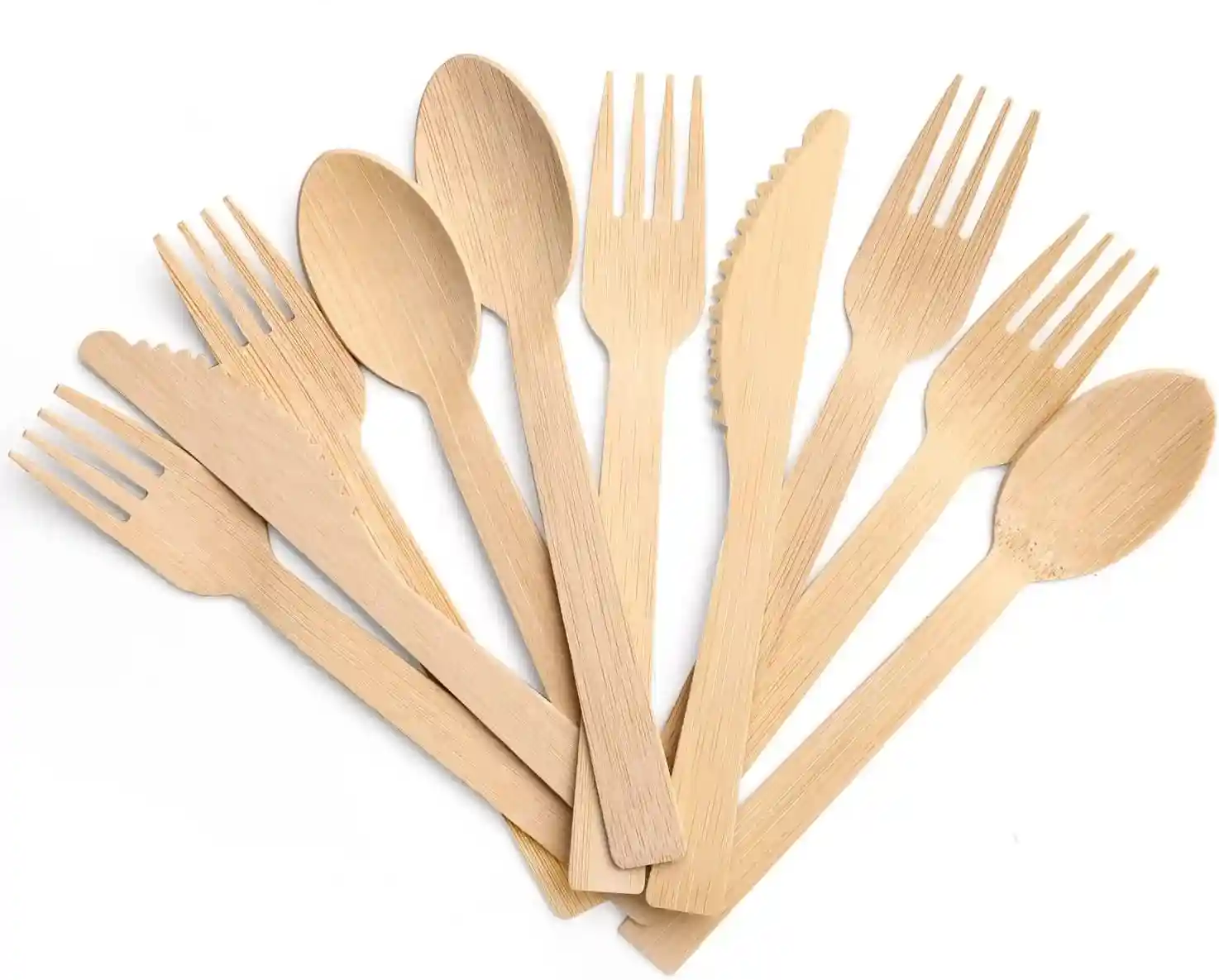
Wood and bamboo are often perceived as the most straightforward natural choice because they look renewable, rustic, and easy to explain to end users. However, from a large-scale procurement perspective, the category is more complex than it appears. Buyers frequently raise concerns around visual consistency, surface finishing, and taste neutrality. In some lower-grade or poorly controlled production batches, there may also be odor issues, roughness, or moisture-related instability. Depending on processing routes, bleaching or appearance-enhancing treatment steps may also lead some buyers to ask more questions about food-contact presentation and supply consistency.
Moisture management is another practical issue. For long-haul shipping, warehouse storage, or humid distribution environments, wood and bamboo programs generally require stronger drying, packing, and storage control. Without strict moisture discipline, mold risk and appearance variation can become more challenging to manage at scale.
For that reason, wood and bamboo can still perform well in niche hospitality, rustic dining, and certain event-driven concepts, but they generally require tighter quality control and moisture management when scaled across mainstream foodservice or export programs.
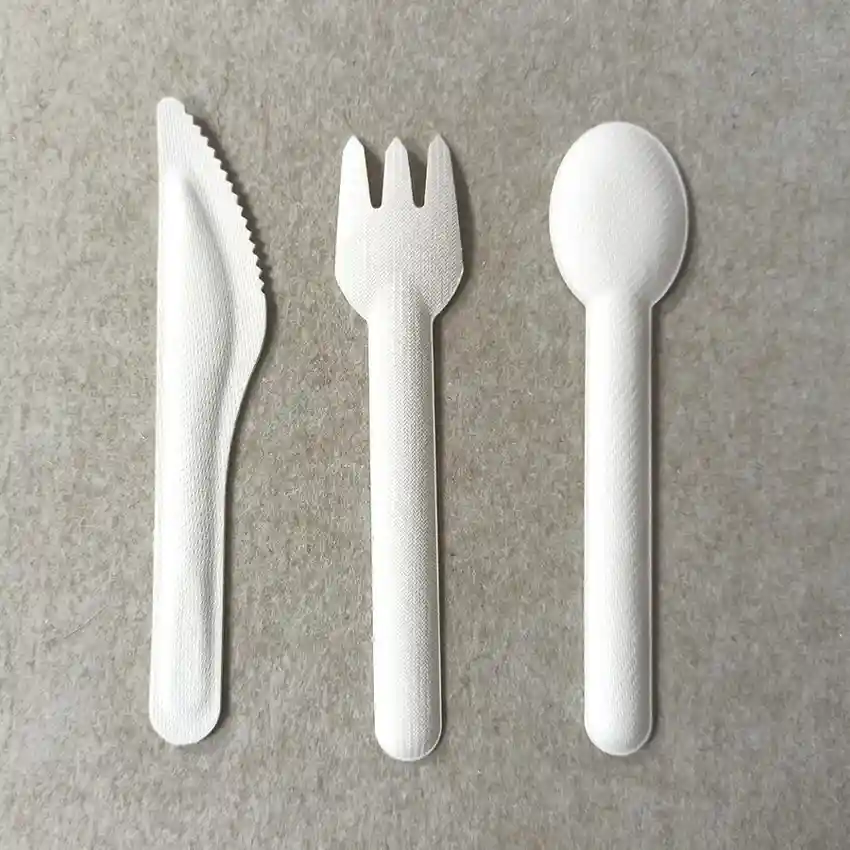
Fiber pulp performs very well in bowls, trays, clamshells, and plates, but it faces greater challenges when translated into forks, knives, and spoons. The core issue is mechanical structure. A cutlery item must remain narrow, hard, and dependable under concentrated pressure. Fiber pulp performs better in broader molded shapes where force can be distributed across a larger surface. In utensil form, the same material typically requires more careful engineering to achieve the rigidity and eating experience expected by mainstream users.
The second issue is wet-use endurance. In hot or wet meal scenarios, and especially when exposure time becomes longer, pulp-based utensils may gradually lose stiffness and feel softer in use. That does not mean fiber pulp has no place in sustainable packaging on the contrary, it remains highly valuable in molded food containers. But for cutlery, buyers should evaluate it more cautiously, especially where firmness, mouthfeel, and longer meal-time use are important.
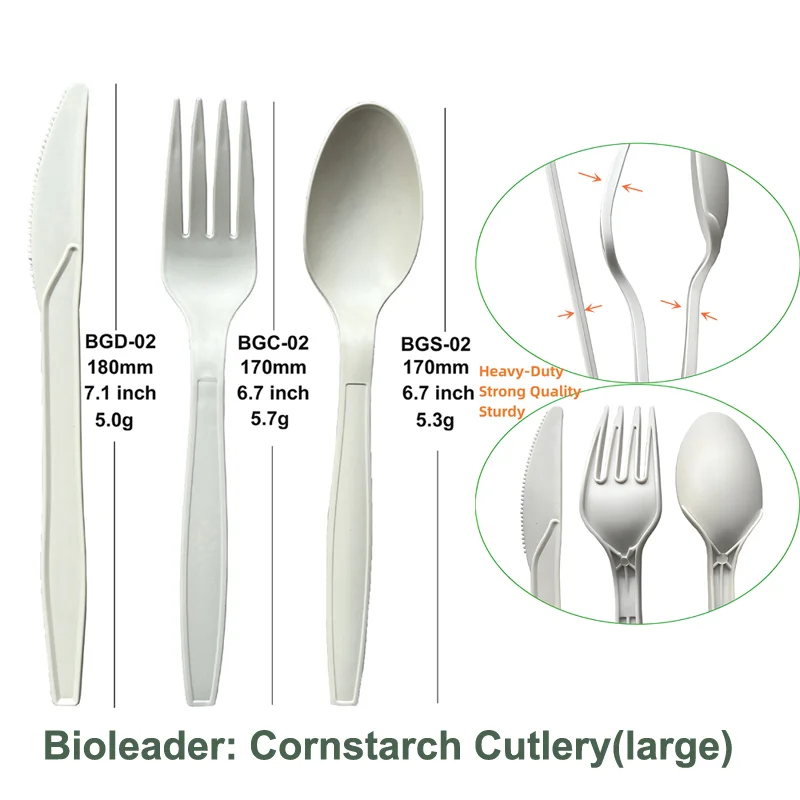
Cornstarch-based cutlery continues to hold an important place in the market because it is commercially accessible, scalable, and attractive for cost-conscious distribution. It offers a practical entry point for buyers who want to move away from conventional disposable plastic while keeping procurement budgets more manageable. In many wholesale environments, that matters.
At the same time, buyers increasingly need clearer communication around what cornstarch-based actually means in composition, performance, and end-market positioning. In todays sourcing environment, the issue is no longer whether cornstarch is simply good or “bad. The issue is whether it fits the compliance narrative, channel expectations, and price architecture of the target market. For many buyers, it remains a viable and commercially useful solution when correctly positioned.
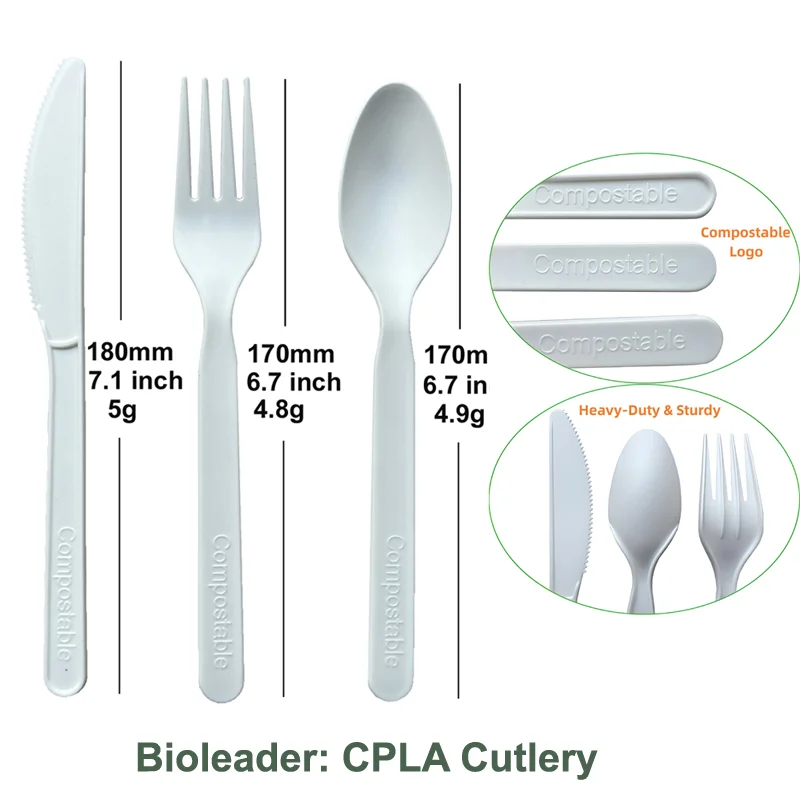
CPLA remains the strongest all-round option where buyers want better rigidity, stronger heat resistance, and a utensil feel closer to conventional plastic. It is not always the cheapest route, but it is often the most commercially credible one for buyers who want compostable cutlery to perform reliably in hot meals, takeaway combinations, and more specification-sensitive procurement programs.
That said, successful CPLA or cornstarch programs still depend on alignment with local disposal systems and industrial composting infrastructure. This is increasingly important for buyers that want their sustainability narrative to remain credible not only at the point of purchase, but also in downstream waste-management discussions.
Leading manufacturers, such as Bioleader, have already integrated these differentiated performance and market requirements into product planning and production strategy rather than forcing all customers into a single material story.
| Material | Main Strength | Main Limitation | Best Fit | Procurement Note |
| Wood / Bamboo | Strong natural appearance and easy eco messaging | Requires tighter moisture control, finishing consistency, and odor management | Niche hospitality, rustic dining, selected event use | More demanding in long-haul scaling |
| Fiber Pulp | Plastic-free image and strong performance in containers | More challenging to maintain rigidity and mouthfeel in utensil form | Better for trays, bowls, plates than cutlery | Requires careful evaluation for wet/hot use |
| Cornstarch-Based | Cost-effective and scalable | Needs clearer positioning in some compliance-sensitive markets | Value-driven wholesale programs | Practical when aligned with channel needs |
| CPLA | Better rigidity, heat resistance, premium feel | Higher cost than entry-level alternatives | Foodservice chains, retail, export programs | Strong fit for performance-led programs |
The first issue is material declaration clarity. Buyers need a supplier that can explain not just the headline material name, but how the product should be positioned in documentation, buyer communication, and target-market conversations. In 2026, generic green language is losing value. Specificity matters more.
The second issue is real-use scenario. A utensil intended for bakery counters or salad bars faces different stress than one used in hot rice meals, takeaway combo boxes, noodles, or curries. Buyers that skip this step often compare unlike-for-unlike products and end up drawing the wrong pricing conclusions.
The third issue is packaging format. Loose bulk-packed utensils, individually wrapped sets, retail presentation, and private-label outer cartons all belong to different operational models. A strong supplier should be able to support not only the utensil itself, but also the packaging logic around the utensil.
The fourth issue is export discipline. For global buyers, production capability is only part of the equation. Consistent packing standards, repeatable loading logic, stable communication, and document readiness matter just as much as the molded product itself.
The fifth issue is product-range flexibility. Many buyers no longer want one supplier for spoons, another for knives, and a third for wrapped sets. Range consolidation has become a practical way to reduce purchasing friction and improve repeat-order confidence.
The most important cutlery debate in 2026 is no longer whether compostable alternatives exist. It is whether buyers should prioritize CPLA or cornstarch-based programs as their main route to scale.
That decision is strategic because the two materials often support different commercial objectives. Cornstarch-based cutlery is usually easier to position in price-sensitive, volume-driven programs where buyers need broad market coverage and lower cost barriers. CPLA works better when the objective is to deliver a higher-performance utensil with a stronger premium feel and a more future-facing compostable profile.
For buyers comparing performance, cost structure, and export readiness side by side, Bioleader provides a useful manufacturer perspective on how CPLA and cornstarch can be positioned within one commercially flexible sourcing model.
That dual-path logic is becoming more relevant because not all markets are evolving at the same speed. Some buyers still need an economical entry-level option. Others are planning for stricter internal procurement standards, closer retailer review, or more demanding downstream brand expectations. In that context, the strongest suppliers are not those insisting on a single material narrative. They are the ones able to match material choice to channel reality.
Among export-oriented top manufacturers in this category, Bioleader (Xiamen, China) offers a useful case study because it does not reduce compostable cutlery to a one-size-fits-all proposition. Instead, the companys strategy reflects a practical reading of the market: different buyers require different material pathways, and forcing all customers into one option often creates friction rather than long-term stability.
Bioleaders approach is notable for treating cornstarch and CPLA as two distinct commercial solutions rather than competing slogans. In value-driven wholesale environments, cornstarch-based utensils can support broader price accessibility and faster rollout. In more specification-sensitive or premium-facing environments, CPLA can offer stronger alignment with performance expectations and buyer presentation goals.
The manufacturing model behind that strategy is also commercially relevant. Bioleader is positioned not only as a supplier of finished cutlery, but as a manufacturing partner with the scale and flexibility required for international brand programs. With daily production capacity exceeding 300,000 pieces, the company is structured to support repeatable supply for distributors, foodservice importers, wholesalers, and private-label packaging buyers across multiple markets.
Bioleaders biodegradable compostable cutlery range also demonstrates how a supplier can consolidate multiple utensils, wrapped sets, and material options into a single export-oriented system that is easier for distributors, importers, and private-label buyers to scale.
Another differentiating point is customization capability. For buyers building their own brand identity, Bioleader can support new mold development for selected formats, branded outer packaging, and individually wrapped branded cutlery sets tailored to channel needs. That combination of manufacturing scale and brand customization is particularly relevant for companies that do not want to source generic utensils, but instead want a more recognizable, market-ready packaging solution.
This matters because procurement strength is rarely about one fork or one spoon in isolation. It is about whether the supplier can support a broader operating model: multiple SKUs, coherent material logic, packaging flexibility, and consistent export execution. In that sense, the competitive edge belongs not simply to the factory with the largest catalog, but to the manufacturer that can translate material choice into a workable sourcing architecture.
The future of compostable cutlery procurement will not be shaped by the loudest green claims. It will be shaped by clearer material positioning, stronger documentation discipline, better alignment between performance and end market, and supplier systems that reduce commercial friction.
For global buyers, the smartest move is no longer to ask which cutlery sounds the most sustainable in theory. The smarter question is which program can remain stable under real-world conditions: changing compliance expectations, tighter customer scrutiny, channel-specific needs, and the operational demands of scale.
In that environment, compostable cutlery companies that combine material fluency, export readiness, customization capability, and stable manufacturing output will hold the advantage. Buyers that evaluate the category through that lens will be better prepared not only for 2026, but also for the procurement standards likely to define 2027 and beyond.