


The flexible packaging market is projected to grow from USD 90.12 billion in 2026 to USD 124.77 billion by 2035, expanding at a CAGR of 3.68% during 2026-2035. The report provides comprehensive insights including market size analysis, segment data, company profiles, competitive analysis, value chain analysis, trade statistics, and manufacturers and suppliers data. Market growth is supported by increasing demand for advanced packaging technologies, rising e-commerce activities, growing urbanization, and higher disposable incomes. The report also highlights how the expansion of food delivery and online retail has increased the demand for lightweight, durable, and protective packaging solutions.
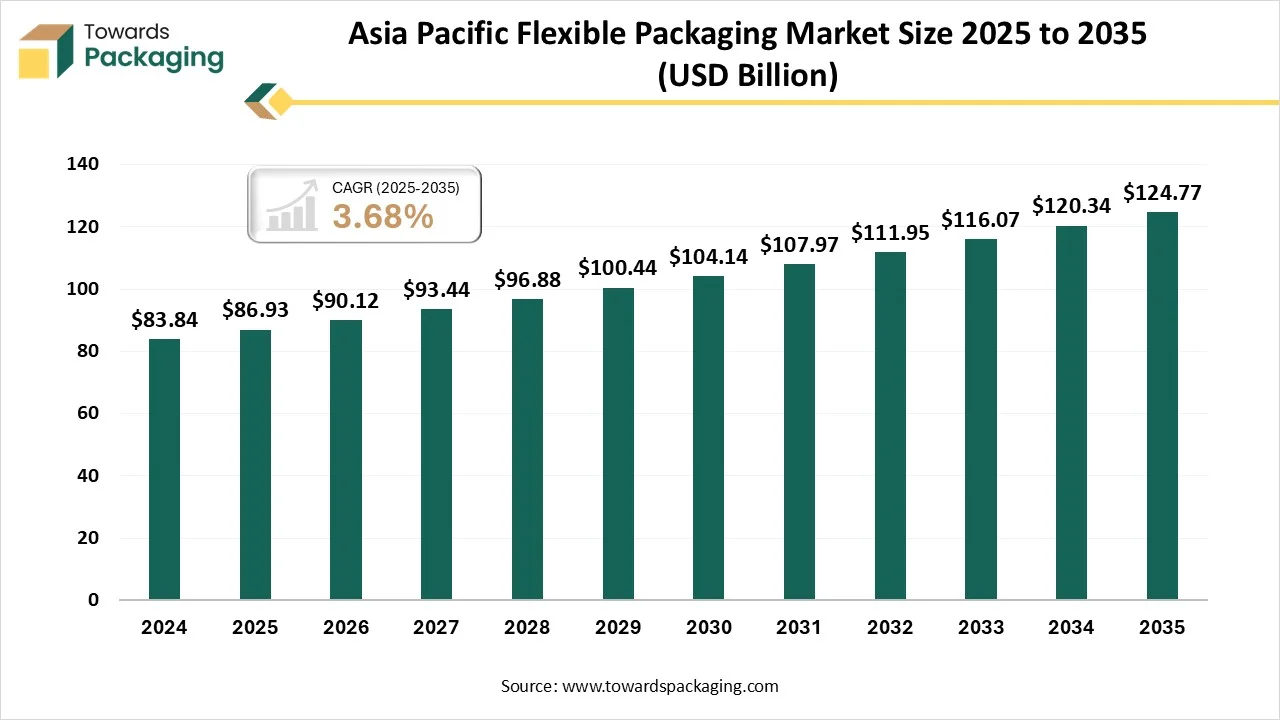
Asia Pacific flexible packaging includes the utilized of adjustable, lightweight resources such as paper, plastic films, and foils to wrap goods in the Asia-Pacific. This market is rising rapidly because of its cost-effectiveness, capability to enlarge shelf life, and suitability for customers, mainly in the personal care, food & beverage, and pharmaceuticals sectors. Major factors comprise e-commerce development, changing customer demand, and a rising emphasis on smart and sustainable packaging choices.
Technological transformation in Asia Pacific flexible packaging market plays a significant role in its extension. The incorporation of advanced technology such as automation and AI has enhanced the adoption of flexible packaging across a wide range of industries. Major market players are progressively utilizing AI-driven packing appearances and digital advancement control arrangements to enhance production efficiency, speed, and accuracy. Inventions in smart packing are being advanced to fulfil the requirements of e-commerce sector, such as improving the unboxing practice and shielding products at the time of transportation.
China introduced nine national standards to enforce stricter recyclability in packaging design. These rules require reduced use of labels, adhesives, and mixed materials, pushing flexible packaging toward mono-material and easily recyclable formats.
India launched a national initiative around 2025 to strengthen domestic packaging capabilities under “Make in India.” It focuses on advanced material development, infrastructure such as testing labs, and improving efficiency in flexible packaging production.
Australia set a target for 100% of packaging to be reusable, recyclable, or compostable by December 2025, with further regulatory consultations continuing into 2026. The initiative is also evolving toward mandatory standards and extended producer responsibility (EPR) schemes for packaging waste.
Malaysia plans to transition its voluntary Extended Producer Responsibility system into a mandatory scheme by 2026. This policy makes producers accountable for the lifecycle of flexible packaging, encouraging recyclability and waste reduction.
Singapore is introducing a deposit return scheme for beverage containers in 2026 to improve recycling rates. The system uses smart collection infrastructure and financial incentives to recover flexible and rigid packaging materials more efficiently.
Vietnam’s Environmental Protection Law mandates eco-labeling and reduction targets for packaging materials, with stronger enforcement in recent years. It promotes bio-based and recyclable flexible packaging alternatives while restricting environmentally harmful materials.
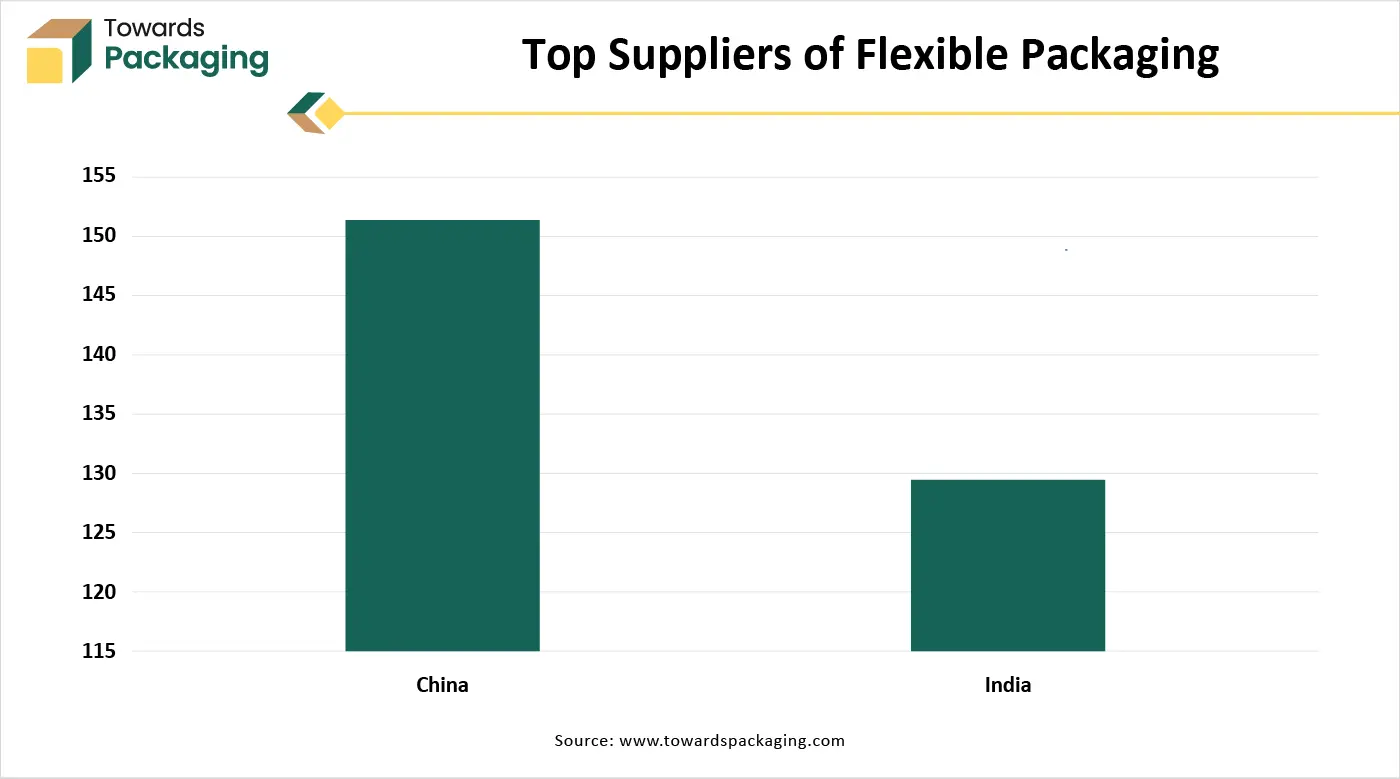
The major raw materials utilized in this market are polyethylene, polypropylene, metal, bioplastic, and various other materials.
The component manufacturing in this market comprises pouches, bags, containers, and various other.
This segment is growing focus on efficient logistics and direct sales of the packaging.
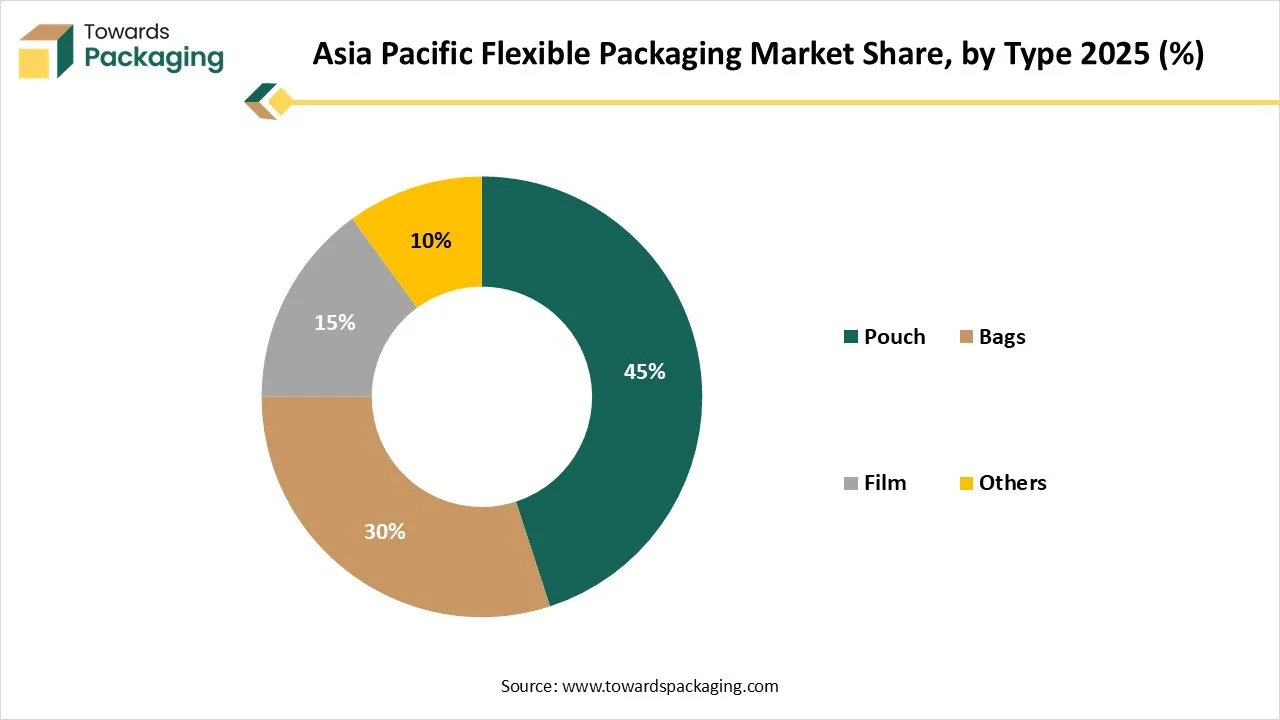
The pouch segment dominated the Asia Pacific flexible packaging market with highest share in 2025 due to its low-cost, versatility, and convenience. These are lightweight, easy for shipping, and are suitable for on-the-go carrying of snacks and ready-to-consume food products. They are commonly inexpensive to manufacture than other rigid packaging such as metal or glass cans. It offers superior-quality modification and printing, which improves their visual appearance on retail drops and supports products show up. They are utilized across a huge variety of industries, comprising personal care, food, beverages, and pharmaceuticals.
The bags segment is expected to grow at the fastest CAGR during the forecast period. This segment is growing due to increasing medical and healthcare infrastructures. The rise in online spending has amplified the need for bags utilized to transport and shield products which is making them an important group in the industry. These are important for packaging of one-time utilization of medical equipment, confirming sterility and comfort of usage, which is a noteworthy development aspect. These are an adaptable and versatile product category, offering to their top position in the industry.
The film is the fastest-growing in the market, as it comprises excellent sealing properties. BOPP and PE films are widely utilized in packaging for beverages, snacks, and various other food products, influenced by high feeding rates in this region. This segment has the largest stake because of its low charge, light weight, and exceptional heat-sealing abilities, making it suitable for generating leak-proof and airtight packaging.
| Material Segments | Market Share 2025(%) |
| Plastic | 55% |
| Paper | 25% |
| Aluminum | 10% |
| Others | 10% |
The plastic segment dominated the market with highest share in 2025 due to its versatility, durability, and cost-efficacy. Polyethylene (PE) has the highest market share because of its less production charge, high flexibility, and strength making it suitable for an extensive variety of applications. It is widely utilized in manufacturing packaging such as films, pouches, and sachets, mainly influenced by the enormous demand from the food & beverage sector in this region. Plastic packaging is highly flexible as well as adaptable system of packaging as it permits producers to tailor its style, shape, and size as per their consumers’ necessities.
The paper segment is expected to grow at the fastest CAGR during the forecast period. This segment is growing due to its versatility, strength, and durability of the material. Its potential makes it an ideal choice for the growth of e-commerce sector. These are easy-to-transport, versatile, and lightweight pattern manufactured for packaging of a wide range of products. The rising need for convenient packaging, rapid urbanization, and changing lifestyle of individual has influenced the growth of this market.
The aluminum is the fastest-growing in the market, as it comprises cost-effectiveness and versatility. It is a top-most resource for metalized flexible packing, valued for its superior barrier belongings against oxygen, moisture, and light, which enlarge shelf life of products such as pharmaceuticals and food. It is important for packaging products which is required to stay fresh, like ready meals, confectionery, dairy products, and coffee.
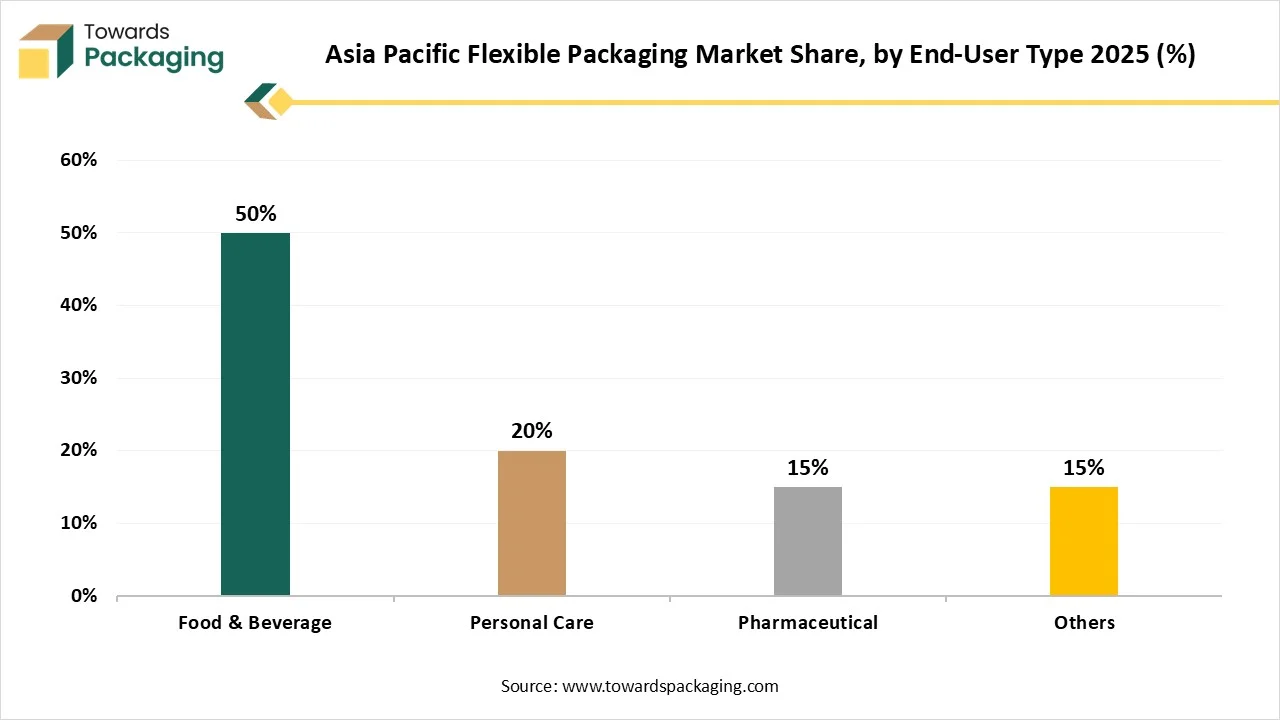
The food & beverages segment dominated the market with highest share in 2025 due to its capacity to extend shelf life of packaged products. A huge population with increasing disposable earning result in high need of wrapped food & beverages across this region. Its exceptional barrier potential shield food from spoilage and contamination, confirming product safety and quality. These can be utilized for an extensive variation of products, from ready-to-consume food products to snacks, and is appropriate for both flexible and rigid set-ups. The cost-efficiency and efficacy of producing flexible packaging offer to its extensive usage in this region.
The personal care segment is expected to grow at the fastest CAGR during the forecast period. This segment is growing due to increasing consumer demand and packaging versatility. Amplified purchasing supremacy and relocation to cities are influencing the demand for personal care goods as well as their packaging. It is suitable for a wide range of personal care goods, from pouches to sachets, and is easy to utilize and transport. It permits for superior-quality and vivacious printing, which improves product performance and consumer demand.
The pharmaceutical is the fastest-growing in the market, as it comprises huge need for safety, ensure drug quality, and maintain shelf life of the products. Pharmacy companies are investing profoundly for advancement of the drug packaging to fulfil the desired standard of the packaging. Producers are integrating patient-friendly services and anti-imitation resolutions into packing to enhance security and operator experience. There is a rising change towards progressive resources that provide better presentation for exact pharmaceutical supplies.
Japan held the largest share in the market in 2025, due to rising emphasis towards sustainability, aesthetics, and convenience. The increasing research and development, resulting towards innovations in sectors such as smart packaging, mono-resource films, and solvent-free lamination. The development of e-commerce has formed a huge demand for safe and material-effectual flexible packaging choices that can endure the rigors of delivery. A sturdy national emphasis on recycling and sustainability, maintained by government creativities, inspires the change in environment-friendly packaging resources and options.
Presence of massive manufacturing industries has raised the demand for the market. It is influenced by government initiatives endorsing sustainable wrapping and progressions in recycling and sturdy demand for appropriate, lightweight, and shielding packaging for customer goods and food items. The extension of online marketing and food delivery facilities needs a huge quantity of flexible packaging for transportation and safe handling. The extension of hypermarkets, supermarkets, and the nation's durable food production industry are main customers of flexible packaging to confirm product integrity and shelf life.
The major factors influencing the growth of market are rising consumer convenience demand, increasing disposable earning, growing e-commerce industry, and continuous technological advancement. The upsurge in food delivery facilities and online shopping needs cost-effective, lightweight, and durable packaging which can endure the severities of transportation, which flexible packaging offers proficiently. Increasing ecological consciousness and government guidelines has raised the growth of this market. The extension of current retail and a huge, aspiring middle class boost this demand. Shifting lifestyles and busy built-up lists have amplified the demand for packed, ready-to-consume, and on-the-go food & beverage goods.
Uflex Limited
Corporate Information
History and Background
Key Developments and Strategic Initiatives
Mergers & Acquisitions
Partnerships & Collaborations
Product Launches / Innovations
Key Technology Focus Areas
R&D Organisation & Investment
In April 2026, the world's leading plastics and rubber industry trade fair, CHINAPLAS 2026, is set to be held in Shanghai. The exhibition showcases flexible packaging technology as a major theme by making it a significant event for the whole Asian flexible packaging industry.
By Type
By Material
By End-User










Research & Advisory Analyst
Yogesh Kulkarni is an experienced Research Analyst specializing in the packaging sector, with a strong foundation in statistical analysis and market intelligence. He currently contributes his expertise to Towards Packaging.
Learn more about Yogesh Kulkarni

Reviewed By
Aditi Shivarkar, with 14+ years in packaging market research, specializes in food, beverage, and eco-friendly packaging. She ensures accurate, actionable insights, driving Towards Packaging Analytics & Consulting 's excellence in industry trends and sustainability.
Learn more about Aditi Shivarkar


Asia Pacific Flexible Packaging Market
 Table of Content

 Download Sample
 Schedule a Meeting