


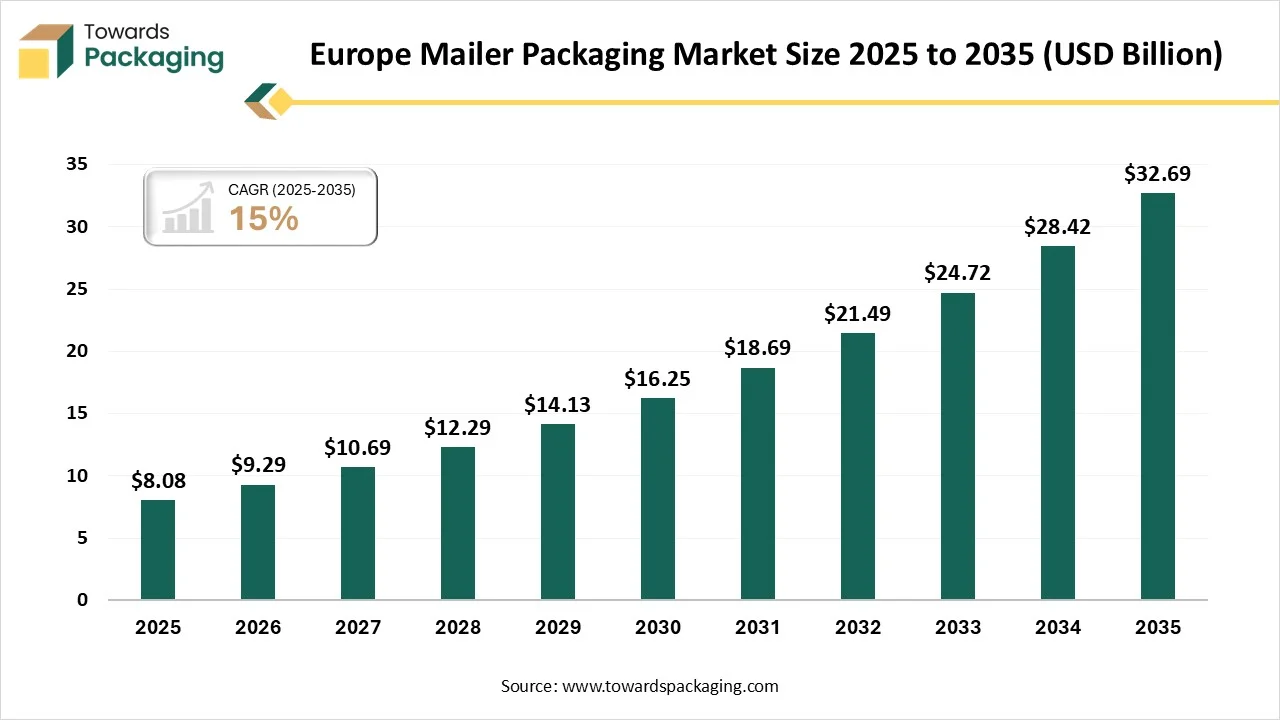
The Europe mailer packaging market is projected to grow from USD 9.29 billion in 2026 to USD 32.69 billion by 2035, expanding at a CAGR of 15% from 2026 to 2035. The report provides comprehensive insights including market size evaluation, detailed segment analysis by material, product type, and end-use industries. It also includes extensive company profiling, competitive landscape assessment, value chain analysis, trade data evaluation, and detailed information on key manufacturers and suppliers operating in the industry.
The mailer packaging box is a self-locking and pre-glued box that is initially used for shipping products. They are convenient to assemble and do not need additional tape, as they are reliable enough to pack products and deliver them securely. Mailer box packaging serves an attractive appearance and an exceptional unboxing experience for customers. Such boxes come flat, lock protectively, and fold quickly in any place.
Intelligent virtual assistants (IVAs) and chatbots are effective for engagement with users and increasing engagement. By developing natural language processing and machine learning, such tools can address customer doubts in real time, which serves tailored shopping experiences and improves user service. IVAs and sales chatbots can deliver the exact functions across mobile use, websites, and messaging services such as WhatsApp.
The non-cushioned mailers segment dominated the Europe mailer packaging market in 2025 as they count corrugated boxes, poly bags, and strong paperboard envelopes, which are crafted to transport products that do ot need padding. Such selections are generally more cost-effective and use less storage space than cushioned packaging. They are perfect for applications like linens, apparel, soft home goods, toys, and pet supplies.
The cushioned mailers segment is expected to witness the fastest CAGR during the forecast period. They are also known as bubble mailers or padded mailers, which are used for shipping envelopes that have pads on the inside. This packaging delivers two aims: it delivers some protection and allows the envelope to retain its shape, regardless of what it carries. Brands choose padded envelopes for transporting cosmetics, jewelry, vitamins and nutraceuticals, essential oils, accessories, books, and other products that demand extra security.
For instance, to this
The non-insulated segment dominated the Europe mailer packaging market in 2025, as standard bubble release effect as insulated bubble bags add a thermal buffer for medical, food, and cosmetics while restricting heavy coolers. For long-design or constant operations, perforated bubble rolls make it convenient to right-size the cover, resulting in less waste. Additionally, air systems deliver lightweight and quick void fill. They secure wrap-ups and are convenient to correct the size of high results. If voids are not regular or in-depth, choose loose fill like packing peanuts to pause moving without over boxing.
The insulated segment is projected to experience the fastest CAGR during the forecast period. This packaging for shipping is being made to track the temperature of interior products, whether it's fresh flowers or healthcare items. Insulated packaging for food is widely used to prevent fragile products like dairy and fresh produce, meat from changing temperature during logistics. It's necessary for protecting freshness and integrity, escaping loss, and maintaining quality and safety. Insulated packaging stores sensitive products that are being protected and at a constant temperature during cold chain transportation.
Paper segment dominated the Europe mailer packaging market in 2025 because they are completely compostable and green as these papers are made from compostable i, i.e., starch-based materials. Mailers iterate the aesthetics of paper from outside with the versatile and soft factor of compostable from the inside layer. Kraft paper mailers, for example, are not only free from plastic, but they can also be reused many times and are created from 100% recycled paper, which is reliable, naturally biodegradable, and lightweight. Those are made of plant materials like wheat straw and field corn. Compostable mailers are also an environmentally friendly kind of paper mailer, which can be decomposed in 180 days at home or 90 days for commercial purposes.
The plastic mailers segment is projected to witness the fastest CAGR during the forecast period. Poly mailers are streamlined envelopes created from reliable polyethylene material, which are waterproof to prevent products from being damaged while they are transported. Poly mailers are tear-resistant, flexible, and available in different colors and sizes to suit any shipping needs. Several poly mailers have self-sealing adhesive strips in order to make an effortless and fast seal. Countless poly mailers are created from recycled materials, which makes them an eco-friendly selection for logistics.
The e-commerce segment dominated the Europe mailer packaging market in 2025, as mailer boxes, also known as corrugated mailers or shipping boxes, are self-locked cardboard containers crafted particularly for shipping the products directly to users. Like regular shipping boxes, which need additional or tape sealing work, mailer boxes highlight integrated locking tabs, which make protective closures while providing convenient tracking and convenient experiences for the recipients. Monthly subscription boxes frequently have luxury materials, seasonal patterns, and standard insert machines that develop a complete user background.
| Clothing Item | Suggested Box Size (L X W X H) | Notes |
| T-Shirts, Shirts | 10” x 8” x 2” | Fits folded shirts with space for tissue paper or branded inserts. |
| Socks, Underwear | 6” x 4” x 1” | Compressed for lightweight items, minimal void fill demanded |
| Jeans, Sweaters | 12” x 10” x 3” | Accommodates bulkier items; foam inserts for heavy fabrics urged |
| Dresses, Jackets | 14” x 12” x 4” | Extra space for sensitive or structured garments; padding for shape. |
| Coats, Multi-Item Orders | 18” x 14” x 6” | Assist bulky items or multiple pieces; void fill for stability. |
The shipping & logistics segment is expected to experience the fastest CAGR during the forecast period. Securing and wrapping materials track the stability of the product and its outer packaging during handling and storage. Starch wraps protect cartons on shields and palletize them from every movement and dust. Packaging paper serves as a clear and protective surface that protects products from scuffs and scratches. Sustainable shipping packaging selections lower ecological effects while protecting the functionality, as environment-friendly and recycled cardboard air pillows make sure sustainable waste handling and shipping.
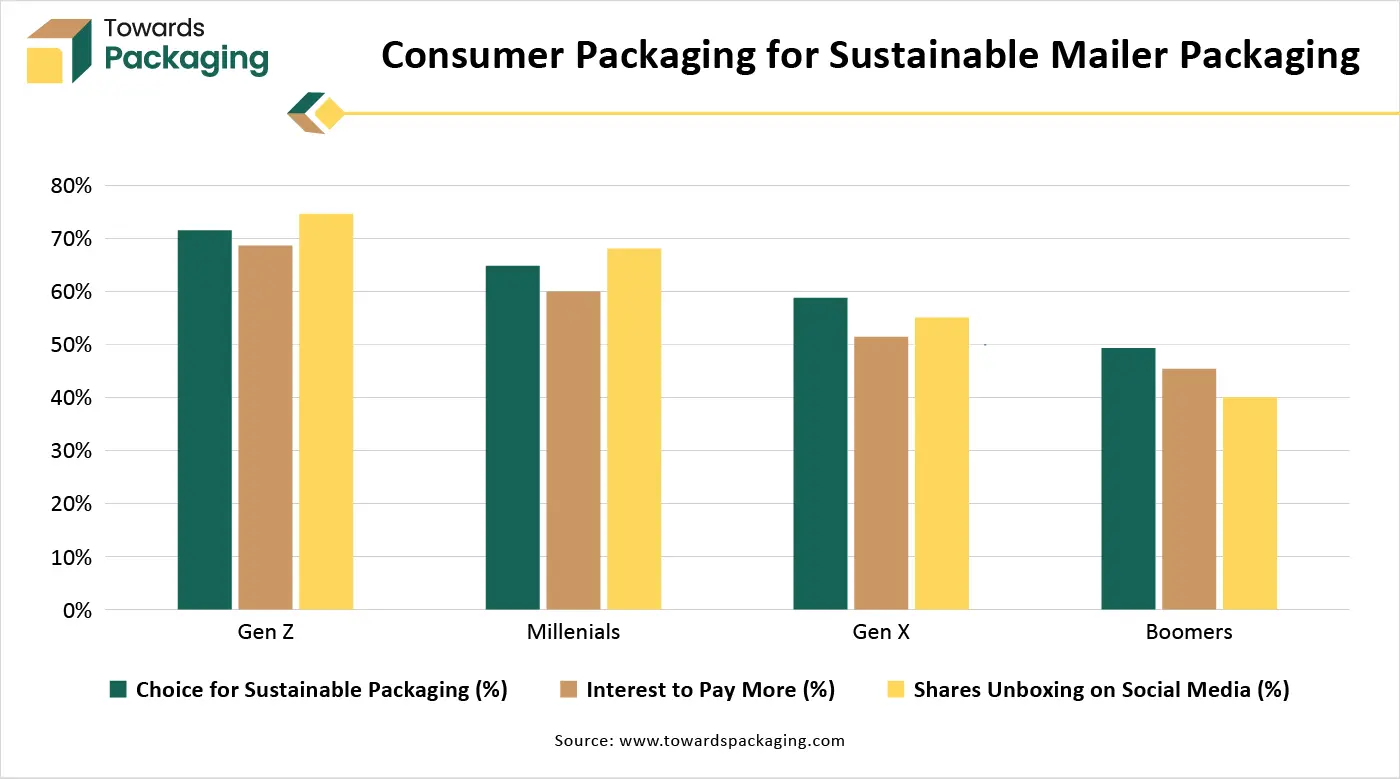
The UK has dominated the Europe mailer packaging market as the latest UK users are excessively eco-conscious, which encourages their buying decisions. A crucial 81% of UK users find more environmentally friendly packaging selections, and additionally, 72% are eager to pay a premium for products that have sustainable packaging. Eco-friendly issues lead to 76% of people selecting paper-based packaging instead of plastic. The growth in e-commerce has pushed the urge for mailer boxes that serve protective yet stylish packaging for direct shipment goals. Such trends show the growing role of packaging as a source for user engagement and brand verticalization.
For instance, to this
The Mailer Packaging Market is growing in Germany because they have the biggest e-commerce industry in Europe, which has higher-than-average internet interest and online shopping demand. Big companies like Zalando and Amazon are the main contributors to such demand. Big companies like Zalando and Amazon are important contributors to such an urge. Organizations are excessively accepting mailers over the boxes to lower dimensional weight, storage space, and shipping costs. There is a move towards environmentally friendly materials due to user choice and the German Packaging Act (VerpackG), which makes it compulsory to charge fees and require high recyclability for the packaging waste.
By Product
By Insulation
By Material
By End-Use
By Country:









Research & Advisory Analyst
Yogesh Kulkarni is an experienced Research Analyst specializing in the packaging sector, with a strong foundation in statistical analysis and market intelligence. He currently contributes his expertise to Towards Packaging.
Learn more about Yogesh Kulkarni

Reviewed By
Aditi Shivarkar, with 14+ years in packaging market research, specializes in food, beverage, and eco-friendly packaging. She ensures accurate, actionable insights, driving Towards Packaging Analytics & Consulting 's excellence in industry trends and sustainability.
Learn more about Aditi Shivarkar

Europe Mailer Packaging Market
 Table of Content

 Download Sample
 Schedule a Meeting