


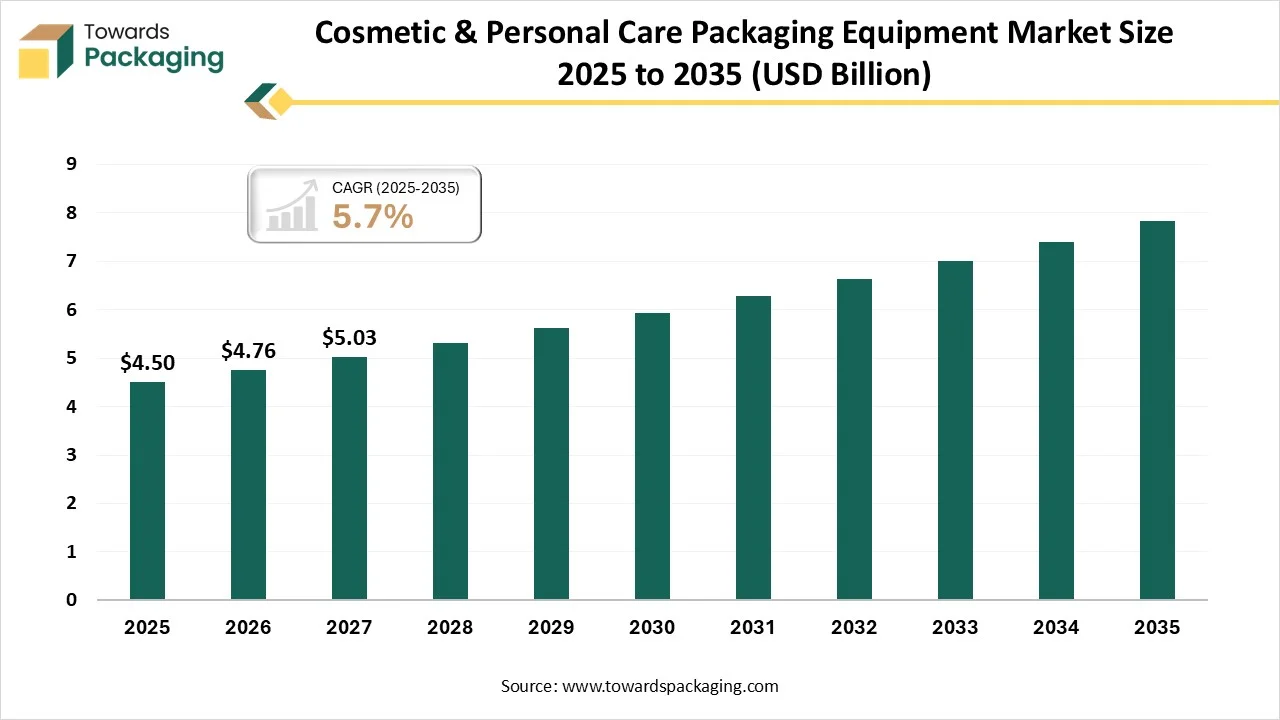
The cosmetics & personal care packaging equipment market is projected to grow from USD 4.76 billion in 2026 to USD 7.83 billion by 2035, expanding at a CAGR of 5.7% during 2026-2035. The cosmetics & personal care packaging equipment market report provides detailed insights on market size, segment-wise data by equipment type, automation level, packaging format, and end-use applications. It also covers regional data across North America, Europe, Asia Pacific, Latin America, and the Middle East & Africa, along with company profiles, competitive landscape evaluation, value chain analysis, trade data, and comprehensive manufacturers and suppliers analysis shaping the global industry.
A cosmetic packaging machine is tailored equipment used to package cosmetic products such as serums, gels, creams, lipsticks, liquid or powder products. This type of machine is crafted to ensure precision, consistency, and security in the product packaging, while developing the manufacturing smoothness and packaging quality. The items that are packed in the cosmetic sector are extremely vast and rich, so there are many types of packaging machines.
Top Cosmetic Importing Brands
|
Rank |
Company |
Approx Importing Value 2024-2025 (USD) |
Leading Source Countries |
Main Products |
|
1 |
L’Oreal India Pvt Ltd |
USD 70 Billion |
USA,SK,China and France |
Skincare and Makeup |
|
2 |
IVIA Beaute Pvt Ltd |
USD 62 Billion |
SK, USA, UK and France |
Makeup, Skin preparation |
|
3 |
Ziri Tradelink Pvt Ltd |
USD 10 Billion |
China, France |
Skin preparation, makeup |
|
4 |
Brillare Science Pvt Ltd |
USD 4 Billion |
USA, EU and SK |
Wellness and Skincare |
|
5 |
The Himalaya Drug Company |
USD 2.5 billion |
France, India (domestic) |
Herbal Skincare |
|
6 |
VLCC Personal care Ltd |
US 2.2 billion |
EU, India |
Personal Care |
|
7 |
Hegde & Hegde Pharmaceutica LLP |
USD 2 Billion |
China,India |
Cosmetics-Pharma |
|
8 |
Aminu Wellness Pvt Ltd |
USD 1 billion |
EU, India |
Wellness Skincare |
|
9 |
Lord’s Homeopathic Lab Pvt Ltd |
USD 75 Million |
India |
Homeopathic skincare |
|
10 |
Animal Ayouthveda Ltd |
USD 600 Million |
EU, India |
Ayurvedic Skincare |
One of the most important investments in AI is in cosmetic product formulation. By managing huge datasets of user choices, ingredient performance, and skin types, AI algorithms assist producers in making formulas that are more secure and effective. Predictive analytics enables cosmetic products to seek future trends and user demands, which allows faster invention cycles. For the private label cosmetic manufacturers, AI allows fast growth of tailored products that can classify their brand in a crowded market.
Generative AI shows the future discovery in serving real-time, personalized beauty experiences that link deeply with users. It goes beyond foundation personalization, which crosses limits by understanding the point of view in current ways. Current personalization includes several data objectives that count lifestyle factors, skin analysis, personal choices, and environmental conditions.
Such an overall strategy makes beauty regimens accept updating demands and situations. On the other hand, artificial intelligence grows product development by predicting ingredient communication, lowering the demand for huge physical testing, and improving stability. Such potential allows a quick time-to-market while developing a formulation success range.
Package Design and Prototyping: Cosmetic packaging design plays a crucial role in checking the success of a beauty product. In such a competitive industry, in which users are loaded with infinite selections, packaging is frequently the primary point of communication between product and capable buyers. A perfectly thought-out design can make an emotional relationship that communicates any brand’s story, and most significantly, grabs attention on crowded shelves.
Recycling and Waste Management: Brands are evaluating cutting-edge ways to reuse packaging, such as refillable containers, and use recycled materials. Expired or unused content can be repurposed for other uses, like making cleaning products or delivering to educational institutions.
Logistics and Distribution: The circular supply chains are not a trend anymore. They are quickly turning into a main business need, as regulations have become strict, and users are already updating their behaviors, as brands that use circularity before will receive a step-by-step benefit. Programs such as refillable packaging, reverse logistics, and up-cycled ingredients are not exploring anymore. They have proven scalable solutions that serve both user predictions and climate goals. Companies which fund such changes are not just losing the loop, but they are sustainable in a link climate - conscious long-term outlook.
The filling machine segment dominated the cosmetics & personal care packaging equipment market in 2025, as they are tailored pieces of machinery that are used to fill lotions, creams, gels, and serums into bottles, tubes, and jars. The basic function of such machines is to streamline the filling procedure, lower manual errors, and track hygiene standards. The correct filling machine not only develops the manufacturing speed but also ensures product uniformity and precision. Cosmetic and personal care filling machines play a main role across different skincare product lines such as lotions and serums, facial creams, herbal and organic products, and medicinal ointments.
The form of fill seal segment is projected to experience the fastest CAGR during the forecast period. These machines are automated systems that change the packaging procedure by integrating three necessary steps, such as forming a package, filling it with a product, and packing it, all in one smooth running. Such evergreen machines have become necessary in different sectors, which include pharmaceuticals, food, and personal care products. The main point of form-fill-seal technology is its capability to make packages from a constant roll of film. Such films, which can be produced from different materials such as metalized foil, plastic, or paper, are changed into a particular package shape, filled with the desired product, and then packed to ensure product freshness and pollution.
The skincare segment dominated the cosmetics & personal care packaging equipment market in 2025, as blister packaging is greatly used in the cosmetics sector, as it is perfect for products that require high levels of hygiene, look, and protection. Prevalent types of cosmetics packaging include lip balms, lipsticks, eye shadows, makeup brushes, powder compacts, travel packs, and travel-sized cosmetics, too. Lip balms and lipstick are being packaged in blister packs. Such a packaging strategy can strongly protect the products, which protects them from scratches and distortion. Such a transparent blister can display the overall appearance of the products that develop the look of the shelves.
The decorative cosmetics segment is expected to witness the fastest CAGR during the forecast period. Cosmetic production counts many stages, each of which needs tailored equipment to ensure product consistency, quality, and efficiency. The most prevalent spaces include emulsifying, mixing, sealing, packaging, labelling, and detection machines. Every one of these plays a different role in shifting raw content into complete and user-ready cosmetics. The cosmetic creation procedure starts with making an ideal and tailored formulation that comes from the highest quality of raw ingredients, aligning with those like mini-test batches to ensure consistency, heating, mixing, and blending.
Asia Pacific has dominated the market in 2025 as the urge for hotspots to count urban centers in tier 1 and tier 2 cities, in which luxury cosmetics, skincare, and personal care products are receiving attention. The mixing of Industry 4.0 and automation is giving excessive importance in highly developed regions to develop quality control and productivity. Supply chain deficiencies rely on dependency on geopolitical tensions, material suppliers, and logistical bottlenecks, particularly during worldwide disturbances such as trade disputes or pandemics.
How is the Cosmetics & Personal Care Packaging Equipment Market Growing in India?
The growing demand for packaging across different end-use sectors, such as cosmetics, is driving market growth. Users are moving towards ease-of-use packaging, which leads to higher acceptance of packaging machinery. The rising user interest in terms of sustainable packaging solutions is increasing the sales of packaging machinery. Environment-friendly selections that combat biodegradable materials, assist in lowering waste, and addressing surrounding issues. Additionally, the fast peak of e-commerce is driving the need for smooth packaging solutions. Online platforms serve a variety of tailored packaging options in various sizes to meet consumer preferences.
North America is expected to grow at a considerable CAGR in the upcoming period, with ongoing innovations in smart manufacturing and airless dispensing that help the colorful and rising brands to trust in the comprehensive equipment supporting the convenient use of the product. Machinery developments are contributing largely to the use of recyclable materials, which promotes the eco-friendly packaging designs and Quadpack’s new wooden excellence. The vast cosmetics and personal care product manufacturers seek automation for their formulations, sealing, and filling for the multi-layer packaging. While the innovations in packaging help aesthetics to fit in the online retail demands.
U.S. Market Trends
The trends in the U.S. are the acceleration of the intervention of intelligent technologies that shape and sharpen the features of the market. The eco-design promotes the use and performance of the paper-related packaging and refillable systems for large-scale adoption of sustainable packaging approaches. The FDA’s strict regulations focus on traceability, tamper-proof packaging, and hygiene, which drives the demand for suitable technologies. While most of the brands prefer personalized packaging designs for their personalized range of products, which strengthens the premiumization base of the brand (product).
The European cosmetics & personal care packaging equipment market is rising in Europe because it is witnessing main development that is being driven by growing demand for sustainable and cutting-edge packaging solutions within the cosmetic sector. As users select the move towards aesthetically and environmentally friendly, promising packaging, producers are investing in high-level machines to match such growing demands. Furthermore, technological inventions and regulatory compliance are designing the accomplished scenario, which makes Europic a methodologically common point for cosmetic and personal care packaging equipment production and distribution in Europe.
Why is Germany using the Cosmetics & Personal Care Packaging Equipment Market Crucially?
Germany firmly stands at a crucial juncture, which is experiencing huge interference by fast technological growth, strict regulatory moves, and growing user choice. As smart packaging solutions and sustainability have become mandatory in the sector, market brands should behave swiftly to highlight growing possibilities and minimize risks. On the other hand, top industry companies in the German market are forming the overall industry with the assistance of focused methods and well-curated priorities. Companies are placing importance on sustainability initiatives, data-driven deep insights, and strong compliance frameworks to solve growing market urges and regulatory needs.
The Middle East and Africa region is expected to grow at a notable CAGR in the foreseeable future, as advancements are uplifted by robotics arms, helping the production and packaging line with more safety for the product. Dubai’s 2025 single-use plastic ban brought a major shift to packaging manufacturers' perception, which has been moving towards the installation of machinery. The machinery excellence for dealing with the compostable, biodegradable, and paper-based materials is a remarkable advancement that the region could have thought of.
Saudi Arabia Market Trends
Saudi Arabia’s trends are still in an excellent frame of the market due to the massive demand for smart packaging, which leads to growth in customer engagements as the QR codes navigate customers towards proven solutions used in the packaging and formulation process. The online purchasing trend is bolstering the range of protective packaging solutions. The labelling machines and filling machinery are unlocking new trends in the market. The luxurious cosmetic products are expanding the use of packaging machinery.
By Product:
By Application
By Region








Principal Research Analyst
Vidyesh Swar is a Senior Research Analyst at Towards Packaging, bringing over 4 years of dedicated expertise in market intelligence and strategic analysis across the dynamic world of packaging technologies and solutions.
Learn more about Vidyesh Swar

Reviewed By
Aditi Shivarkar, with 14+ years in packaging market research, specializes in food, beverage, and eco-friendly packaging. She ensures accurate, actionable insights, driving Towards Packaging Analytics & Consulting 's excellence in industry trends and sustainability.
Learn more about Aditi Shivarkar

Cosmetics & Personal Care Packaging Equipment Market
 Table of Content

 Download Sample
 Schedule a Meeting