


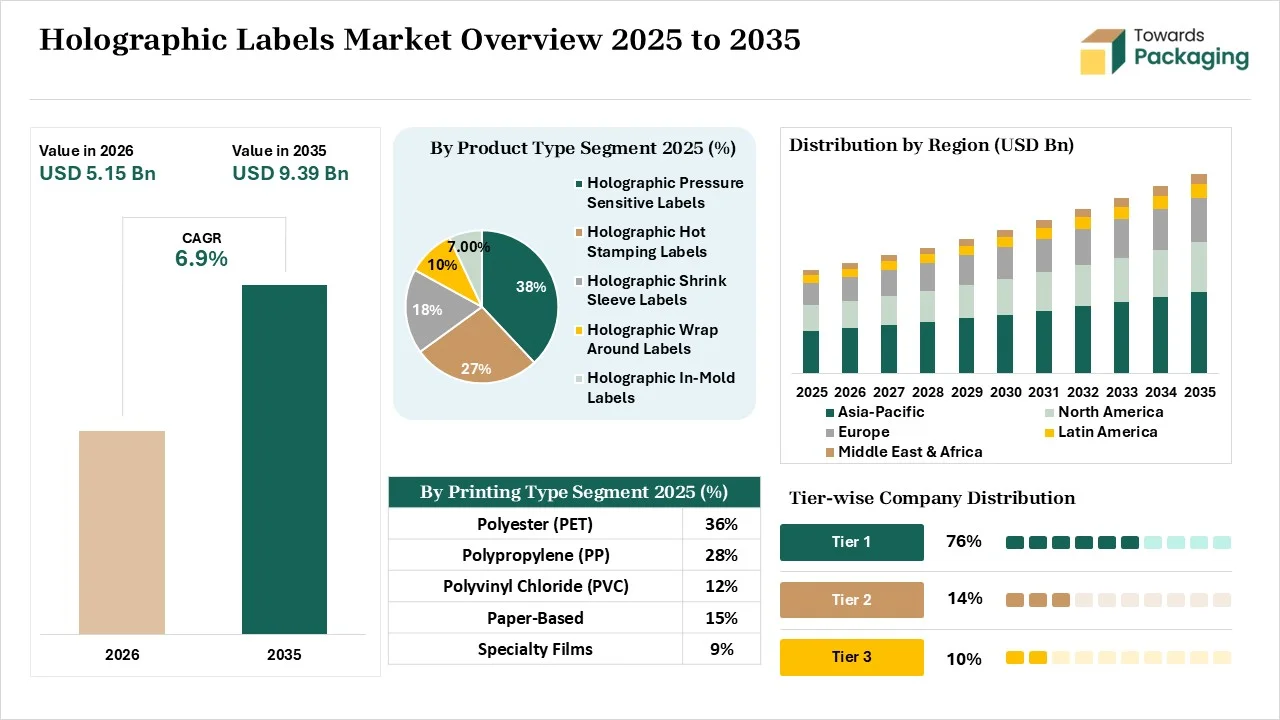
The holographic labels market is projected to grow from USD 5.15 billion in 2026 to USD 9.39 billion by 2035, registering a CAGR of 6.9% during the forecast period. The report provides detailed market size estimates, revenue forecasts, segment-wise analysis by product type, material, technology, application, and end-use industry. It covers regional performance across major markets, competitive landscape assessment, company profiling, market share analysis, value chain evaluation, trade statistics, and extensive insights into manufacturers, suppliers, distributors, and emerging industry trends. The study also examines the impact of rising counterfeit concerns, sustainability initiatives, eco-friendly materials adoption, and technological advancements in holographic labeling solutions.
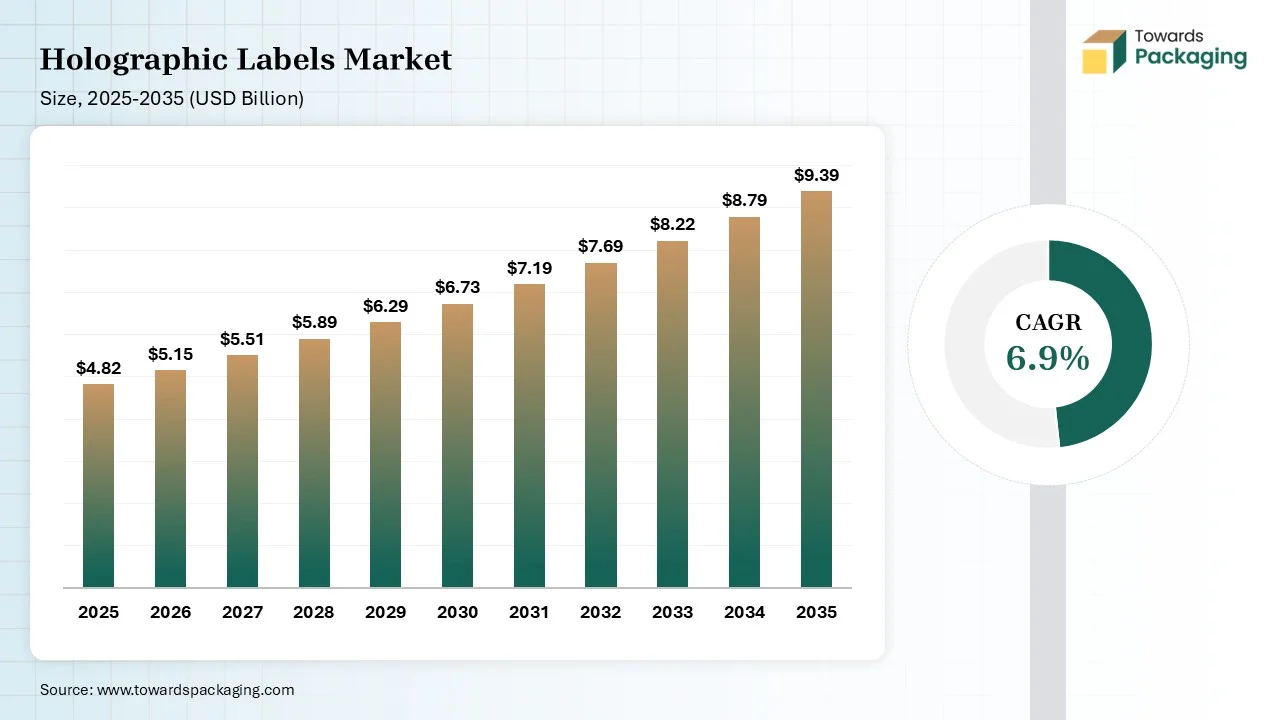
Holographic labels are labels made from adhesives that offers 3-dimension effect. These labels use micro-structured patterns and contain superimposed layers. They are manufactured using technologies like electron-beam lithography, nickel plating, rotary embossing, laser interferometry, vacuum metallization, and many others. The holographic labels are classified as security holograms, holographic material labels, and authenticity holograms. Their primary uses are premium branding, anti-counterfeiting, and tamper-evident seals. The major benefits are high durability, enhanced brand recognition, superior visual appeal, and enhanced traceability.
The holographic labels market growth is driven by the demand for combating counterfeiting, availability of cost-effective production technology, interest in sustainable paper holograms, stricter anti-counterfeiting laws, interest of brands in eye-catching aesthetics, advancing printing technology, focus on anti-tampering, retail sector modernization, and the development of tailored holographic labels.
The holographic labels market is experiencing technological developments driven by the need for authenticating goods and multi-layered security. The ongoing developments are blockchain integration, barcode integration, IoT traceability, digital serialization, and intelligent packaging, which help in identifying fraudulent batches and preventing counterfeiting. The most prominent shift in the landscape is the AI integration, which provides data-driven security.
AI supports real-time verification and detects anomalies in holographic labels. AI offers a dynamic brand experience and personalised customer interactions. AI easily understands design mistakes in holographic labels and speeds up the data collection process. AI develops unique micro-text and accelerates the speed of the development of complex holographic layouts. AI offers zero-error outputs and provides interactive digital experiences. Overall, AI supports advanced anti-counterfeiting and streamlining the design process.
Raw materials like BOPP, holographic paper, permanent adhesives, heat-activated adhesives, thermochromic inks, metallized polyester, transparent PET, tamper-evident coatings, and UV inks are required.
Material processing involves master origination, electroforming, thermal micro-embossing, and vacuum metallization. Conversion includes pressure-sensitive adhesive coating, lamination, and die-cutting.
Design focuses on embracing negative space, leveraging white ink, watching color saturation, and choosing bold typography. Prototyping focuses on digital proofs, material testing, and die-cut alignment.
The holographic pressure sensitive labels segment dominated the market with 38% share in 2025 due to the growing use on crowded retail shelves. The focus on enhancing packaging efficiency and the security of high-value goods increases the use of holographic PSLs. The demand for advanced anti-counterfeiting and the compatibility of holographic PSLs with various surfaces help with expansion. The seamless automation, digital integration, and high-impact aesthetics drive the segment growth.
The holographic hot stamping labels segment held the 27% market share in 2025 due to the demand for safeguarding brand reputation. The higher need for tamper-evident seals and the focus on three-dimensional effects increase the use of holographic hot stamping labels. The prevention of unauthorized replication and the competitive retail ecosystem increases the use of holographic hot stamping labels. The premium aesthetic appeal and customization of holographic hot stamping labels support the segment growth.
The polyester (PET) segment dominated the market with 36% share in 2025 due to its high adhesive compatibility. The brand-authentication features & preservation of intricate interference patterns accelerate the use of PET. The focus on high-heat embossing and the interest in brand-authentication features increase the adoption of PET. The high mechanical strength, superior brightness, excellent embossing, and excellent environmental resistance of PET drive the segment growth.
The polypropylene (PP) segment held the 28% market share in 2025 due to the growing use in holographic tear tapes. The focus on preserving visual appeal and durability in the cosmetics industry increases the use of polypropylene. The interest in wraparound labels and the rise in anti-counterfeiting security have increased the use of polypropylene. The excellent printability and high environmental durability of polypropylene support the segment growth.
The 3D holograms segment dominated the market with 26% share in 2025 due to its unmatched visual authentication. The expansion of consumer-driven industries and the focus on perceiving product value increase the adoption of 3D holograms. The growing authentication platforms and the availability of advanced laser technology increase the demand for 3D holograms. The seamless customization and enhanced shelf impact of 3D holograms drive the segment growth.
The 2D holograms segment held the 24% market share in 2025 due to its multi-layered security. The prevention of cheap unauthorized duplication and the building of strong brand trust increase the adoption of 2D holograms. The demand for cost-effective security and the need for easy visual authentication increase the use of 2D holograms. The omnichannel integration, high-counterfeiting barrier, and hidden features of 2D holograms support the segment growth.
The brand protection segment dominated the market with 32% share in 2025 due to the focus on at-a-glance authentication. The advanced lithography techniques and layered security integration increase the brand protection. The focus on maintaining long-term brand loyalty and the high-tech electronics increases demand for brand protection. The prevention of reputational damage and the reutilization of authentic packaging drive the segment growth.
The product authentication segment held the 25% market share in 2025 due to the growing worldwide counterfeiting threat. The shift away from traditional printing and the expansion of fake goods increases the demand for product authentication. The product safety focus and the need for instant visual verification increase the use of product authentication. The integration of sequential serialization supports the segment growth.
The pharmaceuticals segment dominated the market with 28% share in 2025 due to the growth in fake medications. The focus on preventing tampering with medicine packaging and the stricter packaging requirements increases the use of holographic labels. The focus on maintaining the efficacy of therapeutics and the rising global drug export increases the adoption of holographic labels. The pharmacists' demand for genuine medicine drives the segment growth.
The food & beverages segment held the 22% market share in 2025 due to the availability of fake consumables. The expansion of organic F&B brands and the need for transparent tracking increase the use of holographic labels. The focus on providing a sophisticated look to FMCG products and the growing fraud in the food industry increases the use of holographic labels. The growing regulatory scrutiny supports the segment growth.
The flexographic printing segment dominated the market with 34% share in 2025 due to its ability to handle synthetic materials. The development of cold foil stamping and the rise in short-run customization have increased the use of flexographic printing. The specialized ink versatility and in-line processing of flexographic printing help with expansion. The need for vast labels across the consumer goods industry drives the segment growth.
The gravure printing segment held the 26% market share in 2025 due to the growing micro-engraving reproduction. The increased deposition of security inks and the focus on maintaining long-run consistency increase the adoption of gravure printing for the development of holographic labels. The printing of layered security features and the interest in eco-friendly inks increase the use of gravure printing. The superior substrate compatibility of gravure printing supports the segment growth.
The direct sales segment dominated the market with 42% share in 2025 due to the customization of holographic labels. The focus on avoiding dealing with third-party resellers and the need to remove intermediary markups increases adoption of direct sales. The focus on verified labeling standards and the high demand for highly bespoke designs increases the use of direct sales. The demand for bulk volume discounts drives the segment growth.
The distributors & converters segment held the 30% market share in 2025 due to the high processing of holographic stocks. The brand's focus on fighting copycats and the government's mandates for utilization of secure holograms increases adoption of distributors & convertors. The demand for web-to-print accessibility and the shift to smaller production lines expands the use of distributors & convertors, supporting the growth of the segment.
Asia Pacific dominated the market with a 41% share in 2025 and is expected to grow at the fastest CAGR of 8.1% during the forecast period due to the growing consumer goods manufacturing. The focus on avoiding rampant counterfeiting and the strong presence of global solution providers increase the use of holographic labels. The proliferation of the e-commerce landscape and the strong FMCG manufacturing centers increases the use of holographic labels. The high investment in multi-layered packaging and the strong hub for security printing solutions drive the market growth.
China
India
North America held the 25% market share in 2025 due to regulations like the Drug Supply Chain Security Act. The anti-counterfeiting laws in the United States and the focus on preventing counterfeiting revenue losses have increased the use of holographic labels. The risk of counterfeit components in the automotive industry and the protection of premium alcohol brands increase the adoption of holographic labels. The consumer focuses on authentication marks supports the market growth.
United States
Canada
Europe held the 22% market share in 2025 due to the Anti-Counterfeiting Trade Agreement. The rise in cross-border trade and the brands' focus on meeting sustainability targets increases the adoption of holographic labels. The strong fashion hubs and the focus on supply chain security increase the adoption of holographic labels. The growing development of variable-data holograms boosts the market growth.
The increasing use of serialized hologram stickers in pharmaceuticals and the growing manufacturing resurgence increase the use of holographic labels.
The vast logistics infrastructure and the integration of NFC tags with holograms help with market expansion.
Latin America held the 7% market share in 2025 due to the rise in cosmetics counterfeiting goods. The expansion of premium product packaging and the rising digital landscape increases the use of holographic labels. The rise in cross-border purchasing and the interest in private labels increases the adoption of holographic labels. The interest in holographic-foil cartons drives the market growth.
The burgeoning wine industry authentication and the growing converting industry increase the use of holographic labels.
The high export of domestic products and the lucrative pharmaceutical sector increase the adoption of holographic labels.
The Middle East & Africa held the 5% market share in 2025 due to stringent anti-counterfeiting measures. The brand enhancement in the construction industry and the strongly growing e-commerce industry increase the adoption of holographic labels. The focus on product tracking and tamper-proof verification increases the use of holographic labels. The interest in holographic anti-tamper labels supports the market growth.
| Rank | Company Name | Headquarters | Country | Major Contribution to Holographic Labels Market | Key Packaging Products and Services |
| 1. | 3M | Minnesota, United States | United States | The company offers tamper-evident label materials and high-performance adhesives for the development of holographic labels. | 3M Tamper Evident Label Material 7384, 3M Tamper Evident Label Material 7613T, 3M Overlaminate Label Material 7732Fl |
| 2. | UPM | Helsinki, Finland | Finland | The company focuses on expanding the Raflasec portfolio, and it heavily invests in enhancing geographical manufacturing. | Raflasec Holo Security, Raflasec Chameleon |
| 3. | NanoMatriX | Wanchai, Hong Kong | Hong Kong | The company manufactures tamper-proof materials and focuses on industry-specific customization of holographic labels. | MatriX-Hologram Labels, Security Taggant Holograms |
| 4. | Avery Dennison Corporation | Mentor, Ohio, United States | United States | The company focuses on expanding its holographic range and integrates custom holographic threads into the physical packaging. | Holographic Lens, Seamless Rainbow BOPP, Fasprism Rainbow PET, Holographic Crystal, Holographic Sparkle |
| 5. | CCL Industries | Toronto, Canada | Canada | The company offers holographic labels for brand protection and focuses on expanding its global footprint. | Security Embossed Holograms, Videomark Photopolymer, 3D Visual Motion Labels |
By Product Type
By Material
By Security Feature
By Application
By End-use Industry
By Printing Technology
By Distribution Channel
By Region




Principal Research Analyst
Vidyesh Swar is a Senior Research Analyst at Towards Packaging, bringing over 4 years of dedicated expertise in market intelligence and strategic analysis across the dynamic world of packaging technologies and solutions.
Learn more about Vidyesh Swar

Reviewed By
Aditi Shivarkar, with 14+ years in packaging market research, specializes in food, beverage, and eco-friendly packaging. She ensures accurate, actionable insights, driving Towards Packaging Analytics & Consulting 's excellence in industry trends and sustainability.
Learn more about Aditi Shivarkar


Holographic Labels Market
 Table of Content
 sales@towardspackaging.com
 +1 804-441-9344
 Download Sample
 Schedule a Meeting