


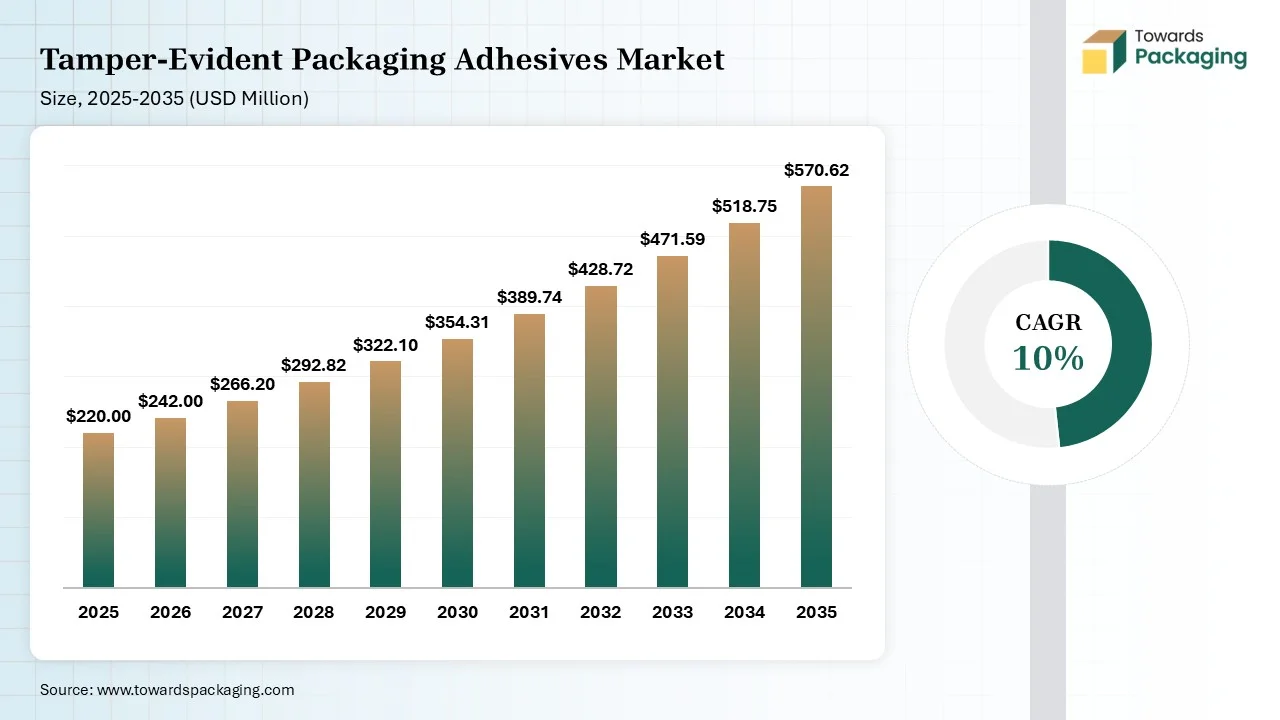
The tamper-evident packaging adhesives market is projected to grow from USD 242 million in 2026 to USD 570.62 million by 2035, registering a CAGR of 10% during the forecast period. This report provides a comprehensive analysis of market size, segment-wise data, and regional performance across North America, Europe, Asia-Pacific, Latin America, and the Middle East & Africa. It also includes detailed company profiles, competitive landscape, value chain analysis, and trade data, along with extensive manufacturer and supplier insights, offering a complete overview of the industry dynamics.
Tamper-evident packaging is a barrier for food and remaining products. It shows whether anyone has tampered with the ingredients. This brightens any kind of food brands that need to serve users to ensure safety. This packaging uses distinct directions to showcase if tampering has taken place. They can be as usual as a broken seal, which is a tampered security label or a missing strip. Such factors help make aware of buyers and help in checking any problems before they use the product.
Tamper-evident characteristics are important in protecting packaging, in an industry where product protection is top priority, specifically in pharmaceutical, food and beverages, spirits and cosmetic sectors. Such tamper-evident packaging solutions make sure that packaging has not been tampered with, which forces user trust and aligns with regulatory demands and needs.
With technological developments like Scheidegger technology, particular solutions make sure highly accurate uses of tamper-evident brands, tamper-evident tape and tamper-evident labels. Such inventions develop security packaging and assist brands in tracking the biggest product security standards.
Pressure-sensitive adhesives segment dominated the market with 38% share in 2025 and expected to be the fastest growing in the market with 8.6% CAGR during the forecast period, due to classified properties of PSAs which make them matched to a huge range of adhesive products across sectors like labels, tapes and bandages to automotive and electronics interiors. They are also known as self-stick adhesives, which serve adhesion to a layer when pressure is applied, with no demand for water, heat, or solvents to cement the link. Such adhesives deliver rigid approach at room temperature and can be re-adhered and avoided, like other polymer adhesives which experience changes as they bond.
Hot-Melt Adhesives segment held the second largest share of 26% in 2025 as they are well-known as hot glue, a thermoplastic and quick-setting adhesive that is utilized across woodworking, packaging, textiles, electronics and packaging. Its fast-curving characteristics, versatile nature, and solvent-free formulation make it a go-to solution for high-speed production and assembly lines. Such adhesives are solids in design at room temperature, used to substrate and melt with heat, and when they cool down, they solidify to create a rigid bond.
The water-based adhesives segment held the third largest share of 18% in 2025 because they are well known as waterborne adhesives, a type of adhesive that is scattered or dissolved in water as the beginning carrier or a solvent. Such adhesives are formulated by using an integration of additives, polymers, and water. The formulation of such adhesives can be adapted to receive desired elements like drying time, viscosity, and bond power. Additives can be included to develop result factors like flexibility, heat resistance, or adhesion to substrates.
Destructive labels segment dominated the market with 30% in 2025 as they serve a highly efficient solution for tamper-evident protection by using materials that are crafted to leave or avoid a visible mark when any of the procedures to remove them come into play. Such labels serve in a clear direction of illegal access, which makes them a necessary tool for protecting products and packaging. The destructive design and adhesive make sure that any tampering is quickly highlighted, protective in nature for both user trust and product integrity.
The Void Labels segment expects the fastest growth in the market with 8.7% CAGR during the forecast period as they provide a tamper-evident, which ensures the security and integrity of packages and products. When they are tampered with or removed, the void label ignores a mark or message on the layer where it was used. This characteristic is specifically insightful for the warranty prevention on high-value products and electronic machines. They are utilized across industries, as they assist in the protection of goods from the producer to the point of sale. Such labels are part of an illegal packaging demand in terms of regulated sectors like pharmaceuticals.
The adhesive seals segment held the second largest share of 24% in 2025 as it is the final surface of the tape. The adhesives are a material that speeds up the adhesion to the layer when it is used on the substrate. Producers will utilize various polymers, such as silicone or acrylic adhesive relying on the application. The substrate on the tape is the most complicated element of adhesion. Therefore, tap adhesion is also affected by sunlight exposure, humidity, and temperature.
The Tamper-evident Tapes segment held the fourth largest share of 22% in 2025 because they are excessively secured. These tapes are integrated with different materials and characteristics which make them formidable defense against tampering. Tamper-evident tapes are self-destructive when they are used and avoided, which provides proof of tampering by avoiding any residue. Pallets, shipping cartons, wooden crates, bags, envelopes and other containers can be packed with a tamper-evident security tape.
Pressure activation segment dominated the market with 34% share in 2025 as High Pressure Processing 9HPP) develops food security and stretches the product shelf life by officially delivering pressure levels in the range of 400-600 MPa/ 58,000 - 87,000 psi during time period of 1-6 minutes. They are non-thermal technologies that enable perfect protection of the nutritional and organoleptic elements of foods. The regular HPP procedure operates In-Pack, which means that the products are ahead of their final package before processing, which avoids post-processing pollutants.
The thermal activation segment held the second largest share of 28% in 2025 because the aim of this technology is to manage the condition of the product or items being transported. It is crucial to track the condition and appearance of food so that the quality elements are protected during shipping. For the pharmaceutical sector, the chemical integration can be updated if they are not kept under a particular temperature range. At the time of the shipping process, one should consider the transportation time and the required temperature that needs to be maintained.
The UV curing segment expects the fastest growth in the market with 8.9% CAGR during the forecast period because this technology uses ultraviolet light to quickly harden or cure inks, coatings, and adhesives. Such an inventive procedure mainly develops manufacturing times while improving the reliability of packaging materials. By utilizing UV light, producers can make coatings that are not only online appealing but also resistant to conditions that normally affect regular results. They include photochemical reactions, as special inks and coatings have photo initiators. When they are exposed to UV light, such photo initiators absorb energy which leads to the development of fast polymerization.
Chemical Activation segment held the third largest share of 20% in 2025 as activated carbon is classified for its exceptional absorption potential, porous design and large surface space, which allows it to absorb gases, such as moisture, gases and ethylene, as each one invests in food pollutants. Furthermore, activated carbon releases antimicrobial activity and can develop the release of nanoparticles, hence it develops food safety with the assistance of microbial development. Their multifunctional factors make them perfect for different uses, which include developing shelf life and tracking the sensory attributes of food products.
The packaging segment dominated the market with 44% share in 2025 and expected to be the fastest growing in the market with 8.8% CAGR during the forecast period, they carry packaging layers in location and prevent the ingredients from contamination, damage and tampering during transit and storage. Packaging film adhesive producers make sure the adhesive tracks the product’s reality and authenticity, particularly in the food, cosmetics, and pharmaceutical sectors. With the development of automation procedures in production, the correct adhesive also develops operational smoothness. Packaging manufacturers should operate with relevant industrial adhesive producers who understand their particular compliance and performance demands.
The labelling segment held the second largest share of 26% in 2025 as pressure-sensitive labels, used as an adhesive to create the label which sticks to a layer. These label adhesives need no heat or solvents that need to be activated. There are three subtypes of adhesives which are utilized by label transformers such as removable, permanent, and repositionable as every adhesive type has its own different properties.
The sealing segment held the third largest share of 18% in 2025 because these are among the most versatile sealing and bonding solutions utilized across various sectors. It is due to different chemical compositions depending on silicon-organic polymers as they deliver classified flexibility, durability, and resistance to high-level conditions. They are made of polymers that consist of crosslinked or individual silicon-oxygen (Si-O) rings or chains.
The bonding segment held the fourth largest share of 12% in 2025 as bonding rubber is a versatile material which is well known for its elasticity, flexibility, abrasion resistance, and water resistance. It can make any creations and is used in a huge series of applications. We can frequently search for rubber-like materials in floor coverings, roofing, medical supplies and automobile tubing too. In general terms, there are two main classifications of rubber, namely synthetic rubber and natural rubber. Natural rubber is a crucial material created from the latex polymers of trees whereas synthetic rubber is created from man-made and artificial polymers that are petroleum dependent.
The pharmaceutical segment dominated the market with a 32% share in 2025 to ensure the highest level of prevention against an outbreak. A variety of sealing procedures are available to protect packs from being opened and closed again without leaving proof. They count fiber-tear labels, which are opened and cannot be substituted again, or void stickers, which vanished and revealed lastly due to sheltered patterns or texts. Additional security has been added to such types of anti-tamper packaging in terms of pharmaceutical serialization.
The Food & Beverages segment held the second largest share of 26% in 2025 as hot melt adhesives serve various benefits when it comes to this packaging. Primarily, they serve quick and effective bonding, lowering time in the manufacturing procedure. Like other adhesives that need drying or curing time, hot melt adhesives set quickly upon cooling, which enables faster manufacturing speed. This quick bonding potential is particularly important in the food and beverage sectors.
Consumer Goods segment held the third largest share of 16% in 2025. Acrylic water-based adhesives use water as the initial solvent, which avoids toxic chemicals such as ketones and toluene, and mainly lowers the volatile organic compound 9VOC) emissions. With precisely crafted formulations, acrylic water-based adhesives match the FDA and EU 10/2011 food contact material standards ensuring user safety and health.
The electronics segment held the fourth largest share of 14% in 2025 because for potting uses, low-viscosity adhesives are usually selected. They enable percent fill around electronic elements and lower the possibility of an air bubble envelopment. Two-space epoxies and updated explosives are a famous choice, as they are polyurethane silicones and adhesives. UV adhesives are prevalent as they serve a fast cure and do not need mixing, as shadow areas and restricted depth cure mean they frequently are not perfect.
Logistics & E-commerce segment is expected to be the fastest growing in the market 8.9% CAGR, during the forecast period. The rapid expansion of e-commerce and increasingly complex logistics networks has significantly boosted demand for tamper-evident packaging adhesives. With higher shipment volumes, multiple handling stages, and rising risks of theft or product tampering, these adhesives ensure package integrity and consumer trust. They provide visible evidence of interference, support secure last-mile delivery, and meet regulatory needs, making them essential for protecting goods, enhancing brand reliability, and maintaining supply chain security.
North America dominated the tamper-evident packaging adhesives market share of 36% in 2025, as they are tailored to adhesive labels crafted to show whether a product has been tampered or opened. Their initial aim is to develop product security and user safety by serving online proof of tampering, which is important in sectors like pharmaceuticals, food, and electronics. The advantages of such labels include lowering the risk of counterfeit goods and ensuring compliance with regulatory standards.
How is Tamper-Evident Packaging Adhesives Market Developing in Canada?
The Canadian tamper-evident packaging adhesives are receiving attention due to their complicated role in product and packaging security. The growing urge for tamper-evident, easy and convenient-to-use packaging solutions in different sectors, which include pharmaceuticals, e-commerce and consumer goods, is driving the market’s development. Self-adhesive tapes serve to smoothly open items while ensuring that they stay securely sealed.
Asia Pacific expects the fastest growth in the market with 9.3% CAGR during the forecast period, as the food and beverage sector is among the main industries making a major demand for self-adhesive labels and is investing as the biggest end-user industry for self-adhesive labels in the area. These labels are well-known for developing the aesthetic elements of food and beverage packaging brands. In this sector, these labels assist in performing main functions in product checking and tamper evidence. In Asia Pacific region, matching with lifestyle updates, the rising disposable incomes of people, there is an increase in the number of operation professionals so there is a developing preference for fast-food centers.
India Tamper-Evident Packaging Adhesives Market Trends:
Automobile and construction sectors are using high-performance adhesives to develop production flexibility, longevity, and structural smoothness. At the same time, the packaging sector is using smart adhesives to satisfy the growing demand for tamper-evident, sustainable and fast-solving alterations. The update towards eco-friendly compositions, particularly water-based and hot-melt procedures, is in line with India ‘s legislative changes for sustainable production efforts.
By Adhesive Type:
By Product Type:
By Technology:
By Application:
By End-use:
By Material Compatibility
By Regions








Research & Advisory Analyst
Yogesh Kulkarni is an experienced Research Analyst specializing in the packaging sector, with a strong foundation in statistical analysis and market intelligence. He currently contributes his expertise to Towards Packaging.
Learn more about Yogesh Kulkarni

Reviewed By
Aditi Shivarkar, with 14+ years in packaging market research, specializes in food, beverage, and eco-friendly packaging. She ensures accurate, actionable insights, driving Towards Packaging Analytics & Consulting 's excellence in industry trends and sustainability.
Learn more about Aditi Shivarkar

Tamper-Evident Packaging Adhesives Market
 Table of Content

 Download Sample
 Schedule a Meeting