


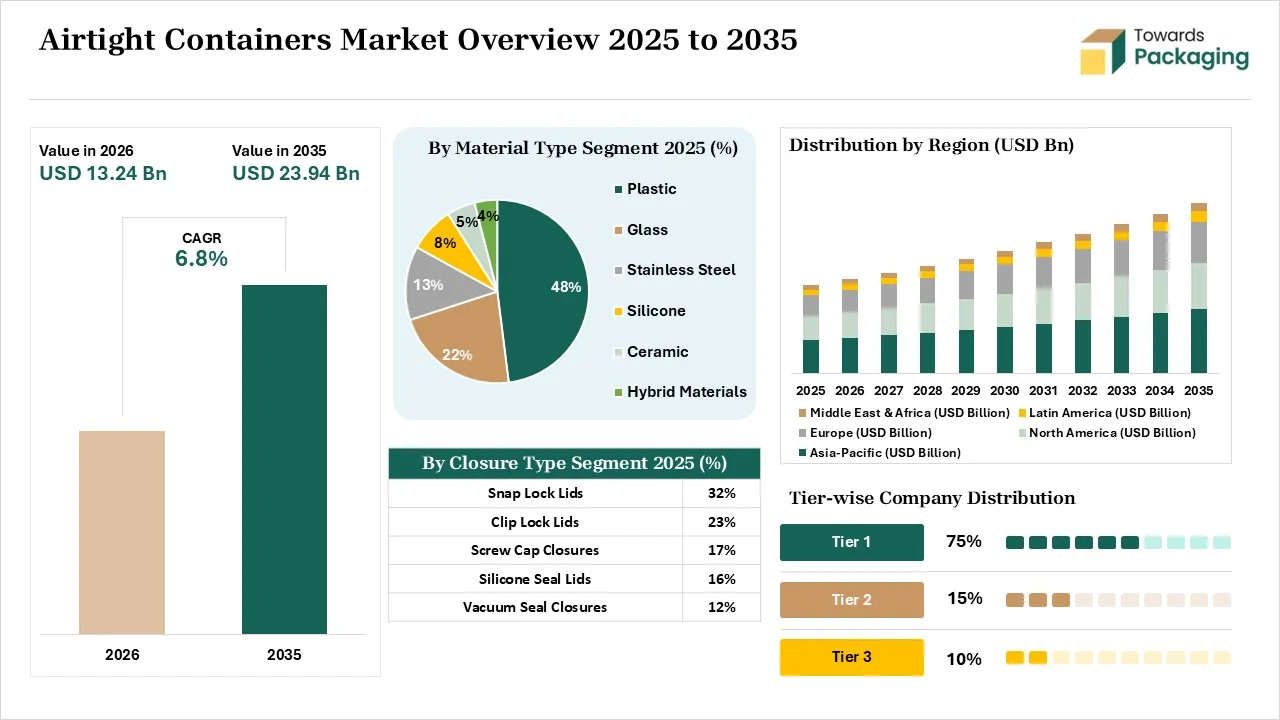
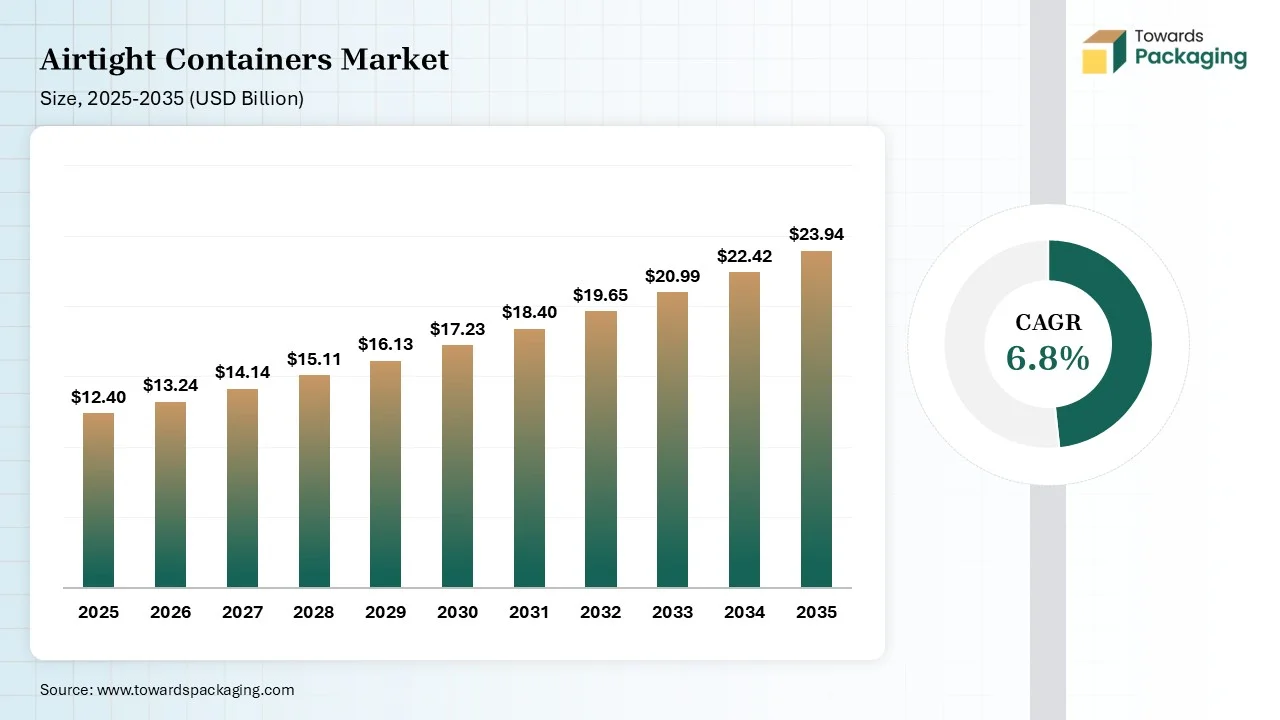
According to Vidyesh Swar, the global airtight containers market size was estimated at USD 12.4 billion in 2025 and is predicted to increase from USD 13.24 billion in 2026 to approximately USD 23.94 billion by 2035, expanding at a CAGR of 6.8% from 2026 to 2035. Factors like food preservation requirements, high dependence on meal-prepping, expansion of compact households, rise in safety consciousness, advancements in borosilicate glass, corporate transition to sustainable containers, development of space-saving designs, need to prevent degradation in cosmetic formulations, enhancements in vacuum-sealed mechanisms, and the rise in chemical-free seals drive the market growth. Airtight containers control moisture, lock in aroma, stop oxidation, and block pests in food preservation. The boom in social media platforms, the rise in open-living, smaller homes, and lifestyle changes are responsible for premium kitchen organization, which increases the use of airtight containers for visual aesthetics, food preservation, and space optimization.
An airtight container is a storage container that completely blocks air from passing outside and inside. It features a sealing mechanism and is made using food-grade materials. Airtight containers are leak-resistant, pest-resistant, moisture-proof, and odor-blocking. It offers benefits like space saving, stops microbial growth, preserves aroma, and saves space. Airtight containers widely used for storing dry staples, leftovers, pet food, medicines, and spices in households. It is used in ingredient bulk storage, food transport, drug preservation, storing hygroscopic reagents, and leftover management in commercial applications.
In ancient periods, the population gave preference to clay jars, glass containers, and ceramic jars for keeping food items fresh and limiting air exposure. In the 19th century, for long-distance transport, industrial canning was developed. In the same century, Earl Tupper developed lightweight containers using polyethylene, which integrates a burp seal. Consumers started using plastic containers for storing household staples. The modern era introduced four-sided snap-locking lids and innovative locking systems in airtight containers. The sustainability transformation created demand for BPA-free polymers, glass materials, and others. Recently, the industry has acquired antimicrobial materials for developing airtight containers.
The airtight containers market boundaries are defined using product coverage, materials, and applications. The material boundaries are plastic, stainless steel, ceramic, glass, and silicone. The product boundaries are food storage containers, vacuum airtight containers, stackable containers, industrial airtight containers, modular storage containers, and beverage storage containers. The application includes household storage, pharmaceutical transportation, manufacturing, and commercial sectors. The technical boundaries include vacuum systems and standard gasket seals. The excluded products are open baskets, vented produce containers, and loose-lid storage.
The changing dietary choices, online inspiration, budget control focus, and modern kitchens increase demand for home cooking. The fitness goals, growing digital access, and time savings focus increase demand for meal preparation. The need to store cooked foods and consumers' portion control increase use of airtight containers that prevent food exposure to external factors. The storage of items like grains, flours, crisps, and sugars increases use of airtight containers for safe transport and odor containment. The containers prevent freezer burn and support portion management. The containers are used in marinating proteins and preserving cut produce in meal preparation. The growing home cooking and meal preparation is a driver for the market growth.
The increased creation of copy designs of famous container brands and the high brand damage increase the risks to popular brands. The utilization of bad materials and poor manufacturing of counterfeit products reduces the sales of original branded products. Trust disruption and higher reputation damage create low-cost unorganized products. The cheap plastic and consumer demand for budget-friendly options increase sales of low-cost unorganized products, which hampers original brand growth. The availability of low-cost unorganized products is a restriction for market growth.
The growing interest in smart inventory management, tracking expiration dates, and faster cooking increases the use of connected kitchen storage. The integration of smart lids and automatic alert systems in airtight containers helps in smart inventory management. The connected technologies help in data-driven cooking and freshness indication. The need for instant detection of seal failures and lowering microorganism growth increases the use of connected kitchen storage. The technologies help in traceability compliance, inventory visibility, and loss reduction. The popular connected air containers are OXO Good Grip Smart Seal and Tupperware Smart Sorter. The rise in connected kitchen storage creates an opportunity for market growth.
From 2025 to 2035, dry storage containers are majorly used containers across the globe, and refrigerated containers demand is expected to grow. The volume growth driver factors are sustainable materials growth, integration of smart freshness features, interest in specialized kitchen organizations, air-barrier protection demand in the cosmetic industry, innovative multi-functional containers, advancing sealing technology, and hygiene focus.
The global production capacity is steadily growing. The global production capacity depends on the sealing component, polymer resins, machinery use, and tooling precision. The spatial utilization depends on nestability, geometric shape, and stackability. The functional utilization focuses on gasket integrity and headspace ratio. The expansion trends are BPA-free materials, stackable formats development, smart lids incorporation, and eco-alternatives use.
Consumption trends are driven by factors like the local retail industry and changing lifestyles. North American consumers focus on premium storage; rising incomes in Asia Pacific increase consumption of airtight containers, and European consumers focus on eco-friendly storage. North American consumption depends on material shift, convenience, and pantry organization. European region focuses on quality preference and sustainability rules. Asia Pacific consumption is driven by expanding retail infrastructure and affordability.
The raw materials like colorants, virgin plastics, & rubber gaskets take up to 40%-50%, manufacturing technologies like injection molding & tooling account for 20%-25%, component assembly & labor take up to 10%-15%, hardware utilization & seals acquire 10%, and final packaging & quality testing takes up to 5%-10%.
The average selling price of each multi-piece set of household category is $5-$15. Premium products' average selling price is $12 to$42 and the average selling price of the commercial category is $10-$105. The average selling price depends on factors like material costs and retail costs.
The average selling price of airtight containers in North America is high due to the presence of companies like Tupperware and increasing use of high borosilicate glass. European prices are also high due to the use of high-grade glass. The locally manufactured product has a low price in Asia Pacific, where imported product prices are a little higher. The expanding organized retail affects Latin America prices. The selling price is moderate in MEA due to the increased importing of premium products.
Raw materials like PET, stainless steel, PP, glass, and silicone are required for manufacturing airtight containers.
Material processing involves polymer drying, batch melting, and compounding. Conversion involves injection molding, gasket integration, and blow molding.
Design focuses on gasket geometry, material selection, and closure mechanics. Prototyping focuses on digital simulation, rapid prototyping, and functional validation.
The plastic segment dominated the market with a 48% share in 2025. The food security focus and need for easy-to-carry containers increase the use of plastics. The development of tight-sealing modular designs and the dishwasher safety focus increase the use of plastics. The high strength, easy transport, low cost, freezer-friendliness, lightweight, and non-reactivity of plastics drive the segment growth.
The stainless steel segment held a 13% market share in 2025 and is expected to grow at the fastest CAGR of 8% during the forecast period. The prevention of leaching of hormone-disrupting chemicals and the preservation of strong food smells increase the use of stainless steel. The focus on handling daily wear and consumers’ eco-friendly choice increases the use of stainless steel. The long life, zero waste, clean surface, superior airtight seals, and sleek aesthetics of stainless steel support the segment growth.
The food storage containers segment dominated the market with a 39% share in 2025. The focus on increasing food shelf life and the rise in convenient meal prepping increase the use of food storage containers. The need to block moisture in perishable foods and the storage of leftovers increases demand for food storage containers. The hygienic protection of dairy items and meal-prep habits drive the segment growth.
The vacuum airtight containers segment held a 15% market share in 2025 and is expected to grow at the fastest CAGR of 8.4% during the forecast period. The focus on stopping mold growth in food and the surging number of commercial kitchens increase the use of vacuum airtight containers. The need to store pre-made food ingredients and the focus on saving grocery bills increase the use of vacuum airtight containers. The integration of built-in hand pumps and lid buttons supports the segment growth.
The snap lock lids segment dominated the market with a 32% share in 2025. The focus on complete blocking of pests and the demand for absolute spill prevention increases the use of snap lock lids. The focus on preventing freezer burn and the need for spill-proof transport increases the use of snap lock lids. The material durability, ease of operation, odor control, space optimization, and microwave friendliness drive the segment growth.
The vacuum seal closures segment held a 12% market share in 2025 and is expected to grow at the fastest CAGR of 8.6% during the forecast period. The focus on removing aerobic bacteria from food and the rise in grocery buying in households increase demand for vacuum seal closures. The nutritional quality preservation in food items and protection of berries increases the use of vacuum seal closures. The ease of use, user-friendly design, and superior preservation in vacuum seal closures support the segment growth.
The 500 ml – 1 liter segment dominated the market with a 30% share in 2025. The storing of pulses and the growing fridge organization increase the use of 500 ml – 1 liter. The demand for school bag-friendly containers and the increased carrying of cut fruits increase the use of 500ml – 1 liter. The presence of modular kitchen racks and the rise in grocery refills increase the use of 500 ml- 1 liter. The easy visibility, portion alignment, and easy handling of 500 ml – 1 liter drive the segment growth.
The 1-3 liters segment held a 28% market share in 2025 and is expected to grow at the fastest CAGR of 7.6% during the forecast period. The growing batch cooking and the storing of family-sized portions of chopped vegetables increase the use of 1-3 liters airtight containers. The maximization of fridge space and the spoilage prevention need in leftovers increase the use of 1-3 liters containers. The expansion of nuclear families and rise in pantry staple storage increases the use of 1-3 liters containers. The urban kitchen constraints support the segment growth.
The food storage segment dominated the market with a 46% share in 2025. The preservation of food taste and preventing chemical changes in food increases the use of airtight containers. The focus on keeping bugs away from grains and the household interest in saving money increases the use of airtight containers. The compact storage space and the daily household storage increase the use of airtight containers, driving segment growth.
The kitchen organization segment held a 16% market share in 2025 and is expected to grow at the fastest CAGR of 7.9% during the forecast period. The creation of visually attractive pantry spaces and the need to maximize cabinet capacity increase the use of airtight containers. The focus on rapid content identification and the compact modern refrigerators increases the use of airtight containers. The home-organization trends on social media and safety transitions support the segment growth.
The household consumers segment dominated the market with a 44% share in 2025. Consumer demand for leak-proof seals for preservation of food and health trends increases the use of airtight containers. Kitchen organization in modern houses and the increased carrying of work lunches increase the use of airtight containers. The messy liquid spill avoiding demand and the availability of premium glass sets drive segment growth.
The restaurants & foodservice segment held a 12% market share in 2025 and is expected to grow at the fastest CAGR of 7.8% during the forecast period. Restaurants' focus on extending prepped foods' life and focus on lowering inventory waste in commercial kitchens increases the use of airtight containers. The busy commercial setups and the increased upgradation of kitchens increase the use of airtight containers. The growing numbers of food delivery orders and the rise in bulk food preparation support the segment growth.
The supermarkets & hypermarkets segment dominated the market with a 35% share in 2025. The buyers' preference for physical inspection and the demand for convenient essential pickup increase buying from supermarkets & hypermarkets. The focus on bulk-buying discounts and the interest in household storage items increase use of supermarkets & hypermarkets. The excellent product display, high stock availability, and one-stop convenience in supermarkets & hypermarkets drive the segment growth.
The e-commerce segment held a 23% market share in 2025 and is expected to grow at the fastest CAGR of 8.5% during the forecast period. The growing online tutorials on home styling and the purchasing of dry items online increase the use of e-commerce. The specialty product availability and the rise in social media ads increase the use of e-commerce. The growth in home bakers and doorstep convenience demand increases the use of e-commerce. The wide selection in e-commerce supports the segment growth.
Asia Pacific dominated the airtight containers market with a 38% share in 2025 and is expected to grow at the fastest CAGR of 7.9% during the forecast period. The crowded urban areas and the huge consumption of delivery services increase the use of airtight containers. Consumers' strong focus on home organization and the availability of cost-effective plastic materials increase the production of airtight containers. The smaller kitchen size and the expansion of portable lunch boxes increase the use of airtight containers. The interest in sealed containers drives the market growth.
China
China held the largest revenue share in the market in 2025. The strong steel production infrastructure and the well-developed manufacturing plants increase the adoption of airtight containers. The large-scale manufacturing infrastructure and easy access to plastic polymers increase the production of airtight containers. The availability of smart machines and the increased purchasing of premium home goods increases the use of airtight containers, supporting market growth.
India
India is expected to grow at the fastest CAGR in the market during the forecast period. The demand for better food preservation and the high investment in premium kitchen solutions increase demand for airtight containers. The focus on keeping pantry staples fresh and the shift to glass containers help with the expansion. The busy routines of consumers and the expansion of modular kitchens increase use of airtight containers. The transparent storage use in supermarkets supports the market growth.
North America held the 27% market share in 2025. The rise in urban living and the preference for creating aesthetic pantry designs increase the use of airtight containers. The transition to BPA-free containers and the robust packaging demand help with the expansion. The rise in weekly meal preparation and the growth in dual-income households increase the use of airtight containers. The high spending on premium modular glass drives the market growth.
United States
The United States dominated the airtight containers market in 2025. The high dependence on meal planning and the bulk purchasing of dry goods increases the use of airtight containers. The focus on lowering household spoilage of food and the rapidly growing retail platforms increase the use of airtight containers. The affordability of plastics and innovations like vacuum-sealed designs supports the overall market growth.
Canada
Canada is experiencing the fastest growth in the market. The focus on minimizing household waste and the rise in home cooking increase demand for airtight containers. The domestic transition to stainless steel containers and the need for leak-proof storage increase use of airtight containers. Green consumer habits and food aroma preservation boost the market growth.
Europe held a 24% market share in 2025. The preference for reusable glass containers and the growth in home cooking help with the expansion. The household focus on managing groceries and the interest in damage-proof storage increase the use of airtight containers. The need for medical sample preservation and the expansion of commercial kitchen supply chains increase the use of airtight containers, driving the overall market growth.
Germany
Germany dominated the airtight containers market in 2025. The stringent hygiene standards in German homes and the increased partnerships in the F&B industry increase the use of airtight containers. The growth in structured pantry management and the meal preparation culture increases the use of airtight containers. The interest in long-lasting glass containers and the popularity of organized home kitchens support the market growth.
United Kingdom
The United Kingdom is experiencing the fastest growth in the market. The healthy eating habits of consumers and household waste reduction goals increase the use of airtight containers. The rise in organization of dry goods and the recycling targets increase the use of airtight containers. The focus on storing food portions safely and the corporate targets boost the market growth.
Latin America held a 6% market share in 2025. The busier routines of urban consumers and increased health awareness increase demand for airtight containers for food preservation. The growing purchasing power of food and the rise in sterile drug storage increase the use of airtight containers. The expanding fresh produce exports and the growing processed food plants increase the use of airtight containers, driving the market growth.
Brazil
Brazil held the highest revenue share in the airtight containers market in 2025. The heavy purchasing of kitchen goods and the expanding digital shopping platforms increase the use of airtight containers. Innovations like microwave-safe containers and the demand for proper food preservation help with the expansion. Consumers' growing interest in organized home kitchens supports the market growth.
Chile
Chile is expected to grow at the fastest CAGR in the market during the forecast period. The hectic daily schedules and the rise in on-the-go food storage increase the use of airtight containers. The large cold-chain infrastructure and the preference for recyclable storage help with the expansion. The exploding food processing boost the market growth.
The Middle East & Africa held a 5% market share in 2025. Increased food purchasing in large quantities and a focus on stopping contamination in food increase the use of airtight containers. The booming modern supermarkets and spending on home-cooked meals increase the adoption of airtight containers. The bulk purchasing of packaged goods and the exploding tourism industry drive the overall market growth.
Saudi Arabia
Saudi Arabia dominated the airtight containers market in 2025. Heavy manufacturing investment and high petrochemical supply increase the production of airtight containers. The prevention of dry goods spoilage and expanding organized retail chains increases the use of airtight containers. The rise in bulk family storage and the increased buying of refrigerator storage containers supports the market growth.
UAE
UAE is expected to grow at the fastest rate in the market during the forecast period. The protection of staple goods and the increasing use of multi-compartment lunch boxes increase demand for airtight containers. The burgeoning food trade and the durable storage demand increases use of airtight containers. The rise in buying prepared meals and a fast-paced population boost the market growth.
The concentration is fragmented with regional producers and global manufacturers. The global leaders in the market are Rubbermaid and Tupperware. The regional competitors are Click Clack and OXO. The competitive intensity is characterized by low switching costs and major global giants. The local players in the market are Newell Brands and Tupperware Brands Corporation. The leading regional producers are present across Asia Pacific, North America, and Europe.
| Company | Product Range | Production Facilities | Sustainability Initiatives | Development and Collaborations |
| Tupperware | Smart Storer, Keep Tab, Freezer Mates, One Touch Fresh, Fridge Mates, Smart Saver |
India, Belgium, China, Mexico, South Africa, India, Portugal, South Korea |
90% reduction in greenhouse gas, Zero waste |
The company manufactures the Voila Glass range. |
| Rubbermaid | Easy Find Lids, Modular Pantry & Cereal Containers, Rubbermaid Brilliance, TakeAlongs |
Winchester, Virginia, Winfield, Kansas, Huntersville, North Carolina |
Recycled Materials, Waste Reduction |
The company launched EasyFindLids Insignia Blue Edition |
The global competitive positioning depends on factors like functional innovation, brand heritage, and material diversification. Rubbermaid is a key competitor that focuses on shatter-resistant materials and everyday utility. LocknLock offers leak-proof confidence. Oggi Company targets aesthetic organization. The regional players' competitive positioning depends on niche material adaptations and cultural preferences. Cello World is a leading Indian regional player that manufactures affordable PET canister sets. The leading regional players are Milton, Borosil, and Signoraware.
| Company Overview | The company offers airtight containers with features like safety, airtight seals, and interlocking lids. |
| Manufacturing Footprint | North America, Chile |
| Product Portfolio | Soup & Salad Bowls, Tall Entrée Containers, Medium Square Containers, Big Bowls |
| SWOT Analysis |
Strength Functional Designs Weakness Niche Priority Opportunity Integration of Eco-Friendly Materials Threats Plastic Regulations |
| Company Overview | The South Korea-based company offers products like cookware, food storage, drinkware, and kitchenware. |
| Manufacturing Footprint | Vietnam, South Korea, and China |
| Product Portfolio | Classic Plus+, Bisfree Modular Plus+, Freezer Fit, All Tritan, Fresh Block |
| SWOT Analysis |
Strength Patented Technology for Sealing Weakness Counterfeiting Opportunity Sustainable Product Lineups Threats Low-Barrier Entry |
| Company Overview | The American company offers products like cookware, cleaning items, and kitchenware. |
| Manufacturing Footprint | China and the United States |
| Product Portfolio | Good Grips POP Containers, POP Container Bundles & Sets, Steel Pop Containers |
| SWOT Analysis |
Strength Ergonomic Design Weakness High Price Point Opportunity Expansion of Lid Accessories Threats Low-Cost Labels |
According to my research, the airtight containers market is expanding due to factors like online shopping, food safety, and availability of new materials. The food storage container dominates the market due to the food safety demand, smart advancements, meal preparation, and sustainability. Food storage containers are widely used in home pantries, snack storage, refrigeration, and commercial kitchens. The household consumption of airtight containers is high due to the growing replacement of open bags, food preservation, and hygiene. Asia Pacific holds the major share in the market due to e-commerce expansion, urban lifestyles, and food preservation. Companies like Rubbermaid, OXO, Tupperware, LocknLock, and Sistema Plastics are major contributors.
By Material
By Product Type
By Closure Type
By Capacity
By Application
By End User
By Distribution Channel
By Region








Principal Research Analyst
Vidyesh Swar is a Senior Research Analyst at Towards Packaging, bringing over 4 years of dedicated expertise in market intelligence and strategic analysis across the dynamic world of packaging technologies and solutions.
Learn more about Vidyesh Swar

Reviewed By
Aditi Shivarkar, with 14+ years in packaging market research, specializes in food, beverage, and eco-friendly packaging. She ensures accurate, actionable insights, driving Towards Packaging Analytics & Consulting 's excellence in industry trends and sustainability.
Learn more about Aditi Shivarkar


Airtight Containers Market
 Table of Content

 Download Sample
 Schedule a Meeting