


The biodegradable plastic films market is forecasted to expand from USD 1.37 billion in 2026 to USD 2.03 billion by 2035, growing at a CAGR of 4.5% from 2026 to 2035. The biodegradable plastic films market continues to grow owing to the demand of harmless packaging materials, especially from the food and beverages sector. The end result of biodegradable films is less harmful to the environment than regular plastic bags.
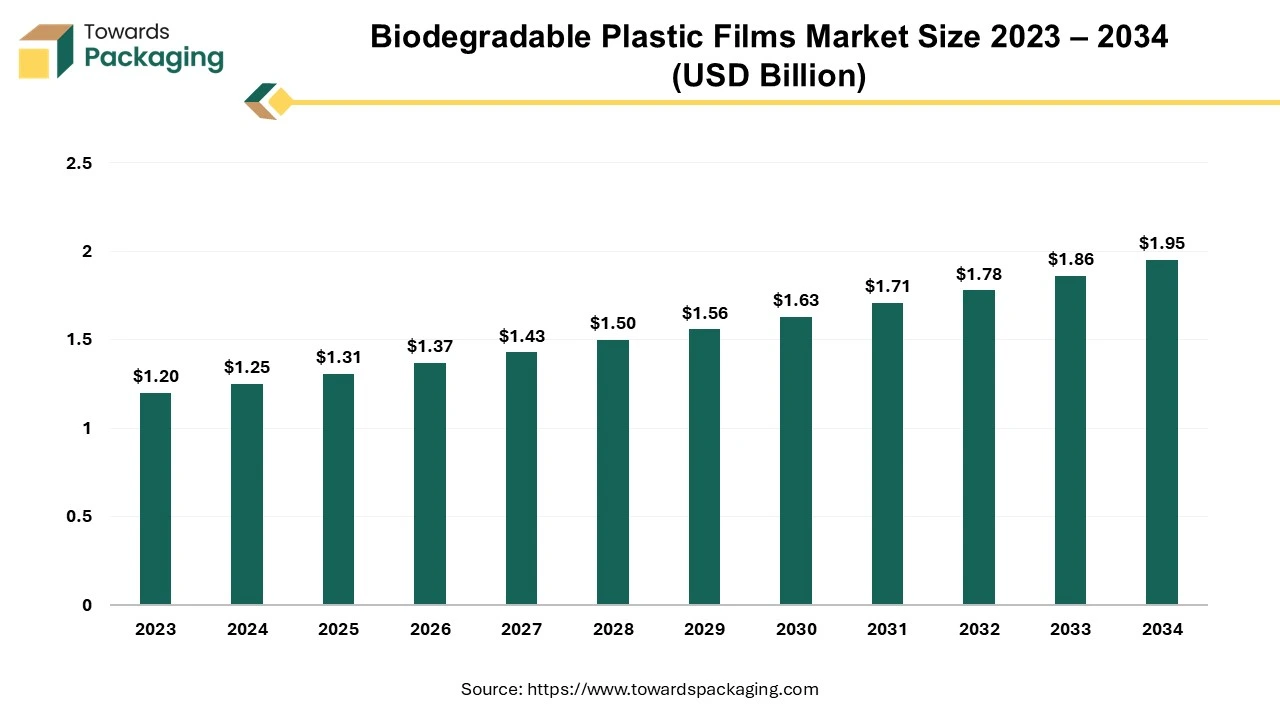
The biodegradable plastic film market is growing rapidly as it offers the material that caters the demand that required products that cause less carbon emission. The materials used to make biodegradable films are plant-based, and the carbon footprint of the composting process is very low. Plastics are widely used in the production of packaging products due to their quality and ease of production. Biodegradable plastics use natural products; therefore, using bioplastics can reduce environmental damage by reducing petroleum use.
The addition of natural bioactive compounds such as antioxidants, antimicrobials, and pigments also improves the film’s performance and provides smart communication with consumers. Some biodegradable films reduce oxygen and increase carbon dioxide to reduce the overall metabolic process, thus extending the shelf life of the product.
The increasing need for sustainable packaging solutions in the food packaging, and distribution industries is key to the growth of the biodegradable plastics films market. High-quality products are recommended for applications such as cartons, egg trays, cloth bags, film packaging, and food packaging due to their good environmental properties. Infusing bioplastics with antimicrobial compounds increases food safety by inhibiting the growth of harmful antimicrobial growth, thus extending shelf life and preserving the quality of fruits and vegetables.
This material is also used as food coating material, composite material, and separator for different food contents. In addition, the widespread use of disposable food products in hospitals, which have advantages such as ease of use, reduced maintenance, and reduced washing, brings additional needs. Increasing environmental concerns about plastic waste and its negative impact on ecosystems are encouraging the transition to biodegradable alternatives and accelerating the adoption of the biodegradable plastic films market.
Technological advancement is important in the expansion of biodegradable packaging. Innovations in materials science have led to the development of new, more biodegradable materials that perform as well as or better than plastic. These advances are making it easier for companies to switch to sustainable packaging solutions without compromising on quality or performance, which is driving the growth of the biodegradable plastic films market.
The EU is taking action on plastics to combat pollution and marine litter and to make changes to the plastics industry. The EU and other countries can develop measures to reduce unnecessary plastic waste, particularly from single-use products or excessive packaging, and encourage the reuse of packaging, which will lead to the growth of the biodegradable plastic films market.
Many countries have introduced plastic bans or restrictions in recent years. Rwanda has one of the strictest plastic bag bans in the world. This ban has reduced plastic bag use by more than 80%. European countries, such as France, have also banned the use of single-use plastic bags, cups, and plates, leading to an increase in the biodegradable plastic film market.
The production process of biodegradable plastic film is combined with artificial intelligence to improve film quality. Combining robotics, machine learning, and molecular dynamics simulations, are enabling the development of environmentally friendly, all-plastic products that meet industry standards. The new approach developed could help reduce global pollution by facilitating the transition to sustainable materials in many areas. The development of more sustainable materials. Biodegradable plastic films integrated with AI enhance the quality of those films, leading growth of the biodegradable plastic films market.
The development of nanocomposite films has unlocked significant opportunities in the biodegradable plastic films market, especially in the food sector. These films have good mechanical strength with strains up to 24 N/mm² and strains up to 220%, making them suitable for commercial packaging applications. The incorporation of nanomaterials into biodegradable polymers improves key properties such as energy efficiency, barrier properties, and thermal stability, paving the way for high-volume products.
The combination of improved performance and antibacterial properties makes biodegradable nanocomposite films an excellent alternative to non-biodegradable materials. However, concerns about the long-term toxicity of these materials present further innovation opportunities for safe, non-toxic, additional market growth.
The growth of the biodegradable plastic films market is constrained by several factors, primarily the high production costs associated with this material. Biodegradable plastics are typically made from raw materials such as corn starch, cassava starch, and vegetable oil, which are more expensive than the petroleum products used in everyday products. The manufacturing process for biodegradable plastics is more difficult and requires the use of technology and specialized equipment, which increases costs.
Additionally, limited capacity and the need for specialized facilities for the production of biodegradable materials increase the overall cost, making them more expensive to process than traditional products. Together, these factors limit the widespread use and growth of the biodegradable plastic films market.
| Rank | Company | Headquarters | Country | Why Relevant to This Packaging Market | Key Packaging Products/Services |
| 1 | NatureWorks | Plymouth, Minnesota | USA | Global leader in PLA biopolymers used extensively for biodegradable packaging films | Ingeo™ PLA biopolymers |
| 2 | Novamont | Novara | Italy | Pioneer in compostable packaging materials and biodegradable film technologies | Mater-Bi® compostable polymers |
| 3 | BASF | Ludwigshafen | Germany | Leading producer of compostable PBAT resins for flexible packaging films | ecovio® and ecoflex® biopolymers |
| 4 | TotalEnergies Corbion | Gorinchem | Netherlands | Major manufacturer of Luminy® PLA resins for sustainable flexible packaging | Luminy® PLA resins |
| 5 | Amcor | Zurich | Switzerland | Global flexible packaging leader developing compostable and biodegradable film solutions | Compostable flexible packaging |
| Rank | Company | Headquarters | Country | Why Relevant to This Packaging Market | Key Packaging Products/Services |
| 1 | TIPA | Hod HaSharon | Israel | Specialist in compostable flexible packaging films for food and consumer products | Compostable flexible films |
| 2 | Futamura | Nagoya | Japan | Manufacturer of NatureFlex™ compostable cellulose films | Cellulose-based biodegradable films |
| 3 | Mondi | Weybridge, England | United Kingdom | Develops sustainable flexible packaging incorporating biodegradable materials | Sustainable flexible packaging |
| 4 | Coveris | Vienna | Austria | Offers compostable and recyclable flexible packaging solutions | Compostable packaging films |
| 5 | Danimer Scientific | Bainbridge, Georgia | USA | Leading producer of PHA-based biodegradable materials for packaging | Nodax® PHA biopolymers |
| Rank | Company | Headquarters | Country | Why Relevant to This Packaging Market | Key Packaging Products/Services |
| 1 | BioBag International | Askim | Norway | Manufactures compostable bags and biodegradable film products | Compostable bags and films |
| 2 | Walki | Espoo | Finland | Develops sustainable barrier films and bio-based flexible packaging | Sustainable flexible packaging |
| 3 | Plascon Group | Nairobi | Kenya | Produces biodegradable flexible packaging films for regional markets | Biodegradable plastic films |
| 4 | Earthfirst Films | Columbus, Ohio | USA | Specializes in PLA-based biodegradable films for packaging | PLA packaging films |
| 5 | CJ Biomaterials | Woburn, Massachusetts | USA | Emerging supplier of PHA biopolymers for biodegradable packaging films | PHA biopolymers |
By type, the starch blends segment dominated the market as it blended with plastic can improve water resistance, performance, and mechanical properties. The starch container is opaque. Cellulose films are another type with a significant market because cellulose films are in principle biodegradable and compostable, meaning they can decompose into their natural products over time. Cellulose films are a durable and versatile choice for food packaging. They have high barrier properties, are transparent, and can be easily shaped into different shapes and sizes.
By applications, the bags segment dominated the biodegradable plastic market as biodegradable film bags have the same durability as plastic bags, are free of toxic substances, and do not need to be specially handled. Biodegradable films are increasingly gaining attention as the most effective material for plastic bags. Whereas wrapping film application segment is fastest growing because biodegradable wrapping films are less harmful to the environment than ordinary plastic bags. It reduces carbon emissions during production.
The food & beverage segment dominated the market as it can protect and preserve food and beverages while being capable of separating them into natural ingredients. It is important to prevent microbial contamination of food, thus extending its shelf life. It is ideal for packaging fresh foods such as fruits and vegetables or baked goods.
Whereas use of biodegradable films is expected to grow in the agriculture industry significantly over the forecast period as biodegradable polymers used as alternatives to plastic in agriculture are starch compress, polybutylene adipate terephthalate alcohol ester (PBAT), polybutylene succinate (PBS), poly(β)-caprolactone) (PCL), polylactic acid (PLA) and polyhydroxyalkanoate (PHA). Biodegradable agricultural plastic has the same properties as standard plastic mulch, so it also helps reduce weeds
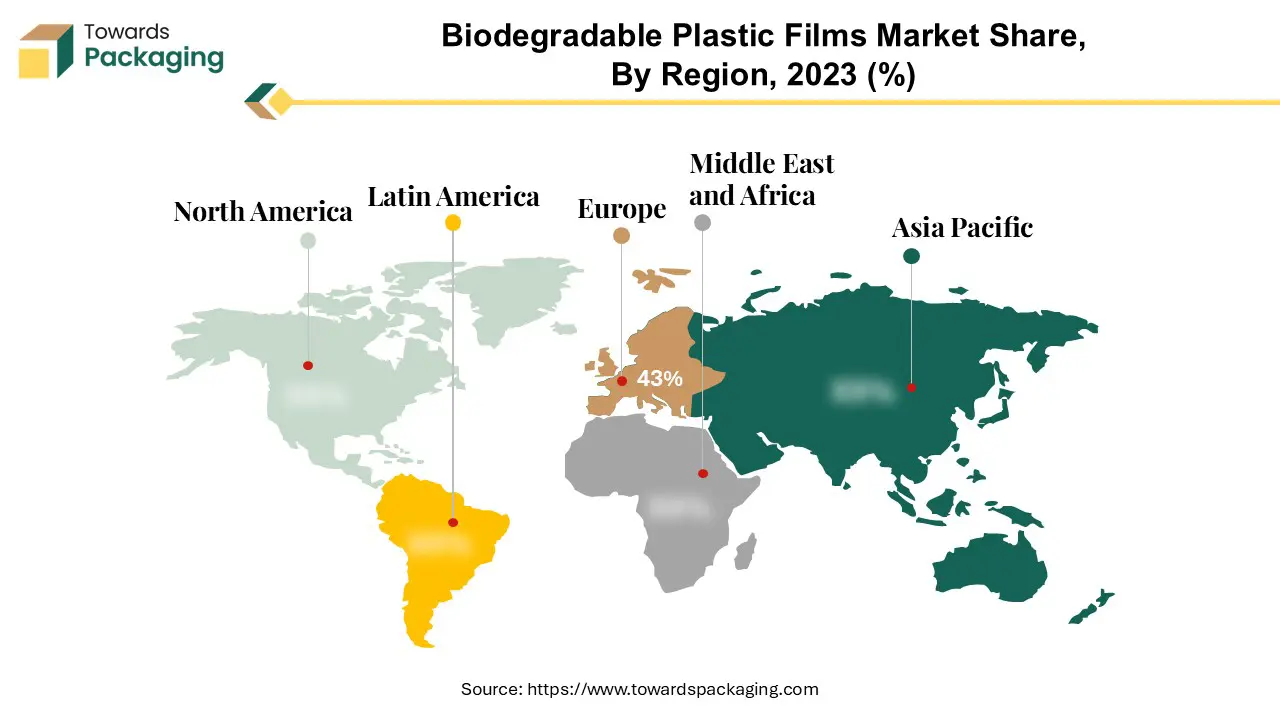
Europe dominated the biodegradable plastic films market as with people’s increasing interest in environmental management, plastic pollution has attracted more attention from the scientific community, government, media, and public due to its negative impact on the environment and human health. Multiple European areas have already banned the use of single-use plastic bags in grocery stores and other stores; this ban was previously thought to increase the waste problem.
Eco-conscious consumers are increasingly looking for brands that are committed to being eco-friendly and creating sustainable packaging. Several governments and large businesses are interested in degradable plastics, especially biodegradable plastics. The use of biodegradable plastic is expected to grow rapidly and its application is expanding further, leading to the growth of the biodegradable plastic film market.
Germany
Germany represents a key market for biodegradable plastic films, motivated by strong government support for bio-based materials, stringent environmental regulations, and a high level of recycling awareness. Leading manufacturers of biodegradable polymers and sophisticated manufacturing capabilities bolster market expansion, particularly in sustainable packaging and industrial applications.
Asia Pacific is expected to witness notable growth in biodegradable plastic films market during the forecast period, driven by the increasing focus on sustainability in Asia, which is a major growth factor. The region focuses on environmental, social, and governance issues. Therefore, packaging companies need to understand the needs of the customer so that they can seize the growth opportunity.
The Pan-India Plastic Waste Management (PWM) Rules for Single-Use Plastic Products (SUPP) 2021 came into effect in mid-2022 and gave a starting point for the process of increasing plastic waste laws. The government is requiring companies to reduce single-use plastic waste.
In China, the restaurant industry has been asked to reduce single-use plastic by 30% and is set to phase out all single-use plastic products (cutlery, chopsticks, straws, stirrers) by the end of 2025. For agricultural plastic items that are likely to end up in green waste streams, the substitution with certified compostable plastics alternatives makes sense in the Asia Pacific and is driving the growth of the biodegradable plastic films market.
The biodegradable plastic films market in the MEA region is in an emerging growth phase, supported backed by a growing consciousness of plastic pollution and a slow rollout of sustainability programs. Increased demand for food packaging, growing urbanization, and growing interest in environmentally friendly alternatives are all contributing to the region's adoption of biodegradable film.
UAE
The UAE is a leading adopter of biodegradable plastic films within the MEA region, backed by policies and sustainability initiatives run by the government that try to cut down on single-use plastics. Demand for biodegradable and compostable film solutions is being driven by strong growth in the retail, hospitality, and food service sectors, as well as growing consumer awareness.
Biodegradable plastic films are produced from bio-based polymers such as PLA, PBAT, and other compostable materials derived from renewable feedstocks like corn, sugarcane, and plant oils. Feedstock availability and sustainable sourcing strategies impact cost and production scalability.
Key players in the biodegradable films value chain include BASF SE, NatureWorks LLC, Novamont S.p.A., Futamura Chemical Co., Ltd., Biome Bioplastics Limited, Taghleef Industries, TIPA Corp Ltd., Cortec Corporation, BioBag International AS, Mitsubishi Chemical Corporation, Total Corbion PLA, Toray Industries, and Kingfa Sci. & Tech. Co., Ltd.
Distribution networks are often aligned with packaging converters, retail brands, and regional hubs to ensure customized biodegradable film supply. Temperature-controlled storage and coordinated shipments help preserve material integrity, especially for food and medical packaging applications.
End-of-life management emphasizes industrial composting and certified biodegradation. Compliance with compostability standards and waste segregation infrastructure is vital for effective biodegradation and minimizing environmental impact.
The bioplastic projects expected to be ventured in Kolkata holds the revenue potential of about Rs.1800 Crore, commissioned in 2026.
Avantika Saraogi, Executive Director, Balrampur Chini Mills,
By Type
By Application
By End-use
By Region









Principal Research Analyst
Vidyesh Swar is a Senior Research Analyst at Towards Packaging, bringing over 4 years of dedicated expertise in market intelligence and strategic analysis across the dynamic world of packaging technologies and solutions.
Learn more about Vidyesh Swar

Reviewed By
Aditi Shivarkar, with 14+ years in packaging market research, specializes in food, beverage, and eco-friendly packaging. She ensures accurate, actionable insights, driving Towards Packaging Analytics & Consulting 's excellence in industry trends and sustainability.
Learn more about Aditi Shivarkar


Biodegradable Plastic Films Market
 Table of Content

 Download Sample
 Schedule a Meeting