


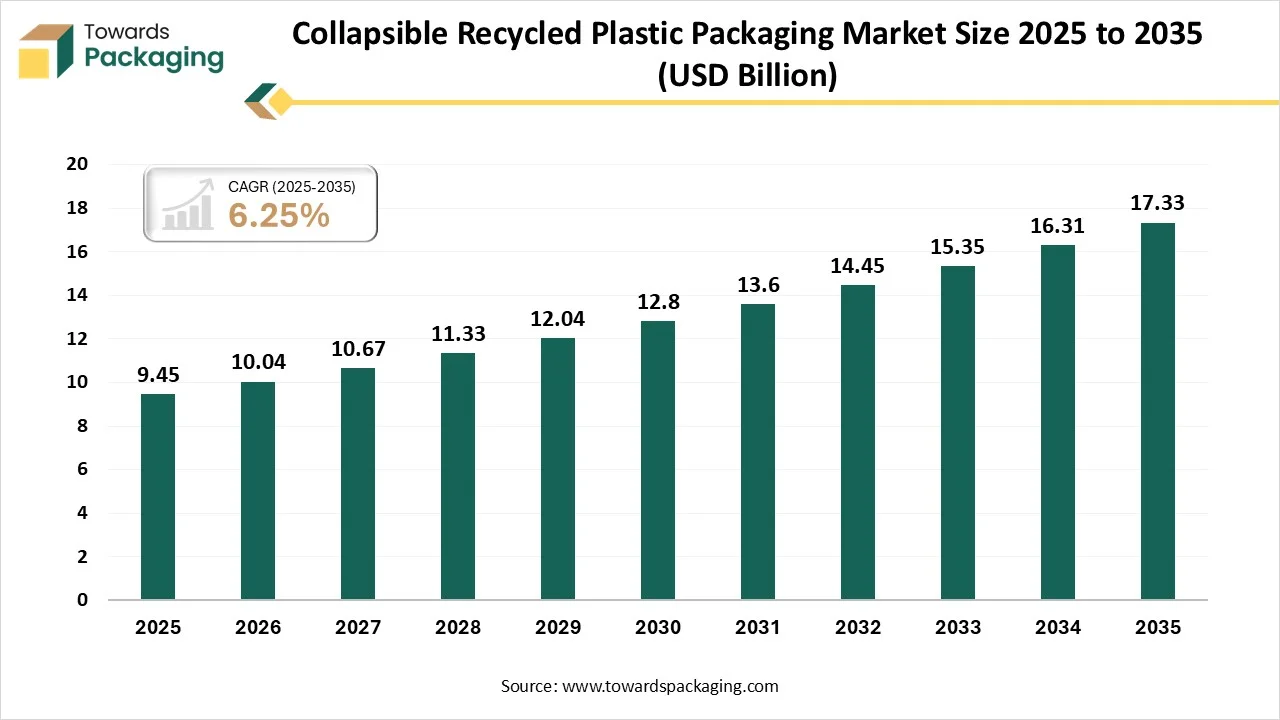
The collapsible recycled plastic packaging market is projected to grow from USD 10.04 billion in 2026 to USD 17.33 billion by 2035, expanding at a CAGR of 6.25% from 2026 to 2035. The report provides comprehensive insights covering market size, segment data by product type, material, and end-use industry, along with regional analysis across North America, Europe, Asia Pacific, Latin America, and the Middle East & Africa. It also includes competitive analysis, company profiles, value chain analysis, trade statistics, and detailed data on manufacturers and suppliers, highlighting the rising demand for sustainable logistics solutions in the growing e-commerce sector.
Collapsible recycled plastic packaging is a kind of storage container that is crafted to be both collapsible and strong. Like regular rigid containers, these containers can be folded flat when not in use, which enables maximum space savings. They are generally created from high-quality, reliable plastic materials like polypropylene (PP) or high-density polyethylene (HDPE), which ensure they can firmly withstand heavy loads, withstand impact, and sustain repeated folding and unfolding cycles.
| Percentage | Trend |
| 85% | Weight Reduction |
| 90% | Stacking Efficiency |
| 78% | Storage Space Optimization |
| 95% | Reusability |
| 88% | Reduced Waste |
| 80% | Cost Savings |
| 92% | Eco-Friendly Materials |
| 75% | Durability |
| 82% | Customer Satisfaction |
| 86% | Supply Chain Efficiency |
The plastic sector is quickly encouraged by technological development, constant efforts, and the developed demand for eco-friendly solutions. The circular economy stretches sector closed loops are shifted towards manufacturing systems, in which plastic is constantly re-presented and reused. Government policy and industry principles apply strict rules and lead to permanent market recycling and production. AI and automation -robotics and the AI-driven classification systems in recycling increase smoothness in recycling functions, as it lowers human communication and develops material recovery. Sustainable packaging invention brands fund plant-based packaging and stock manure to lower plastic pollution.
The rHDPE segment dominated the collapsible recycled plastic packaging market in 2025, as Recycled HDPE is also known for its high density, generally developing from 0.93 to 0.97 g/cm, which contributes to its durability. This material shows effective resistance and abrasion of opposition, which makes it perfect for uses in which power and longevity are needed. Its moisture resistance ensures that products are created from rHDPE, which do not soften when exposed to humid surroundings or a direct water connection. This packaging is prevalently used for bottles of non-food liquids, like shampoos, motor oil, detergents, and household cleaning items.
The rPET segment is projected to experience the fastest CAGR during the forecast period. Sustainability loyalty is driving a demand for rPET usage across sectors. At the same time, top brands have set passionate targets of including up to 50% recycled plastic into their packaging. Furthermore, the urge develops, so supply stays constant. Processing infrastructure and collection haven’t kept pace, which has created bottlenecks that have kept brands at risk of missing such sustainability goals.
The collapsible crates & foldable totes segment dominated the market in 2025. They are generally produced from more challenging elements like cardboard, plastic, or fabric that can be painted to survive, which are kept clean daily. The folding action enables them to fold into a flat form, which can be stored in a closet, a nook, or below a bed. The flexible nature creates a foldable, inexpensive desire for humans who have limited space or permanent demand for a garage crate. Foldable crates are smooth and lightweight to shift, even if they are loaded.
The collapsible bottles & tubes segment is expected to witness the fastest CAGR during the forecast period. Collapsible tubes or squeeze tubes are a type of flexible cosmetic packaging. They contain a cylindrical shape as squeeze tubes are generally made of plastic, which can be searched for aluminum squeeze tubes. Plastic squeeze tubes are made of PE and PP, which makes them affordable and flexible. These tubes are reliable as we can utilize them with skin care products, cosmetics, and even pharmaceuticals. Additionally, they serve waste-free use on the skin. Such tubes also use different viscosities and formulas, from gels, serums, to creams.
The food & beverage segment dominated the collapsible recycled plastic packaging market in 2025. Plastic pallets are resistant to moisture; as a result, they are less susceptible to rot, splinter, or grow mold when they are exposed to damp conditions, which makes them perfect for both cold and dry chain logistics. They are specifically crucial for organizations that have exported dairy, meat, packaged goods, or fresh produce, which should align with strong safety and health standards.
The e-commerce & retail segment is projected to witness the fastest CAGR during the forecast period. Effective packaging not only saves space but also lowers the number of trips needed for logistics. By using packaging that can be collapsed or stacked, organizations can transport more products in a single means of transportation, which lowers the demand and the associated carbon emissions. Organizations can select by using cutting-edge packaging designs, such as “right-sizing.” This includes using packaging that is personalized to match the size of the product, which lowers the amount of unwanted material used.
Asia Pacific dominated collapsible recycled plastic packaging market in 2025, which is initially being driven by the fast development of the retail, logistics, and production industry across developing economies. The development of urbanization and the demand for e-commerce activities boost the urge for smooth, space-saving packaging solutions. The growing focus on eco-friendly and sustainable materials pushes the acceptance of collapsible crates that are reusable and lowers the waste. Furthermore, technological developments in production procedures develop product customization and reliability, which attracts more users.
Government initiatives market the sustainable packaging practices, which have further assisted the market growth. The lightweight nature and reliability of collapsible recycled plastic packaging make them suitable for storage and transportation, particularly in densely populated regions. Completely, an integration of technological inventions, economic development, and eco-friendly consciousness mainly encourages the market’s development.
How is the Collapsible Recycled Plastic Packaging Market Growing in India?
More producers are now depending on recycled granules (rPET, rHDPE, and rLDPE) to lower the production amount. As an outcome, recyclers can sell processed materials at an overall competitive amount while tracking healthy profit margins. It begins with a medium or small-scale recycling plant that needs less initial investment than several production ventures. Once they are discovered, plants can be expanded by adding washing, shredding, and pelletizing units to develop capacity. India’s circular economy policies have made strong incentives for formal recyclers. Many states now offer subsidies on machines, fast-track clearances, and tax advantages.
The collapsible recycled plastic packaging market is being classified by an integration of perfectly discovered industry top organizations and inventive developing companies important organizations make big distribution links, big-level production potential and rigid R&D investments to prevent their dominant market shares. Such corporate leaders frequently have step-by-step partnerships and collaborations to stretch the product profiles, develop the latest verticals, and grow technological potential, such as cold chain supply chains and e-commerce logistics
Why is Canada using the Collapsible Recycled Plastic Packaging Market Importantly?
As eco-friendly issues develop and public pressure for sustainability develops, governments globally are implementing strong regulations to drive the acceptance of recycled material packaging waste. Such new and future laws make fewer levels compulsory for recycling packaging recyclability standards and place greater responsibility on manufacturers. Extended Producer Responsibility (EPR) schemes keep ahead of such regulatory moves, which are complicated by having the goal to stay compliant and align with growing user expectations for practices.
By Material
By Product
By End-Use
By Region








Principal Research Analyst
Vidyesh Swar is a Senior Research Analyst at Towards Packaging, bringing over 4 years of dedicated expertise in market intelligence and strategic analysis across the dynamic world of packaging technologies and solutions.
Learn more about Vidyesh Swar

Reviewed By
Aditi Shivarkar, with 14+ years in packaging market research, specializes in food, beverage, and eco-friendly packaging. She ensures accurate, actionable insights, driving Towards Packaging Analytics & Consulting 's excellence in industry trends and sustainability.
Learn more about Aditi Shivarkar


Collapsible Recycle Plastic Packaging Market
 Table of Content

 Download Sample
 Schedule a Meeting