


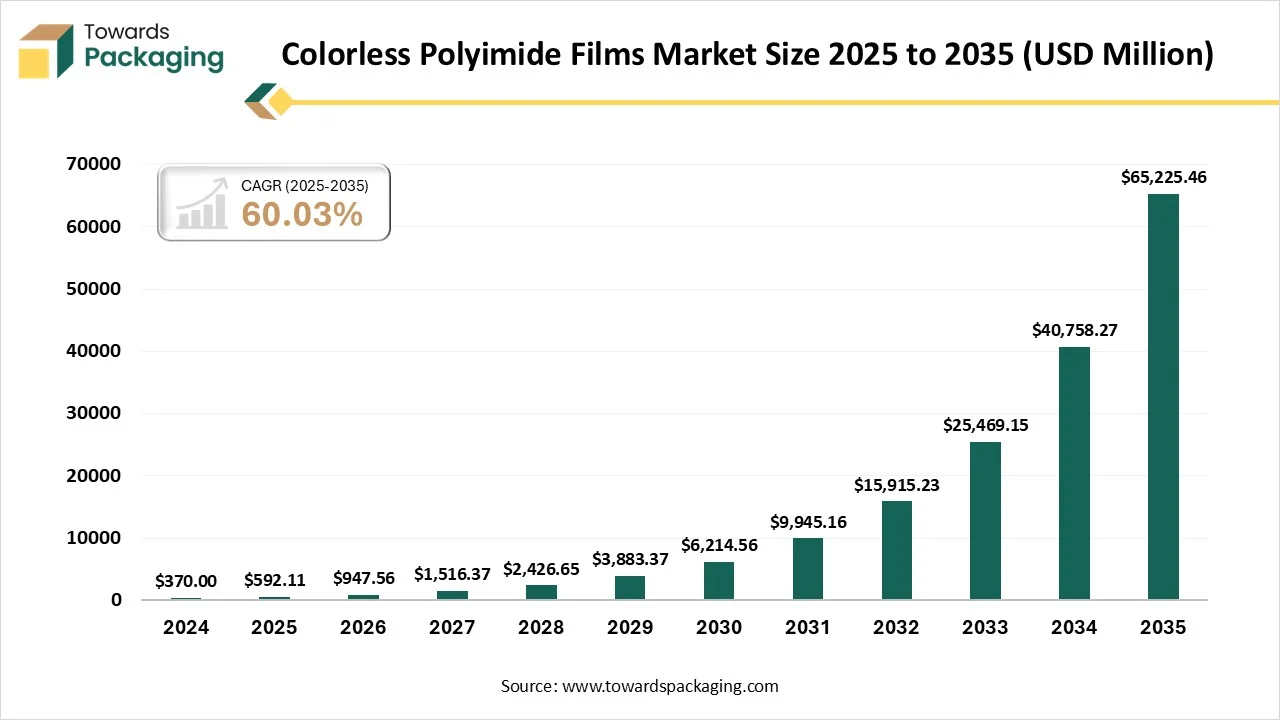
The colorless polyimide films market is projected to grow from USD 947.56 million in 2026 to USD 65,225.46 million by 2035, registering a CAGR of 60.03% during 2026–2035. The report provides comprehensive insights including market size, segment data, regional trends, company profiles, competitive analysis, value chain analysis, trade statistics, and detailed manufacturers and suppliers data. Increasing demand for flexible displays in foldable smartphones, laptops, and tablets is a key growth driver, as these films offer high transparency, superior thermal stability, chemical resistance, and strong mechanical performance.
Colorless polyimide films include high-presentation, transparent, and colorless plastic films with exceptional thermal steadiness, flexibility and mechanical strength. Contrasting old-style polyimide films, these are yellow, these are precisely manufactured to be optically transparent and are utilized as alternate for solar cells, flexible displays, and several other optoelectronics. Their exclusive properties create them suitable for usages in customer aerospace, electronics, and various other requesting sectors where high sturdiness and transparency are crucial.
Technological transformation in market plays a significant role in coating technique and advanced processing. Advanced technology resolves the issues with functionality and durability, ensure longer lifespans suitable for flexible devices such as wearables, laptops, and foldable smartphones. The major shift includes operating the molecular construction of polyimides to generate a balance among robust thermal/mechanical properties and high optical transparency. The increasing demand for sustainable manufacturing methods and flexible electronics has raised the adoption of high skilled technology.
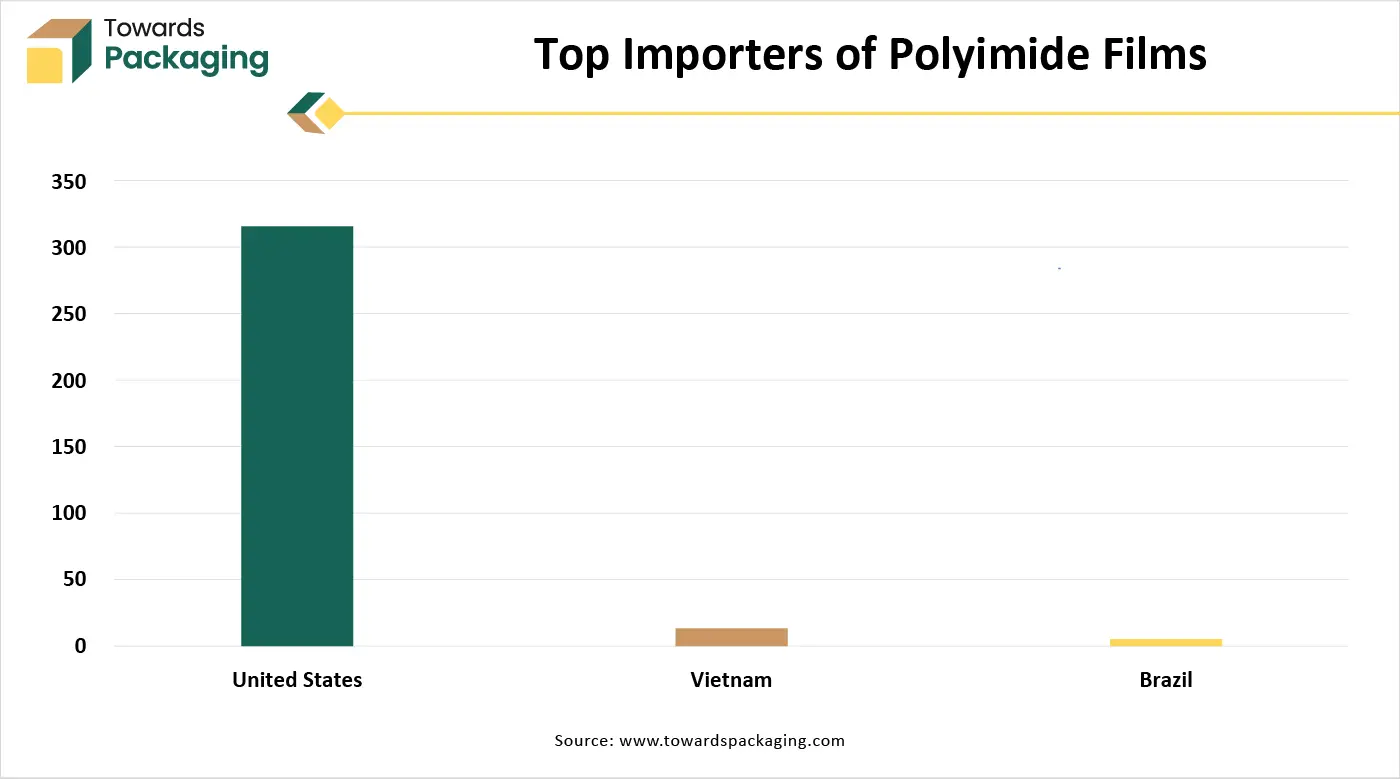
The major raw materials utilized in this market are Oxydianiline (ODA) and Pyromellitic Dianhydride (PMDA).
The component manufacturing in this market comprises process such as polyamic acid (PAA) route.
This segment is growing focus on strict managing protocols and direct supply chains to electronics producers.
The flexible displays segment dominated the market with highest share in 2024 due to increasing demand for portable, thinner, and lighter devices. The enhancing demand is influenced by the requirement for durable, lightweight, and foldable electronic devices such as wearables, smartphones, and tablets. These are utilized as transparent and defensive cover plates for solar cells. These films offer crucial benefits such as thermal stability and high transparency, and are important for presentation in high-tech usages. Constant increasing demand for environment-friendly and operative adhesive options is aligning them for possible development.
The flexible printed circuit boards segment is expected to grow at the fastest CAGR during the forecast period. This segment is growing due to its optical transparency, flexibility, and thermal stability. These are utilized as a durable, and lightweight alternate in the manufacturing of the lightweight as well as flexible solar panels. Rising demand for high-performance, miniaturized, and lightweight devices has raised the demand for this segment. The excellent heat resistance which enhanced its adoption in electronics manufacturing industry.
The flexible solar cells are the fastest-growing in the market, as it comprises flexible and lightweight substrate. Huge support from governmental bodies for the adoption of solar electronic devices has raised its protection concern among manufacturing bodies. It has high clarity and thermal stability which enhance its demand in several sectors. Increasing adoption for portable devices has majorly raised the demand for this segment.
| End Use Industry Segments | Market Share 2025(%) |
| Electronics | 55% |
| Solar Energy | 25% |
| Medical | 10% |
| Others | 10% |
The electronics segment dominated the market with highest share in 2024 due to enhancing wearable technology and lighting equipment. These are utilized in automotive usages for instrument, displays, and touchscreens panels because of their reliability and durability. The development of wearable equipment such as health monitors and smartwatches boosts the demand for durable, lightweight, and flexible resources has raised this segment. Several other noteworthy electronics claims comprises wearable technology, semiconductor packing, automotive electronics, and lighting devices.
The solar energy segment is expected to grow at the fastest CAGR during the forecast period. This segment is growing due to enhanced usage of flexible solar cells and solar street lighting. A worldwide change in the direction of renewable energy are enhancing the demand for efficient and versatile solar technologies. The significant shift towards enhanced performance and cost-operative options, which further helps market extension.
The medical segment is the fastest-growing in the market, as it comprises high optical quality and thermal stability. The exclusive mixture of high clarity, optical worth, thermal stability and flexibility made these films suitable for a huge variety of medical usages. These are utilized in medical devices partly because of their proven reliability and biocompatibility. The increasing reliance of healthcare industry on reliable and durable resources for new technologies helps the development of this segment.
Asia Pacific held the largest share in the market in 2024, due to the presence of strong manufacturing industries of various sectors such as electronics, pharmaceutical, and various others. Continuous advancement and increasing demand for miniature products has raised the safety concern among producers. This region is the major manufacturing centre for products such as foldable smartphones and various other flexible displays, that result in enhancing the demand for these colorless films. Increasing household earnings and a huge customer base for electronics products in developing economies within this region have boosted noteworthy demand for flexible devices.
Rising demand for durable, clear, and flexible films has enhanced the demand for colorless polyimide film in China. It is influenced by its huge electronics products ecosystem, mainly for flexible devices and displays, together with government support towards R&D, a robust drive for electric vehicles (EVs). Continuously growing domestic customer demand for high-tech devices. Major factors such as increasing disposable earnings, rapid industrialization, and increasing population have raised a huge demand for customers electronics in China. It has noteworthy production potential in associated fields like nanotechnology, printed electronics, and optoelectronics, which is directly associated with flexible electronic equipment.
Presence of hi-tech industries like renewable energy, flexible electronics, and aerospace has enhanced the demand for the market. The demand for advanced consumer electronics like foldable smartphones, tablets, laptops with flexible screens, and wearable devices is a primary driver. These films are substituting traditional, more delicate glass films and thicker plastic substrata as they provide excellent toughness, transparency, and the capacity to twist repeatedly without causing any damage. The change toward renewable energy source and sustainable films has enhanced the demand for durable, lightweight, and flexible materials in solar panels.
Growing electronics, automotive, and aerospace sector has boosted the development of the market in the U.S. The rapid advancement in the manufacturing process of the films has influenced the growth of this market. Incorporation of AI in manufacturing are enhancing efficacy, product integrity, and allowing faster invention, which offers to market extension. A rising range of usages, like flexible printed circuit boards, flexible solar panels, and lighting equipment, is intensifying the market's potential. The growing production of electric vehicles and increasing demand for lightweight resources are boosting this development.
The major factors influencing the growth of market are increasing industries of electronics, automotive, and aerospace. Increasing emphasis on advanced manufacturing and sustainability initiatives has raised the need for advanced films. Lightweighting enterprises to enhanced boost efficacy and complete presentation of vehicles. The demand for high-presentation, durable, and lightweight resources in the defense and aerospace industries offers suggestively to market development. Producers are emphasizing on rising sustainable constructing processes and recyclable monomers to fulfil these values, which influences invention in the market.
The strong medical device, automotive, and electronics manufacturing has fuelled the development of the market. It needs transparent materials, high-performance, and durable films which can enhance the protection. This market is growing because of their electrical insulation and superior thermal stability properties. These are important for making lighter, thinner, and more compressed electronic machineries like wearable devices, smartphones, and laptops.
The market for colourless polyimide (CPI) films in the Middle East and Africa (MEA) is still small but growing rapidly, driven by rising demand from renewableenergy, electronics, aerospace and infrastructure sectors. Growth is concentrated in Gulf countries (like UAE, Saudi Arabia) and South Africa where solarenergy projects, lightweight electronics, flexible circuits, and advanced industrial / aerospace uses are increasingly adopted.
In the United Arab Emirates (UAE), the market for Colorless Polyimide Film (CPI film) or more broadly polyimide films is small but gaining traction as the country pushes modernization and diversification beyond oil. The broader Middle East & Africa (MEA) region counts UAE among the leading adopters, driven by growth in electronics, renewableenergy (solar), aerospace and telecom infrastructure all usecases where CPI’s heatresistance, durability and flexibility make it attractive.
In South America, the colorless polyimide film market is gradually growing, driven by increasing industrialization, electronics imports, automotive expansion, and rising demand for advanced materials. Key demand drivers include growth in the automotive sector (including emerging electric vehicle initiatives), increasing use of electronics (consumer devices, flexible circuits), and modest but rising adoption in infrastructure, industrial systems, and renewableenergy applications.
In Brazil, the colorless polyimide film market remains modest but shows promising growth as electronics, automotive and industrial sectors adopt advanced materials. Demand is driven by Brazil’s expanding electronics manufacturing, growing automotive and EVrelated production (which uses PI films for battery management systems, wire insulation, and flexible circuits), and increasing interest in highperformance insulation or substrate materials.
DuPoint - Advanced Materials & CPI Capacity Expansion
In January 2026, DuPont is increasing investment in next-generation polyimide film production and R&D, targeting high-performance transparent substrates for flexible electronics. This investment strengthens its position in supplying CPI materials for foldable displays and advanced semiconductor applications.
Kaneka Corporation - High-Performance Film Manufacturing Investment
In March 2026, Kaneka is investing in expanding the production of high-clarity polyimide films with improved thermal and optical properties. The focus is on scaling commercial output to meet rising demand from flexible OLED displays and wearable devices.
SK Innovation - CPI Supply Chain & Materials Integration
SK Innovation is channeling capital into advanced materials and CPI-related film technologies in March 2026, integrating them into broader electronics and battery ecosystems. This investment supports vertical integration, ensuring a stable supply for next-gen electronic components.
Sumitomo Chemical - Specialty Polymer Innovation Investment
Sumitomo Chemical is investing in specialty polymer R&D in February 2026, including transparent polyimide films with enhanced durability and flexibility. These investments are aimed at enabling CPI adoption in high-reliability applications such as automotive electronics and advanced displays.
SKC - Production Line Expansion Investment
SKC is investing heavily in expanding polyimide film production lines, including advanced variants applicable to transparent CPI films. This capacity expansion improves global supply capability and supports growing demand from flexible circuit boards and display manufacturers.
Jiangsu Ostin Technology Group - Mass Production Facility Investment
In December 2025, Jiangsu Ostin Technology announced the launch of mass production for colorless polyimide films, marking a major commercialization milestone. This investment transitions CPI films from pilot scale to industrial scale for flexible displays and aerospace applications.
Beijing Technical Institute of Physics and Chemistry - Collaborative CPI R&D Investment
Collaborative investments between this institute and industry players are advancing next-generation CPI formulations with improved optical transparency and thermal stability. These efforts are critical for overcoming material limitations and enabling broader commercialization across electronics and packaging sectors.
By Application
By End Use Industry
By Region








Research & Advisory Analyst
Yogesh Kulkarni is an experienced Research Analyst specializing in the packaging sector, with a strong foundation in statistical analysis and market intelligence. He currently contributes his expertise to Towards Packaging.
Learn more about Yogesh Kulkarni

Reviewed By
Aditi Shivarkar, with 14+ years in packaging market research, specializes in food, beverage, and eco-friendly packaging. She ensures accurate, actionable insights, driving Towards Packaging Analytics & Consulting 's excellence in industry trends and sustainability.
Learn more about Aditi Shivarkar


Colorless Polyimide Films Market
 Table of Content

 Download Sample
 Schedule a Meeting