


The Europe advanced healthcare packaging coating market is projected to grow from USD 3.99 billion in 2026 to USD 7.84 billion by 2035, registering a CAGR of 7.8% during the forecast period. The market study covers detailed market size analysis, growth trends, segment data by coating type, material, application, and end user. The report also provides regional insights across Western Europe, Eastern Europe, Nordic countries, and Southern Europe, along with competitive analysis, company profiling, trade flow analysis, value chain assessment, and detailed manufacturers and suppliers data. Rising chronic disease prevalence and increasing emphasis on infection prevention in healthcare packaging applications are accelerating market demand.
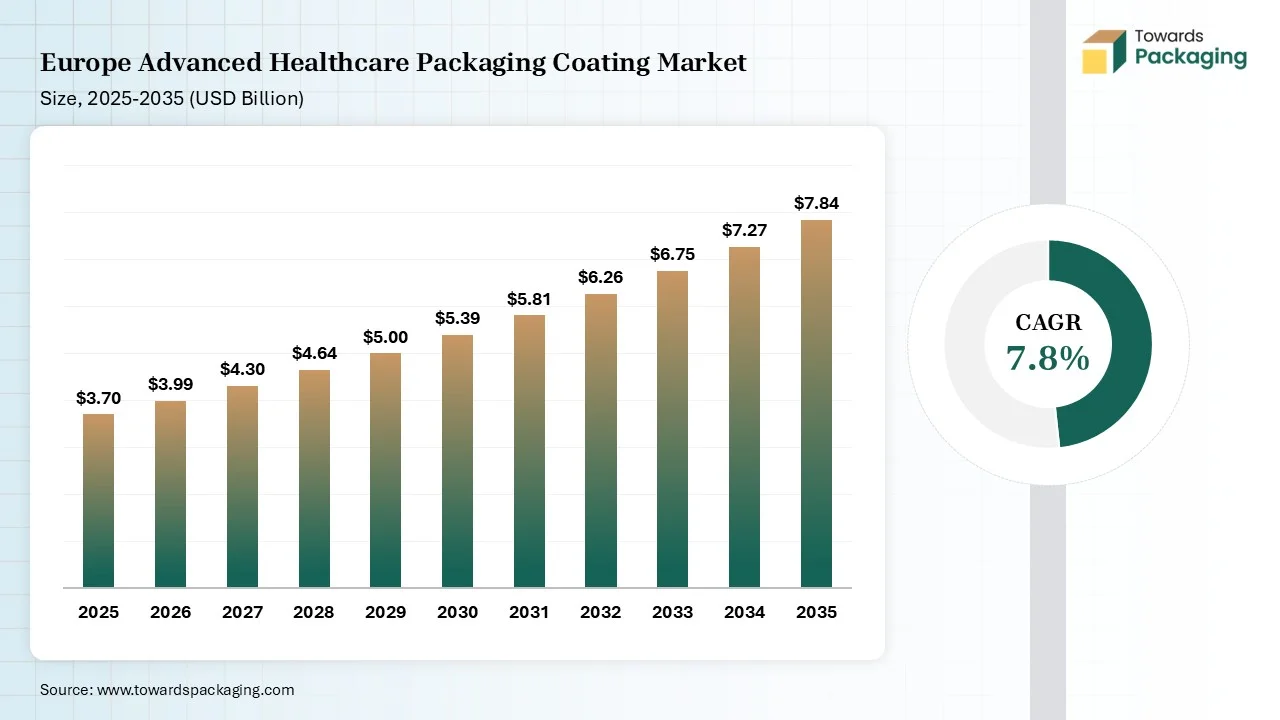
Market Size (2025): USD 3.70 Billion
CAGR (2025–2035): 7.8%
Market Volume (2025): 1.01 Million Metric Tons
Volume CAGR (2025–2035): 6.5%
Advanced healthcare packaging coatings are functional layers utilized in healthcare packaging materials to ensure sterility. These coatings offer advanced peelability, biocompatibility, sterile barrier protection, sterilization compatibility, and eco-friendly design. It offers benefits like optimized sterilization, contamination defense, product efficacy preservation, easy peeling, and supply chain durability. The diverse types of anti-coatings include antimicrobial coatings, heat seal coatings, anti-contamination coatings, and barrier coatings. Advanced healthcare packaging coating is widely used in blister packs, medical device packaging, wipe packaging, and drug-contact components.
Technological developments like smart packaging coatings, energy-curable coatings, nano-engineered coatings, digital twins, process analytical technology, and predictive analytics are happening in the market. Technological developments are happening to prevent counterfeiting and monitor medication integrity. AI is the major current transformation in the market.
AI easily manufactures various types of advanced healthcare coating formulations and offers a flawless finish to coatings. AI identifies microscopic gaps in coatings and helps in preventing drug degradation. AI lowers the risk of incorrect labels and predicts the performance of the coating. AI identifies improper thickness of coatings and monitors machinery. Overall, AI helps in developing intelligent coatings.
The stage acquires raw materials like PVDC, acrylics, rosin esters, polyethylene glycol, water, titanium oxide, antimicrobial agents, EVA, PVA, silicones, hydrocarbon resins, citrate esters, waxes, organic solvents, iron oxides, and desiccants.
Material processing involves roll application, extrusion coating, and vapor deposition. Conversion includes methods like thermal lamination, slitting, pouch making, precision rotary die cutting, and perforation.
The stage focuses on temperature controls, sterility maintenance, traceability, inventory rotation, last-mile logistics, climate control, regulatory compliance, and vibration dampening.
Key Players:- UPS Healthcare, DB Schenker, CEVA Logistics, Marken, DHL Supply Chain, FedEx Healthcare Solutions, DSV Air & Sea, Bollore Logistics
The barrier coatings segment dominated the market with 34.20% share in 2025 due to the expansion of modern pharmaceuticals. The focus on preventing chemical breakdown in medicines and the high sterility standards increase the adoption of barrier coatings. The focus on maintaining sterility in sensitive injectables and the need for UV light & oxygen protection in pharma packaging increases adoption of barrier coatings, driving the overall segment growth.
The antimicrobial coatings segment held the 22.50% market share in 2025 due to the growing need for preventing pathogen growth. The focus on a contaminant-free pharmaceutical environment and the rise in microbial-resistant strains increase the adoption of antimicrobial coatings. The need to inhibit the degradation of sterile surgical devices and the growing use of reusable medical packs increase the adoption of antimicrobial coatings. The expansion of silver-based antimicrobial coatings supports the segment growth.
The anti-counterfeit coatings segment held the 18.10% market share in 2025 due to the complex supply chains. The stricter serialization mandates and the drug stability focus increase the adoption of anti-counterfeit coatings. The growing logistics vulnerabilities and focus on brand protection increase demand for anti-counterfeit coatings. The availability of multi-layered security and the regulations for drug traceability boost segment growth.
The plastics segment dominated the market with 38.40% share in 2025 due to its high customization and unmatched versatility. The development of flexible blister packs and the focus on maintaining the integrity of sensitive biologics increase the use of plastics. The need to lower performance failure risk and the minimization of manufacturing expenses increase plastic adoption. The smart packaging integration with plastics drives the segment growth.
The paper & paperboard segment held the 21.30% market share in 2025 due to the healthcare industry shift to circular economy models. The development of child-resistant closures and the prevention of medical device degradation increases the use of paper & paperboard. The increasing demand for blister packs lidding and advanced barrier technology enhance the adoption of paper and paperboard. The anti-tamper quality of paper and paperboard drives the growth of the segment.
The metals segment held the 15.20% market share in 2025 due to its excellent safety features and sustainability. The preservation of advanced drugs from biological contaminants and the carbon-neutrality goals of pharmaceutical brands increase the adoption of metals. The shelf-life maintenance of sterile implants and the prevention of physical breakage of diagnostic kits increase the use of metals, boosting the overall segment growth.
The pharmaceuticals segment dominated the market with 41.50% share in 2025 due to the growing drug manufacturing. The rise in temperature-sensitive vaccines and the growing demand for patient-friendly designs increase the adoption of advanced healthcare packaging coatings. The specialty drugs production and the growing self-administration of medications increase the adoption of advanced healthcare packaging coatings. The high volume of API manufacturing drives the segment growth.
The medical devices segment held the 23.20% market share in 2025 due to the expansion of single-use medical devices. The higher demand for home-monitoring devices and the popularity of disposable surgical instruments increase demand for advanced coatings. The development of delicate medical technologies and the prevention of device counterfeiting increase the use of advanced coatings, supporting the segment growth.
The diagnostics segment held the 15.30% market share in 2025 due to the interest in point-of-care. The shift to advanced diagnostics and the preference for patient safety increase the use of advanced coatings in diagnostics. The popularity of at-home diagnostics and the maintenance of diagnostic integrity increase demand for advanced healthcare packaging coatings. The growing diagnostic test volume boosts segment growth.
The water-based coatings segment dominated the market with 29.10% share in 2025 due to the stringent mandates on VOCs. The strong need to maintain extreme purity and the preservation of sensitive medications increases the adoption of water-based coatings. The prevention of chemical leaching and the sterility maintenance of surgical tools increase the adoption of water-based coating. The eco-friendliness and exceptional adhesion of water-based coatings drive the segment growth.
The solvent-based coatings segment held the 18.40% market share in 2025 due to the rise in modern healthcare packaging. The expansion of sterile pouches and the growing life-saving drug demand increase the adoption of solvent-based coatings. The excellent UV light resistance, superior microbial resistance, and heat-seal capabilities of solvent-based coatings help with expansion. Solvent-based coatings' compatibility with diverse medical-grade substrates supports segment growth.
The UV-cured coatings segment held the 17.20% market share in 2025 due to its ultra-fast processing. The rise in development of medical device trays and the increased use of blister pouches increases the adoption of UV-cured coatings. The protection of pharmaceutical containers' integrity increases the use of UV-cured coatings. The higher throughput, energy efficiency, and excellent contamination control of UV-cured coatings boost segment growth.
The sterile packaging segment dominated the market with 30.60% share in 2025 due to the rising use of single-use catheters. The high demand for sterilized bags and the rise in injectable therapies increase the adoption of advanced healthcare packaging coating. The rising hospital admissions due to chronic disorders and the popularity of pharmaceutical injectables increase the adoption of advanced healthcare packaging coating. The burgeoning cell therapies drive the segment growth.
The blister packs segment held the 21.40% market share in 2025 due to the rise in demand for separate dose protection. The patient preference for daily dosage tracking and the rise in advanced drug formulations increase demand for blister packs, which require advanced coatings. The rise in eco-friendly blister packs supports the segment growth.
The vials & ampoules coating segment held the 14.80% market share in 2025 due to the popularity of RTU formulations. The personalized medicine protection and the increasing use of ready-to-fill vials increase the adoption of vials & ampoules coatings. The strong pharmaceutical research and the elimination of leachables from vials help with expansion. The focus on maximum drug recovery boosts the segment growth.
Germany leads the market due to the presence of advanced healthcare manufacturing. The stringent healthcare regulations and the growing research in the biotechnology industry increase demand for advanced healthcare packaging coating. The massive presence of medical device companies and the shift to eco-friendly polymers increase the production of advanced healthcare packaging coating. The healthcare industry is transitioning to smart packaging, and stringent sterilization techniques drive the market growth.
France is experiencing rapid growth in the market due to the growing demand for medical devices. The focus on anti-counterfeiting in the healthcare sector and the rise in temperature-sensitive biologics increase the adoption of advanced healthcare packaging coating. The higher demand for surgical tools and the robust growth in specialty therapeutics increase the adoption of advanced healthcare packaging coating. The transition to hydrophilic coatings supports the market growth.
| Rank | Company Name | Headquarters | Country | Why Relevant to This Market | Key Packaging Products/Services |
| 1 | Actega | Wesel, North Rhine-Westphalia | Germany | Global leader in packaging coatings including healthcare applications | Heat-seal coatings, barrier coatings, healthcare coatings |
| 2 | Henkel | Düsseldorf, North Rhine-Westphalia | Germany | Major supplier of healthcare packaging coatings and sealants | Functional coatings, seal coatings |
| 3 | Michelman | Cincinnati, Ohio | USA | Strong healthcare and pharmaceutical packaging coating portfolio | Barrier coatings, water-based coatings |
| 4 | PPG Industries | Pittsburgh, Pennsylvania | USA | Significant specialty coating technologies for healthcare packaging | Protective and functional coatings |
| 5 | Sun Chemical | Parsippany, New Jersey | USA | Major provider of pharmaceutical packaging coatings and inks | Functional coatings, healthcare inks |
| Rank | Company Name | Headquarters | Country | Why Relevant to This Market | Key Packaging Products/Services |
| 1 | Siegwerk | Siegburg, North Rhine-Westphalia | Germany | Strong healthcare packaging coating capabilities | Functional coatings and inks |
| 2 | Flint Group | Luxembourg City | Luxembourg | Established packaging coatings supplier | Pharmaceutical coating solutions |
| 3 | Hubergroup | Kirchheim bei München, Bavaria | Germany | Specialty healthcare packaging coatings | Barrier and protective coatings |
| 4 | Toyo Ink Europe | Düsseldorf, North Rhine-Westphalia | Germany | Healthcare and pharmaceutical packaging coatings | Functional coating technologies |
| 5 | Altana AG | Wesel, North Rhine-Westphalia | Germany | Parent group with healthcare packaging coating innovations | Specialty packaging coatings |
| Rank | Company Name | Headquarters | Country | Why Relevant to This Market | Key Packaging Products/Services | |
| 1 | Avery Dennison | Mentor, Ohio | USA | Healthcare label coatings and functional materials | Medical label coatings | |
| 2 | Tekra | New Berlin, Wisconsin | USA | Specialty healthcare coating solutions | Medical packaging coatings | |
| 3 | Chemcoaters | Cheshire | United Kingdom | Specialized coating technologies | Barrier and protective coatings | |
| 4 | Coim Group | Offanengo, Lombardy | Italy | Polyurethane and specialty coating systems | Functional healthcare coatings | |
| 5 | Loparex | Cary, North Carolina | USA | Silicone-coated healthcare packaging materials | Release coatings and liners | |
By Coating Type
By Substrate
By End-Use Industry
By Technology
By Application








Research & Advisory Analyst
Yogesh Kulkarni is an experienced Research Analyst specializing in the packaging sector, with a strong foundation in statistical analysis and market intelligence. He currently contributes his expertise to Towards Packaging.
Learn more about Yogesh Kulkarni

Reviewed By
Aditi Shivarkar, with 14+ years in packaging market research, specializes in food, beverage, and eco-friendly packaging. She ensures accurate, actionable insights, driving Towards Packaging Analytics & Consulting 's excellence in industry trends and sustainability.
Learn more about Aditi Shivarkar


Europe Advanced Healthcare Packaging Coating Market
 Table of Content

 Download Sample
 Schedule a Meeting