


The Europe fiber-based tray market is projected to grow from USD 2.79 billion in 2026 to USD 5.21 billion by 2035, registering a CAGR of 7.2% during the forecast period. The study provides comprehensive insights into market size, revenue forecasts, segment-wise analysis by material type, product type, and end-use industry. It further covers regional trends across Western Europe, Eastern Europe, Nordic countries, and Southern Europe, along with detailed company profiling, competitive benchmarking, value chain analysis, trade flow assessment, and extensive manufacturers and suppliers data. The report also highlights sustainability trends, eco-friendly packaging adoption, and the impact of expanding food delivery and retail sectors on market demand.
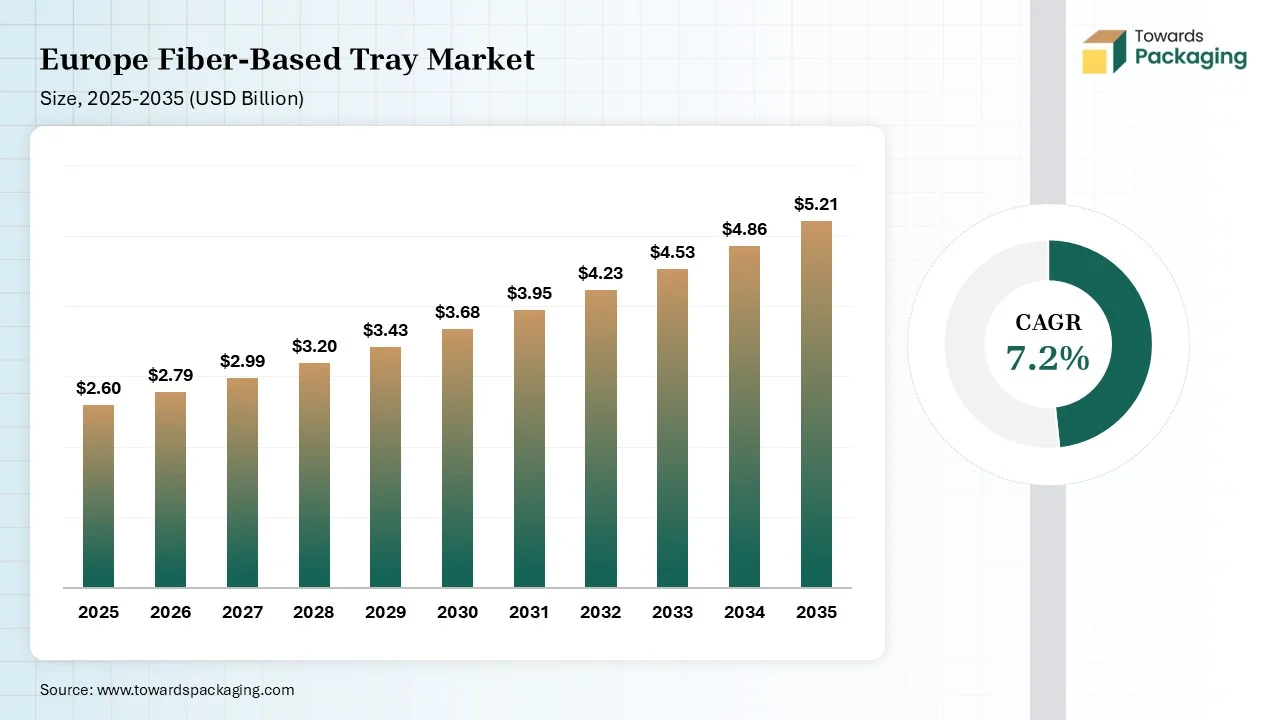
Market Size (2025): USD 2.60 Billion
CAGR (2025–2035): 7.2%
Market Volume (2025): 38.0 Billion Units
Volume CAGR (2025–2035): 7.8%
Pricing Data (2025):
Fiber-based trays are eco-friendly packaging derived from renewable plant fibers. It has high cold tolerance, superior durability, exceptional customizability, excellent thermal insulation, and exceptional heat tolerance. It offers benefits like excellent protection, cost-effectiveness, superior sustainability, and moisture resistance. Fiber-based trays used in applications like frozen meals, catering, industrial components, hygienic consumables, cosmetics, and fresh produce.
The Europe fiber-based tray market is undergoing key developments, driving demand for optimizing the usage of fiber and minimizing manufacturing emissions. Developments like predictive analytics, automated manufacturing, predictive logistics, advanced simulation, and integrated ERP help in automating cost estimations, lowering scrap waste, and minimizing logistical costs. The most prominent development in the market is AI, which helps in accelerating the tailor-made design of the tray.
AI designs protective tray shapes and detects uneven thickness of fiber-based trays. AI optimizes the use of resources and monitors the drying process. AI lowers the rate of product rejection and monitors the properties of the material. AI predicts the trends of the market and lowers the need for manual testing. AI enhances the accuracy of shipping and conserves electricity. Overall, AI supports high-speed fiber-based tray production.
The raw materials like wheat straw, recycled paperboard, wood pulp, bagasse, bamboo, recycled newsprint, barrier coatings, corrugated cardboard, softwood, and natural binders are required.
Processing includes raw material sourcing, pulping, forming, and drying. Conversion includes thermoforming, barrier coating, and trimming.
The package design includes steps like material selection, primary manufacturing using dry pressing, wet pressing, & dry forming, structural design, and finishing. Prototyping involves 3D modeling, low-fidelity prototyping, tooling for pulp modelling, and functional testing.
| Rank | Company Name | Headquarters | Country | Why Relevant to This Market | Key Packaging Products/Services |
| 1 | Huhtamaki | Espoo, Uusimaa | Finland | Global leader in molded fiber food packaging and sustainable trays | Fiber food trays, molded fiber packaging |
| 2 | Stora Enso | Helsinki | Finland | Major innovator in fiber-based tray and food packaging solutions | Fiber trays, formed fiber packaging |
| 3 | DS Smith | London, England | United Kingdom | Strong European paper-based packaging footprint | Fiber trays, retail packaging |
| 4 | Smurfit Westrock | Dublin | Ireland | Extensive fiber packaging production and innovation capabilities | Paper-based trays and packaging |
| 5 | Hartmann | Gentofte | Denmark | Leading molded fiber packaging specialist | Egg trays, molded fiber trays |
| Rank | Company Name | Headquarters | Country | Why Relevant to This Market | Key Packaging Products/Services |
| 1 | Metsä Board | Espoo, Uusimaa | Finland | Advanced paperboard solutions for fiber tray applications | Food-grade paperboard trays |
| 2 | Billerud | Solna | Sweden | Sustainable fiber packaging materials provider | Tray-grade paperboard |
| 3 | Graphic Packaging International | Atlanta, Georgia | USA | Growing European fiber food packaging presence | Fiber trays and carton packaging |
| 4 | Sonoco | Hartsville, South Carolina | USA | Strong molded fiber and food packaging operations | Fiber trays and molded pulp packaging |
| 5 | Coveris | Vienna | Austria | Developing fiber-based food tray alternatives | Fiber food packaging solutions |
| Rank | Company Name | Headquarters | Country | Why Relevant to This Market | Key Packaging Products/Services |
| 1 | PulPac | Gothenburg | Sweden | Pioneer in dry molded fiber technology | Fiber tray manufacturing technology |
| 2 | Pulpac Green Packaging | Gothenburg | Sweden | Commercialization of fiber replacement solutions | Dry molded fiber trays |
| 3 | CKF Inc. | Hantsport, Nova Scotia | Canada | Specialty molded fiber packaging producer | Food trays and fiber containers |
| 4 | EnviroPAK | Worcestershire, England | United Kingdom | Sustainable molded pulp packaging specialist | Fiber trays and inserts |
| 5 | Cellulose de la Loire | Nantes | France | Regional molded fiber packaging supplier | Industrial and food trays |
The molded fiber segment dominated the market with 62% share in 2025, due to the plastic packaging taxes. The preference for green packaging and the focus on minimizing the corporate carbon footprint increase the adoption of molded fiber. The strong restaurant industry and the focus on protecting fragile electronics in logistics increase the use of molded fiber. The superior cushioning and high customizability of molded fiber drive the segment growth.
The paperboard-based fiber segment held the 15% market share in 2025 due to the increased utilization of recycled fiber-based formats. The surging modified-atmosphere packaging and the rising meal deliveries increase demand for paperboard-based fiber. The high-volume delivery and the growing RTE applications increase the use of paperboard-based fiber. The superior printability and structural integrity of paperboard-based fiber support the segment growth.
The bagasse fiber segment held the 10% market share in 2025 because of the European Green Deal. The consumers' priority for plastic-free alternatives and the brands' focus on improving their green image increase demand for bagasse fiber. The growing sustainable food packaging increases the use of bagasse fiber. The fast composting rates, microwave-safe, and excellent performance of bagasse fiber boost segment growth.
The food trays segment dominated the market with 34% share in 2025, due to the ban on plastic use in the food industry. The explosion of online food delivery and key foodservice brands increases demand for fiber-based food trays. The preference for organic produce and the expansion of cloud kitchens increase the use of fiber-based food trays. The transportation of delicate food items requires fiber-based food trays, driving the overall segment growth.
The egg trays segment held the 18% market share in 2025 due to the focus on protecting fragile eggshells. The high rate of egg consumption and the shift away from foam egg cartons increase demand for fiber-based egg trays. The surge in free-range eggs and the focus on protecting eggs during transport require fiber-based egg trays. The growing egg production supports the segment growth.
The meat & poultry trays segment held the 16% market share in 2025 due to the focus on lowering plastic use in the meat & poultry industry. The industry’s priority for hygienic packaging and the strong poultry processors increase demand for fiber-based meat & poultry trays. The need to increase the shelf life of meat and the high demand for artisanal proteins increase the use of fiber-based meat & poultry trays, boosting the segment growth.
The food & beverage segment dominated the market with 38% share in 2025, due to the strong FMCG industry. The rise in cloud kitchen deliveries and advancements in food safety increases demand for fiber-based trays. The shift towards disposable meal trays and the burgeoning takeout industry increases the adoption of fiber-based trays. The expansion of grab-and-go and the growing baked goods sector drives the segment growth.
The retail & e-commerce segment held the 22% market share in 2025 due to the expansion of online retailers. The explosion of quick commerce and the expansion of last-mile delivery increase demand for fiber-based trays. The rise in online shoppers and the need for custom-fit cushioning increases demand for fiber-based trays. The rising popularity of e-commerce and the focus on creating a premium brand perception support the segment growth.
The agriculture segment held the 12% market share in 2025. The growing agricultural residues increase the production of fiber-based trays. The need for agricultural seedling trays and the shift away from plastic fruit containers increase demand for fiber-based trays. The protection of delicate vegetables & fruits and the transportation of wet agricultural products increase the use of fiber-based trays, boosting the overall segment growth.
The wet molded fiber segment dominated the market with 45% share in 2025, due to the rising use in food packaging applications. The regulations on polystyrene and the focus on premium retail environments increase the adoption of wet molded fiber. The buyers' move to bio-based packaging and the prevention of transport damage increase the adoption of wet molded fiber. The excellent vibration dampening, exceptional load-bearing capacity, excellent surface finish, and superior aesthetics of wet molded fiber drives the segment growth.
The dry molded fiber segment held the 20% market share in 2025 due to the high utilization of sustainable materials. The production of stackable trays and the higher need for catering trays increases the use of dry molded fiber. The focus on complex branding details and the growing cost-sensitive markets increases the use of dry molded fibers. The superior production, high-quality finish, and unmatched sustainability of dry molded fiber support the segment growth.
The thermoformed fiber segment held the 15% market share in 2025 due to demand for a recyclable alternative. The development of durable trays and the huge demand for drink carriers increases demand for thermoformed fiber. The explosive growth in healthcare products and the creation of paper-like surfaces increase demand for thermoformed fiber. The premium aesthetics and compatibility with automated production of thermoformed fiber drives the segment growth.
The direct sales segment dominated the market with 40% share in 2025, due to rising bulk buying in the FMCG industry. The development of bespoke shapes according to industry and the strong relationships with manufacturers increase demand for direct sales. The strong coordination with clients and the stable pricing models increase the adoption of direct sales. The streamlined negotiations, automation compatibility, and specifications of direct sales drive the segment growth.
The distributors/wholesalers segment held the 28% market share in 2025 due to the strong presence in the fragmented sector. The strong focus on keeping restaurants stocked and the need to maintain localized inventories increase the adoption of wholesalers. The focus on just-in-time deliveries and growth in grab-and-go retail increases the adoption of distributors/wholesalers. The minimum order quantities and diversified offerings in distributors/wholesalers support segment growth.
The retail packaging suppliers segment held the 20% market share in 2025. The growing number of consumers who actively avoid plastic and the corporate ambition goals increase the adoption of retail packaging suppliers. The growing demand from SMEs and the increased customization of regional packaging increase demand for retail packaging suppliers. The creation of brand value and the preference for circular economy packaging increase the adoption of retail packaging suppliers, boosting the segment growth.
Germany held the largest share in the market due to its strong recycling systems. The well-developed industrial manufacturing infrastructure and the growing eco-conscious consumer increase demand for fiber-based trays. The presence of the Packaging Act and the growing food catering industry increases demand for fiber-based trays. The innovations in the barrier coatings and the expanding e-commerce demand drive the overall market growth.
France is robustly growing in the market due to the stricter legislation. The presence of major food manufacturers and the French shoppers' preference for natural products increases demand for fiber-based trays. The rise in home meal deliveries and the growing brands' investment in circular-economy packaging increases the adoption of fiber-based trays. The mandates, like France's AGEC Law and the increased use of renewable materials in QSRs, support the overall market growth.
By Material Type
By Product Type
By End Use
By Production Process
By Distribution Channel








Research & Advisory Analyst
Yogesh Kulkarni is an experienced Research Analyst specializing in the packaging sector, with a strong foundation in statistical analysis and market intelligence. He currently contributes his expertise to Towards Packaging.
Learn more about Yogesh Kulkarni

Reviewed By
Aditi Shivarkar, with 14+ years in packaging market research, specializes in food, beverage, and eco-friendly packaging. She ensures accurate, actionable insights, driving Towards Packaging Analytics & Consulting 's excellence in industry trends and sustainability.
Learn more about Aditi Shivarkar


Europe Fiber-Based Tray Market
 Table of Content

 Download Sample
 Schedule a Meeting