


The internet of packaging market was valued at USD 22 billion in 2025 and is projected to grow from USD 23.82 billion in 2026 to USD 48.61 billion by 2035, expanding at a CAGR of 8.25% during the forecast period. This report covers comprehensive insights including detailed segmentation by technology such as barcode & QR code, RFID, NFC, BLE, sensors, and indicators, along with end-use industries like food & beverages, healthcare, personal care, automotive, and electronics.
It also includes regional analysis across North America, Asia Pacific, Europe, and other regions, where North America dominated in 2025 while Asia Pacific is expected to grow at the fastest rate. The study further provides competitive analysis of key companies, value chain evaluation, and trade data highlighting top exporters such as the United States (16,554 shipments), China (9,464 shipments), and Germany (3,800 shipments), along with manufacturers and supplier insights.
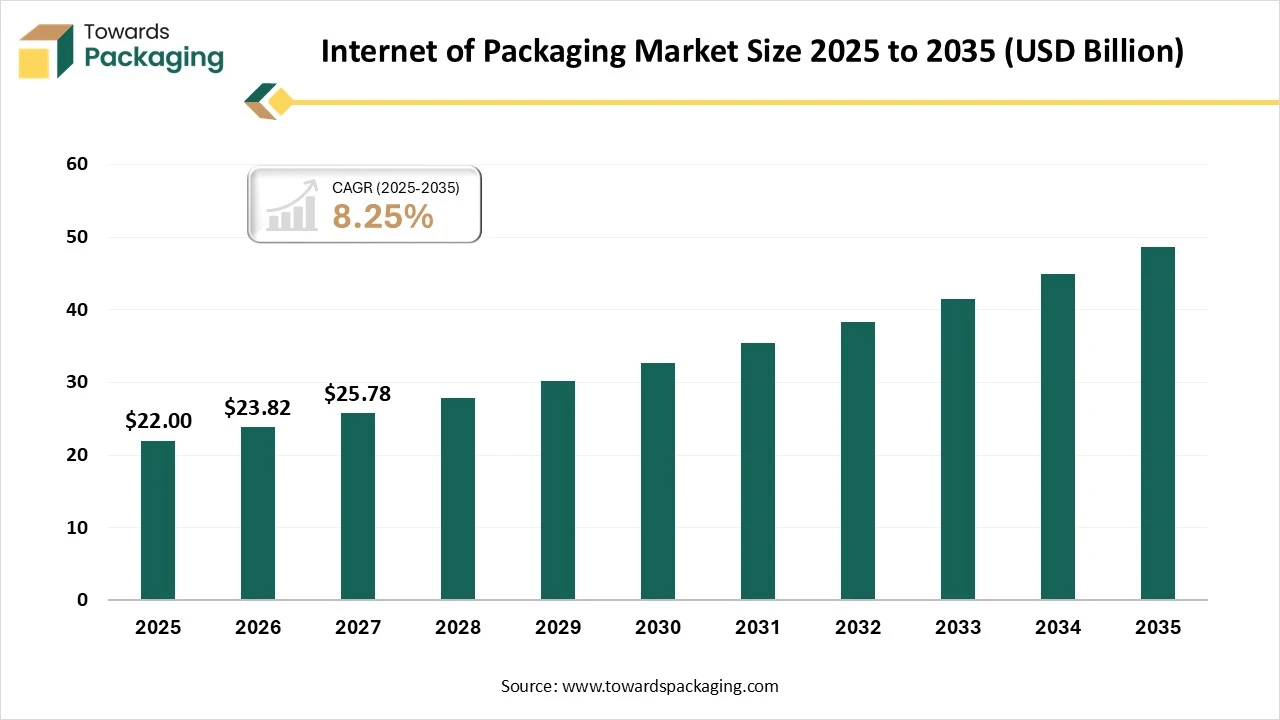
Internet of packaging incorporates digital technology like RFID tags, QR codes, sensors and NFC chips into physical packing, allowing it to interconnect data in actual-time. It changes passive packing into collaborative, traceable possessions, permitting brands to track logistics, confirm product authenticity, improve sustainability, and involve customers straight through smartphones.
Technological transformation in the internet of packaging market plays a significant role by developing sustainable and data-driven ecosystem. Packages now comprise IoT-allowed sensors that help in tracking ecological conditions such as light, temperature, and humidity exposure in actual-time. This is essential for food and pharma logistics to avoid spoilage. RFID and NFC tags offer safe, both-ways communication to validate luxury products and pharmaceuticals, fighting counterfeiting. Indicators that notice pathogens or brightness directly, rather than depending on static termination dates, are decreasing food waste.
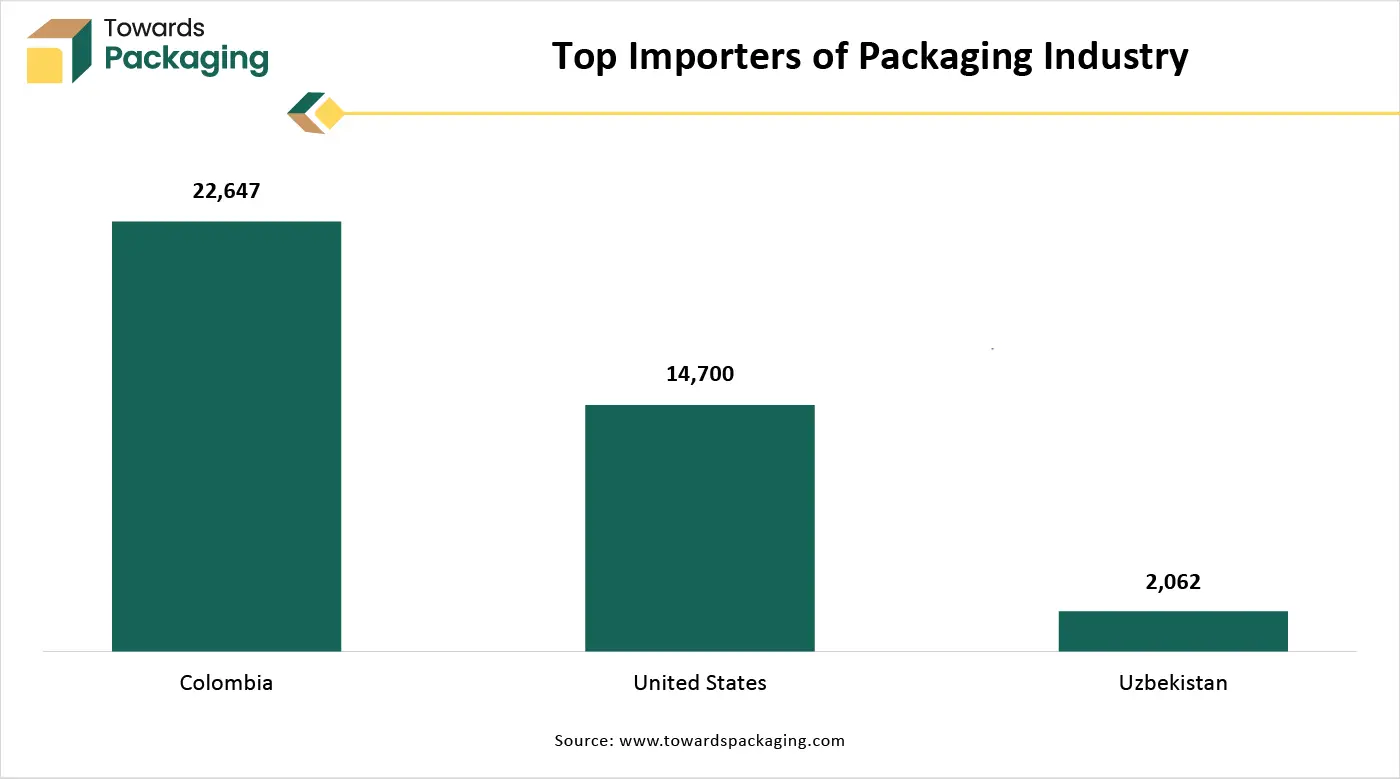
The major raw materials utilized in this market are graphene nanoplatelets or bentonite clay, wood fibers, tinplate, paper, aluminum, paperboard, and several others. It is shifting towards bio-based and sustainable packaging from renewable plant-based polymers.
Key Players: Avery Dennison Corporation, Thinfilm
The component manufacturing in this market comprises NFC and RFID tags, digital and QR codes watermark, embedded microchips, and many others. It influenced by the requirement for supply chain efficacy, better traceability, and customer engagement.
Key Players: Zebra Technologies, THIMM Group
This segment enhances distribution chain visibility, decreases spoilage, and enhances inventory supervision. It upsurges sustainability via streamlines and traceability distribution.
Key Players: GAO Tek Inc., CEVA Logistics
The barcode & QR code segment dominated the market with highest share in 2025 due to its high accessibility and low charges. QR codes are used globally and need no particular apps, allowing immediate access to goods information and promotions. These are utilized to guide customers on recycling performs, supporting, environment-friendly branding exertions. It is widely used to bridge physical products with digital information. These codes are making products look highly attractive to appeal mass-industry FMCG and packaged products.
The low-energy Bluetooth (BLE) segment is expected to grow at the fastest CAGR during the forecast period. This segment is growing due to its excellent power efficacy. This segment is ideal for connected and smart packaging that needs extended life-spans without any maintenance. It provides excellent speed, stretched variety, and better safety which is important for actual-time tracking and ecological sensing. It is extremely operative for smart packaging in manufacturing and retail sector.
The food & beverage segment dominated the market with highest share in 2025 due to supply chain transparency and food safety. Smart packaging help in tracking the freshness of the food products. Rising consumers demand for safe food packaging to maintain the hygiene and convenience has raised the adoption for such packaging. Expansion of e-commerce sector, meal delivery platforms, and ready-to-eat packaged meals demands and packaging which is functional as well as interactive and necessitating intelligent as well as portable packaging options.
The healthcare segment is expected to grow at the fastest CAGR during the forecast period. This segment is growing due to presence of strict guidelines for packaging in this industry. Advanced technologies such as blockchain-anchored and RFID digital IDs are important to fulfil the demand of the consumers. Smart packing with fixed IoT sensors supports in tracking temperature and humidity through the distribution chain that confirm medicine efficiency and patient security. The rapid development of temperature-sensitive vaccines and biologics requires real-time observation that fuels the adoption of such packaging.
North America held the largest share in the market share in 2025, due to rising adoption of advanced technology. It is widely influenced by the expansion of e-commerce sector, an enhanced retail ecosystem, and noteworthy investments. It permits for actual-time tracking, improved inventory supervision, and goods safety in food and pharmacy. A robust drive for product data sustainability influences the usage of smart packing to confirm authenticity, offer interactive practices, and decrease carbon footprints. Huge investments in automation, AI-influenced data analytics, sustainable, smart and environment-friendly packing resources permit for faster growth and acceptance. Increasing smart packaging options to confirm security and efficacy during transportation.
U.S. Internet of Packaging Market Trends
Efficient production process with advanced technology has fuelled the expansion of the market in the U.S. It is majorly influenced due to its traceability facility and rising concern for food safety. These packaging are widely used to track goods authenticity in pharmaceutical and food & beverage sectors. Brands are looking for smart packing to offer customized experiences like connecting customers to digital information through QR codes. Incorporation of sensors, AI, and machine learning for efficient and actual-time monitoring is growing rapidly.
Increasing demand for packaging with RFID and NFC tags for detailed information has fuelled the expansion of the market in Asia Pacific. Growing demand for authenticity proof of the product, majorly in pharmacy and luxury sectors. Along with tech advanced packaging there is a robust push for sustainable packaging is pushing the usage of environment-friendly, biodegradable or recyclable resources that also help in smart functionalities. Huge development of online retail has made effective, smart, and protective packaging important for tracking of high-volume transportation. Robust shift towards interactive packaging has enhanced the adoption of this packaging sector.
China Internet of Packaging Market Trends
Rising digitalization and expansion of e-commerce sector has fuelled the expansion of the market in China. Rapid shift towards lightweight, sustainable, and smart packaging has pushed the demand for this market. Strong packaging policies has influenced brands to adopt such packaging process. Amplified usage of active resources for freshness checking comprising indicators for temperature, oxygen and moisture to improve safety in delivery of food products. Digital printing permits cost-operative, customized, and limited-edition packing options for enhanced brand differentiation. Increasing packaging of luxury products in cosmetic as well as electric industry has pushed advancement in this sector.
Growing demand for traceability and sustainable packaging solution has pushed the innovation process in the market in Europe. Rapid shift towards recyclable as well as detailed information has pushed the advancement of this sector. Presence of NFC tags in the products provide its authenticity proof in the market. Brands are utilizing interactive packaging to involve directly with customers while offering digital experiences and distribution chain clarity. IoT-based packaging for the monitoring of temperature is important for fragile pharmaceutical and food logistics that is confirming product quality during transportation. Development in flexible packaging options that incorporate smart sensors for enhanced sustainability and protection.
Germany Internet of Packaging Market Trends
Increasing personalization in the packaging sector has pushed the innovation process in the market in Germany. Such personalization support in meeting the demand of the consumers as well as establish brand identity. Strict ecological guidelines have enhanced the demand for incorporation of smart technology. Progressive digital identifiers are progressively embedding into high-worth product packing to confirm authenticity. Businesses are accepting connected packing to monitor goods in actual-time that is emphasizing on tamper evidence and freshness at the time of transportation. Strong development is observed in AI-influenced smart packaging to fulfil high regulatory as well as e-commerce standards. Development in sensor packaging technology is permitting for smart tracking of temperature to ensure the protection of products’ integrity.
By Technology
By End Use
By Region




Principal Research Analyst
Vidyesh Swar is a Senior Research Analyst at Towards Packaging, bringing over 4 years of dedicated expertise in market intelligence and strategic analysis across the dynamic world of packaging technologies and solutions.
Learn more about Vidyesh Swar

Reviewed By
Aditi Shivarkar, with 14+ years in packaging market research, specializes in food, beverage, and eco-friendly packaging. She ensures accurate, actionable insights, driving Towards Packaging Analytics & Consulting 's excellence in industry trends and sustainability.
Learn more about Aditi Shivarkar


Internet of Packaging Market
 Table of Content
 sales@towardspackaging.com
 +1 804-441-9344
 Download Sample
 Schedule a Meeting