


The metal-free pump market is projected to grow from USD 2.33 billion in 2026 to USD 4.25 billion by 2035, registering a CAGR of 6.9% during the forecast period. The report provides a comprehensive evaluation of market size along with detailed segment data by product type, material, and end-use industries. It offers in-depth regional analysis across key geographies, along with insights into leading companies, competitive benchmarking, and strategic developments. Additionally, the study includes value chain analysis, trade flow data, and detailed profiling of manufacturers and suppliers, highlighting the growing demand driven by corrosion resistance, contamination-free operations, and sustainability advancements.
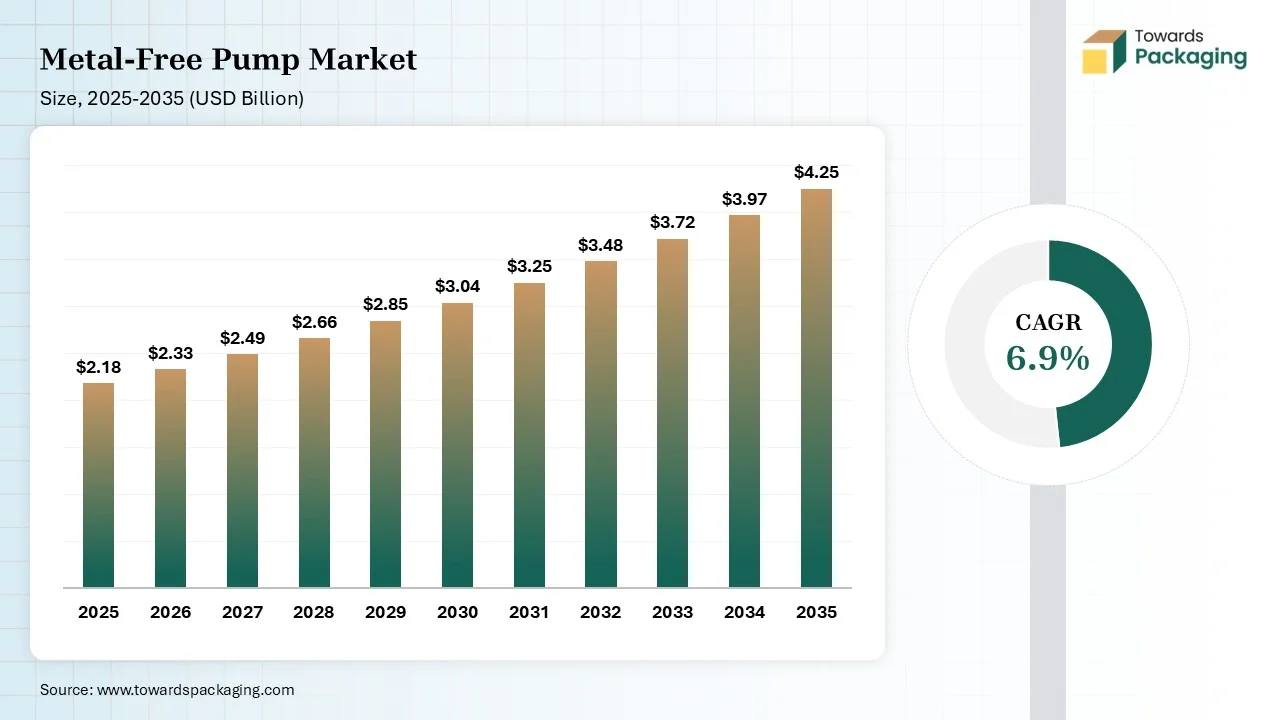
Market Size (2025): USD 2.18 Billion
CAGR (2025–2035): 6.9%
Market Volume (2025): 5.72 billion Units
Volume CAGR (2025–2035): 6.2%
Metal-free pumps are high-performance dispensing pumps that have a metal-free path for updated formula reliability across a huge variety of formulas, including high-viscosity and water-based formulas. The spring outside has an invisible and dosage chamber because of the retainer. It is an underscore locking system that has counterclockwise and clockwise opening, which enables it to be packed in open and closed positions.
The technological growth in metal-free pumps is the penetration of airless paint sprayer pump technology, which points to the mechanical machine that gives pressure and shifts the coating material from the supply link with the assistance of the sprayer and out of the spray tip without any application of compressed air. Instead of segmenting material with air, the pump forces the coatings with the assistance of a small opening at high pressure, which makes a constant spray design. Such technology enables airless paint sprayers to manage a huge series of materials, which includes high-solids coatings and high-viscosity materials, while managing constant coverage and effective materials shifting. The pump makes enough pressure, that tracks a constant flow and firmly stands with continuous working in urgent surroundings.
Package Design and Prototyping: Actuators are designed to align with the motion of the hand. A push-button actuator or a palm actuator makes it convenient to press. We frequently seek a bottle that has thread sizes like GCMI 20/410 or a 24/410/. Other details, such as a lockable bottom or top, can assist in storing the product safely. An accurate collar and housing protect against leaks. Such features develop both performance and comfort over time.
Recycling and Waste Management: The metal-free pump design assists sustainability goals in two different ways, as proximate checking lowers product waste, and the industry is shifting quickly towards mono-material PP (polypropylene), which matches with EU recyclability needs under the Packaging and Packaging Waste Regulation (PPWR). Airless bottles are also accessible with post-consumer recycled (PCR) content.
Logistics and Distribution: Distribution pumps are crafted particularly for a huge array of heavy liquids, which are utilized in the semiconductor industries, including highly pure and corrosive chemicals and slurries. Boiswood delivers timely-examined operating Furon A2 pumps that have 1005 metal-free and coring-free pollutants that avoid any capable ionic pollutants caused by corrosive chemicals to such elements, which serve end users.
The polypropylene (PP) segment dominated the market with 38% share in 2025 as they are the most widely used material for pump working, internal piston, and several other bodies. PP serves perfect chemical resistance, is highly recyclable, and is lightweight in nature. They are reliable with most pharmaceutical and cosmetic formulations. They are made of crystal-clear plastic that uses glass. PETG (polyethylene terephthalate glycol) is appreciated for luxury skincare packaging when transparency is needed to display the product texture or color.
The polyethylene (PE) segment held the 24% market share in 2025 because this is a cutting-edge product that comes from international discovery under the planning of marketing sustainable packaging. The pump accepts a plastic-element design spring, in which the spring hole can be utilized as the ingredient channel to substitute the stainless-steel spring, which conveniently updates the design of the pump and saves space. Every part of the pump is created by PE material that can be aligned with PE tubes, as PE film for packaging, and PE bottles.
The polyoxymethylene (POM) segment held the 14% market share in 2025, also known as polyacetal, which is a high-performance engineering thermoplastic. It develops perfect high strength, ideal dimensional stability, and power. Such elements make POM a preferred choice for technical use, from electrical engineering to the automotive sector. Though they are semic-crystalline in nature, POM stays exceptionally chemically stable and delivers high-quality sliding and abrasion characteristics, which makes them perfect for accuracy-urging elements.
The lotion pumps segment dominated the market with 34% share in 2025 because they are one of the most prevalently used dispensing machines in the cosmetic sector. They include many parts which count the actuator, dip tube, and chamber, that operate together to push the product inside the dispenser and container at a managed price. Such systems are crafted to track constant and smooth functionality, even with various product viscosities. For a thicker cream, the pump should make enough force to shift the product through a system without hampering or adjusting results.
The spray pumps segment held the 26% market share in 2025, as airless spray painting is a procedure that uses high pressure to granulate paint without depending on adjusted air. Instead of integrating paint with air that is regular or HVLP sprayers, an airless system encourages the paint with the assistance of a small nozzle at high pressure, specifically between 1500 and 3000 PSI. The outcome is a little mixture of paint particles, which creates an even smooth coating on any layer.
The foam pumps segment held the 12% market share in 2025 because they are non-aerosol dispensing machines that shift liquid formulations into foam with the assistance of a smart mixture of liquid, air, and physical filtration. Like traditional pumps, which get released directly, foam pumps generate both air and liquids, as a mix inside a chamber pushes the overall mixture with a fine mixture to make pre-lathered foam. Such dual-working mechanisms enable accurate mixing and constant foam output.
The personal care & cosmetics segment dominated the market with 42% share in 2025 because airless plastic cosmetic bottles store products fresh for a longer time. The vacuum-dependent working and an airtight container totally block air from penetrating. This avoids oxidation and assists active ingredients such as vitamin C serums, which remain effective. An airless pump dispenser serves the exact amount each time. This delivers users an ideal control and avoids spoiling. Airless packaging is available in several designs, such as airless tubes, airless bottles, and child-resistant airless bottles.
The household products segment held the 22% market share in 2025. As metal-free pumps are quickly receiving attention in the household industry, users and producers are giving importance to chemical safety, longevity, and sustainability. They are tailored devices created from designed polymers and plastics instead of regular metals. Lotions, hand soaps, and skincare bottles use metal-free and airless PP (polypropylene) pumps. Regular dispensers have a small internal metal spring that can conveniently react with a product over a period of time.
The pharmaceuticals segment held the 14% market share in 2025 because a vacuum pump in this industry is quite crucial as it can manage everything from crystallization to devitalization and even sterilization. It ensures precision, quality, and security within all manufacturing stages, which ensures products align with the highest quality standards. In this industry, oil-covered vacuum pumps are initially used in strong and non-sterile bulk intermediate and chemical stages.
Screw closure segment dominated the market with 52% share in 2025 as they are prevalently known as screw cap, as cap which screws onto the threads are present on the neck of the container, making a strong and relevant seal. Such a closure is perfect for a multitude of uses, right from personal care products to food and beverages. PP screw caps are created from polypropylene, which is a reliable plastic that offers exceptional resistance to fatigue, making them perfect for containers that are opened often.
Snap-on closure segment held the 30% market share in 2025 because snap-on vials are a kind of pharmaceutical container that are crafted for the protective transport and storage of vaccines, liquid medications, and other substances. They are crafted for application in labs and clinical settings, as well as home healthcare. One of the uses in daily life is the actual nasal spray. The word ‘snap-on” points to the procedure by which the vial closure or a cap is being attracted. Snap-on vials are complicated elements in the pharmaceutical initial packaging supply chain, which ensure that various types of drugs are securely being served from the producer to the end-user.
The crimp closure segment held the 18% market share in 2025, as these are aluminum seals that are used to fix elastomeric stoppers onto an injection vial. Their crucial function is to protect the stopper in place, which ensures container closure of integrity (CCI) and tracks the sterility of the drug item. Crimp caps are crafted to ensure compatibility with an injectable vial system and to withstand the physical and chemical stress of pharmaceutical processing.
The 28/410 segment dominated the market with 38% share in 2025 as dispenser pumps are designed to fit this size neck bottle, which are commonly used across industries like home care, personal care, pharmaceutical, and cosmetic industries. The soft actuator and the ribbed closure deliver a protective grip and smooth operation that uses a huge range of liquid viscosities.
The 24/410 segment held the 26% market share in 2025. It is one of the most prevalent sizes, which is used for hair products, body lotions, and complete-size skincare. A pump has its spring mechanisms kept outside the product journey, which lowers the metal contact with a formula/ This is perfect for acids, serums, or formulations that react with metal.
20/410 segment held the 18% market share in 2025, as they are a little bit bigger in size, which is perfect for liquid soaps or facial creams. They are being designed with no dip tube; airless pumps use a vacuum system to encourage the product in an upward direction. They are ideal for sensitive or natural formulas that demand protection from contamination and air.
The OEM (Brand Owners) segment dominated the market with 48% share in 2025 because they substitute elements mainly in terms of luxury engineering and professional quality, as they ensure optimal smoothness of the equipment. Additionally, OEM designs the main parts which are designed accurately as per the machine specifications, as the risk of machine failure and lower manufacturing results is unavoidable. Thus, OEM guarantees its current results.
The contract manufacturers segment held 32% market share in 2025 because this service frequently depends on an airless pump to align with the various demands of their respective clients. Such jars are versatile in nature and can be utilized for various products, such as serums, creams, and lotions. Due to the annual manufacturing capacity of over 60 million pieces and a minimum order quantity (MOQ) of 10,000 pieces, producers can smoothly generate big volumes while using smaller batch sizes for main markets.
The direct sales (B2B) segment dominated the market with 55% share in 2025 because one of the highlighted characteristics of airless treatment pumps is their potential to serve accurate and managed dispensing. This ensures that users can utilize the pump bottle for the precise dosage of product they want, which lowers waste and extends the life of skincare products. For manufacturers, such accuracy can be helpful in managing consistency in product application, user satisfaction, and brand commitment.
Distributors/Wholesalers segment held the 30% market share in 2025 as they deliver metal-free pumps, which are cost-effective, bulk buying, supply chain assistance, and important inventory management for producers and brands that are specifically present in the pharmaceutical and beauty industry. They expedite availability to such high-end packaging applications for small-to-medium enterprises that cannot align with high and low order quantities (MOQ) set by producers.
Asia Pacific dominated the market with 32% share in 2025 and is expected to have the fastest growth in the market with 8.10% CAGR during the forecast period. This region has topped the worldwide metal-free pump industry in both growth and volume, which is being driven by large-scale production in India and China, as they are growing in terms of personal care consumption and growing industrial automation. The region benefits from cost-competitive manufacturing and a quickly developing middle class that urges luxury packaging.
India Metal-Free Pump Market Trends:
The metal-free pump market in India is experiencing steady growth driven by increasing demand from industries such as chemicals, pharmaceuticals, and water treatment, where corrosion resistance and contamination-free fluid handling are essential. Rising environmental regulations and stricter safety standards are encouraging industries to adopt non-metallic solutions. Rapid industrialization, expansion of manufacturing facilities, and investments in wastewater management are further supporting market expansion.
North America held the 26% market share in 2025 because this region is being driven by the development of the luxury skincare industry and strong zero-waste choices. It carries a huge space of the worldwide airless packaging sector. Furthermore, users are excessively urging organic and natural products that lower chemical preservatives. Due to airless pumps, which restrict air exposure and protect oxidation, are necessary for expanding the shelf life of such fragile formulations.
United States Metal-Free Pump Market Trends:
The United States metal-free pump industry is meant for crucial development over the next 5-10 years, which is driven by growing user demand, assistive regulatory frameworks, and technological developments. Growing acceptance of cutting-edge solutions and moving user choices are predicted to develop the market size that displays the quickest growth. Supply-side potentials, which count distribution links and manufacturing reliability, allow brands to align with rising demand effectively.
Europe is expected to grow at a considerable CAGR in the upcoming period, due to strict sustainability regulations, growing demand for recyclable packaging, and rapid expansion of premium cosmetics, pharmaceuticals, and personal care industries. Conventional spring-based dispensers are being replaced with metal-free pumps because they improve recyclability, reduce contamination risks, and support mono-material packaging systems aligned with Europe’s circular economy goals.
Germany Market Trends
Germany has strong packaging engineering capabilities, an advanced recycling infrastructure, and leadership in sustainable packaging innovation. German cosmetic and pharmaceutical companies are rapidly adopting mono-material pump systems to comply with the EU Packaging and Packaging Waste Regulation (PPWR). Germany is becoming a major manufacturing hub for recyclable dispensing technologies and precision pump systems.
Latin America is considered to be a significantly growing area, due to sustainability awareness, premium beauty consumption, and recyclable packaging adoption continuing to expand across the cosmetics and personal care industries. The region’s growing skincare, beauty, pharmaceutical, and personal care sectors are creating strong demand for recyclable airless dispensers, PP-based pumps, and sustainable dispensing technologies. Rising e-commerce activity and premiumization trends in cosmetics are encouraging brands to invest in the market.
Brazil Market Trends
Brazil dominates the regional market due to its position as the region’s largest beauty and personal care market. The country has a massive cosmetics consumer base, supported by rising middle-class spending and strong demand for skincare, haircare, and premium beauty products. Major packaging manufacturers are expanding local production capabilities to improve supply chain efficiency and support regional beauty brands.
The Middle East and Africa region is expected to grow at a considerable CAGR in the upcoming period. Rising environmental awareness, increasing demand for recyclable packaging, and the rapid growth of premium skincare and beauty products are encouraging brands to shift toward mono-material and fully recyclable dispensing systems.
Saudi Arabia Market Trends
Saudi Arabia is emerging gradually in the metal-free pump market of the region due to the country’s rapidly expanding beauty, personal care, and pharmaceutical sectors. The country’s increasing focus on sustainable consumer products and the rising popularity of refillable beauty packaging are supporting the adoption of metal-free and airless pump systems.
By Material Type:
By Pump Type:
By Application
By Closure Type
By Neck Size
By End-User
By Distribution Channel
By Regions



Research & Advisory Analyst
Yogesh Kulkarni is an experienced Research Analyst specializing in the packaging sector, with a strong foundation in statistical analysis and market intelligence. He currently contributes his expertise to Towards Packaging.
Learn more about Yogesh Kulkarni

Reviewed By
Aditi Shivarkar, with 14+ years in packaging market research, specializes in food, beverage, and eco-friendly packaging. She ensures accurate, actionable insights, driving Towards Packaging Analytics & Consulting 's excellence in industry trends and sustainability.
Learn more about Aditi Shivarkar

Metal-Free Pump Market
 Table of Content
 sales@towardspackaging.com
 +1 804-441-9344
 Download Sample
 Schedule a Meeting