


The high-tech airless packaging market is projected to grow from USD 6.93 billion in 2026 to USD 13.73 billion by 2035, registering a CAGR of 7.9% during the forecast period. This report delivers a comprehensive analysis of market size along with detailed segment data by material type, product type, and application. It further provides in-depth regional insights across North America, Europe, Asia-Pacific, Latin America, and the Middle East & Africa. Additionally, the study includes extensive company profiles, competitive landscape analysis, value chain assessment, trade data, and detailed insights on manufacturers and suppliers shaping the market.
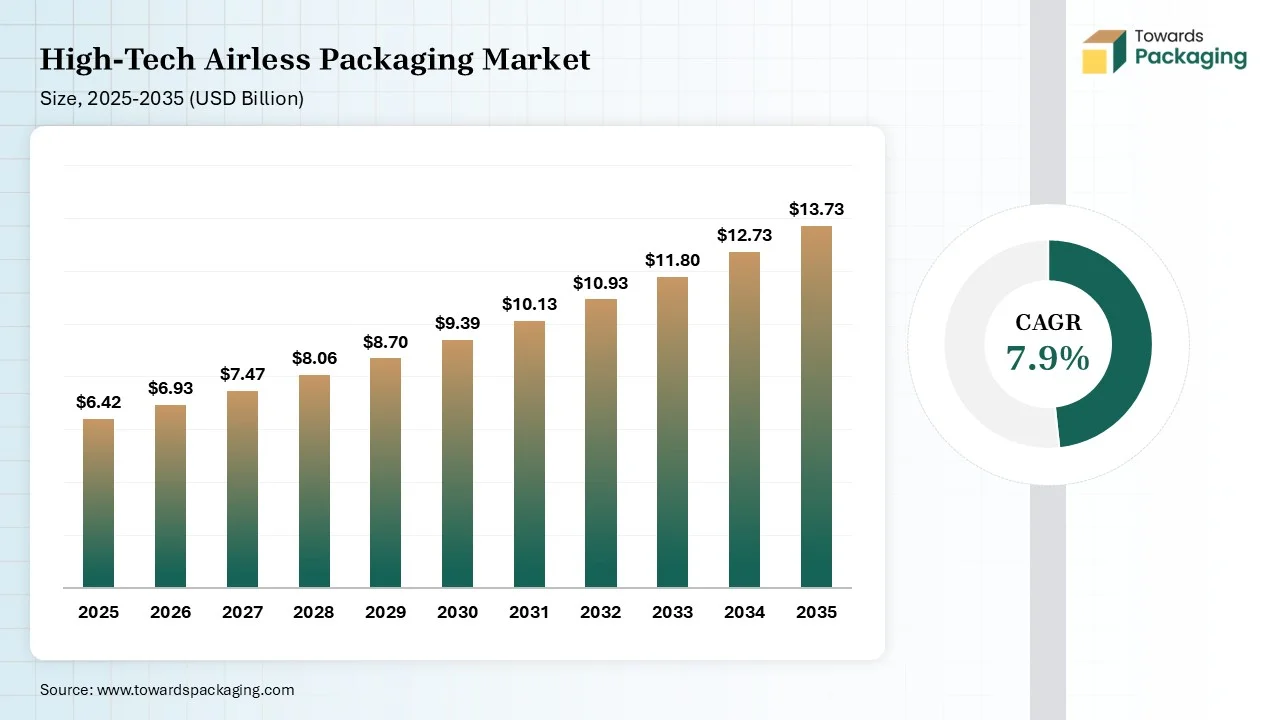
Market Size (2025): USD 6.42 Billion
CAGR (2025–2035): 7.9%
Market Volume (2025): 18.6 Billion Units
Volume CAGR (2025–2035): 6.8%
High-tech airless packaging is an advanced dispensing process for creams and liquids that eliminates the requirement for air to contact the item, avoiding oxidation, pollution, and premature deprivation. Unlike conventional pump bottles that utilize a "dip tube" (straw) and permit air to re-enter the bottle, airless equipment utilizes a vacuum mechanism normally an increasing piston or a folding bag that forces the items upward and out.
Technological transformation in the high-tech airless packaging market plays a significant role in the development of premium packaging, advanced sustainability, and smart digital packaging. The rapid advancement in the barrier technology has raised the adoption of these packaging. Advancement in the manufacturing process has reduced error chances and boost the reliability on this industry. The integration of smart and digital technology has supported in the reduction of waste generation while manufacturing.
The major raw materials utilised in this market are polypropylene, polyethylene terephthalate, aluminum, polyethylene, glass, and acrylic. These materials are used for the manufacturing of high-quality packaging.
The component manufacturing in this market comprises piston, eco-lock technology, dual chamber airless, metal-free pumps, collapsing bags, and smart packaging components. These are useful in the production of packaging that meet the evolving demand of the consumers.
This segment ensures smooth e-commerce shipping and reduces waste production. It plays an essential role in meeting the demand of the consumers.
The Plastic Segment Dominated The Market With 68% Share In 2025
The plastic segment dominated the market with 68% share in 2025. Due to its lightweight nature, cost-effectiveness, and versatility. The increasing concern towards logistics charges these materials as a lightweight packaging option is adopted significantly. Brands favour this material due to its high flexibility and compatibility with airless systems.
The glass segment held the 22% market share in 2025. Due to the increasing demand for premium and luxurious packaging of products. These materials offer chemical stability that is considered ideal for storage of products. Consumers consider these glass packaging as sustainable and safe packaging options for sensitive products.
The metal segment held the 10% market share in 2025. Due to its superior barrier properties companies are inclining towards this material. The increasing demand in the cosmetic and pharmaceutical industries has fuelled the adoption of this material. The rising sustainable guidelines has raised the demand for this segment.
The bottles segment dominated the market with 34% share in 2025. Due to the ease of dispensing brands are adopting bottles packaging more. Its design improves the shelf life of the products and decrease contamination charges. These bottles packaging have high compatibility with pumps that has driven its adoption.
The dispensers segment held the 22% market share in 2025. Due to continuous innovation in pumps and sprayers packaging has improved precision and user experience. The huge demand for high-performance dispensing systems boosts segment expansion. Advancement of smart dispensing technologies further accelerate the growth of this segment.
The tubes segment held the 16% market share in 2025. Due to the rising demand for travel-friendly packaging formats. Major brands prefer tubes for controlled dosing and reduced waste. With the increasing cosmetics miniaturization trends the demand for this segment has grown rapidly.
The jars segment held the 14% market share in 2025. Due to the rising need for controlled dispensing packaging. The premium product positioning supports the growth of the demand. The increasing concerns towards hygiene boost the usage of jars.
The bags & pouches segment held the 14% market share in 2025. Due to the increasing demand for lightweight and refillable pouch systems that reduce ecological footprint. The major brands adopt pouches for cost effective and bulk applications. The growth of this segment aligns with sustainability trends.
The standard airless systems segment dominated the market with 38% share in 2025. Due to the rising demand for cost-effectiveness and simplicity in packaging sector. These are considered as suitable option for mass-market cosmetics and pharmaceuticals. The presence of strong manufacturing base supports widespread usage.
The bag-in-bottle technology segment held the 26% market share in 2025. Due to its capacity of excellent product protection and minimal air exposure. Major brands leverage this technology for sensitive formulations. The increasing demand for contamination-free packaging drives growth.
The piston-based airless systems segment held the 21% market share in 2025. Due to its consistent product dispensing capacity and minimal residue. These are highly preferred in premium skincare applications. The rapid technological improvements enhance efficiency and raise the demand of the segment.
The vacuum-based systems segment held the 15% market share in 2025. Due to the advancement of vacuum systems that maximize product evacuation and shelf life. The increasing adoption in high-value pharmaceuticals and luxury cosmetics has raised the demand for this segment. The rapid innovation drives huge market penetration.
The cosmetics & personal care segment dominated the market with 52% share in 2025. Due to the rising demand for anti-aging and organic skincare products. Major brands are focusing on airless packaging for product integrity. The rising consumer preference for premium packaging fuels growth of this segment.
The pharmaceuticals segment held the 28% market share in 2025. Due to the rising concern for safety and shelf life of topical drugs. The presence of strict regulatory compliance boosts demand of this sector. The growth in dermatology products accelerates adoption of this segment.
The food & beverages segment held the 12% market share in 2025. Due to the rising niche applications such as sauces and functional foods. The presence of airless systems reduce contamination and extend shelf life. The growth of this segment remains moderate due to cost constraints.
The others segment held the 8% market share in 2025. Due to the increasing industrial and specialty applications. The increasing specific use cases requiring contamination control that pushed the demand for this sector. Limited scalability restricts pushed the growth of this sector.
The direct Sales (B2B) segment dominated the market with 55% share in 2025. Due to the presence of large manufacturers that prefer direct procurement for customization and cost control. The presence of strong supplier relationships that drive volume sales. The bulk purchasing has supported its dominance.
The distributors & wholesalers segment held the 30% market share in 2025. Due to SMEs rely on distributors for accessibility and lower order volumes. It supports in establishing networks ensure steady supply. The growth of this segment is supported by regional expansion.
The online retail segment held the 15% market share in 2025. Due to the presence of digital platforms that enable small brands to access packaging solutions easily. The rising e-commerce sector supports direct-to-brand sales. The increasing digitalization accelerates the adoption of this segment.
The 50–100 ml segment dominated the market with 32% share in 2025. Due to the increasing skincare products packaging demand. These are considered as ideal for regular-use cosmetics and pharmaceuticals. It offers balanced cost and usability that drive the dominance.
The below 50 ml segment held the 26% market share in 2025. Due to the increasing demand for travel-size and sample packaging gain popularity among consumers. Major brands use small formats for premium product trials. The growth of this segment is majorly driven by miniaturization trends.
The 100–200 ml segment held the 24% market share in 2025. Due to the rising usage for medium-volume personal care products. Major brands focus on value packs which raise the demand for this segment. The stable demand for this segment supports the growth.
The above 200 ml segment held the 18% market share in 2025. Due to the increasing bulk packaging of products. The limited usage in airless systems due to cost factors. The rising adoption occurs for specialized applications.
Asia Pacific dominated the high-tech airless packaging market with 32% share in 2025 and expects the fastest growth in the market with 9.10% CAGR during the forecast period. Due to the rapid adoption in the cosmetics and pharmaceutical industries drives the demand. The rising disposable earning boosts the premium packaging demand among consumers. The presence manufacturing infrastructure accelerates the supply.
China High-Tech Airless Packaging Market Trends
The increasing demand for recyclable and premium packaging has fuelled the expansion of the market in China. The increasing demand for refillable system has raised the demand for this packaging sector. The rising demand for smart packaging has fuelled the innovation process in this industry. The unique designs and premiumization packaging have raised the demand for this industry.
North America held the 28% market share in 2025. The presence of strong demand for packaging of premium cosmetic brands raises the production. The rising consumer awareness supports adoption of advanced packaging. The rapid innovation in the ecosystem fuels the growth of this industry.
The U.S. High-Tech Airless Packaging Market Trends
The increasing adoption of recyclable materials has fuelled the expansion of the market in the U.S. The increasing demand for sustainable and eco-friendly packaging has raised the demand for this industry. The rapid expansion of pharmaceutical sector has raised the demand for this industry. The presence of major market players promotes rapid innovation in this sector which has raised its expansion.
By Material Type
By Product Type
By Technology
By Application
By Distribution Channel
By Capacity
By Regions



Research & Advisory Analyst
Yogesh Kulkarni is an experienced Research Analyst specializing in the packaging sector, with a strong foundation in statistical analysis and market intelligence. He currently contributes his expertise to Towards Packaging.
Learn more about Yogesh Kulkarni

Reviewed By
Aditi Shivarkar, with 14+ years in packaging market research, specializes in food, beverage, and eco-friendly packaging. She ensures accurate, actionable insights, driving Towards Packaging Analytics & Consulting 's excellence in industry trends and sustainability.
Learn more about Aditi Shivarkar

High-Tech Airless Packaging Market
 Table of Content
 sales@towardspackaging.com
 +1 804-441-9344
 Download Sample
 Schedule a Meeting