


The lightweight packaging market is accelerating, with forecasts predicting hundreds of millions in revenue growth between 2026 and 2035 powering sustainable infrastructure globally.
The lightweight packaging market is projected to witness considerable progress in the future. Lightweight packaging has gained popularity in the packaging sector due to its numerous financial and environmental benefits. Any material intended to minimize the weight without compromising strength, durability and protective properties is considered lightweight packing.
It can be utilized in consumer products packaging, shipping containers, and packaging for food and drink. Organizations may substantially reduce the weight of their packaging by implementing a variety of strategies with the utilization of lightweight materials.
EPP and EPS are very lightweight packaging materials as they are composed of 98% air and 2% substance. They are 62% lighter than other polymers and 82% lighter than wood. They additionally provide a number of unique packaging qualities such as exceptional thermal insulation and shock absorption capabilities. PET is another lightweight, sustainable material that is frequently used for food and drink packaging. It is easily recyclable, clear, and long-lasting. Lightweight packaging provides sustainability, cost-efficiency and convenience for industries such as food and beverages, healthcare, personal care, e-commerce, and more.
The rising demand for sustainable and eco-friendly packaging along with the rapid growth of the e-commerce sector is expected to augment the growth of the lightweight packaging market during the forecast period. Furthermore, technological advancements in material science such as bio-based plastics and advanced polymer blends as well as increased investments in the recyclable and compostable materials are also anticipated to augment the growth of the market.
Additionally, the growing consumer preference for convenience and portability coupled with the rising focus on reducing the transportation costs and the expansion of the food and beverage industry are also projected to contribute to the growth of the market in the near future.
The growing demand for sustainability due to the increasing awareness of climate change, pollution and resource depletion as well as introduction of stringent measures by governments and regulatory bodies worldwide is anticipated to augment the growth of the lightweight packaging market during the forecast period. Approximately 430 million tons of plastic are manufactured worldwide each year, of which 42% is packaging waste and two thirds is discarded after a short period of use.
This considerable contribution to the global plastic waste demonstrates the importance of transitioning to the sustainable packaging alternatives such as lightweight materials, to reduce environmental impact. Sustainable packaging signifies safer packaging, posing no harm to human health. Lightweight packaging focuses on these issues by reducing the quantity of materials required, minimizing waste production and improving recycling operations.
Consumers are also choosing packaging based on its sustainability credentials, and fewer are likely to buy products they consider environmentally harmful. According to the Buying Green Report 2023 by Trivium Packaging, seventy-nine percent of the buyers prefer products that are packed sustainably. This is specifically evident for the younger generations and those who earn more than the norm. Almost 76-77% of the survey participants in the Gen Z and Millennials choose to purchase products in sustainable packaging, which is 7% more than the average.
This indicates that both the categories have a considerable inclination towards sustainable packaging. Additionally, lightweight packaging also reduces transportation emissions and further contributes to the environment conservation. Brands are using this trend to improve their corporate social responsibility (CSR) reputations and attract an increasing percentage of sustainable-minded consumers. As sustainability becomes a priority across industries, the adoption of the lightweight packaging is expected to grow substantially during the forecast period.
The complexity in durability, costs, and regulatory compliance is expected to impede the growth of the lightweight packaging market within the estimated timeframe. The packaging of the product may appear sturdy when packed in environmentally friendly, lightweight packaging. Products, however, might be kept on store shelves and in the warehouses for a long time. Over time, the packaging could start to degrade. When it comes to packaging that customers will refill and reuse after usage, durability is important.
Customers may stop trusting a brand if it advertises that its packaging is reusable but breaks down after multiple uses. Furthermore, organizations may resist using such packaging techniques due to cost restrictions. They must think about using different kinds of sustainable materials in place of the packaging methods they currently implement. This change could result in higher labor, packaging as well as production costs. Smaller enterprises, in specific, may find these investments unaffordable.
Additionally, the regulatory compliance adds another layer of complexity. Many regions have introduced stringent laws that mandate recyclability as part of packaging. It's possible that organizations will have a shorter period to implement sustainable packaging practices. Regulations requiring organizations and packaging manufacturers to provide recyclable or compostable packaging have been introduced or passed in the US as well as various nations. The United Kingdom and California are two particular areas having similar regulations. These combined issues indicate the need for balanced, economical options that meet durability, affordability, and compliance requirements without compromising sustainability goals.
The circular economy initiatives are expected to create substantial opportunity for the lightweight packaging market in the years to come. Such initiatives not only reduce waste but also set benchmarks for replicating similar models across industries and regions, spurring demand for lightweight, recyclable materials. For instance
The funds will assist Licella in moving on with the development of one of Australia's first innovative recycling facilities. Licella will recycle end-of-life plastic using its revolutionary Catalytic Hydrothermal Reactor (Cat-HTRTM) technology, turning it into a crude oil replacement that can be used to create new food-grade plastic packaging.
These hubs will speed-up the global use of lightweight materials by demonstrating increased recycled content, improved recyclability and waste reduction. These efforts collectively position the lightweight packaging market as an important player in achieving global sustainability targets, driving development, innovation, and future potential.
The application of artificial intelligence (AI) has already transformed the lightweight packaging market. Companies in the market are deploying AI-powered solutions that are helping them to optimize packaging design, analyze material performance, reduce waste and provide cost-effectiveness. For instance
Throughout the waste value chain, the information given to producers, waste management, and regulators makes sorting, recycling, and reporting easier. Greyparrot can correctly differentiate between a variety of categories, such as regular PET bottles, non-food grade and food grade materials, colorful and black plastics, various high-density PE types, and a number of standard flexible film types.
AI has revolutionized the lightweight packaging market primarily by merging advanced analytics, material science and automation to achieve a balance between functionality, environmental responsibility as well as economic achievability.
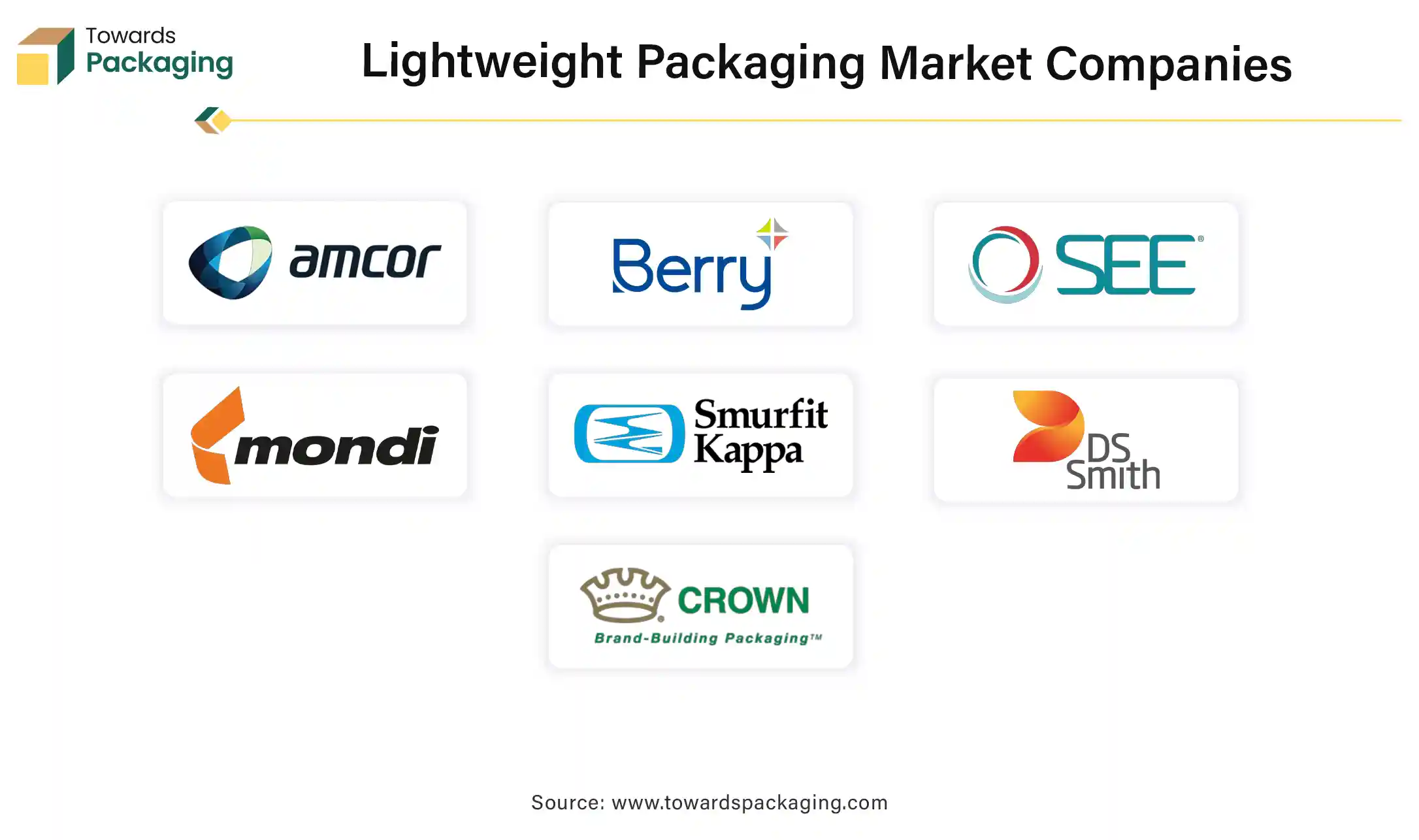
| Rank | Company | Headquarters | Country | Why Relevant to This Packaging Market | Key Packaging Products/Services |
| 1 | Amcor | Zürich | Switzerland | Global leader in lightweight flexible and rigid packaging with extensive sustainable packaging innovations | Flexible packaging, lightweight PET packaging, recyclable packaging |
| 2 | Berry Global | Evansville, Indiana | USA | Major supplier of lightweight rigid plastics, closures, and flexible packaging | Lightweight plastic containers, closures, films |
| 3 | Mondi | Weybridge, England | United Kingdom | Global leader in lightweight fiber-based and flexible packaging solutions | Paper packaging, flexible packaging, lightweight laminates |
| 4 | Sealed Air | Charlotte, North Carolina | USA | Pioneer in lightweight protective packaging and material-efficient packaging systems | Protective packaging, lightweight films, cushioning solutions |
| 5 | Smurfit Westrock | Dublin | Ireland | Global supplier of lightweight corrugated and paper-based packaging optimized for sustainability | Corrugated packaging, paperboard packaging |
| Rank | Company | Headquarters | Country | Why Relevant to This Packaging Market | Key Packaging Products/Services |
| 1 | Sonoco Products Company | Hartsville, South Carolina | USA | Develops lightweight composite cans, flexible packaging, and protective packaging | Composite containers, flexible packaging |
| 2 | Huhtamaki | Espoo | Finland | Manufactures lightweight foodservice and fiber-based packaging | Fiber packaging, food packaging |
| 3 | SIG | Neuhausen am Rheinfall | Switzerland | Provides lightweight aseptic beverage cartons and filling systems | Beverage cartons |
| 4 | Ball Corporation | Westminster, Colorado | USA | Leader in lightweight aluminum beverage can technologies | Beverage cans, aluminum packaging |
| 5 | O-I Glass | Perrysburg, Ohio | USA | Develops lightweight glass bottles and containers for beverage and food applications | Lightweight glass containers |
| Rank | Company | Headquarters | Country | Why Relevant to This Packaging Market | Key Packaging Products/Services |
| 1 | Billerud | Solna | Sweden | Develops lightweight packaging paper and high-strength fiber materials | Packaging paper, kraft paper |
| 2 | Metsä Board | Espoo | Finland | Produces lightweight premium paperboard with high strength-to-weight ratio | Folding boxboard, white kraftliner |
| 3 | Stora Enso | Helsinki | Finland | Invests in renewable lightweight fiber packaging solutions | Renewable packaging materials |
| 4 | Constantia Flexibles | Vienna | Austria | Develops downgauged flexible packaging structures for food and pharmaceutical markets | Flexible laminates, barrier packaging |
| 5 | Coveris | Vienna | Austria | Focuses on lightweight recyclable flexible packaging for consumer goods | Flexible films, recyclable packaging |
The plastic segment held largest market share in 2023. Plastic can be just as durable as steel. From expensive gadgets to perishable foods, this durability shields the product from all the damage that comes with manufacturing and delivery. Plastic packaging guarantees that the product will appear brand new when it is delivered to customers' homes or displayed on store shelves.
Further, plastics emit a lower carbon footprint since they are lightweight, take up a smaller space than other materials, and are useful for transportation. Additionally, as plastics are one of the most regulated packaging materials on the market, their safe usage is guaranteed, and they deliver the best way to preserve the safety of the food that comes into touch with them. These factors are likely to support the segmental growth of the market during the forecast period.
The food and beverage segment held largest market share in 2023. This is due to the growing global population and increasing urbanization across the globe. Furthermore, the growing demand for ready-to-eat meals, on-the-go snacks as well as premium beverages is also anticipated to promote the growth of the segment.
Also, the growing food delivery services are further expected to contribute to the segmental growth of the market during the forecast period. Additionally, the growing focus on health has driven demand for organic, gluten-free, plant-based, and fortified products as well as increasing consumption of functional beverages and super foods are also expected to support the growth of the segment in the global market in the years to come.
This is due to the growing urban populations and rising middle class in countries such as China and India. Also, the expanding food and beverage industry with the increasing consumption of packaged foods is likely to contribute to the regional growth of the market. As per the India Brand Equity Foundation, India's food processing market is expected to grow from US$ 866 billion in 2022 to US$ 1,274 billion in 2027. Furthermore, the growing consumer preference for convenience and portability is also expected to contribute to the regional growth of the market.
This is owing to the growing environmental consciousness among consumers and stringent government regulations. Furthermore, the presence of key companies like Berry Global, Amcor and DS Smith as well as widespread adoption of innovative manufacturing techniques, such as advanced polymer engineering and digital printing is also expected to contribute to the regional growth of the market. Additionally, the growth of e-commerce and logistics is also expected to contribute to the regional growth of the market.
According to the Statistics Canada and Transport Canada, Canadian airports handled 1.3 million tonnes of cargo from both domestic and international carriers in 2021, a 5.1% increase over 2020. Throughout 2021, there was a high demand for consumer products. As a result, Canadian ports saw a 5.6% increase in container traffic over 2020. Also, the growing demand for consumer goods, including personal care, household products, and electronics is also anticipated to promote the growth of the market in the region in the near future.
The fundamental advancements in this regional industry are the alternatives to heavy materials. The same use of fibre-related and mono-material solutions is accelerating across various sectors. The region’s core advancements span a broad spectrum, with a deep dive into groundbreaking lightweight materials. Materials like mycelium, bioplastics, and translucent materials are gaining traction in the regional industry.
Alongside, the industry champions are introducing fascinating packaging solutions, an alternative to extraordinary materials, with their intelligence and long-term promise in this packaging market. For instance, the French manufacturers such as SWM International introduced breathable papers, and Ardagh Glass Packaging-Europe also showcased lightweight wine bottles. Moreover, the popular mushroom packaging takes up most of its valuable time to replace polystyrene and produce mycelium on a massive scale.
Latin America’s innovation in this market is aligned and fuelled by stringent sustainability regulations, as eco-conscious solutions can be innovative with the creative ideas and efforts of the market leaders. Hence, proving this and standing true to the ecosystem betterment, Mondi started with recycled mono-material films and paper-based bags used in Colombia, with attractive designs in its range of packaging. While Amcor inaugurated its modern production hubs in Brazil and Peru mainly for recycle-ready flexible films, paving the way for innovations to line up in the regional market.
The raw materials are the essential first stage of success to meet the market and dealer needs for lightweight packaging. Overall, it aims for performance, the right pitch of sustainable alternative, and cost efficiency.
The branding and packaging happen to be a source of communication and fine deals between the manufacturers and big brands to accelerate brand integration and promote lightweight packaging to the larger audience, suiting best with the commercial strategies.
The availability of lightweight materials and packaging in the vast packaging sector presents more real deals and businesses, both online and offline. It covers a wider range of brands and grabs the attention of leaders as well to welcome collaborations.
By Material
By End-User Industry
By Region


Research & Advisory Analyst
Yogesh Kulkarni is an experienced Research Analyst specializing in the packaging sector, with a strong foundation in statistical analysis and market intelligence. He currently contributes his expertise to Towards Packaging.
Learn more about Yogesh Kulkarni

Reviewed By
Aditi Shivarkar, with 14+ years in packaging market research, specializes in food, beverage, and eco-friendly packaging. She ensures accurate, actionable insights, driving Towards Packaging Analytics & Consulting 's excellence in industry trends and sustainability.
Learn more about Aditi Shivarkar


Lightweight Packaging Market
 Table of Content
 sales@towardspackaging.com
 +1 804-441-9344
 Download Sample
 Schedule a Meeting