


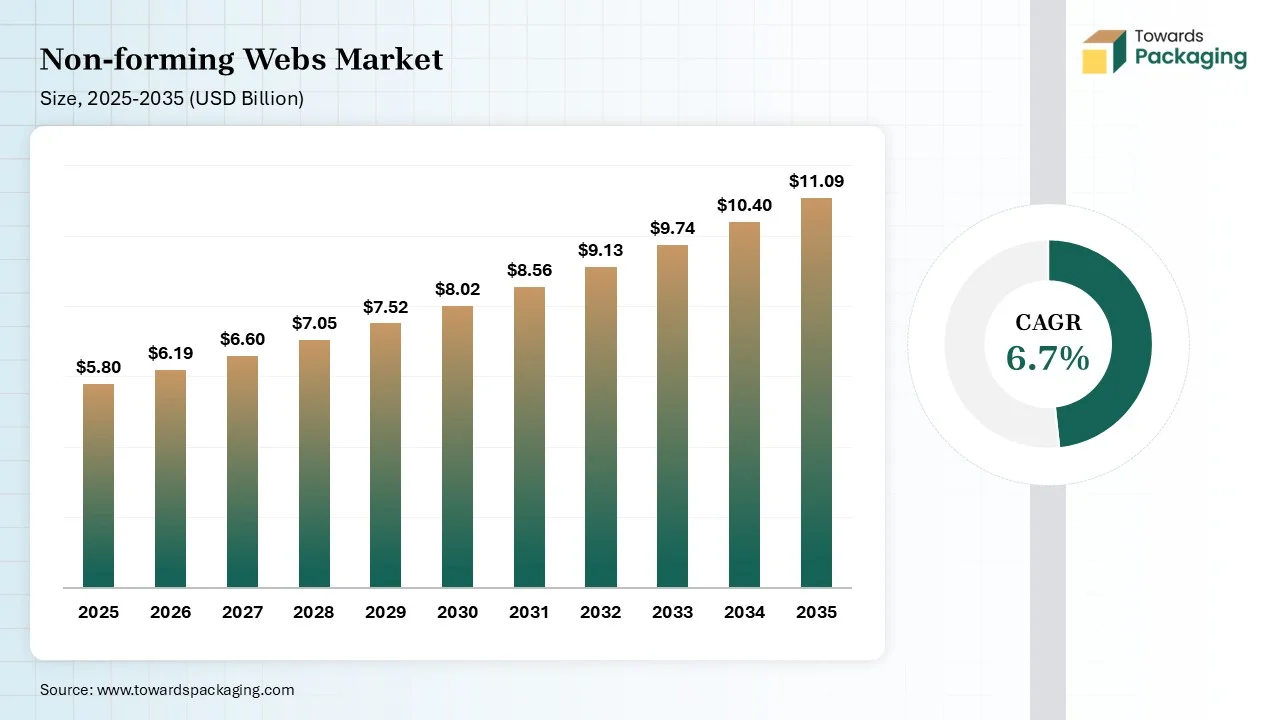
The Non-Forming Webs market is projected to grow from USD 6.19 billion in 2026 to USD 11.09 billion by 2035, expanding at a CAGR of 6.7% during the forecast period. The market growth is driven by rising demand for advanced packaging solutions, especially in top-lidding applications that require strong barrier properties, improved aesthetics, and high-speed processing capabilities. This report covers detailed market size analysis, segment-wise insights, regional performance, key company profiles, competitive landscape, value chain analysis, trade data, and manufacturers and suppliers data.
AI adds smart scenes to the market vision and acts as a developmental hub, turning the whole operation into an automated, unique, and smart space. The AI-sponsored vision systems closely detect the defects in the flexible webs that might be an imperfect sealing and labels. The AI is an eye analysing the thermal images to avoid spoilage. AI algorithms support the popular sustainable design trend that serves the essential barrier properties. Alongside the AI predictive models provides plastic replacement ideas with its accurate prediction power.
Non-forming webs are usually made of a variety of materials, as every non-forming web is crafted to perform smoothly within any working window. Non-forming films can be crafted with desired strength, barrier properties, clarity, gloss, and seal performance in mind. One can serve any web product with highlighted features like moisture and gas barrier properties, peel seal elements or lock seals, potential to seal through pollutants, heat opposition outer surfaces for developed processability.
One of the main trends in non-woven technology is the growth of biodegradable and bio-based fibers. As the eco-friendly issues develop, there is a growing urge for materials that can lower the ecological footprint. Polylactic Acid, which is sourced from renewable resources such as sugarcane or corn starch, is a biodegradable and compostable fiber. They serve as perfect mechanical elements and are used in different applications, such as agricultural fabrics and disposable hygiene products. Additionally, cellulose-based fibers generated from natural sources such as cellulose fibers and wood pulp are not only biodegradable but also provide good strength and absorbency. Current developments have improved their performance and processing, which makes them ideal for medical wipes and textiles.
Package Design and Prototyping: The design of a non-forming web is well-known as a lidding film or top web that is focused on making a flat cover and high performance covers that pack onto a “forming” bottom tray. Alike forming films, which are heated and molded into cavities, non-forming webs, which are crafted for barrier prevention, stability, and high-quality branding.
Recycling and Waste Management: Chemical fiber recycling utilizes a chemical procedure to break down fibrous materials into molecular building blocks that can then be used to make high-quality fibers that are equal in quality to virgin fibers. Chemical recycling is more energy-intensive than mechanical recycling and can also reduce chemical wastage stemming from chemical inputs.
Logistics and Distribution: With an industrial packaging point of view, non-forming webs are flat in nature, rigid materials that do not update shape during the packaging procedure. Alike forming webs that are heat-molded into the pockets to carry a product, non-forming webs behave as the flat “lid” that packs the package shut.
The polypropylene (PP) segment dominated the market with 42% share in 2025 as non-woven polypropylene is a synthetic textile created from polypropylene, which is a petroleum-based plastic. Fibers are linked by using pressure, heat, or chemicals that make a breathable, flat, and water-resistant material. Non-woven polypropylene fabric is strong, lightweight, and tear resistant. These fabrics are used in hygiene products, medical items, reusable bags, and packaging. These resins get spun and melt into fibers which connect to make sheets through a melt-blow, SMS procedure, and spin bond. The kind of non-woven material is made as per the softness, reliability, or filtration needs by using the PP non-woven fabric procedure.
The biodegradable polymers segment held the fourth largest share of 11% in 2025 and is expected to have the fastest CAGR of 9.30% during the forecast period. These polymers are those that can decompose carbon dioxide and water under normal, eco-friendly conditions through microbial action, which serves compost as a simple and sustainable disposal option. Many biodegradable polymers are made, and several of them display perfect capability for many uses. Among them, poly-lactic acid (PLA) possibly holds the biggest interest for many applications. Additionally, they are biocompatible and bioresorbable, as this polyester is crucially included in biomedicine for the making of drug-delivery devices, tissue-engineering scaffolds, and biosensors, and is calculated as one of the most promising for food packaging uses.
The polyester segment held the second largest share of 18% in 2025 because polyester non-woven fabric coverings belong to a space of materials that are defined as non-woven fabrics. Like woven fabrics, which are made by weaving threads collectively, non-woven fabrics are created by linking fibers together using different techniques. Such outcomes in fabrics are more versatile and convenient to generate in various thicknesses and forms. One highlight of polyester non-woven is its color stability, which ensures that it maintains its vibrant look over a period without fading.
The polyethylene segment held the third largest share of 12% in 2025 as they are non-toxic, odorless, and reaches like wax. PE resin for processing and molding is waxy in nature for pellets that come through granulation and extrusion, as it looks milky white. The molecular weight ranges between 10,000 and 1,000,000. There are ultra-molecular-weight polyethylenes, which have molecular weights that exceed 100,000. The bigger the molecular weight, the more perfect the mechanical and physical elements, reaching near the demands of engineering materials.
The spunbond segment dominated the market with 38% share in 2025 as spunbond nonwoven is a kind of fabric manufactured by using the spunbond procedure, which involves the direct extraction of polymer filaments to make a nonwoven fabric. This procedure is widely used because it enables economical and smooth manufacturing of versatile and reliable nonwoven materials. They are a one-step production procedure from either the polymer or chemical stage to the complete nonwoven products on a roll. The main steps in this process are web bonding, web formation, and winding into rolls.
Meltblown held the second largest share of 16% in 2025 and expects the fastest CAGR of 7.8% during the forecast period. This technology has had significant growth in the last two years, which has its own benefits and disadvantages. There have been several growths mainly in its production procedure and in its uses. This paper serves as a brief description of the manufacturing procedure, which is a crucial element that develops this procedure, the economical aspects, the structure-property relations, and some crucial applications of melt-blown technology.
Spunlace segment held the third largest share of 14% in 2025 because this fabric is made through a different procedure that mixes with fibres to make an overall fabric without the demand for regular knitting or weaving. This procedure includes using high-pressure water in order to mix the fibers, resulting in a durable and strong fabric that maintains a flexible and soft texture. The procedure enables a variety of fibre types that can be used, including synthetic and natural materials, which gives producers the flexibility to generate fabrics personalized to uses.
The needle punch segment held the fourth largest share of 12% in 2025 because they are a kind of nonwoven fabric that is created by passing fibres with the assistance of a series of barbed needles, which mix them collectively. Like woven or knitted fabrics, needle looms do not need any threads, yarns, or looms. Instead, it requires loose fibers which can be of various types, as they are synthetic, natural, mixed, or recycled. The fibers can also be of various textures, colors, and amounts, which rely on the desired look and properties of the outcome product.
The disposable non-forming webs segment dominated the market with 64% share in 2025 and expects the fastest CAGR of 7.2% during the forecast period because Thai fabrics have become one of the most reliable materials in the current sectors. From agricultural covers to medical masks, its huge range of uses makes it a main choice over regular woven and knitted fabrics. Like fabrics generated by knitting or weaving yarns, nonwovens are created directly from fibers that are linked together by using mechanical, chemical, and thermal methods. This different design serves properties that are lightweight and breathable in nature.
The durable non-forming webs held the second largest share of 36% in 2025. These webs have flexible top surfaces, high power that is used in thermoforming packaging machines to protectively pack products. Like forming webs, which are heated and stretched to make a container’s bottom shape, non-forming webs stay flat to fit as a lid or top film. In order to give reliability, such webs are crafted with particular material properties to firmly stand for processing and transportation.
The hygiene products segment dominated the market with 34% share in 2025 because absorbent hygiene products are made of many layers. Each one delivers a particular aim, as clothes stay soft against the skin, preventing the absorption of fluids and pollutants. Printed nonwovens and nonwovens are main laments in uses like back sheets, top sheets, pouch pockets, cores, and closure systems that all operate together to serve comfort. They are main elements in feminine hygiene, baby diapers, and incontinence care, which are used in medical uses like ostomy bags and wound care.
The medical segment held the second largest share of 18% in 2025, and it is also expected to grow at the fastest CAGR of 7.9% during the forecast period. Film coating is necessary for the tablet result and patient experience, which serves to prevent the tablet from being affected by the surrounding elements that affect swallowability and cover unwanted tastes. Film-coated tablets serve various benefits over uncoated tablets, which include developed stability, managed release for perfect therapeutic results, and branding possibilities.
The filtration segment held the third largest share of 14% in 2025 because the filtration procedure has many steps. First, the fluid went through a pre-filter to capture large materials. Then, it conveniently passes through finer filters in order to catch smaller ones. Special procedures, such as biological or chemical filtration, are used for strong issues. The materials that are used in filtration are important. Prevalent selections count metals, non-woven fabrics, and ceramics. Non-woven fabrics are affordable and flexible. Metals are rigid and can withstand high temperatures.
The automotive segment held the fourth largest share of 10% in 2025 because polypropylene is a low-density thermoplastic, which makes it lighter in nature as compared to plastics such as metals and PVC. These highlights are important for the automotive sector, in which lowering vehicle weight is necessary for developing fuel efficiency and lowering the C02 emissions. For instance, polypropylene is used in automotive fuel machine elements that need resistance and durability to withstand oil degradation, which ensures a longer service life and improved safety.
The personal care & hygiene segment dominated the market with 32% share in 2025 because these fabrics serve necessary features like absorbency and softness. Feminine hygiene and diapers of products depend on nonwoven materials for effectiveness and comfort. Their absorbent characteristics create nonwoven fabrics perfect for personal hygiene products, which manage it in everyday situations. Discoveries whose goal is to lower waste have led to the growth of 100% recyclable diaper closures manufactured by PLA materials. Such developments not only develop the working of this industry but also meet the rising urge for sustainable nonwoven materials.
The healthcare segment held the second largest share of 20% in 2025, and it is also expected to grow at the fastest CAGR of 7.8% during the forecast period. Surgical gown fabric and surgical drape material are generally created from non-woven fabrics like SMS (spunbond-meltblown-spunbond) and spunbond. Such fabrics deliver a complicated barrier against fluids and bacteria that protects both the surgical team and patient from cross-contamination. Managing sterility is crucial in healthcare packaging. Medical packaging nonwovens serve as a relevant solution, which prevents supplies and instruments from pollutants until the point of usage.
The automotive segment held the third largest share of 13% in 2025 as nonwoven materials are excessively used in the automotive sector, which is driven by the developing demand for lighter and more sustainable materials, which improves both comfort and vehicle performance. As automotive designers concentrate on lowering weight, developing acoustics, and assisting with eco-friendly goals, nonwovens are increasingly classified as a solution. The growth of electric vehicles (EVs) also makes the latest possibilities for such materials, which leads producers and suppliers to predict highlighted demand and a main role for nonwovens.
The construction segment held the fourth largest share of 12% in 2025 because non-woven geotextiles are created by linking polymeric fibers together with the assistance of procedures like heat bonding. The scattered arrangement of fibers generates a porous, rigid, and flexible material. Geotextiles, which are non-woven, are more perfect than those that are woven. They are perfect at draining, filtering, and cushioning, which are convenient to install. Additionally, they are more budget-friendly as such elements create non-wovens perfect for several functions like drainage, filtration, and reinforcement.
Asia Pacific dominated the market with 41% in 2025 and is expected to sustain its position with the fastest CAGR of 7.6% during the forecast period. They are expected to be the biggest users of non-woven fabrics worldwide, which is owing to the completion of further potential and increased non-woven fabric manufacturing in the region. Technological invention is initially changing the region’s non-forming webs scenario, with digital integration and automation that leads to change. High-level production procedures, which include accurate cutting and automated web handling, are developing manufacturing smoothness and lower operational costs.
South Korea Non-Forming Webs Market Trends:
The South Korean non-woven fabric industry is witnessing main development, which is being driven by technological inventions, stretched industrial uses, and developing eco-friendly awareness. As sectors like automotive, healthcare, and production urge high-performance filtration solutions, the industry is meant for constant development. The mixing of high-level manufacturing processes and the acceptance of sustainable materials has further developed this development path. Furthermore, government initiatives set clean air and water standards that meet market demands. This tracking serves as an in-depth clearance of current trends, competitive dynamics, growth drivers, and further points of view that design the non-woven webs landscape in South Korea.
Europe held the second largest share of 22% in 2025. The wrapping films and forming webs have strong development, which is initially driven by the growing demand for co-extruded films and flexible films that have perfect thermoforming qualities and developed puncture resistance. The growing acceptance of such films in the food sector, specifically for packaging like meat, fresh produce, and dairy products, has continued to drive the market expansion. Producers are also concentrating on making sustainable solutions in this segment, with several organizations that reveal recyclable selections that manage the exact level of performance and barrier prevention.
Germany Non-Forming Webs Market Trends:
Brands inside this industry are excessively concentrated on growing resource usage while lowering the amount, which firmly stands on higher innovation and efficiency. The market’s development is being driven by developments in technology and moves in user demands, as it directs producers to accept sustainable practices and update resources. As sustainability becomes crucial, nonwoven materials are expected to play an important role across different sectors, from automotive to healthcare, which shows a loyalty to feedback and quality in a competitive scenario.
North America is considered to be a significantly growing area, due to its valuable initiatives with the popular use of dynamic non-woven materials. This supports and promotes the sustainable growth, alongside the packaging giants' high-barrier paper options, which are a boon to the regional sector. The linerless labels are alleviating the material waste. These joint initiatives through either of the ways are strengthening the footprint of the region in the sector. The recyclable paper options for filling magnify the efforts of the Amazon.
U.S. Market Trends
The U.S. trends cover the excellence of airlaid technology, mainly featuring protective packaging and new dry-moulded solutions. The massive use of non-woven proves to be a best-in-class soaker (absorber) for fish, poultry, and meat. The famous biodegradable materials trend is highlighting the efforts of manufacturers to meet environmental regulations.
The Middle East and Africa are expected to grow at a considerable CAGR in the upcoming period, as the regional companies are bolstering their recognition in the industry. Manufacturers' investments are promoting the value of specialized technology like melt-blown and spunbonded technologies. The commendable advancements in the GCC are improving the potential of industrial packaging.
Saudi Arabia Market Trends
The rising hygiene concern is driving the need for disposable products in the healthcare sector, which highlights the capability of the market. The popular and expanding automotive sector and construction projects are strengthening the manufacturing of non-woven fabrics while accelerating the market's footprint and potential.
By Material Type
By Technology:
By Product Type:
By Application:
By End-Use Industry:
By Regions








Research & Advisory Analyst
Yogesh Kulkarni is an experienced Research Analyst specializing in the packaging sector, with a strong foundation in statistical analysis and market intelligence. He currently contributes his expertise to Towards Packaging.
Learn more about Yogesh Kulkarni

Reviewed By
Aditi Shivarkar, with 14+ years in packaging market research, specializes in food, beverage, and eco-friendly packaging. She ensures accurate, actionable insights, driving Towards Packaging Analytics & Consulting 's excellence in industry trends and sustainability.
Learn more about Aditi Shivarkar


Non-forming Webs Market
 Table of Content

 Download Sample
 Schedule a Meeting