


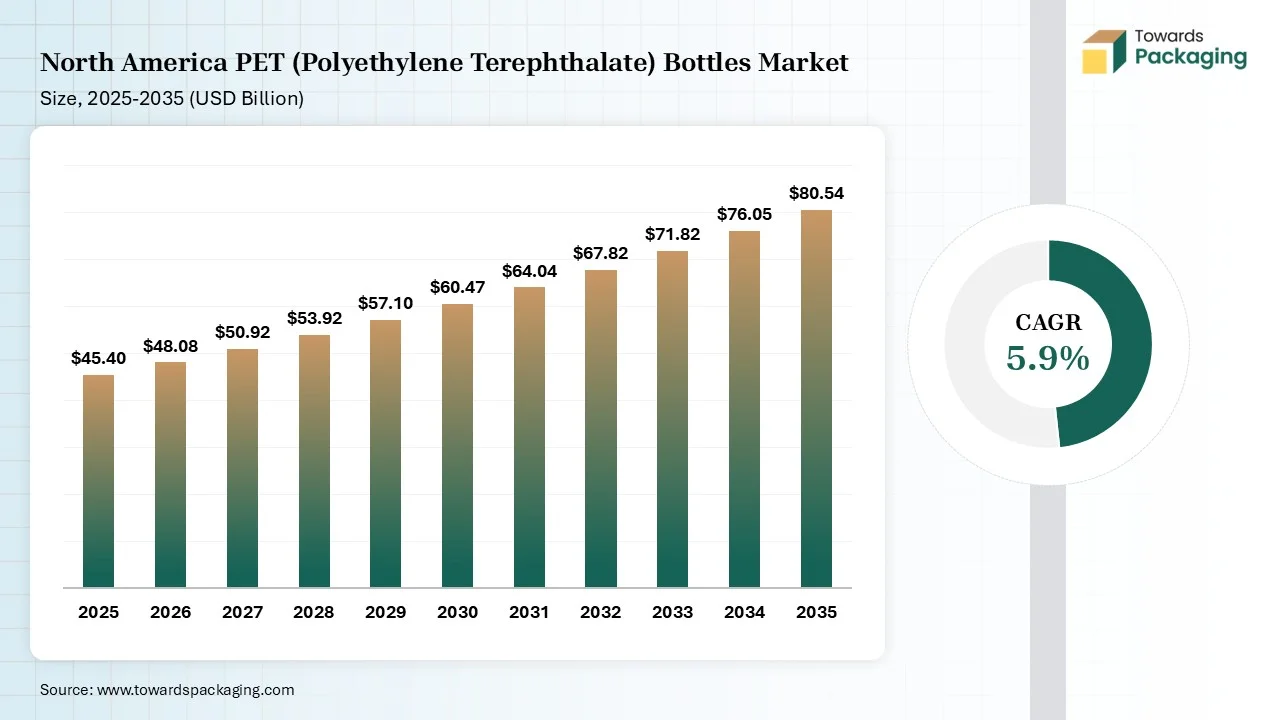
The North America PET (Polyethylene Terephthalate) bottles market is projected to grow from USD 48.08 billion in 2026 to USD 80.54 billion by 2035, registering a CAGR of 5.9% during the forecast period. The report delivers detailed market size analysis, segment-wise revenue forecasts, regional demand trends, competitive benchmarking, company market share analysis, trade statistics, value chain assessment, and extensive manufacturers and suppliers data. The study highlights the increasing demand from the functional beverage sector and ongoing packaging innovation driving market expansion across North America.
Sources:
Market Size (2025): USD 45.4 Billion
CAGR Forecast (2025–2035): 5.9%
Market Volume (2025): 320 Billion Units
Volume CAGR (2025–2035): 4.8%
Pricing Data (2025):
PET bottles are lightweight plastic containers used for packaging. It provides high transparency & superior barrier properties. PET bottles are lightweight and 100% recyclable. It is durable, non-toxic, & hygienic and offers great temperature resistance. PET bottles offer benefits like product preservation, energy efficiency, and design versatility. It offers immense flexibility and cost efficiency. PET bottles are widely used in the packaging of carbonated drinks, salad dressings, cough syrups, mouthwash, agrochemicals, motor oils, and many other products.
Technological advancements are growing in the market due to growing demand for material efficiency and stricter sustainability mandates. The developments, such as all-electric blowing machines, advanced optical sorting, machine learning, advanced lightweighting, and predictive maintenance, help in lowering energy consumption, optimizing cooling cycles, and maintaining durability.
One of the most impactful developments is the incorporation of AI. It easily adjusts air pressure and optimizes catalyst ratios. AI easily detects stress fractures and maintains the structural integrity of the product. AI supports faster prototyping and develops high-clarity PET. AI supports in lowering capital waste and optimizes temperature in production.
The stage requires raw materials like monoethylene glycol, recycled PET flakes, purified terephthalic acid, and recycled PET pellets.
The stage performs steps like resin preparation, injection molding, stretch blow molding, and end-of-life conversion.
The package design focuses on functional engineering, lightweighting, and graphic integration. Prototyping focuses on 3D modeling, finite element analysis, rapid prototyping, and blowability testing.
| Category | Key Companies |
| PET Resin Producers | Indorama Ventures, Alpek, Far Eastern New Century |
| Recycled PET Suppliers | Plastipak Packaging, Phoenix Technologies, Evergreen Recycling |
| Additives & Barrier Technologies | Avient Corporation, Ampacet Corporation |
| Category | Key Companies |
| Global PET Bottle Manufacturers | Amcor plc, Berry Global, Silgan Holdings |
| PET Preform Specialists | Retal Industries, Plastipak Packaging |
| Beverage Packaging Specialists | Graham Packaging, ALPLA Group |
| Company Name | Headquarters | Country | Why Relevant to This Market | Key Packaging Products/Services |
| Berry Global | Evansville, Indiana | USA | One of the largest rigid plastic packaging producers | PET containers, closures, sustainable packaging |
| Plastipak Packaging | Plymouth, Michigan | USA | Major PET bottle and rPET producer | PET bottles, preforms, recycling systems |
| Silgan Holdings | Stamford, Connecticut | USA | Strong presence in consumer product PET packaging | PET containers, closures, dispensing systems |
| Company Name | Headquarters | Country | Why Relevant to This Market | Key Packaging Products/Services |
| Graham Packaging | Lancaster, Pennsylvania | USA | Major supplier to beverage and household sectors | PET bottles and containers |
| Pretium Packaging | Chesterfield, Missouri | USA | Strong specialty PET packaging presence | Custom PET containers |
| Alpha Packaging | St. Louis, Missouri | USA | Food, nutraceutical and personal care PET packaging | PET bottles and jars |
| Company Name | Headquarters | Country | Why Relevant to This Market | Key Packaging Products/Services |
| Aptar CSP Technologies | Auburn, Alabama | USA | Advanced PET packaging solutions and barrier technologies | PET pharmaceutical packaging |
| MJS Packaging | Livonia, Michigan | USA | Specialized PET bottle supplier serving multiple sectors | PET containers and closures |
| Berlin Packaging | Chicago, Illinois | USA | Fast-growing packaging platform with PET bottle portfolio | PET containers and design services |
| Ring Container Technologies | Oakland, Tennessee | USA | Specialized beverage PET container producer | PET bottles and preforms |
| Sipa North America | Atlanta, Georgia | USA | PET bottle innovation and integrated production systems | PET preform and bottle technologies |
The water bottles segment dominated the market with 38% share in 2025 due to the focus on safely carrying hydration. The consumer's strong focus on verifying water purity and preservation of water's natural taste increases the adoption of PET water bottles. The unmatched portability and growing industry endorsement help with expansion. The 100% recyclability, shatterproof, exceptional clarity, unmatched logistics, flavor neutrality, and resealability of PET water bottles drive the segment growth.
The carbonated soft drink bottles segment held the 25% market share in 2025 due to the busy urban commutes. The growing family-sized carbonated soft drink purchases and the growing integration of meals with soft drinks increase the adoption of PET bottles. The expansion of zero-sugar lines and the surge in soda consumption increase the adoption of PET bottles. The cheap production, structural resistance, and strong marketing appeal of PET-based carbonated soft drink bottles support the segment growth.
The juice bottles segment held the 15% market share in 2025. The growing consumer demand for organic functional juices and the shift to portable beverages increase the adoption of PET bottles. The focus on preserving the flavor of juices and the need for cost-effective shipping increase the adoption of pet juice bottles. The authenticity and extended shelf life of PET juice bottles boost the segment growth.
The 500ml – 1L segment dominated the market with 40% share in 2025 due to the growing grab-and-go culture. The rise in travel activities and the focus on improving logistical efficiency increase the adoption of 500ml – 1L PET bottles. The popularity of 500ml – 1L PET bottles in CSD, juices, and bottled water helps with expansion. The growth of household cleaning liquids and the single-sitting consumption accelerate the segment growth.
The <500ml segment held the 30% market share in 2025 due to the rise in active commuters. The consumer focuses on managing calorie intake, and the rise in smart vending machines increases demand for <500ml PET bottles. The convenience of a <500ml PET bottle in car cup holders and backpacks helps with expansion. The improved recycling efficiency and the popularity of premium health shots increase the adoption of the <500ml PET bottle, supporting the segment growth.
The 1 – 2L segment held the 22% market share in 2025. The growing drinks consumption at home and the focus on minimizing manufacturing costs increase demand for 1 – 2L PET bottles. The rapidly expanding edible oils and the increased use of detergents increase the adoption of 1 – 2L PET bottles. The popularity of packaged juices and the higher demand for budget-friendly options increase the use of 1 – 2L PET bottles, boosting the overall segment growth.
The beverages segment dominated the market with 55% share in 2025 due to the rise in bulk retail purchases. The interest in carbonated soft drinks and the growing number of outdoor events increase the use of PET bottles. The rise in packaged fresh water and the presence of large beverage corporations increase the adoption of PET bottles. The rise in RTD teas and the focus on maintaining beverage freshness drive the segment growth.
The food segment held the 15% market share in 2025 due to the growing demand for travel-friendly food solutions. The need for barrier protection in edible oils and the rise in easy-to-carry food products increase demand for PET bottles. The growing online food delivery and the focus on preventing food spoilage increase demand for PET bottles. The interest in single-serve food items and the need for exceptional preservation in sauces support the overall segment growth.
The personal care & cosmetics segment held the 12% market share in 2025 due to the focus on protecting cosmetic formulas. The rise in sensitive skincare products and the focus on lowering the shipping cost of personal care products increase the adoption of PET bottles. The development of premium visuals of personal care products and the focus on travel convenience increase the use of PET bottles. The focus on ensuring the integrity of skincare ingredients boosts the segment growth.
The bottled water industry segment dominated the market with 35% share in 2025 due to the surging health consciousness. The robust growth in travel and the higher demand for single-use hydration increase demand for bottled water. The rise in on-the-go hydration and the explosion of daily commutes increase demand for bottled water. The heavy consumption of bottled water drives the overall segment growth.
The soft drinks industry segment held the 28% market share in 2025. The North American consumers' fast-paced lifestyle and availability of multi-serve family packs increase the adoption of soft drinks. The focus on maintaining carbonation levels in soft drinks increases the use of PET bottles. The popularity of RTD and the focus on preserving soft drinks' taste increase the adoption of PET bottles, supporting the segment growth.
The FMCG packaging segment held the 15% market share in 2025. The surging sports drinks market and the need to protect FMCG goods increase demand for PET bottles. The expansion of household consumables and the focus on increasing consumer trust increase the adoption of PET bottles. The need to lower FMCG shipping weights and the integration of tamper-evident caps in FMCG goods boost the segment growth.
The screw caps segment dominated the market with 60% share in 2025 due to its compatibility with beverages. The focus on securing household chemicals and the preference for lowering plastic litter increases the use of screw caps. The high manufacturing efficiency & superior sealing retention of screw caps help with growth. The exceptional leak-proof performance, tamper-evidence, and reclosability of screw caps drive the segment growth.
The sports caps segment held the 15% market share in 2025. The participation in outdoor recreation and the growing demand for hygienically designed closures increase the adoption of sports caps. The rise in physical activities and the need for spill-proof closures increases the use of sports caps. Consumer awareness about hydration and nutraceutical expansion increases demand for sports caps, supporting the overall segment growth.
The flip-top caps segment held the 15% market share in 2025 due to the growing demand for closures opening with a single thumb. The reduction of over-pouring and the focus on safeguarding sanitizers increase the use of flip-top caps. The utilization of flip-top caps in products like conditioners, pharmaceuticals, sports beverages, and lotions helps with expansion. The controlled dispensing and enhanced security of flip-top caps support the segment growth.
The direct sales (B2B) segment dominated the market with 50% share in 2025. The rise in securing bulk volumes and the maintenance of profit margins increases the adoption of direct sales. The highly negotiated contracts and the minimization of lead times increase the adoption of direct sales. The exact design specifications and the focus on consistent operational efficiency increase demand for direct sales. The supply chain security in direct sales drives the segment growth.
The distributors/wholesalers segment held the 30% market share in 2025 due to the shorter lead times. The low order quantities and demand for a one-stop-shop experience increase the adoption of distributors/wholesalers. The expansion of localized brands and the explosion of on-the-go goods increase demand for distributors/wholesalers. The transportation cost-efficiency in distributors/wholesalers supports segment growth.
The retail packaging suppliers segment held the 15% market share in 2025. The growing regulations regarding packaging and the growing demand for portable pet containers increase demand for retail packaging suppliers. The rising customization demand and growing SMEs needs increase the adoption of retail packaging suppliers. The superior logistics, higher product visibility, energy efficiency, and technological innovation in retail packaging suppliers boost the segment growth.
The United States is the leading contributor to the market. The higher consumption of carbonated soft drinks and the strong presence of major beverage companies increase demand for PET bottles. The high consumer preference for convenience and the shift to closed-loop recycling systems increase the adoption of PET bottles. The heavy investment in double-layer technology and the strong recycling base drive the overall growth of the market.
Canada is robustly growing in the market. The federal recycling targets and the growing consumption of personal care increases demand for PET bottles. The focus on food-safety validation and the rising investment in the local recycling infrastructure increase the development of PET bottles. The expanding pharmaceutical base and the focus on zero plastic waste increase the use of PET bottles. The strong presence of beverage giants supports the overall growth of the market.
By Product Type
By Capacity
By Application
By End-Use Industry
By Closure Type
By Distribution Channel







Research & Advisory Analyst
Yogesh Kulkarni is an experienced Research Analyst specializing in the packaging sector, with a strong foundation in statistical analysis and market intelligence. He currently contributes his expertise to Towards Packaging.
Learn more about Yogesh Kulkarni

Reviewed By
Aditi Shivarkar, with 14+ years in packaging market research, specializes in food, beverage, and eco-friendly packaging. She ensures accurate, actionable insights, driving Towards Packaging Analytics & Consulting 's excellence in industry trends and sustainability.
Learn more about Aditi Shivarkar

North America PET (Polyethylene Terephthalate) Bottles Market
 Table of Content

 Download Sample
 Schedule a Meeting