


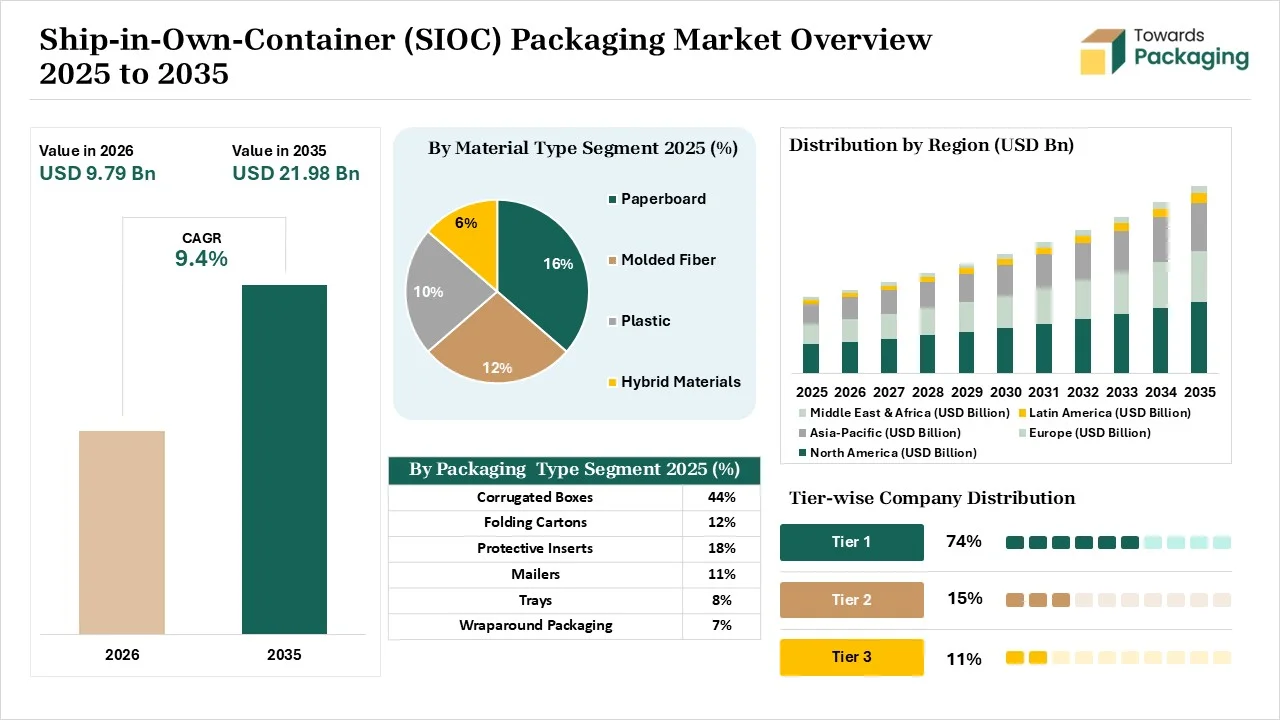
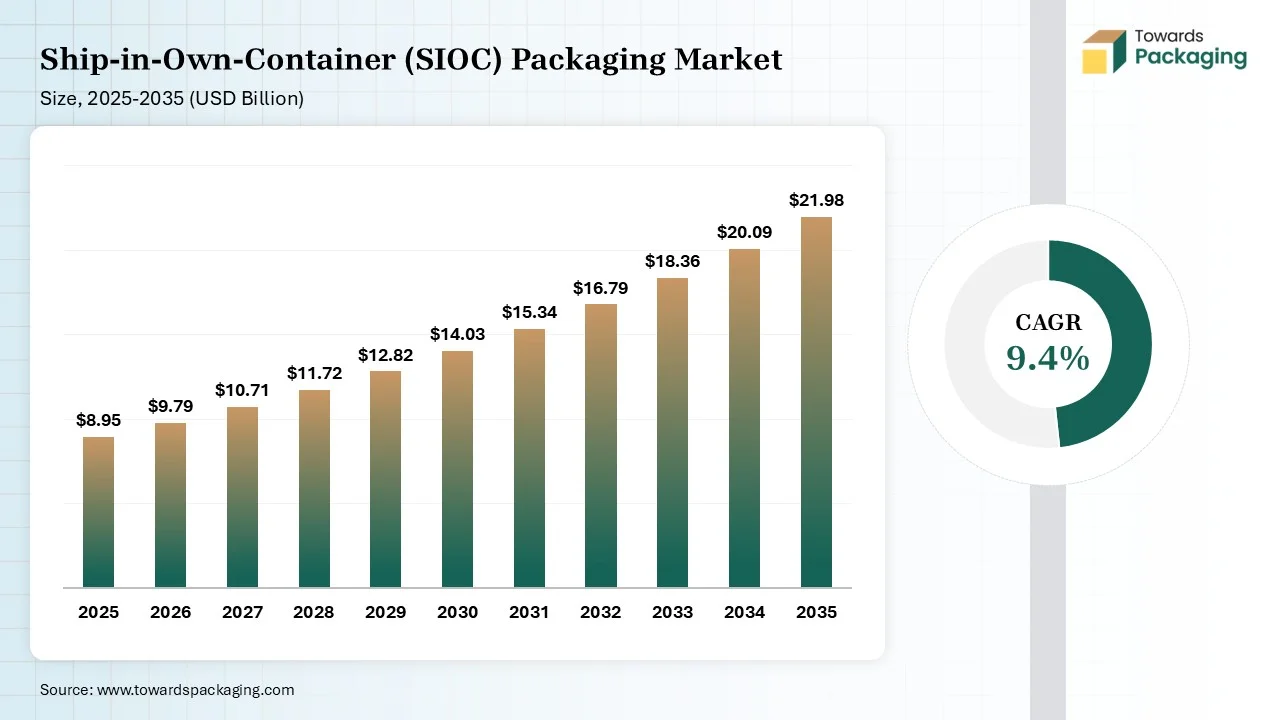
According to Vidyesh Swar, the global ship-in-own-container (SIOC) packaging market size was estimated at 8.95 billion in 2025 and is predicted to increase from USD 9.79 billion in 2026 to approximately USD 21.98 billion by 2035, expanding at a CAGR of 9.4% from 2026 to 2035. The key growth factors driving the market growth are a focus on shipping cost savings, packaging waste reduction, trending e-commerce, environmental concerns, brand visibility focus, innovative packaging materials, creation of positive brand perception, stringent testing standards, increased electronics buying, and various fulfilment initiatives by retailers. The SIOC packaging plays a key role in e-commerce by providing reduced shipping costs, minimized product damage, overboxing elimination, and streamlining fulfilment. Sustainable packaging plays a key role by lowering emissions, improving consumer experience, eliminating waste, and providing structural durability.
The ship-in-own container packaging is an approach of packaging that uses the original producer's packaging for delivering the product. This packaging does not include an additional cardboard box. The purpose of packaging is to enhance sustainability, lower cardboard waste, and save material expenses. The features of packaging are zero secondary packaging, minimized shipping cost, built-in product protection, and lower frustration. The retailer certifications, like Walmart SIOC guidelines and Amazon SIOC or SIPP program, are required. The packaging offers benefits like lower environmental wastage, improved parcel unboxing, reduced material cost, and maintained brand visibility.
Before the boom of e-commerce companies designed packaging according to retail shelf appeal. Companies mainly use packaging formats like double boxing, corrugated boxes, and padded mailers to survive the delivery process. The sudden e-commerce boom increased the cardboard waste, which drives demand for frustration-free packaging. This shift focused on eliminating materials like redundant boxes, blister packs, and others to lower shipping weight. The traditional packaging method is environmentally unsuitable in the era of e-commerce. For the safe transit of the product, the modern SIOC concept is combined with standardized testing. The stage focuses on vibration testing, stacking pressures, and drop testing. The rigorous testing helps in the development of eco-friendly closures and solving transit damage challenges. The consumer shift towards sustainable goals increases the adoption of IOC packaging. The initiatives, like Amazon SIPP, increase the adoption of SIOC packaging in DTC brands. The consumer sustainability commitments increased the use of SIOC packaging.
SIOC packaging is used across end user industries like home appliances, electronics, beauty, and F&B. The market scope focuses on certification requirements, fee reductions, and sustainability standards. The packaging products, like rigid boxes, clamshells, corrugated boxes, and bags, are included in SIOC packaging. The packaging formats like welded structures, protrusions, undersized packages, internal add-ons, L-shape boxes, and large hand holes are excluded. The SIOC packaging is used for products like air purifiers, cat litter, laptops, microwaves, smart speakers, and many more. The distribution network includes omnichannel retailers, e-commerce giants, and D2C shipping. The market covers regional areas like Europe, Asia Pacific, North America, Latin America, and the MEA.
Packaging Optimization Demand
The rapid expansion of industries like healthcare and e-commerce increases demand for packaging optimization to meet environmental regulations. According to my study, factors like increasing shipping costs, the need to improve palletization, and product damage minimization increase the demand for packaging optimization. The increased removal of over-boxing and the adoption of right-sized packaging help in packaging optimization. The Amazon mandates, and the companies' focus on qualifying Amazon programs, optimize the packaging. The push away from over-engineered packaging and the preference for packaging that produces a smaller footprint help with expansion. The packaging optimization demand is a driver for the market growth.
High Initial Cost for Redesigning Packaging
The protocols, like the high fees of the ISTA-6 test and the iterative redesigns of packaging, increase the cost. Factors like tailored structural engineering of packaging, old inventory write-offs, and tooling changes are responsible for the high initial cost. The need for physical prototyping and the high investment requirement in structural modelling increase the cost. The incorporation of new printing plates and scrapping retail packaging increases the initial cost. The upgradation of box materials and the integration of security overwraps increase the cost. The high initial cost for redesigning packaging is a major restraint for the market growth.
Expansion of Online Grocery
The expanding grocery product catalogues on online platforms and the availability of dietary filtering increase online grocery shopping. Factors like instant deliveries, integrated digital payments, and personalization are responsible for growing online grocery shopping. The multi-stop deliveries of groceries and the rapid fulfilment demand increase the use of SIOC packaging. The hassle-free grocery unboxing demand and the rise in buying of heavy groceries increase demand for SIOC packaging. The redesign of grocery products helps with growth. The expansion of online grocery unlocks opportunities for market growth.
The procurement of raw materials like kraft paper, softwood fibers, agricultural residues, and kraft paper is available in paper mills. The mills offer diverse paper grades and recycled papers. The raw materials meet Amazon ISTA-6 standards. Companies like Mondi and International Paper provide raw materials.
The coverts raw material into the final products. They focus on structural design, printing, corrugation, and conversion. They use technologies like CAD, flexography, corrugators, rotary die-cutters, digital printing, and many more.
Design software providers focus on the simultaneous design, heterogeneous integration, multi-physics simulation, and supply chain collaborations. The companies like Esko, Dassault Systèmes, and Arden Software are design software providers.
These laboratory tests the durability of packaging in a simulated environment. The testing focuses on waste reduction, compliance certification, and packaging optimization. The laboratories like Intertek, UL Solutions, SGS, and others perform ISTA 6-Amazon SIOC testing.
Logistics company offers transit simulation, reverse logistics, freight optimization, and warehouse fulfilment. The key players are ShipMonk, FedEx, and others.
Retailers focus on the optimization of the supply chain, sustainability enforcement, and providing a good consumer experience.
The end users focus on the easy opening, premium unboxing, durability, and recycling the packaging.
The major industry stakeholders include packaging manufacturers, certification organizations, logistics providers, corrugated producers, technology companies, and retailers.
The compliances like Walmart SIOP and Amazon SIPP focus on the transit compliance and durability. The packaging compliance focuses on material elimination, structural integrity, and cube optimization, which develops accurate packaging design. This stage provides inventory forecasting adjustments, cost-benefit reallocation, and stringent sourcing. The packaging compliance performs tests like shock testing, vibration testing, preconditioning, and compression testing.
The supply trends of the corrugated cardboard are sustainable packaging transition, Fit-to-Product demand, dominance of F&B, rightsizing, and enhanced customization. According to research, the pricing of cardboard design focuses on factors like order volume, printing, paper costs, flute types, energy, customization, and board grade. The use of renewable resources, raw materials, eco-friendly inks, and lightweighting increases its sustainability.
The paperboard is used in applications like cosmetics, spirit cartons, accessory boxes, slide boxes, specialty folding cartons, gift boxes, and magnetic closure boxes. The features like surface smoothness, high brightness, excellent gloss, exceptional ink absorption, and dimensional stability provide excellent printability. It provides sustainability advantages like high recyclability, lightweight transport efficiency, and biodegradability.
The diverse trends of molded fibers are e-commerce adoption, PFAS phase-outs, EPS foam alternative demand, foodservice adoption, advancing barrier technology, thermoformed innovations, and rising medical device usage.
They are used in applications like developing juice cartons, creating high-barrier films, manufacturing vacuum-sealed food containers, and developing anti-microbial packaging. The material offers durability benefits like lowered crack propagation, synergistic strength, and custom thermal stability. The advancing recycling base and expansion of recycled plastics increase future demand.
The average manufacturing price depends on the product's fragility, material upgrades, sustainability requirements, testing, and manufacturing volume. According to the price, USD 0.31 per packaging unit, the corrugated board manufacturing takes $0.15, printing & graphics takes $0.06, die-cutting & gluing requires $0.06, and shipping & warehousing requires $0.04.
The average selling price depends on certification requirements, structural complexity, volume, product size, and branding. According to the average selling price of USD 0.48 per packaging unit, direct materials require $0.22, internal dunnage & protection require $0.10, labor & assembly require $0.11, testing & ISTA 6 Certification requires $0.03, and QA requires $0.02.
The packaging cost structure depends on the primary materials, design & certification, labor & automation, and fulfilment fees. The 60-70% of total cost requires primary materials, 10-15% requires acquiring certification and designing packaging, 10-15% requires automation process and labor utilization, and fulfilment fees vary according to fragility, DIM, & non-compliance penalties.
Raw materials like test linerboard, additives, polyethylene, PCR resins, hot-melt adhesives, security seals, virgin kraft linerboards, and corrugated medium are required.
Material processing involves corrugated board production and the processing of polymer. Conversion includes printing, application of coating, cutting, gluing, and assembling the product.
Design focuses on minimalism, damage prevention, and theft resistance. Prototyping focuses on virtual prototyping, structural modelling, and iterative testing.
The corrugated paperboard segment dominated the market with 56% share in 2025 due to its dimensional customization. Based on my study, factors like unique fluted designs, focus on lowering empty space in packaging, and lightweight packaging need to increase demand for corrugated paperboard. The elimination of supplementary void fill and the growing individual parcel delivery increases the use of corrugated paperboard. The superior durability and high-quality branding drive the segment growth.
The molded fiber segment held the 12% market share in 2025 and is expected to grow at the fastest CAGR of 11.2% during the forecast period due to its exceptional shock absorption. The replacement of void-fill materials and the demand for curbside-recyclable materials increases the use of molded fiber. The development of sensitive semiconductor components and a focus on reverse logistics efficiency increase the use of molded fiber. The lower damage rates support the segment growth.
The corrugated boxes segment dominated the market with 44% share in 2025. The reduction of handling costs and the focus on maximization of load density in delivery vehicles increase the use of corrugated boxes. The increased incentives by fulfilment centers and the preservation of the unboxing experience increase the use of corrugated boxes. According to my research, the excellent branding and exceptional transit protection of corrugated boxes drive the segment growth.
The protective inserts segment held the 18% market share in 2025 and is expected to grow at the fastest CAGR of 10.8% during the forecast period. The focus on delivering goods in perfect conditions and the storage fees reduction demand increases the use of protective inserts. The transition away from traditional loose-fill foam and smart machinery advancements increases the use of protective inserts. The significant cost reductions in protective inserts support the segment growth.
The consumer electronics segment dominated the market with 24% share in 2025. The shipping of televisions and the internal component protection of consumer electronics increase demand for SIOC packaging. The electronics producers focus on lowering the expenses of feedstock, and the rise in eco-friendly practices in consumer electronics increases the adoption of SIOC packaging. The theft issues in electronics drive the segment growth.
According to Vidyesh Swar, the food & beverages segment held the 16% market share in 2025 and is expected to grow at the fastest CAGR of 10.6% during the forecast period. The increased sales of online grocery and the avoidance of plastic bubble wrap in food packaging increase the adoption of SIOC packaging. The freshness maintenance in F&B products and the F&B brands' focus on positive reviews increase the adoption of SIOC packaging. The rise in subscription beverage services supports the segment growth.
The primary ship-in-own container packaging segment dominated the market with 38% share in 2025. The Amazon SIPP program and the demand for hassle-free packaging increase the use of primary ship-in-own container. The maximization of brand visibility and rapid dispatching of orders increases the use of primary ship-in-own container. The shipping of bulky home appliances and bottled products helps with expansion. The cost reduction and enhanced customer experience of primary ship-in-own container packaging drive the segment growth.
The retail-ready & shipping packaging segment held the 22% market share in 2025 and is expected to grow at the fastest CAGR of 10.4% during the forecast period. The focus on lowering in-store labor and the need to maintain individual parcel transit structural integrity increases the use of retail-ready & shipping packaging. The recyclability regulations and the focus on increasing the efficiency of conveyor systems increase the use of retail-ready & shipping packaging. Factors like brand visibility and labor efficiency support the segment growth.
According to Vidyesh Swar, the e-commerce segment dominated the market with 58% share in 2025 and is expected to grow at the fastest CAGR of 10.50% during the forecast period. The focus on avoiding the purchase of extra materials and the tightening of global sustainability increases the adoption of e-commerce distribution. The elimination of frustrating plastic formats and the packaging's primary focus on surviving multiple touchpoints increases the use of e-commerce distribution. The fast deliveries era and massive cost reductions drive the segment growth.
The retail distribution segment held the 18% market share in 2025. The demand for lower shipping costs and the need to lower pick-and-pack fulfilment time increases the use of retail distribution. The avoidance of oversized cardboard boxes and the growing use of single-parcel delivery trucks increase the use of retail distribution. Factors like operational efficiency and enhanced protection support the segment growth.
The e-commerce companies segment dominated the market with 31% share in 2025 and is expected to grow at the fastest CAGR of 10.7% during the forecast period. The availability of discounted fulfilment fees and the packaging waste minimization in e-commerce increases the use of SIOC packaging. The optimization of e-commerce freight efficiency and the rise in faster pick operations increase the use of SIOC packaging. According to my study, factors like transit safety, cost reduction, and faster pack operations in e-commerce companies support the segment growth.
The consumer electronics manufacturers segment held the 19% market share in 2025. The manufacturing of high-value electronics and the focus on carbon footprint reduction in electronics brands increase the use of SIOC packaging. The focus on consumer electronics' aesthetic appeal and the rising redesign of electronics boxes increases the use of SIOC packaging. The demand for thinner gadgets and the need for thermal management in wearable electronics increases the use of SIOC packaging, supporting the segment growth.
The printed SIOC packaging segment dominated the market with 54% share in 2025. The demand for built-in brand identity and the eco-friendly inks integration increases the use of printed SIOC packaging. The monetary incentives and the focus on reducing fulfilment overhead increase the use of printed SIOC packaging. The minimalist packaging demanded by consumers and the leading e-commerce companies increases the use of printed SIOC packaging, driving the segment growth.
The smart packaging with QR/RFID segment held the 12% market share in 2025 and is expected to grow at the fastest CAGR of 12.3% during the forecast period. The demand for supply chain visibility and focus on rapid order fulfilment increases the use of smart packaging with QR/RFID. The advanced anti-counterfeiting in luxury goods and the brands' focus on offering an easy gateway increase the use of smart packaging with QR/RFID. Factors like shrinkage control, freshness monitoring, and advanced security support the segment growth.
North America dominated the ship-in-own-container (SIOC) packaging market with a 38% share in 2025. The preference for frustration-free packaging in companies like Amazon and the adoption of dimensional weight pricing in companies like UPS increase the use of SIOC packaging. The focus on lowering the fees of last-mile shipping and the streamlined fulfilment networks increases the use of SIOC packaging. The massive online shopping volume and the strong testing ecosystem for packaging increase the use of SIOC packaging, driving the overall market growth.
United States
The United States held the largest share of the market in 2025 and is expected to grow at the fastest CAGR during the forecast period due to e-commerce standardization. According to my study, factors like stringent testing environments, high sustainability pressures on brands, and cost efficiency focus increase demand for SIOC packaging. The unpredictable parcel networks and the high prices of corrugated over-boxes increase the use of SIOC packaging. The focus on improving supply chain recyclability supports the overall market growth.
Canada
Canada is growing in the market. The rigorous transit of parcels and the brand's focus on adopting packaging that lowers total packaging weight increase the use of SIOC packaging. The well-developed ISTA 6 testing infrastructure and the focus on lowering over-boxing increase the use of SIOC packaging. The Amazon’s SIOC programs and the need to eliminate unnecessary secondary overboxing increase the use of SIOC packaging, boosting the overall market growth.
According to Vidyesh Swar, Europe held the 27% market share in 2025. The increased penalization of unnecessary packaging and the growing retailer chargeback penalties increase the use of SIOC packaging. The need to eliminate manual repacking and the increased shipping of large items increases the adoption of SIOC packaging. The brand's focus on eliminating extra cardboard and the expansion of green-minded shoppers increase the use of SIOC packaging. The high logistics efficiency of SIOC packaging drives the market growth.
Germany
Germany dominated the ship-in-own-container (SIOC) packaging market in 2025. The interest in easily recyclable containers and the rise in e-commerce chargeback penalties increase the use of SIOC packaging. The high environmental awareness among German consumers and the innovations in corrugated packaging increase the use of SIOC packaging. The automation in large logistics hubs supports the market growth.
United Kingdom
The United Kingdom is expected to grow at the fastest CAGR in the market during the forecast period. The focus on avoiding the use of bulky tertiary packaging and the high incentives for non-compliant sellers increase the use of SIOC packaging. The high domestic sales of online retail and the interest in frustration-free unboxing increase the use of SIOC packaging. According to my research, protective design innovations boost the market growth.
Asia Pacific held the 26% share in the ship-in-own-container (SIOC) packaging market and is expected to grow at the fastest CAGR of 10.8% during the forecast period due to the explosive D2C deliveries. The focus on lower volumetric weight of packaging and the prohibitions on high-waste packaging increase the use of SIOC packaging. The businesses' focus on maintaining profitability and the creation of a green reputation in brands increases the adoption of SIOC packaging. The adoption of automated robotics in fulfilment centers and the dense delivery routes in urban areas drives the market growth.
China
China held the largest market share in 2025. The key D2C brands' presence and the massive presence of paper mills increase the use of SIOC containers. The high manufacturing rate of home goods and the increased investment in lab-testing capacities increase the production of SIOC packaging. According to my research, an advanced logistics network and favorable state financing increase the development of SIOc packaging, supporting the overall market growth.
India
India is expected to grow at the fastest CAGR in the market during the forecast period. The presence of strong e-commerce fulfilment hubs and the focus on the reduction of cardboard waste increase the use of SIOC packaging. The emergence of digital retail in tier-2 cities and packaging materials innovations increases the use of SIOC packaging. The preference for brand-forward aesthetics boosts the overall growth of the market.
According to Vidyesh Swar, Latin America held the 5% market share in 2025. The interest in durable corrugated packaging and the focus on the reduction of outbound freight costs increase the use of SIOC packaging. The focus on streamlining the packaging fulfilment process and the elimination of over-boxing materials increases the use of SIOC packaging. The ISTA standards and the need to simplify warehouse logistics increase the use of SIOC packaging, driving the market growth.
Brazil
Brazil dominated the ship-in-own-container (SIOC) packaging market in 2025. According to the research, factors like strong corrugated paperboard infrastructure, elimination of plastic mailers, and the avoidance of DIM weight charges are responsible for the growing adoption of SIOC packaging. The rigid durability protocols and the minimization of labor increase the use of SIOC packaging. The growing direct distribution supports the market growth.
Argentina
Argentina is expanding in the market. The drastic growth in e-commerce volumes and the ongoing economic instability in the country increase the adoption of SIOC packaging. The need to enhance vehicle space utilization and the innovative packaging durability increases the use of SIOC packaging. The strong Mercado Libre platform and the focus on stable long-distance transit increase the use of SIOC packaging.
The Middle East & Africa held the 4% market share in 2025. The demand for D2C delivery models and the fluctuations in the ocean freight cost increase the use of SIOC packaging. The congestion in Jeddah Islamic Port and the government-provided sustainability mandates increase the use of the SIOC container. The import of consumer electronics and the rise in furniture shipping increase the adoption of SIOC packaging. The businesses' focus on maximizing cargo space supports the market growth.
Saudi Arabia
Saudi Arabia dominated the market in 2025 due to the online shopping surge. The reduction in packaging imports and the manufacturing of fulfilment centers increases the use of SIOC packaging. The large refining base and Saudi Green initiatives increase the production of SIOC packaging. The higher adoption of heavy-duty SIOC boxes and the populated urban centers increase demand for SIOC packaging, driving the market growth.
United Arab Emirates (UAE)
UAE is expected to grow at the fastest CAGR in the market during the forecast period. The growing digital sales of platforms like Noon and stringent environmental measures increase the use of SIOC packaging. The presence of a premier transshipment hub and the interest in original product packaging increase the use of SIOC packaging. The growing mobile-first population and the availability of cost-effective polymers support the segment growth.
The SIOC packaging market is highly competitive due to the exploding growth of e-commerce. The companies are divided into specialized startups, major packaging giants, and regional specialists. The high certification requirements and regulatory pressures increase the market concentration. The key players include Sonoco, Sealed Air Corporation, and Smurfit Kappa.
| Company | Annual Corrugated Production Capacity | Sustainability Initiatives | Geographic Reach | Packaging Certification Capabilities |
| Smurfit WestRock | Over 10 billion square meters | Better Planet Packaging Initiative |
|
ISTA-Certified Lab Testing Amazon SIOC Testing |
| International Paper | Over 20 million metric tons | Designing for Circularity |
|
ISTA-Certified Labs |
The competitive positioning depends on the transit protection, cost efficiency, sustainability, consumer perception, retailers' requirements, and minimalist design. Competitive positioning is evaluated by factors like compliance, material innovation, ESG leadership, and automation integration. The leading players include International Paper, Smurfit WestRock, Sealed Air, Mondi, and DS Smith.
| Company | Company Overview | Manufacturing Footprint | Product Portfolio | SWOT Analysis |
| Mondi Group | The company offers sustainable, flexible packaging and corrugated packaging solutions. |
|
|
|
| Amcor | The Swiss-based company provides rigid packaging and flexible packaging formats to serve industries like consumer goods, food, and many more. |
|
|
|
| Berry Global | The company offers engineered materials, consumer packaging solutions, and innovative plastic packaging solutions. |
|
|
|
|
Sealed Air Corporation
|
The company is the leading producer of food packaging and protective packaging. |
|
|
|
The stage is seeing rapid growth in SIOC packaging adoption due to the sustainability mandates. The short-term trend focuses on supply chain efficiency and balancing eco-friendliness. The short-term outlook focuses on increasing the use of right-sizing technology and sustainable materials.
In this period, factors like e-commerce surge, cost efficiency, and sustainability focus drive the adoption of SIOC packaging. The key trends include redesigning brand experience, stricter testing protocols, and material innovations.
The long-term outlook focuses on regulatory pressures and retailers' mandates. Factors like shift to biodegradable materials, rightsizing adoption, and reshaping of brand experience drive the growth.
Based on Vidyesh Swar's research, the ship-in-own-container (SIOC) packaging market is expected to grow significantly in the forecast period due to the giant retailers' mandates and regulatory push. The e-commerce industry is a major contributor to the market due to the lower freight expenses, customer convenience, and warehouse fulfilment. E-commerce platforms like Alibaba and Flipkart are major contributors to the SIOC packaging. The corrugated paperboard material is widely used in the market due to its high crush resistance, sustainability profile, superior shock absorption, and direct printability. Companies like Amcor, DS Smith, Sealed Air Corporation, and International Paper majorly develop the diverse SIOC packaging product range.
By Material
By Packaging Type
By Product Category
By Packaging Function
By Distribution Channel
By End User
By Print & Branding
By Region








Principal Research Analyst
Vidyesh Swar is a Senior Research Analyst at Towards Packaging, bringing over 4 years of dedicated expertise in market intelligence and strategic analysis across the dynamic world of packaging technologies and solutions.
Learn more about Vidyesh Swar

Reviewed By
Aditi Shivarkar, with 14+ years in packaging market research, specializes in food, beverage, and eco-friendly packaging. She ensures accurate, actionable insights, driving Towards Packaging Analytics & Consulting 's excellence in industry trends and sustainability.
Learn more about Aditi Shivarkar

Ship-in-Own-Container (SIOC) Packaging Market
 Table of Content

 Download Sample
 Schedule a Meeting