


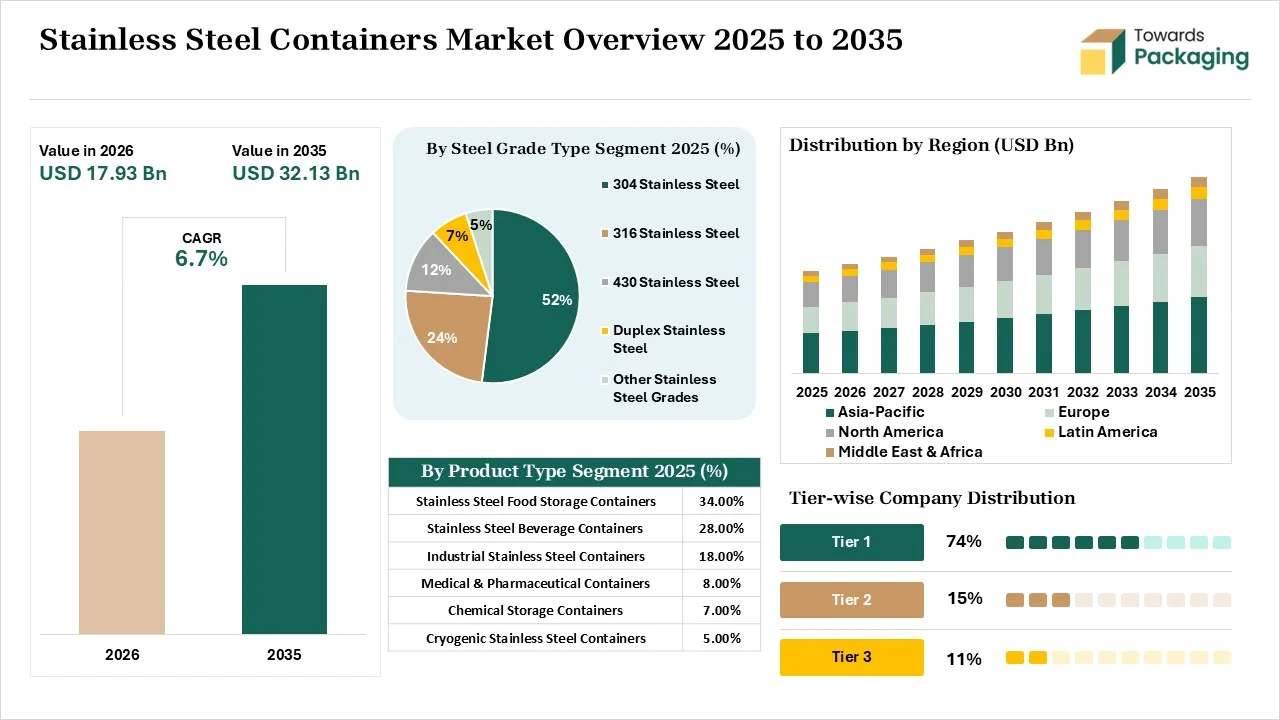
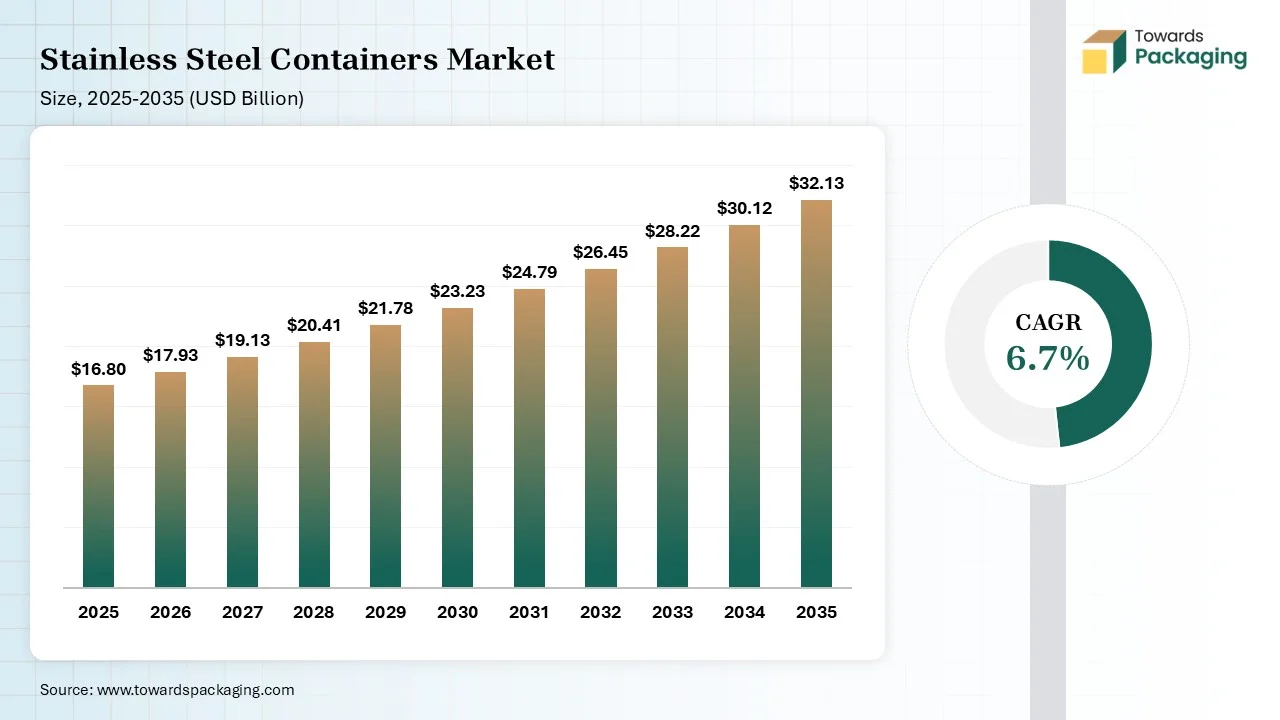
According to Vidyesh Swar, the global stainless steel containers market size was estimated at USD 16.8 billion in 2025 and is predicted to increase from USD 17.93 billion in 2026 to approximately USD 32.13 billion by 2035, expanding at a CAGR of 6.7% from 2026 to 2035. According to the research, the market growth is driven by factors like consumer awareness, global safety guidelines, expansion of lunchware, rise in cryogenic storage, innovations in vacuum insulation, rise in global trade, exploding beverage processing, investment in healthcare networks, demand for durable meal-prep, popularity of hygienic steel containers, and the rapid expansion of large-scale ingredient tanks. The reasons like non-toxic material use, eco-friendly products demand, growing takeaway services, exploding medical logistics, and bulk transport are responsible for the market expansion.
Stainless steel containers are storage units made from stainless steel. The key stainless steel grades used in the production of stainless steel containers are grade 316 and grade 304. It possesses characteristics like high corrosion resistance, exceptional durability, 100% recyclability, easy maintenance, no chemical leaching, excellent longevity, and high sustainability. The popular containers are fridge storage, lunchboxes, and pantry canisters. It offers benefits like non-toxicity, stain resistance, eco-friendliness, and temperature retention. Stainless steel container widely used in commercial brewing, sterile storage, hazardous material transportation, meal preparation, and agricultural product storage. In the food industry is widely used for bulk storage, commercial storage, processing, and transportation. In the chemical industry, it is used for reaction equipment, secure transportation, temperature control, bulk chemical storage, and blending.
In 1912, Harry Brearley discovered corrosion-resistant steel. While developing the steel, the British metallurgists primary focus was on wear resistance. Industries like food and chemical adopted Austenitic grades of steel by the 1920s. Between the 1950 to 1970 industry focused on mass-producing steel. In this period, the Argon Oxygen Decarburization process was developed, which was used for the mass production of stainless steel. In regions like South Asia, stainless steel was used for early tiffin carriers and other household goods. In this, a major limitation was the single-ply lamination. From 1980, the industrys main focus was fixing the heat issues by using multi-layered construction. The manufacturers created a sandwich base to solve heat issues. In 2000, the popularity of induction cooktops increased. The modern era (2010-2020) mainly focuses on digitization of stainless steel, vacuum-insulated stainless steel containers, CNC precision, and other technological innovations. The plastic ban in the period is the main reason for increasing stainless steel adoption. In the present period, the industry focuses on recyclability and circularity of stainless steel and integrating smart tagging.
The market scope focuses on the product type, steel grade, end users, and regions. The market covers products like lunch boxes, meal prep containers, water bottles, drums, storage tanks, food canisters, tumblers, IBCs, pharmaceutical containers, and chemical storage containers. The market excludes products like powder metallurgy, modular building conversions, downstream fabricated products, scrap trading, clad plates, and resale boxes. The market covers steel grades like 304, 430, duplex stainless steel, and 316. The end users included are food & beverage, industrial manufacturing, logistics & transportation, healthcare, laboratories, and many more. The regions like Asia Pacific, Europe, and North America are key contributors to the market.
The growing plastic sustainability concerns, such as destruction of the ecosystem, inefficient recycling infrastructure, high GHG emissions, and chemical toxicity, increase demand for stainless steel containers. Factors like safety concerns, food integrity preservation, and regulatory bans increase demand for BPA-free containers. Policies like National Anti-Corrosion initiatives and Quality Control Orders increase the use of stainless steel containers. The demand for containers that withstand temperature extremes and the increasing ESG commitments of corporate increases use of stainless steel containers. The transition away from plastic containers is a driver for the stainless steel containers market.
The growing EV battery demand and the rising geopolitical issues are responsible for fluctuations in raw material prices. The improvement of corrosion resistance and supply chain disruptions increase the prices of chromium and molybdenum. The fluctuating alloy metal prices directly affect the production cost. The use of processes like rolling & others increases raw materials cost. The volatility in coking coal prices and automotive manufacturing are responsible for fluctuating costs. The import-export tariffs and currency exchange rates increase raw material costs. The fluctuations in raw material prices restrict market growth.
Laboratory applications like hazardous waste handling, pharmaceutical manufacturing, and sampling increase the use of stainless steel containers. The storage of excipients and the transportation of reference samples increase the use of stainless steel containers. The holding of sterilized equipment and the fire-resistant vessel demand increases use of stainless steel containers. The investment in advanced bioprocessing and the prevention of reactivity in pharmaceutical formulations increases the use of stainless steel containers. The growing laboratory applications create an opportunity for the growth of the market.
The collaboration landscape focuses on B2C sustainability and B2B supply chains. The collaboration includes end-user partnerships, feedstock suppliers partnerships, and manufacturers partnerships. Some collaborations are given below:-
In February 2026, Jindal Stainless collaborated with Indian Railways to manufacture stainless steel salt containers. The trials of the containers were done in Gandhidham, Gujarat. The container is made from 304 stainless steel, and the payload capacity of the container is 33 metric tonnes. The containers were designed according to the RDSO prototype. The production partner for the container is Kalyani Cast Tech Private Limited
In July 2026, ISSDA collaborated with GSSE to promote stainless steel in the clean energy transition in India. The stainless steel is used in the development of transportation infrastructure, hydrogen production, and storage. The collaboration focuses on providing stainless steel for new applications like renewable energy, infrastructure development, green hydrogen, industrial processing, and mobility.
The profit of stainless steel containers calculated on the based of selling price and manufacturing price. The manufacturing price depends on the material selection, manufacturing technique, heat treatment, quality control, and surface finishing. Selling price depends on alloy composition, material grade, order quantity, design, thickness, and tolerances.
The manufacturing cost is divided into raw materials, fabrication & labor costs, overhead, and packaging & logistics. The raw material takes 40-50% of the total cost, labor requirements & fabrication process take 25-30%, quality control & overhead accounts for 10-15%, and packaging & shipping account for 5-10%.
The cost-efficient production hubs in Asia Pacific are responsible for aggressive pricing. The price of industrial containers is $1200 to $2000 USD in Asia Pacific. The high energy costs in Europe are responsible for premium pricing of stainless steel containers. The strong pharmaceutical sector in North America increases demand for containers. The price of bulk containers in North America is $2500 to $4500+ USD for the capacity of 500L-1000L.
Raw materials like chromium, recycled scrap metal, iron ore, and nickel are required.
Material processing involves melting, refining, and casting. Conversion includes hot & cold rolling, annealing, and pickling. Fabrication involves cutting steel sheets, creating shapes, welding shaped pieces, and surface finishing.
Design includes CAD modelling, material selection, and DFM. Prototyping involves 3D printed mock-ups and fabricated metal prototypes. Testing involves load testing, leak testing, and ergonomic evaluation.
The stainless steel food storage containers segment dominated the stainless steel containers market with a 34% share in 2025. The consumer focus on lifetime reusability and the need to retain food taste increases the use of stainless steel food storage containers. The expansion of commercial food service operations and the rising number of working population carrying packed meals increase the use of stainless steel food storage containers. According to my study, factors like easy maintenance, thermal regulations, superior health benefits, and lifestyle changes drive the segment growth.
According to my research, the stainless steel beverage containers segment held a 28% market share in 2025 and is expected to grow at the fastest CAGR of 7.6% during the forecast period. The rise in anti-plastic movements and the focus on maintaining the temperature of beverages increase the use of stainless steel beverage containers. The safety concerns in the beverage industry and the focus on avoiding leaching of metallic flavors in beverages increase the use of stainless steel beverage containers. The interest in vacuum-insulated bottles and the smart-tech integration in stainless steel beverage containers supports the segment growth.
The 304 stainless steel segment dominated the stainless steel containers market with a 52% share in 2025. The hot-filling storage of food and the focus on long lifecycle value increase the use of 304 stainless steel. The need for reduction of specialized rust treatments and the development of small thermal flasks increase the use of 304 stainless steel. The huge pharmaceutical manufacturing and perishables transportation increase the use of 304 stainless steel. The excellent corrosion barrier, wide temperature tolerance, and optimal formability of 304 stainless steel drive the segment growth.
The 316 stainless steel segment held a 24% market share in 2025 and is expected to grow at the fastest CAGR of 7.3% during the forecast period. The prevention of pitting for storing salty foods and the storage of sterile liquids increases the use of 316 stainless steel. The development of transport tanks and the surging biotech demand increases the use of 316 stainless steel. The rise in insulated thermos cups helps with expansion. The unmatched chloride resistance, transport durability, and longevity of 316 stainless steel support the segment growth.
The 1-5 liters segment dominated the stainless steel containers market with 33% share in 2025 and is expected to grow at the fastest CAGR of 7.4% during the forecast period. The growing portable container demand for everyday personal hydration increases use of 1-5 liters. Office lifestyles and the interest in vacuum insulation technologies increase use of 1-5 liters. The pantry staples stored in households and expanding commercial kitchens increase use of 1-5 liters. The high convenience, household versatility, and thermal effectiveness of 1-5 liters drive the segment growth.
The up to 1 liter segment held the 26% market share in 2025. The focus on 2-liter daily water intake and the growing outdoor activities increases use of up to 1 liter containers. These size containers are used across the food processing industry and daily commuting. The popularity of up to 1 liter in insulated configurations helps with the expansion. The eco-friendliness and high durability of up to 1 liter containers support the segment growth.
According to my research, the double-wall vacuum insulated segment dominated the stainless steel containers market with a 49% share in 2025 and is expected to grow at the fastest CAGR of 7.8% during the forecast period. Characteristics like exceptional thermal efficiency, superior rust resistance, and sweat-free exterior of double-wall vacuum insulated helps with the expansion. The demand for durable hydration hardware and the rise in meal-prep culture increase the use of double-wall vacuum insulated containers. The hybrid work schedules and the demand for reusable vacuum containers increase adoption of double-wall vacuum insulated containers, driving the overall segment growth.
The single-wall segment held a 38% market share in 2025. The use of single-wall containers in school backpacks, corporate gifting, and gym bags helps with the expansion. The rising sports activities and the creation of food jar collections increase the use of single-wall containers. The non-toxic storage, lightweight portability, affordability, freezer compatibility, and sustainability of single-wall stainless steel containers support the segment growth.
The food & beverage segment dominated the stainless steel containers market with a 31% share in 2025. The storage of acidic foods and the burgeoning commercial food operations increase the use of stainless steel containers. The zero-contamination focus and thermal regulations needed in F&B increase the use of stainless steel containers. The lunchbox manufacturing and maintaining natural integrity of products increases the use of stainless steel containers. Dairy production drives the segment growth.
The hospitality & foodservice segment held a 12% market share in 2025 and is expected to grow at the fastest CAGR of 7.5% during the forecast period. The stringent regulations in commercial kitchens and the need for safe food preparation increase the use of stainless steel containers. The busy culinary environments and the growing number of restaurants increase the use of stainless steel containers. The rise in open kitchens and the use of insulated carriers in the hospitality industry supports the segment growth.
According to Vidyesh Swar, the direct sales segment dominated the stainless steel containers market with a 32% share in 2025. The focus on avoiding markup costs and expanding commercial buyers increases the use of direct sales. The rise in bulk contracts with factories and the development of specific lifestyle narratives increase adoption of direct sales. The specialized brands demand direct communication, and growing B2B clients increase the use of direct sales. The bulk orders drive the segment growth.
The e-commerce segment held a 15% market share in 2025 and is expected to grow at the fastest CAGR of 8.3% during the forecast period. The rise in influencer marketing and the increased online searching for products increases adoption of e-commerce. The increased procurement of high-quality kitchenware and safety awareness increases use of e-commerce. The buying of bulk shipping containers in the retail industry and the availability of premium features increase use of e-commerce. The availability of cross-border trade in e-commerce supports the segment growth.
The food storage segment dominated the stainless steel containers market with a 29% share in 2025. The demand for cost-effective solutions in food storage and the interest in travel mugs increase the use of stainless steel containers. The rise in institutional caterers and the focus on keeping meals sanitary increases the use of stainless steel food containers. The busy consumer and increased food storage in workplaces increase demand for stainless steel containers, driving the segment growth.
The beverage storage segment held a 24% market share in 2025 and is expected to grow at the fastest CAGR of 7.7% during the forecast period. The surge in outdoor activities and the shift away from single-use kegs in breweries increase adoption of stainless steel containers. The storage of citrus juices and the focus on liquid transport efficiency increase the use of stainless steel containers. The popularity of tumblers and the expansion of wineries support the segment growth.
Asia Pacific dominated the stainless steel containers market with a 39% share in 2025 and is expected to grow at a 7.5% CAGR during the forecast period. The strong global metal production base and the growing chemical processing industry increase the use of stainless steel containers. Health-conscious consumers and pro-industrialization policies increase demand for stainless steel containers. According to my study, factors like low regional labor costs, supportive trade regulations, and massive construction increase demand for stainless steel containers. The high utilization of stainless steel tanks and the high consumption of household storage containers drive the market growth.
China
China held the largest share in the market in 2025. The high steel production capacity and the localized network for raw materials increase the production of stainless steel containers. The automated manufacturing and strong port integration increase the production of stainless steel containers. The development of commercial stainless steel products and strong hygienic facilities supports the market growth.
India
India is expected to grow at the fastest CAGR in the market during the forecast period. The safety focus in food industries and the logistics expansion increase the use of stainless steel. The upgraded manufacturing technology and the manufacturing-friendly policies like Make in India increase the use of stainless steel containers. The increased supply of stainless steel kitchenware and the interest in stainless steel water bottles boost the market growth.
According to Vidyesh Swar, Europe held a 26% share in the stainless steel containers market in 2025. The presence of the chemical sector across Western Europe and the increased demand for long-lasting storage containers increase the use of stainless steel containers. The large automotive industry in countries like Germany and growing industrial transport increase the use of stainless steel containers. The interest in reusable kitchenware and the stricter hygiene standards increase the use of stainless steel containers, driving the market growth.
Germany
Germany dominated the market in 2025. The highest chemical production infrastructure and the incorporation of precision processing increase the adoption of stainless steel containers. Domestic initiatives like VerpackG eco-modulation fees and the expansion of the HORECA sector increase the use of stainless steel containers. The growing vehicle manufacturing and the export of engineered machinery support the market growth.
United Kingdom
The United Kingdom is expected to grow at the fastest CAGR in the market during the forecast period. The national green mandates and the expanding chemical logistics increase the use of stainless steel containers. The preference for food-grade materials and the demand for high-strength units in the aerospace industry increase the adoption of stainless steel containers. The high use of Intermediate Bulk Containers made up of stainless steel boosts the market growth.
North America held the 24% market share in 2025. The demand for non-reactive storage solutions in the F&B industry and the adoption of eco-friendly practices increase the use of stainless steel containers. The transition away from chemical-leaching alternatives and the surging catering industry increase the use of stainless steel containers. According to my research, high investment in heavy-duty steel containers and the preference for grade 316 drives the market growth.
United States
According to Vidyesh Swar, the United States dominated the stainless steel containers market in 2025 and is expected to grow at the fastest CAGR in the market during the forecast period due to the growing food storage applications. The leading presence of the biotechnology industry and the strong demand for durable products increase the use of stainless steel containers. The interest in stainless steel tumblers and advanced production environments helps with the expansion. The demand for stainless steel drums and the increased private investment in the defense industry support the market growth.
Canada
Canada is growing in the market. The increasing use of storage tanks in the food industry and the well-established fabrication industry increase the production of stainless steel containers. The hygiene standards in the beverage industry and the investment in non-vacuum containers help with the expansion. The demand for shipping containers and the high use of insulated goods boost the market growth.
Latin America held a 6% market share in 2025 due to the expansion of 304 stainless steel containers. Higher spending on processed food and the transport of hazardous chemicals increases the use of stainless steel containers. The processing of dairy products and the consumption of canned beverages increase the use of stainless steel containers. The demand for contamination-free storage and the focus on transport convenience drive the market growth.
Brazil
Brazil held the highest revenue share in the stainless steel containers market. The massive iron ore presence and strong agricultural processing footprint increase the use of stainless steel containers. The hygiene requirements in drug processing and the established metal fabrication clusters increase the use of stainless steel containers. The explosion of port logistics and the large reserves of raw materials support the overall market growth.
Argentina
Argentina is expanding in the market. The demand for sanitary containers in the agricultural industry and the boom in delivery services increase the use of stainless steel containers. The focus on non-toxic storage and continuous steel supplies increases production of stainless steel containers. The high food export and industrial upgradation boost the market growth.
According to Vidyesh Swar, the Middle East & Africa held a 5% market share in 2025. The demand for durable transport solutions in the construction industry and the stricter health regulations in the pharmaceutical processing increases use of stainless steel containers. The higher adoption of community utility containers and the increased availability of high-performance containers help with the expansion. The rise in massive water treatment and the expansion of insulated food containers drive the market growth.
Saudi Arabia
Saudi Arabia held a dominant revenue share of the stainless steel containers market in 2025. The increased investment in NEOM projects and the active processing industry increase the use of stainless steel containers. The transportation of chemical additives and programs like NIDLP increase the use of stainless steel containers. The surge in luxury hotels and expanding real estate increases the use of stainless steel containers, supporting the overall market growth.
UAE
The UAE is expected to experience the fastest growth during the predicted timeframe. The move away from aluminum non-stick cookware and the rising beverage exports increase adoption of stainless steel containers. Policies like Operation 300Bn and the burgeoning residential projects increase the use of stainless steel containers. The strong hospitality industry and the use of industrial processing tanks boost the market growth.
The stainless steel container market is intensely competitive due to cost-effective manufacturing and product developments. The industry includes well-established global players. Factors like consumer reusability demand, burgeoning corporate sustainability, and manufacturing advancements are responsible for intensive competition. Regional players are also growing in the market. Regional companies like China-based Baosteel, Germany-based Thielmann, and India-based Jindal Stainless are expanding. Leading players in the market are Zojirushi, Muller, Thermos L.L.C., Klean Kanteen, and Tiger Corporation.
| Company | Product Range | Production Capacity or Selling Capacity | Sustainability Initiatives | Development and Collaborations |
| Theilmann | Pressure Vessels, Beverage Kegs, Intermediate Bulk Containers, Industrial Drums, Defense Containers | More than a million containers | Green Energy Transition | Company expanded its stainless steel drum for pharmaceutical and chemical handling. |
| Schafer Werke Group | SUDEX KEGs, ECO KEGs, Silo Tanks, PLUS KEGs, BTA Tank Containers, Insulated Containers | Sold over 25 million containers in 40 years | Sustainable Logistics and Green Steel Development | SCHAFER WERKE Group acquired Automationstechnik GmbH to expand specialized stainless steel containers and IBCs. |
The market is fragmented into stainless steel manufacturers, IBC & specialized containers, and F&B containers. The top players in IBCs and specialized containers are SCHAFER WERKE Group, Servolift GmbH, THIELMANN, and Eagle Stainless. These companies serve industrial logistics and pharmaceuticals. The top players in F&B containers are Thermos L.L.C., Hydro Flask, and Zojirushi. Top stainless steel producers are Acerinox, POSCO, Tsingshan Holding Group, and Outokumpu.
| Company Overview | The company headquarters are located in the United States, and it specializes in stainless steel storage equipment and processing. |
| Manufacturing Footprint | United States, Netherlands, Vietnam |
| Product Portfolio | Processing Vessels, Multi-Compartment Tanks, Pharmaceutical Reactors, Custom Containers, Mixing Vessels, Vertical Storage Tanks, Chill Tanks |
| SWOT Analysis |
Strength Sanitary Design Expertise Weakness Complexity in maintenance Opportunity Biotechnology Growth Threats Low-cost competition |
| Company Overview | The company is a supplier of stainless steel products like stock, tubing, and bar. |
| Manufacturing Footprint | Franklin, Massachusetts |
| Product Portfolio | Sanitary Containers, Storage Tanks, Stability Testing Bottles |
| SWOT Analysis |
Strength Customized Fabrication Capabilities, Excellent Material Quality Weakness High Initial Cost Opportunity Growing Pharmaceutical Industry Threats Stringent Regulatory Changes |
| Company Overview | The Illinois-based company manufactures vacuum-insulated containers like food jars, outdoor equipment, drinkware, and others. |
| Manufacturing Footprint | China, United States, Germany, Australia, Taiwan, United Kingdom, Malaysia, South Korea, Indonesia |
| Product Portfolio | Stainless King Food Jar, Stainless King Beverage Bottle, All-In-One Insulated Meal Carrier, Travel Mugs, Hydration Bottles |
| SWOT Analysis |
Strength Advanced Insulation Capabilities Weakness Low Digital Engagement Opportunity Corporate Branding Threats Counterfeit Limitations |
The drivers for immediate demand are safety consciousness, focus on beverage-grade safety, fuel efficiency, growing automation, and thermal insulation demand. The consumer trends are eco-friendly lifestyles, on-the-go needs, and premiumization of products. The price is expected to grow moderately in the period due to raw material volatility.
In regions like Asia Pacific, production of stainless steel containers is expected to expand due to export demand. Technologies like advanced material engineering and electric arc furnaces are widely used in this period. The pharma processing expansion and F&B growth demand will increase demand.
In this period, premium products like airtight design, advanced thermal insulation, commercial upgrades, and premium alloys gain traction. The demand for temperature-retentive storage solutions will expand. Demand for containers like IBCs will increase in high-stress applications. Investment opportunities like foldable drums and IoT-enabled industrial IBCs will grow.
According to Vidyesh Swar research, the stainless steel containers market is expanding due to the demand for reusable products and focus on sustainability. Factors like eco-friendliness, hygiene, healthcare expansion, and durability demand drive the growth. Food storage containers are a major contributor to the market growth. Factors like meal prep trends and health requirements increase the use of food storage containers. The widely used containers are kitchen canisters and lunch boxes. Asia Pacific widely uses stainless steel containers due to the high raw material production, growing disposable incomes, and commercial expansion. The region widely uses stackable tiffin boxes made up of stainless steel. Companies like SCHAFER WERKE Group, Servolift GmbH, Thermos L.L.C., Theilmann, Klean Kanteen, and Tiger Corporation are major producers of stainless steel containers.
By Product Type
By Steel Grade
By Capacity
By Insulation Type
By End User
By Distribution Channel
By Application
By Region








Principal Research Analyst
Vidyesh Swar is a Senior Research Analyst at Towards Packaging, bringing over 4 years of dedicated expertise in market intelligence and strategic analysis across the dynamic world of packaging technologies and solutions.
Learn more about Vidyesh Swar

Reviewed By
Aditi Shivarkar, with 14+ years in packaging market research, specializes in food, beverage, and eco-friendly packaging. She ensures accurate, actionable insights, driving Towards Packaging Analytics & Consulting 's excellence in industry trends and sustainability.
Learn more about Aditi Shivarkar


Stainless Steel Containers Market
 Table of Content

 Download Sample
 Schedule a Meeting