


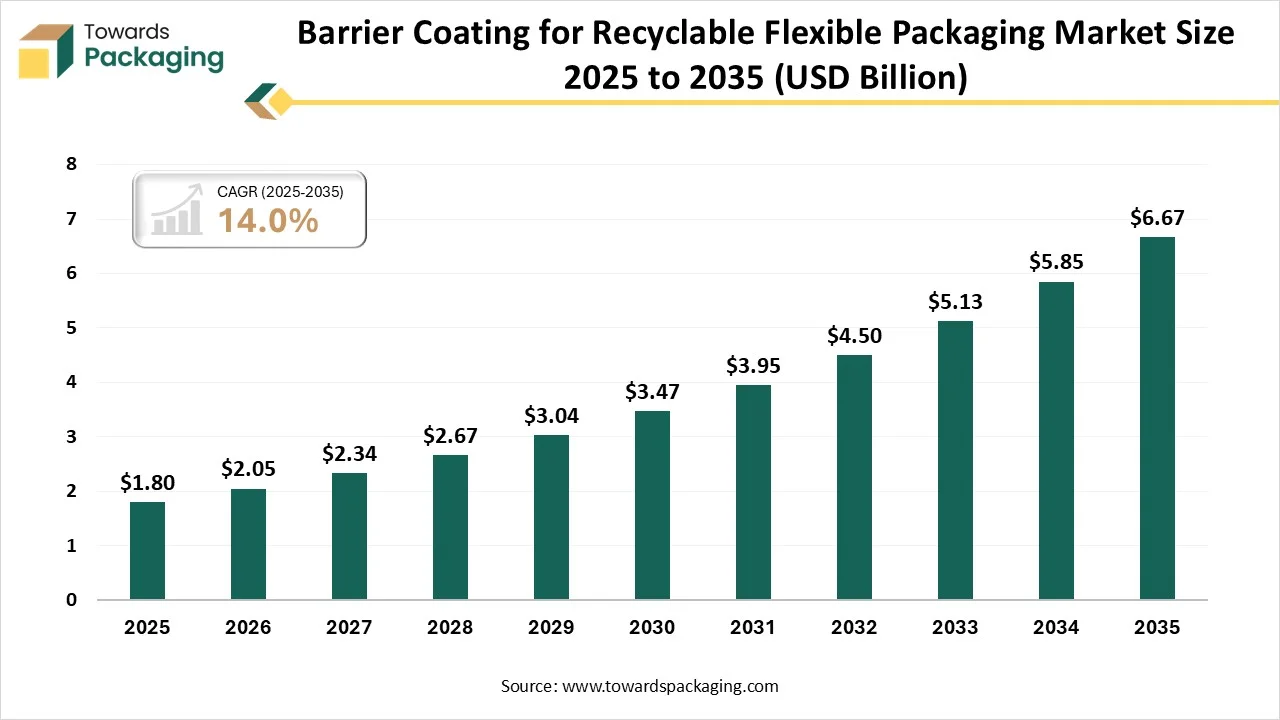
The barrier coating for the recyclable flexible packaging market is forecasted to expand from USD 2.05 billion in 2026 to USD 6.67 billion by 2035, growing at a CAGR of 14.0% from 2026 to 2035. There is high demand for this packaging as they move from non-recyclable, complicated, and multi-material plastics to simple and recyclable mono-materials such as mono-PE or paper while still serving important functions against various external factors.
Barrier coating for the recyclable flexible packaging prevents products from oxygen, moisture, light, and pollutants, which helps track freshness and extend the shelf life. Prevalent materials include aluminum for strong gas and moisture resistance, glass for dense, and plastics such as PP and PET for flexible protection. Additionally, a barrier in terms of flexible packaging is served by foils/metallized films and specialty films, which protect products from external factors such as oxidation, humidity, and sunlight too. It assists in expanding shelf life, preventing degradation or spoilage, and tracking freshness.
Intelligent packaging is implemented in recyclable flexible packaging, which uses digital elements to serve real-time details and develop traceability. Visual showcases, such as temperature-sensitive labels, are becoming more common, as well as technologies that count NFC(Near Field Communication), QR codes, and RFID (Radio-Frequency Identification) tags. Such potential allows users to get more information about the item, check the product, and analyze expiry dates, or get the application rules by just scanning their mobile phones.
Multi-layer flexible materials are challenging to recycle. But the sector is quickly developing, as inventions such as mono-material films now enable flexible packaging to penetrate the recycling stream through store drop-offs or the specialty programs, too.
The recycling of the flexible plastic packaging counts items such as bread bags, crisp packets, and bubble wrap, too, which is complicated due to its lightweight nature and multi-surfaced composition. Currently, while store drop-off programs and industrial initiatives are perfectly established for simple films, and curbside collection for household flexible plastics, which is constantly being expanded globally through various legislative compulsions and pilots, too.
The logistics and distribution of the recyclable flexible packaging, such as films, pouches, and wraps, are being centered on circular economy rules. This counts on updating materials for convenient handling and establishing strong reverse logistics systems to process and capture used materials. Effective internal logistics, by using the automated warehouse roller conveyors and the IoT sensors, ensures high-speed handling of various flexible designs.
The water-based barrier coatings segment has dominated the barrier coating for a recyclable flexible packaging market as they are thin and protective surfaces that are used on paper or paperboard layers by using a water-based formulation. Its aim is to oppose water, grease, oil, and other pollutants that serve barrier characteristics regularly and are received through plastic covering or the wax coatings too. Unlike solvent-based coatings, which liberate VOC (volatile organic compounds), water-based coatings are eco-friendly and safe to generate and apply.
The bio-based barrier coatings segment is predicted to witness the fastest CAGR during the forecast period. They have come up with complicated inventions in sustainable packaging solutions over the last decade. Implementing the functional additives into bio-based barrier formulations can crucially develop their performance. Such additives contain silicates, nano clays, anti-microbial compounds, and waxes too, which can develop barrier properties while using the workability, such as UV protection and antimicrobial activity.
The oxygen barrier segment dominated the market in 2025, as these films are being designed with several layers, as every layer serves a particular function in preventing the food from being oxidized. Barrier layers are responsible for protecting oxygen from transitory packaging. Materials such as polyvinylidene Chloride (PVDC), ethylene vinyl alcohol (EVOH), and metallized coatings are prevalent because of their perfect oxygen-blocking properties. The application of these films is highly active in preventing oxidation, tracking crunchiness, and flavor, as nuts, crisps, and chocolates are excessively fragile to oxygen exposure.
The moisture/water-vapour barrier segment is expected to experience the fastest CAGR during the forecast period. Moisture barrier packaging serves this necessary level of protection, preventing moisture from the surroundings from polluting package-sealed products. This kind of packaging is specifically applicable when it comes to keeping sensitive contents, such as food products or pharmaceuticals. This material should also safeguard against aromas and gases that can affect the quality and freshness of stored products.
The films segment has dominated the barrier coating for recyclable flexible packaging market in 2025 because LDPE is a terribly lightweight and flexible plastic material in its actual sense, which is a thermoplastic created from monomer ethylene. Such films are well known for their low temperature durability, flexibility, chemical and environmental resistance, and corrosion resistance, too. Secondly, BOPP Films flaunt undeniable resistance and reliability for moisture contact, along with additional advantages like clarity, which makes it a perfect choice with respect to retail packaging. Furthermore, PET offers high-barrier elements and develops durability with applications in snack foods, coffee packaging, and high-barrier food applications.
The pouches and bags segment is predicted to witness the fastest CAGR during the forecast period. Flexible packaging pouches and bags are sturdy, tiny, and perfect for high-speed production procedures like horizontal form fill seal (HFFS) packaging, which effectively seals and fills pouches. Additionally, flexible pouches assist with personalized designs and branding while lowering the material usage. The stand-up gusset pouches are being made with a gusseted bottom, which allows products to stand strongly on the shelves, making them ideal for detergents, tea, and pet food. Moreover, zipper reclosable pouches are the ideal solution as they enable users to reseal the package after opening and storing items like candies and granola.
The food and beverages segment has dominated the market in 2025 as their plan is to make sure that materials stay in application for a longer period, which assists a circular economy, lowering one’s carbon footprint and decreasing the plastic waste too. Several brands are shifting towards mono-material packaging (a packaging that is created from just one kind of plastic), such as recyclable packaging, which is created from recycled plastics.
For instance, some main beverage organizations are changing the packaging designs to use paper-based cartons, aluminum bottles, and recycled materials instead of plastic bottles to help sustainability goals.
The healthcare and pharmaceuticals segment is expected to witness the fastest CAGR during the forecast period. The integration of aluminum, PVC, and other materials utilized in this kind of packaging results in a complicated waste stream, which shifts away from multi-layer packaging, making disposal and recycling simple, thus reducing the volume of medical packaging waste that ends up in landfills. The capability to recycle flexible packaging in the standard plastic recovery systems makes it a highly sustainable selection for organizations to develop their eco-friendly effect without compromising product safety.
Sustainability is now a benefit, with pharmaceutical organizations that are being measured on their surrounding loyalty. Accepting complete recyclable flexible packaging strengthens corporate responsibility efforts while assisting organizations align with regulatory liners more effectively.
The Asia Pacific region has dominated the barrier coating for recyclable flexible packaging market in 2025, as mechanical recycling is long-standing throughout Asia, specifically in Northeast Asia and the Indian subcontinent. In today’s scenario, recycling installed potential is over 18 million tones each year, with China has of 66% and India with 8%. On the other hand, chemical recycling is an initial market as compared to mechanical recycling, as most of the fixed working capacity is focused on Northeast Asia, where predominant countries have well-designed waste management systems.
How is Barrier Coating for Recyclable Flexible Packaging Market Growing in India?
The barrier coating for the recyclable flexible packaging market demand in India has policies that market Extended Producer Responsibility (EPR), advanced recycling technologies, and recycled content, which were referred to as complicated drivers that develop India’s transformation towards a circular economy. In India, reusability, recyclability, and recycled content have developed as the most crucial sustainability element that drives the choice for materials such as paper and glass.
The barrier coating for the recyclable flexible packaging market is growing in North America, as to align with the recyclability focus, brand owners are shifting away from regular multilayer laminates towards mono-material designs (which are initially PP or PE), which are convenient to implement in the current recycling procedure. Additionally, the growth of online retail has developed the urge for durable and lightweight pouches and mailers that lessen shipping costs and the carbon footprint as compared to strong alterations.
Why is Canada using the Barrier Coating for the Recyclable Flexible Packaging Market? Importantly?
The initial aim of penetrating the Canadian barrier coating for recyclable flexible packaging market is to highlight the quickly developing urge for sustainable packaging solutions, which is driven by the developing environmental awareness, shifting user choice, and strict regulatory frameworks. Canada’s loyalty to eco-friendly sustainability, linked to its high-level production structure and an impartial industry for environmentally friendly discoveries, makes it an attention-grabbing region for decisive growth.
The barrier coating for recyclable flexible packaging market in the region is growing, as in Europe. PPWR and the national taxes, such as the UK’s plastic packaging Tax on the packs that have <30 % recycled content, are allowing brands to shift away from multi-material laminates towards mono-material structures.
There is an urge for durable, lightweight, and protective flexible mailers, which are developing as direct-to-user and grocer shipments develop. Pouches are the fastest -developing item designs, which are substituting rigid designs in the space of pet food, home care, and ready meals because of lower logistics costs and the material application.
Germany Barrier Coating for Recyclable Flexible Packaging Market
Germany is excessively using recyclable flexible packaging, which is driven by the developments from solution providers and end-users, too. The rigid user trust in the products being labelled as ‘Made in Germany' has developed the performance of the local plastic packaging films. This region is the frontline of the European pharmaceutical industry and ranks fourth worldwide.
Hence, the urge for flexible packaging acceptance, especially in the pharmaceutical scenario, is being driven by the capability to protect tablets, medications, and capsules from moisture and oxygen, also safeguarding their potency till usage.
In the Middle East and Africa, the barrier coating for recyclable flexible packaging market is growing steadily as the packaging organizations in this region have witnessed constant development over the last year because of updated user expectations and a growing population. Environmental factors and sustainability can continue to be underscored in the regions where the industry is expecting different inventions in terms of packaging materials, growing demand for sustainable and recyclable materials, as recycled PET and bioplastics are driving the market development.
UAE Barrier Coating for Recyclable Flexible Packaging Market
The UAE barrier coating for the recyclable flexible packaging market is led by pouches, as they are portable, versatile, and resealable. Polyethylene remains the main material choice due to its power, recyclability, and moisture resistance, too. Such trends assist the UAE’s Net Zero 20250 goals and the shift towards bio-based packaging. With the help of new technologies, sustainability policies, and developing user demand, the UAE recyclable flexible packaging industry is on a path to becoming a regional leader.
By Coating Type
By Barrier Function
By Flexible Packaging Type
By End-Use Industry
By Region







Research & Advisory Analyst
Yogesh Kulkarni is an experienced Research Analyst specializing in the packaging sector, with a strong foundation in statistical analysis and market intelligence. He currently contributes his expertise to Towards Packaging.
Learn more about Yogesh Kulkarni

Reviewed By
Aditi Shivarkar, with 14+ years in packaging market research, specializes in food, beverage, and eco-friendly packaging. She ensures accurate, actionable insights, driving Towards Packaging Analytics & Consulting 's excellence in industry trends and sustainability.
Learn more about Aditi Shivarkar

Barrier Coating for Recyclable Flexible Packaging Market
 Table of Content

 Download Sample
 Schedule a Meeting