


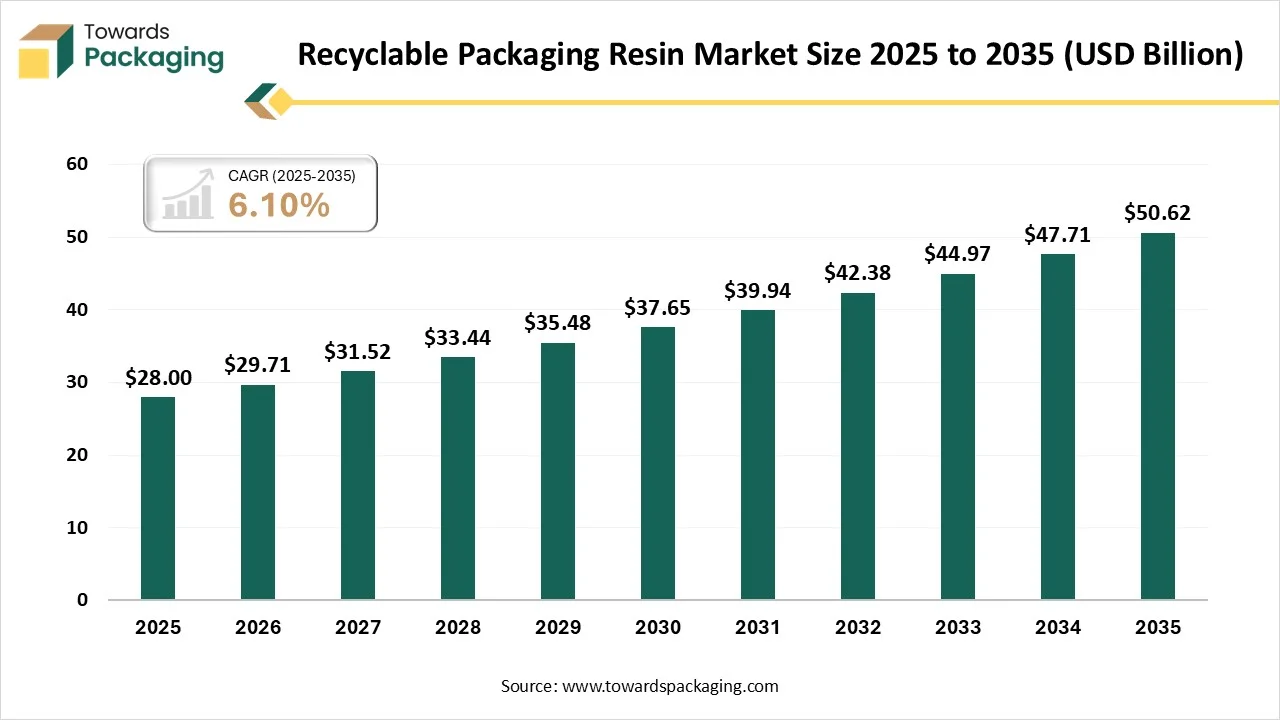
The recyclable packaging resin market is forecasted to expand from USD 29.71 billion in 2026 to USD 50.62 billion by 2035, growing at a CAGR of 6.10% from 2026 to 2035. The demand is due to growing user demand for sustainable packaging, driven by rising environmental awareness and the urge to reduce waste.
Recyclable packaging resin is a material that can be easily collected, classified, or even recovered and made for reuse and recycling as a secondary raw material. Some of these materials include paper, cardboard, aluminum, glass, as well as particular plastics, which are recyclable and are counted as eco-friendly packaging alternatives to single-use plastics.
Current inventive packaging solutions widely accept recycled material. By using post-consumer materials, the organizations can update high-quality packaging with less need for virgin resources. This discovery is mainly in the creation of FIBC bags, tarpaulins, and BOPP bags, which are a reliable yet sustainable option too. Secondary trend is making growing and packaging that can be reused multiple times.
Polyethylene segment dominated the recyclable packaging resin market in 2025 as current inventions in the polyethylene technology are allowing mono-material packaging and recyclability with various discoveries such as BOPE and all-PE barrier and sealant resins, too. Such latest resins are delivering more possibilities for recyclability to regularly non-recyclable packaging designs, which are flexible packaging. It depends on multi-material laminates in order to meet performance demands.
The Polyethylene Terephthalate (PET) segment is predicted to witness the fastest CAGR during the forecast period. Plastic bottle recycling uses less energy compared to the production of the latest material from a raw material, which has reduced emissions during production, thus lessening the overall carbon emissions in the sector. Recycled plastic also assists in smoothing the logistics. Its lighter weight nature means the shipments use low fuel, which leads to efficiency and savings among distribution links.
The rigid packaging segment has dominated the market in 2025 as they have received huge attention across different sectors due to a unique combination of advantageous elements. Their durability ensures that products are perfectly protected from effects and external factors too, which has stretched their lifespan and lowered the damage at the time of handling and transportation. Such a strong nature is important for packaging sensitive, poor, and high-value products that safeguard their entire supply chain.
The flexible packaging segment expected to witness the fastest CAGR during the forecast period. They are constantly updating, specifically in the space of sustainability. With developments in biodegradable and recyclable materials, producers are striving to create flexible packaging that is more eco-friendly. Future growth can count on intelligent factors, such as resealable closures and QR codes, that serve developed functionality and communication.
The food and beverage segment dominated the recyclable packaging resin market in 2025, as food packaging is regularly disposed of in landfills, with several tons that are discarded per year. Recyclable packaging can usually lower the volume, as materials like paper, glass, and particular plastics can be reused and repurposed. The manufacturing and disposal of food packaging are responsible for a significant portion of carbon release. Hence, recyclable packaging, however, frequently needs less energy to generate and can be used several times, which leads to a lower carbon footprint.
The pharmaceuticals and personal care segment is projected to witness the fastest CAGR during the forecast period. Recycling professionals in pharmaceutical packaging often need high-level technologies to differentiate the waste streams that can be costly to use and work, particularly when the economic return from the recycled materials is less. Organizations are excessively shifting to mono-material packaging, that is, using a single kind of material or plastic completely. Furthermore, eco-design rules are being accepted to make packaging that is both environmentally and socially responsible.
The virgin recyclable resins segment dominated the recyclable packaging resin market in 2025, as virgin polymers are plastic materials created directly from petrochemical raw materials like crude oil or natural gas. They have not been utilized or used before, which means they are constant and clear for integration. Virgin resins are prevalent in the sectors that need perfect standards in terms of food containers, medical packaging, automotive safety parts, and aerospace elements. Such materials are being crafted to serve performance without adjustment.
The recycled resins segment is predicted to witness the fastest CAGR during the forecast period. rPET is a recycled PET. It is a PET that has already been utilized at least once, recycled, and kept back too. Currently, recycling displays a more sustainable substitution for the raw materials of virgin PET in the manufacturing of the latest beverage containers. Additionally, the urge for food-grade rPET packaging for plastic bottle manufacturing is actually growing the supply.
Europe has dominated the recyclable packaging resin market in 2025 as the European Union’s Packaging and Packaging Waste Regulation has marked a major shifting point for the recyclable packaging. They are a central space of the EU’s Green Deal and Circular Economy Action Plan, whose aim is to solve the fastest developing packaging waste issue. Due to the latest principles, all packaging in the EU industry should be recyclable by the year 2030 at an economically viable cost.
Germany is using Recyclable Packaging Resin Market crucially; it's growing as an integral frontier in the transformation to more sustainable materials. As the country develops its efforts to lower carbon emissions, align with the ambitious surrounding focus, and develop circularity, the biobased solutions, such as PLA (polylactic acid), are receiving appreciation. The official acceptance of recyclable packaging resin solutions in Germany and its reflection on worldwide markets is primarily being driven by the growing environmental consciousness and strict regulatory pressures.
The Recyclable Packaging Resin Market is developing rapidly in the Asia Pacific because in several parts of Asia, recycling still depends on links. Small-range processors and collectors are tracked as the backbone of waste management, particularly in countries such as India, Vietnam, and Indonesia. India is also proactively pushing ahead with an extended producer responsibility (EPR) compulsions globally.
The Recyclable Packaging Resin Market is growing in India, as the development is being driven by growing awareness about the environmental impact, rigid demand from FMCG, e-commerce, and food and beverages sectors, and government bans on single-use plastics. In India, packaging manufacturers are investing in the latest materials, updating their supply chains, and aligning with carbon-neutral goals. The expanding cost of traditional plastics and user enthusiasm to pay more for environmentally friendly products are growing the acceptance.
By Resin Type
By Packaging Type
By End-Use Industry
By Source
By Region







Research & Advisory Analyst
Yogesh Kulkarni is an experienced Research Analyst specializing in the packaging sector, with a strong foundation in statistical analysis and market intelligence. He currently contributes his expertise to Towards Packaging.
Learn more about Yogesh Kulkarni

Reviewed By
Aditi Shivarkar, with 14+ years in packaging market research, specializes in food, beverage, and eco-friendly packaging. She ensures accurate, actionable insights, driving Towards Packaging Analytics & Consulting 's excellence in industry trends and sustainability.
Learn more about Aditi Shivarkar

Recyclable Packaging Resin Market
 Table of Content

 Download Sample
 Schedule a Meeting