


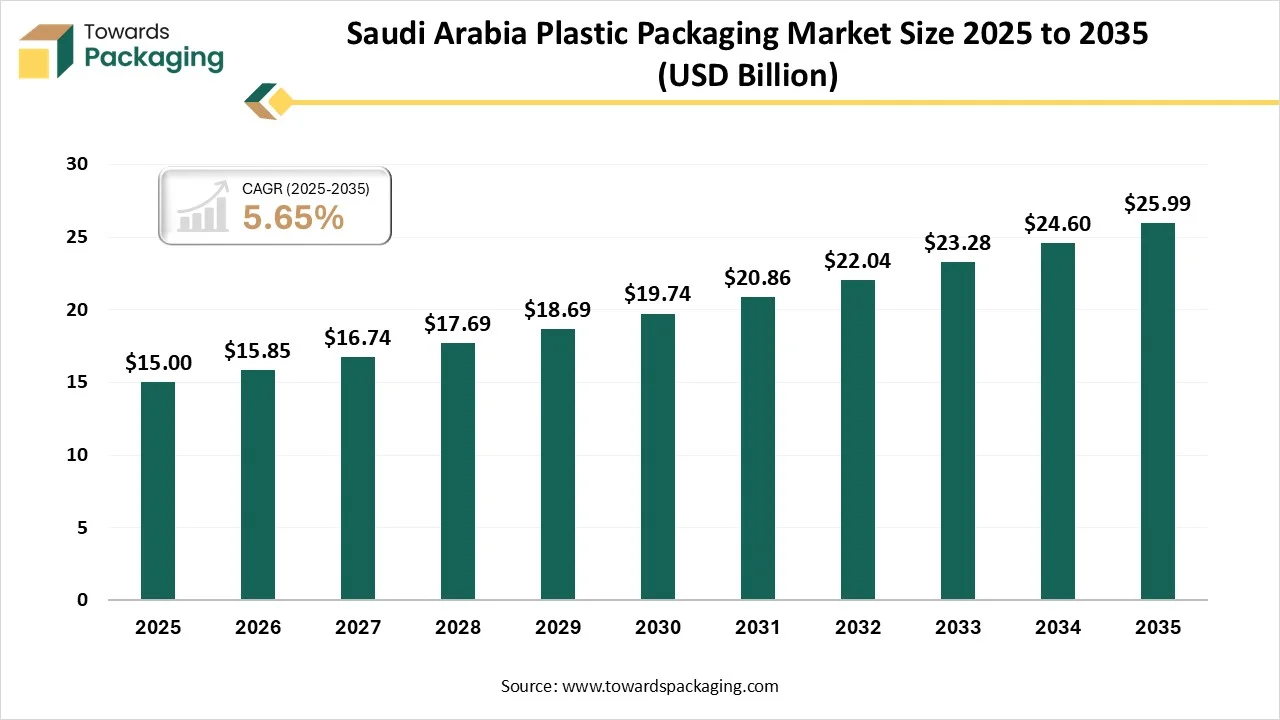
The Saudi Arabia plastic packaging market is projected to grow from USD 15.85 billion in 2026 to USD 25.99 billion by 2035, expanding at a CAGR of 5.65% during 2026–2035. The report provides detailed insights on market size, segment-wise analysis, regional demand trends, and growth drivers such as rapid urbanization, expansion of the middle-class population, and increasing consumer spending on packaged food products. It also includes competitive analysis, company profiles, value chain analysis, trade data, and detailed information about manufacturers and suppliers operating in the Saudi Arabia plastic packaging industry.
Plastic packaging is a reliable and widely used material that plays a crucial role in protecting, preserving, and transferring products. Its durable, flexible, and cost-effective nature makes it a perfect selection for different sectors, from electronics to food and beverages and pharmaceuticals. Additionally, plastic has updated the packaging industry by extending the shelf life of fresh food, by allowing necessary health uses, by funding safer and lighter shipping, and by lowering emissions.
Lightweighting has emerged as the main invention in packaging design, which has served as a practical solution to develop sustainability while assisting plastic recycling efforts in 2025. By lowering the material use without adjusting durability, strength, or functionality, the lightweight packaging lessens the eco-friendly effect and avoids manufacturing costs. This strategy is receiving attention across industries such as e-commerce, food and beverages, and personal care, in which packaging mainly encourages product safety and the user's point of view.
As more brands accept lightweighting methods, they not only solve user demand for environmentally friendly solutions but also align with ESG goals. This changing trend shows that the polymer companies and brand owners stay loyal to lowering their carbon footprint and developing a circular economy, which shows the way for a more sustainable future.
The polyethylene terephthalate (PET) segment dominated the Saudi Arabia plastic packaging market in 2025 as it is strong and durable, offering effective opposition. It will not break down, which makes it a perfect glass substitution for uses. It is also lightweight in nature and displays perfect transparency. Such material has perfect chemical resistance and tracks its ethical behavior when they are discovered to factors like ultraviolet rays, chemicals, and alkalis. PET also has aligned barricade properties against carbon dioxide, moisture, and oxygen, which is particularly helpful while protecting packaged goods. PET can have a highlighted look that develops the packaging’s visual appearance. It also serves high clarity, which enables users to look at the products in terms of packaging.
The polypropylene (PP) segment is projected to witness the fastest CAGR during the forecast period. Polypropylene has come up as the crystal clear frontline. They are created from variety of plastics ,which are widely used in categories of agriculture, food ,aeronautics and electronics because of its recyclability, durability and the cost-effectiveness nature. Its classified feature of sustainability and cost-effective creates it as more necessitate material for the protective transportation and storage of goods. Polypropylene are also semi0crystalline kind of polymer which is chosen for its durability and strength nature.
The food & beverages segment dominated the Saudi Arabia plastic packaging market in 2025 because in food packaging, PET is utilized for dry food containers, edible oil bottles, dairy packing, ready-to-eat trays, and condiment jars. Its reliability with food link packaging material and its opposition to moisture create the perfect conditions for both expanded shelf life and short shelf life. In the beverage packaging solutions, PET has dominated carbonated drinks, juices, bottled water, and functional beverages. Its lightweight nature has integrated with structural structure, enabling producers to update the supply chain without compromising container integrity. Plastic packaging material also plays an important role in user and household packaging. Liquid detergents, personal care bottles, pharmaceutical packaging, and cosmetic containers depend on PET for durability, clarity, and chemical resistance.
The pharmaceutical and healthcare segment is expected to experience the fastest CAGR during the forecast period. As a synthetic polymer, plastic materials have heavily substituted inorganic materials like glass and metal in pharmaceutical packaging because of their low cost, flexibility, and ease of manufacturing. Polypropylene(PP), polyethylene (PE), and polyvinyl chloride (PVC) are well-known as plastic materials used in pharmaceutical packaging. They release perfect flexibility. As it enables making sure different drug shapes, along with superior chemical stability, have frequently reacted chemically with pharmaceuticals.
The Saudi Arabia plastic packaging market is seen to grow notably as the food and beverage industry in Saudi Arabia is expected to gain USD 30 billion, which serves the rigid driver packaging discoveries. This development has largely been filled by the Saudi Arabia’s food security programs. The field’s growth has been driving the urge for solutions that protect food quality and expand shelf life as users move towards quality and convenience. Inventions such as modified atmosphere packaging and vacuum sealing are becoming increasingly crucial for future growth in the packaging industry.
The e-commerce industry in Saudi Arabia is projected to reach USD 13 billion, which has driven the urge for packaging solutions personalized to online retail, including lightweight, durable, and protective materials, specifically for flexible and corrugated cardboard pouches. As more users move online shopping, the overall demand for protective and secure packaging is becoming so important that producers have been ordered to update and accept their services to align with growing market demands.
Plastic cases, bags, and plates-on these products; the current regulations are being affected by the current regulations. As per the regulations of the accountable Saudi organization (SASO), plastic products should be made of an Oxo-biodegradable material.
Packaging and products created with polypropylene or polyethylene must comply with the current principles and have an oxo-biodegradable expert from a supplier that is checked by the Saudi Arabian government. To cross-verify imported products precisely, the customs authority in Saudi Arabia has worked with a laboratory.
By Material
By Application








Research & Advisory Analyst
Yogesh Kulkarni is an experienced Research Analyst specializing in the packaging sector, with a strong foundation in statistical analysis and market intelligence. He currently contributes his expertise to Towards Packaging.
Learn more about Yogesh Kulkarni

Reviewed By
Aditi Shivarkar, with 14+ years in packaging market research, specializes in food, beverage, and eco-friendly packaging. She ensures accurate, actionable insights, driving Towards Packaging Analytics & Consulting 's excellence in industry trends and sustainability.
Learn more about Aditi Shivarkar

Saudi Arabia Plastic Packaging Market
 Table of Content

 Download Sample
 Schedule a Meeting