


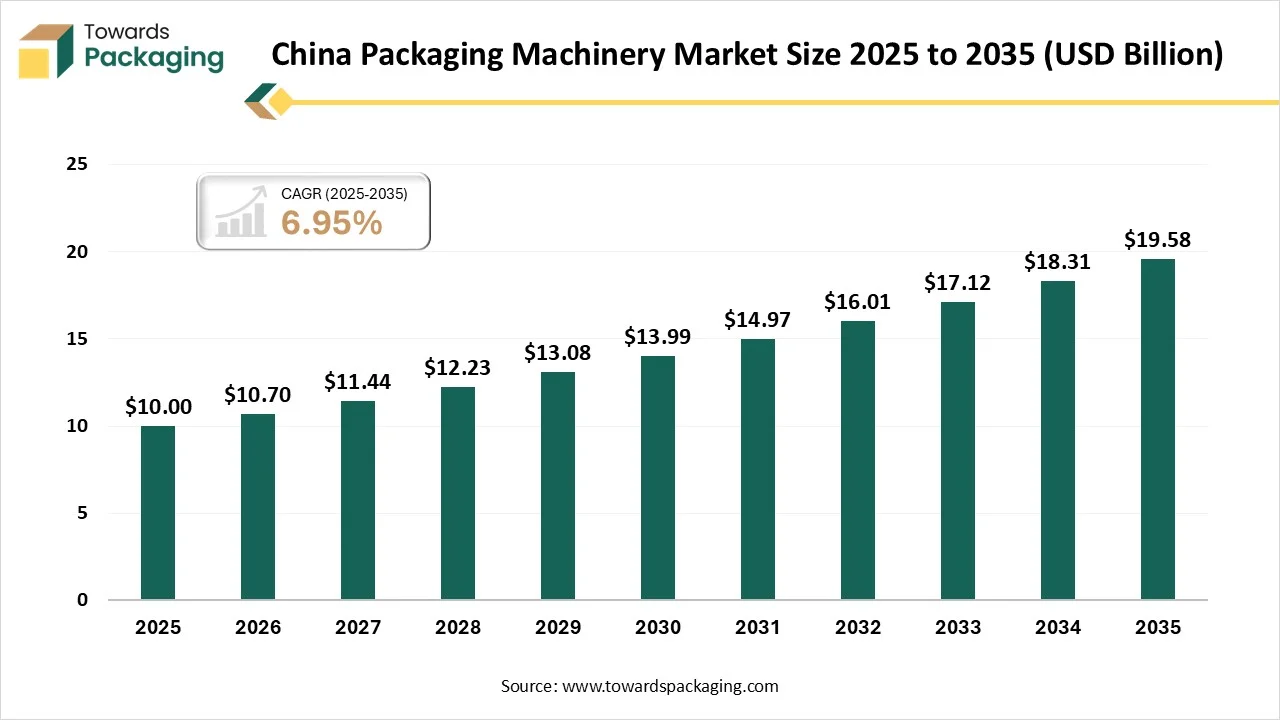
The China packaging machinery market is projected to grow from USD 10.7 billion in 2026 to USD 19.58 billion by 2035, registering a CAGR of 6.95% during 2026-2035. The report provides comprehensive insights including detailed market size statistics, segment-wise data by machinery type, automation level, and end-use industries. It also covers regional demand analysis across major Chinese provinces, trade and import-export data, value chain analysis, and competitive benchmarking of leading manufacturers, suppliers, and technology providers in the packaging machinery industry.
Packaging machinery has automated the procedure of protecting and incorporating products for distribution goals. It counts machines for filling, sealing, labelling, and wrapping. Such machines run by using conveyors, sensors, and programmable controls to ensure accuracy, speed, and consistency at the time of packaging across different product types. They also include automated systems that make products for storage, distribution, sale, and usage.
AI’s impact and transformation on this sector have brought robotic integration to the limelight, bragging about the automated packing machines like robotic arms' contribution to this sector. The arms scan, pick, and organize items accurately just like a human hand, but with more accuracy and less error. The potential of analyzing future scenarios alleviates the requirement of human interventions as AI algorithms are in rhythm with the market strategy and expansion, calculating possibilities.
The brilliant sorting of the products featuring the capacity and involvement of AI-sponsored recycling machines is helping the environment to follow the ‘no plastic’ rule. While the AI visual inspection is sharpening the detection power and ensuring automatic alignment of content. This is essential for the pharmaceutical and food sectors. The AI Plus policies are welcoming brand new automated and smart solutions to further join hands with the environment by mitigating material waste.
The packaging sector is experiencing a huge change, which is driven by developments in artificial intelligence and robotics. Current machines are not only automated, but they are also smart. Robots that are filled with AI can understand their surroundings. They get adjusted to various tasks without huge reprogramming. Such flexibility allows producers to update between products smoothly. Mergers between robots and humans are also developing. Partnering robots, or cobots, operate alongside workers to develop effectiveness while managing the safety standards.
Such technologies optimize operations smoothly, which lowers labor costs and increases productivity across different sectors of packaging machinery.
The best in class popular initiatives are focusing on sustainable packaging solutions as the polished guidelines and rigorous regulations are introducing sincerity in the industry. The use of 5G, IoT, and AI in the packaging space is supporting advancements like 5G remote monitoring and real-time monitoring. The regional acceptance for the customized designs, mainly for popular cosmetics, pharmaceutical, and food sectors, is attracting fancy profit and businesses to the regional industry.
The advanced machinery has embedded the security shield, like foreign objects, and vision systems. This visionary initiative is a power to the industry vision, which is seeking enhancements to expand the engagement meeting needs of diversified sectors.
The impressive innovations are derived from the acceptance and righteous use of the tech advancements in the correct space of innovation. The modernized sealing procedure unlocks the potential of the accurate vacuum and ultrasonic packing procedure. While the sustainability trend is stimulating machines' confidence in achieving green technology standards. The popular use of vast data analytics is strengthening the digitization power, complementing innovations and supporting lengthy packaging processes.
The filling machines segment dominated the market in 2025, as they are an industrial machine that uses and automates the procedure of dispensing precise amounts of products into different packaging. They are easily accessible in a series of configurations, which depend on the kind of product that is filled, which includes powders, liquids, and heavy products like gels and creams. They run by drafting the product from one hopper and then counting and dispensing it into containers by using pistons, pumps, and augers. Apart from the filling procedure, several of these machines integrate additional functions like quality control and sealing to ensure that every container aligns with compulsory standards.
The form-fill-seal machines (FFS) segment is projected to witness the fastest CAGR during the forecast period. They create a package, fill the package with a product, and then finally seal it. It begins with a big roll of film, which is formed into a bag design. The machinery then fills the bag with any product and packs it vertically or horizontally. Such machines have become unavoidable in sectors like pharmaceuticals, food and beverages, cosmetics, and beyond, that serve a smooth and effective packaging solution.
The automatic packaging machinery segment has dominated the market in 2025 because this packaging is especially for FMCG, other high-tech and robotics machines are used for sealing, filling, labelling, palletizing, and case packing for high-demand products like drinks, food, household, and cosmetics goods. Alike the outmoded procedures, FMCG packaging automation utilizes robotic arms and conveyors, which need very little to no human interference for constant actions and accuracy at unaligned speeds.
The semi-automatic packaging machinery segment is projected to witness the fastest CAGR during the forecast period. They demand human communication at some stage, but they are constant and much quicker than manual procedures. For instance, semi-automatic filling mechanisms need an operator to keep the containers and make a move. The machine completes the container, which is then shifted to the next procedure of the process by the operator. The next shift is generally a semi-automatic cap fixing machine that positions the filled containers and tightens the cap. Semi-automatic machines serve different benefits to companies that have medium manufacturing requirements.
The food and beverages segment dominated the China packaging machinery market in 2025, as the food packaging machine enables one to run with food products at a serving surface of a location and compare them with other items. The scope of a food packaging machine serves applications by using cover applications that count packaging materials, marking or coding the packets, and filling various containers. Furthermore, these protect the making of aid and messes in the culinary field, which secures food for a long time by preventing pollutants or decomposing them. Efficiency, automation, and green technologies will continue to update the food packaging sector due to food packing machines that can process a large volume of products in a shorter period.
The pharmaceuticals segment is projected to experience the fastest CAGR during the forecast period. Pharmaceutical packaging machinery can be recognized in many spaces depending on its capabilities and functions. Some of the most prevalent kinds of packaging machinery used in this industry include bottle filling machines, blister packing machines, labelling machines, and cartooning machines. Blister packing machines are utilized to package solid dosage forms, such as capsules and tablets, in particular blisters made of aluminum foil or plastic. Such machines can manage various shapes and sizes of blisters and have the potential to print crucial information, such as batch numbers and expiration dates.
The primary packaging machinery segment dominated the market in 2025, as they are primary and most complex layer. They are packaging which comes into direct connection with any product. For food, personal care products, pharmaceuticals, such surfaces are strongly tracked by hygiene regulations and the quality standards. The machine uses at these platforms which are usually expeditious and accurate. Several routine machines include flow wrappers, VFFS machines and premade pouch machines.
The tertiary packaging equipment segment is projected to experience the fastest CAGR during the forecast period. These are generally cartoners, tray formers, wraparound case packers, and multipack over wrappers. Every machine type carries a particular secondary design, but the running principle is the exact one, as the flow of primary packs, that keeps them in a fixed design, that closes or protects or secures them in a secondary container and releases them with a complete unit that is ready for tertiary packaging or a direct dispatch.
The China Packaging Machinery market is expected to grow notably as this industry displays substantial development possibilities filled by e-commerce growth, urbanization, and strong packaging regulations. The developing demand for automated and sustainable packaging solutions have further grown from the current market's contact. Producers are investing heavily research and development that make smarter, faster, and more eco-friendly machinery. The industry’s discovery is also being driven by the mixing of digital technologies, which serve developed operational customization and smoothness. They are being run by fast industrial development and updation across various industries which count food and beverages, user goods and pharmaceuticals.
By Machine Type:
By Automation Type:
By Application:
By Packaging Format:








Principal Research Analyst
Vidyesh Swar is a Senior Research Analyst at Towards Packaging, bringing over 4 years of dedicated expertise in market intelligence and strategic analysis across the dynamic world of packaging technologies and solutions.
Learn more about Vidyesh Swar

Reviewed By
Aditi Shivarkar, with 14+ years in packaging market research, specializes in food, beverage, and eco-friendly packaging. She ensures accurate, actionable insights, driving Towards Packaging Analytics & Consulting 's excellence in industry trends and sustainability.
Learn more about Aditi Shivarkar


China Packaging Machinery Market
 Table of Content

 Download Sample
 Schedule a Meeting