


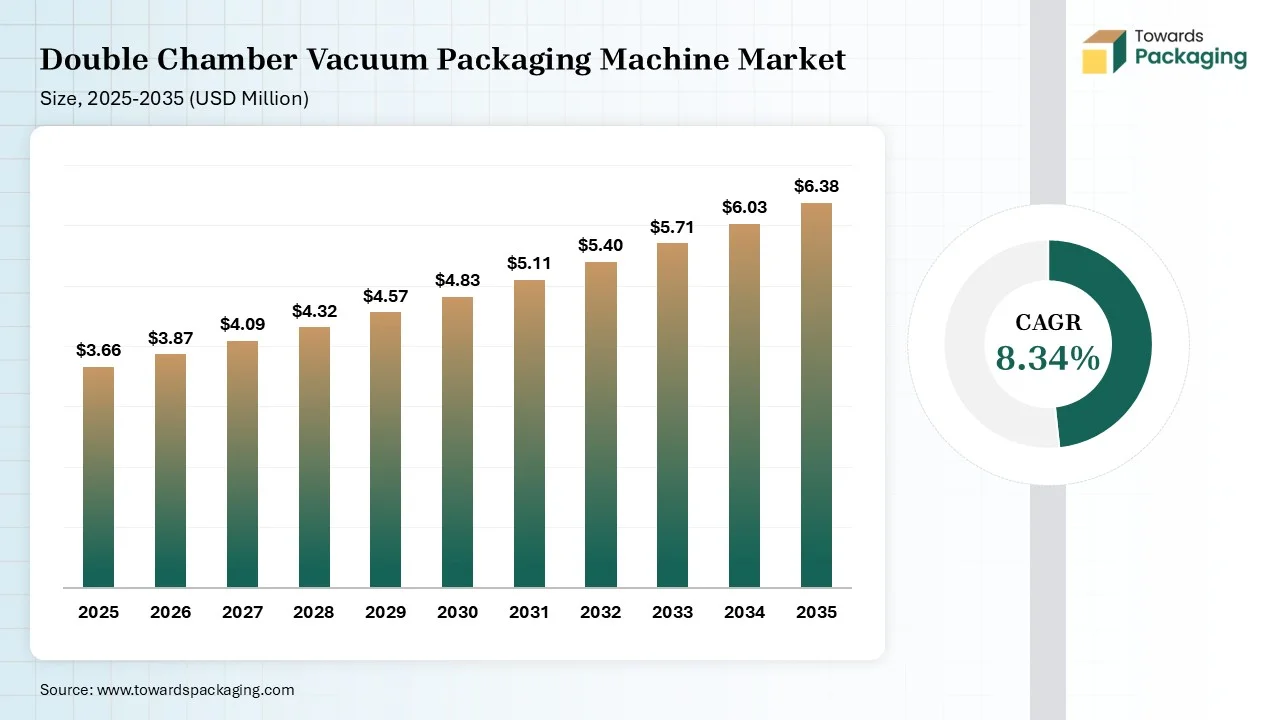
The double chamber vacuum packaging machine market is projected to grow from USD 1,780.16 million in 2026 to USD 3,660.64 million by 2035, registering a CAGR of 8.34% during the forecast period. This report covers detailed market size analysis, along with segment-wise insights based on machine type, automation level, application, and end-use industries. It also includes comprehensive regional data across North America, Europe, Asia-Pacific, Latin America, and the Middle East & Africa. In addition, the study provides company profiles, competitive landscape, value chain analysis, trade data, and extensive manufacturers and suppliers data, helping stakeholders understand the full market ecosystem.
Dual chamber vacuum packaging machines are crafted to remove air from two separate chambers at the same time to pack food in vacuum bags. This procedure removes oxygen, a main factor in terms of food spoilage. By making a vacuum seal, such machines assist in preventing the development of mold, bacteria, and yeast, ensuring any food stays secure and fresh for a longer duration.
Operating with two chambers means we can make products on one side and vacuum products on the other. This makes it capable of vacuum packing large quantities without disturbing the workflow.
As sectors continue to accept smart technologies and automation, vacuum packaging machines will transform into even more standard options. Implementation of data analytics and IoT devices can serve insights into machine outcomes and product quality, which allows predictive maintenance and procedure updating. Companies that penetrate the vacuum packaging industry have benefited from accepting such developed systems, which assist in achieving higher results and perfect product protection. The combination of vacuum science and current control technology is designing a smoother and more sustainable packaging industry.
Automatic segment dominated the market with 60% share in 2025, as this machine is a kind of packaging machine. It can automatically remove air in the packaging seal and bag as the packaging bag after passing the prescreened vacuum degree. A vacuum packaging machine can also be packed with nitrogen or other inert gases and sealed. They are frequently used in the food sector because, after vacuum packaging, food can maintain its freshness for a long period.
The semi-automatic segment held 40% market share in 2025 and is expected to have the fastest CAGR of 10.5% during the forecast period. This machine works by having an operator who manually operates the machine by placing the bag into the chamber and closing the lid. Then, in the second stage, the machine automatically removes the air, packs the bag, and opens the lid. The significant steps include setting seal or vacuum times, vacuum pump extraction, and heat sealing.
The food packaging segment dominated the market with 55% share in 2025 because vacuum packaging can extend food safety and freshness due to its potential to reduce oxygen levels, which prevents food spoilage and microbial contamination. Because of the expanded food shelf life and the reliability of the packaging, which needs to be utilized in commercial food making and at home, vacuum packaging is being selected. Relying on the kind of food and storage surroundings, such as freezing or refrigeration, will help determine how long vacuum-packaged food will stay fresh. In most scenarios, food texture, taste, and nutrients will be protected, and food waste will be minimized.
The pharmaceutical packaging segment held 18% market share in 2025 and is expected to have the fastest CAGR of 9.2% during the forecast period. Air consists of approximately 21% oxygen, which can react with sensitive pharmaceutical elements. Vacuum avoids such oxygen, which slows down oxidation. By mitigating degradation, the drug gains its characteristics for a long time, which enables storage and distribution without adjusting the quality. Double chamber vacuum packaging can be mixed with barrier materials that are crafted to prevent light and gas entry, by pushing protection.
The electronics & electrical segment held the 13% market share in 2025, as vacuum packaging totally removes air and thus most of the water vapor from the packed eco-friendly atmosphere, fragile factors. Generally, devices are kept within moisture barrier bags (MBBs) created from multilayer covered materials with very low water vapor transmission rates (WVTR). The air is cleared before sealing, which mainly reduces internal humidity. Skilled moisture control methods integrate vacuum packaging with humidity and desiccant indicator cards (HICs). Desiccants such as molecular sieve materials and silica gel have actively packed residual moisture that stays after vacuum sealing.
The industrial goods segment held the 8% market share in 2025 because packaging is a complicated procedure that needs sealers that are generally more versatile and powerful in nature, which are perfect for heavy-duty applications. They are capable of sealing liquids and are frequently used in commercial settings. Such vacuum sealer machines have a seal bar inside a chamber in which sealing and vacuum procedure takes place, which makes them perfect for wide cellaring and cooking sensitive foods. Industrial vacuum sealers are strong machines that are used in large-scale operations with the potential of handling a variety of packaging types and sizes. Such vacuum packing machines are necessary for businesses that need a vacuum packaging machine.
The food processing companies segment dominated the market with 45% share in 2025 because vacuum technology smooths different food processing, which includes extraction, freeze drying, distillation, and concentration. Such procedures work more efficiently in a vacuum, as the lower pressure enables such procedures to come at lower temperatures. This not only saves energy but also prevents heat-sensitive ingredients from pollution.
For instance, vacuum distillation enables food producers to focus on nutrients and flavors without using high temperatures, which can otherwise change or degrade sensitive compounds.
The retail/in-house packaging segment held 10% market share in 2025 and is expected to have the fastest CAGR of 10% during the forecast period. Double-chamber vacuum packaging machines are one of the most widely used solutions for textile packaging. In such a procedure, the complete bag is kept inside a packed chamber, in which air is withdrawn before the package is sealed. Such solutions are particularly suitable for folded garments like T-shirts, shirts, towels, and textile sets. Due to this, the vacuum surrounding areas is managed; sealing quality is constant and relevant, even when using broad vacuum bags.
The pharmaceutical companies segment held the 20% market share in 2025 because organizations in this industry rely on controlled vacuum surroundings to ensure product purity, regulatory compliance, and process efficiency. Double-chamber vacuum packaging machines are extensively used in filtration, drying, solvent recovery, distillation, and sterile processing. From research and development laboratories to complete -scale manufacturing facilities, relevant vacuum outcomes are complicated to track, process repeatability, and quality standards.
The electronics manufacturers segment held 10% in 2025 because electrical vacuum generators, such as blowers or pumps, make a vacuum purely in electrical format. In contrast to pneumatic machines, vacuum generation occurs without the application of compressed air. Relying on the version, there are outcomes in bigger energy efficiency and lower working costs. Additionally, semiconductor chips are fabricated, and vacuum technology has played a crucial role in their final packaging step.
The industrial goods manufacturers segment held the 15% market share in 2025 because vacuum packaging with aluminum foil has come up as a top solution for both export and industrial packaging, which serves unparalleled protection against eco-friendly factors. Aluminum foil serves as a perfect barrier against oxygen and moisture, which is important for protecting against spoilage and corrosion in moisture-sensitive goods. Vacuum sealing has further developed this prevention by avoiding air from packaging, lowering the overall risk of microbial growth and oxidation.
The direct sales segment dominated the market with a 50% share in 2025 because, in the farmers' industry or in the store, user service is most crucial at the beginning and quality of the product. Packaging is the perfect machine to serve additional value to users. Cheese and meat packaging generally needs high-barrier films and multi-layer laminates that oppose oxygen entry and serve as a mechanical barrier to managing cold chain handling.
The online sales segment held 20% market share in 2025 and is expected to have the fastest CAGR of 11% during the forecast period. The category of retail, e-commerce, and business is continuously changing its operational strategy to develop new ways. This assists them in developing cost reduction and quality, which leads to developed user satisfaction. Vacuum packaging machines are prevalently used in the food sector and serve a series of advantages that affect packaging methods for a variety of products.
How Did North America Dominate The Double Chamber Vacuum Packaging Machine Market In 2025?
North America dominated the market with 30% share in 2025, as this industry is currently valued at a billion dollars and is projected to witness strong development over the future years, which is being driven by growing demand for pharmaceuticals, packaged food, and consumer goods. Top players count the main packaging companies that develop sustainable materials and high-level technologies. Furthermore, market trends show a move towards environmentally friendly solutions and intelligent vacuum technologies.
The import and export dynamics are encouraged by regulatory standards and trade agreements, while pricing stays competitive because of technological developments. Growing convenience that finds user behavior is important in driving the urge for vacuum packaging solutions in North America.
United States Double Chamber Vacuum Packaging Machine Market Trends
The United States double chamber vacuum packaging machine industry has kept at the mix of technological invention and growing user choice, that shows a strategic move towards a shelf-stable, high-quality and online appealing food products. Developing analytics, proprietary data sources, and landscape modelling. Additionally, the use of eco-friendly and sustainable packaging technologies is driven by user demand and regulatory pressures for eco-friendly, responsible products.
Asia Pacific is expected to experience the fastest growth in the market with 9.5% CAGR during the forecast period. The overall urge for vacuum packaging in this region is witnessing fast growth, as it remains the biggest and fastest-developing industry worldwide. This demand is initially due to a huge shift in user lifestyles and the industrial growth in developing economies like India, China, Vietnam, and Indonesia. The growing urbanization and developing middle class have led to a bigger demand for convenience and packaged foods such as meat, ready-to-eat meals, and dairy. Vacuum packaging is selected for its potential to stretch the shelf life and protect against contamination without chemical preservatives.
India Double Chamber Vacuum Packaging Machine Market Trends
Indian vacuum bag producers have discovered rigid distribution networks that ensure a constant supply to North American retailers. Their potential to manage heavy orders and service accurately has solidified their position in the market. Indian vacuum bags and machines match different demands, from industrial packaging to food storage. Products such as air-sealed bags for food, merging innovative sealing with wool, ensure an airtight safeguard.
By Type
By Application
By End User
By Distribution Channel
By Regions








Principal Research Analyst
Vidyesh Swar is a Senior Research Analyst at Towards Packaging, bringing over 4 years of dedicated expertise in market intelligence and strategic analysis across the dynamic world of packaging technologies and solutions.
Learn more about Vidyesh Swar

Reviewed By
Aditi Shivarkar, with 14+ years in packaging market research, specializes in food, beverage, and eco-friendly packaging. She ensures accurate, actionable insights, driving Towards Packaging Analytics & Consulting 's excellence in industry trends and sustainability.
Learn more about Aditi Shivarkar

Double Chamber Vacuum Packaging Machine Market
 Table of Content

 Download Sample
 Schedule a Meeting