


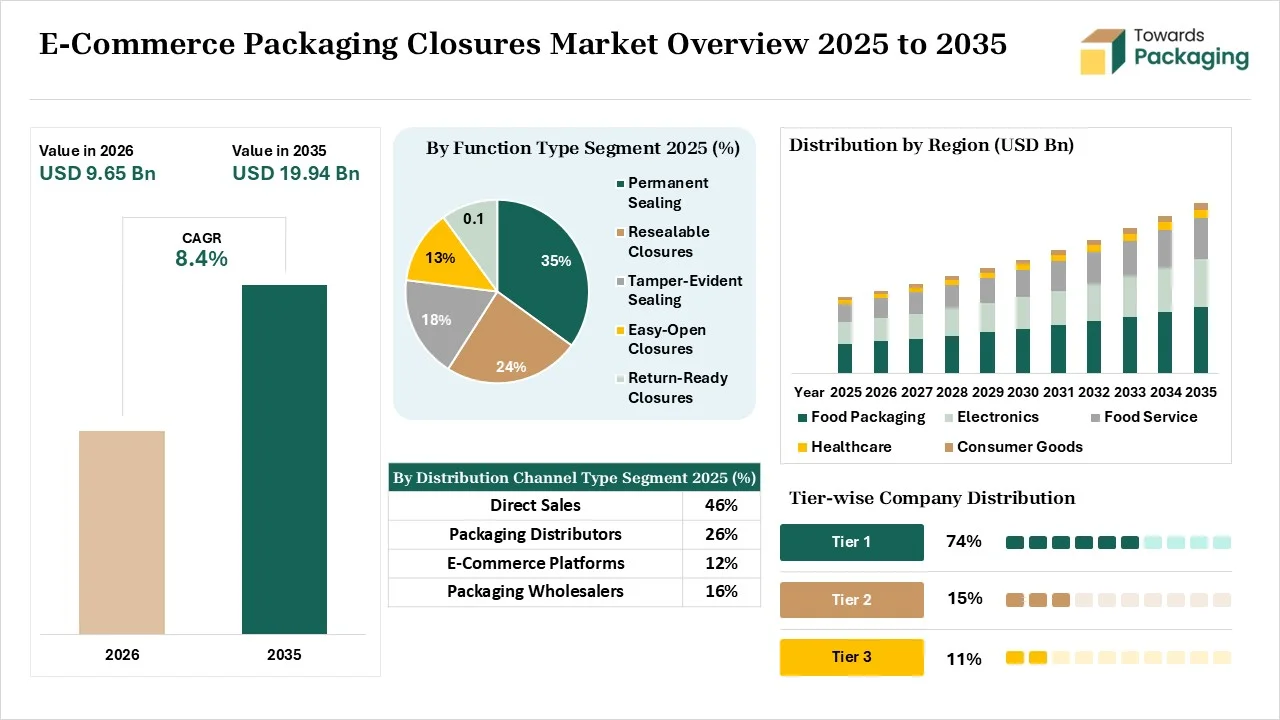
According to Vidyesh Swar, the global e-commerce packaging closures market size was estimated at USD 8.90 billion in 2025 and is predicted to increase from USD 9.65 billion in 2026 to approximately USD 19.94 billion by 2035, expanding at a CAGR of 8.4% from 2026 to 2035. The market growth is driven by factors like leak protection demand, transition to mono-material paper closures, NFC tags integration in packaging, rise in D2C skincare demand, growth in warehouse robots, interest in child-safe caps, growing middle-class buyers, growing smartphone shopping, popularity of lightweight caps, and FMCG expansion. The closure stops spills, builds consumer trust, resists handling impact, and maintains product security in e-commerce logistics.
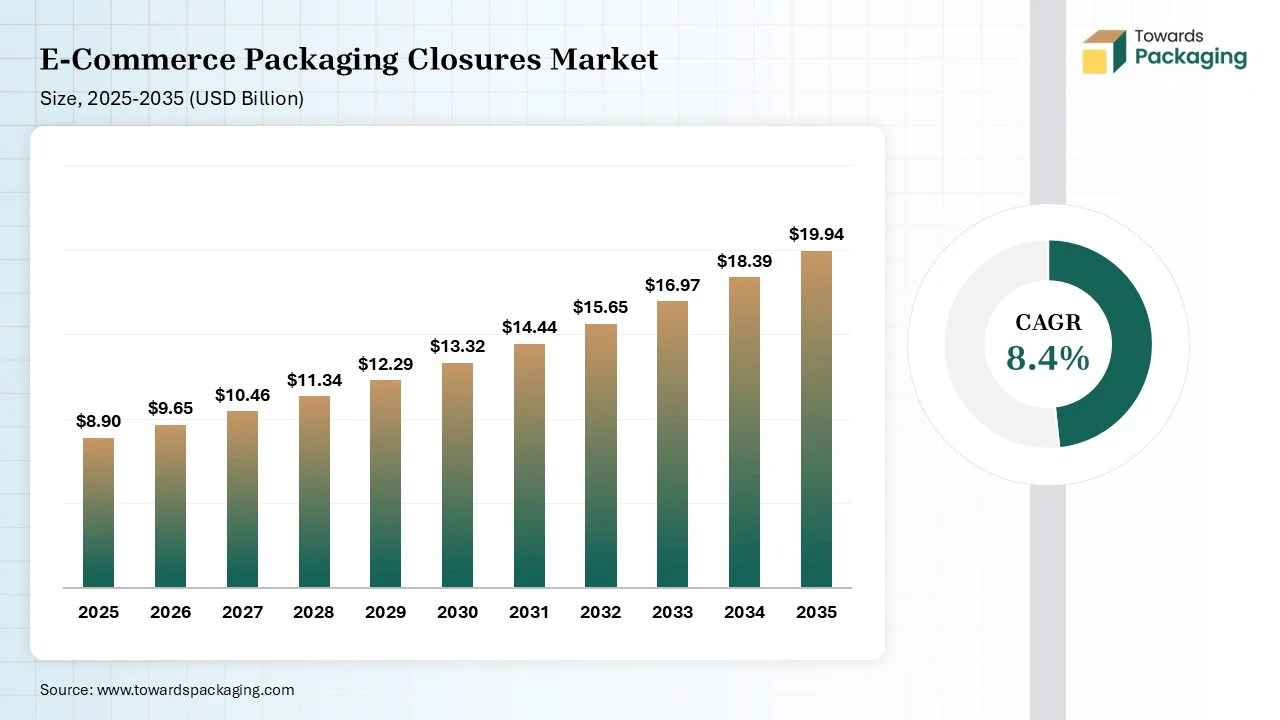
Market Size (2025):- USD 8.90 Billion
Market CAGR (2025–2035):- 8.4%
E-commerce packaging closures are a specific seal used to close various containers. It features characteristics like impact resistance, secondary element elimination, frustration-free unboxing, back-off resistance, and tamper visibility. It offers benefits like leak prevention, less material waste, easy opening, brand trust, lighter weight, and shipping safety. The common types are resealable zippers, disc caps, peel-and-seal strips, and flip-top closures. Packaging closures like water-activated paper tapes, ergonomic sliders, locking disc tops, and sensory zippers are widely used in e-commerce. The functions of the closures are protection, security, sealing, dispensing, and safety.
In ancient times, the pottery industry widely used natural cork stoppers. In the 19th century, the development of bail closures happened to store pressurized contents. The corrugated metal cap was developed in 1890 with PVC-free linings. In the 1940 ROPP closures were developed, which offered clear initial opening. After World War 2 the revolution of plastic happened. The revolution started the creation of plastic-based lightweight closures. The growing safety issues increased demand for tamper-evident closures like plastic shrink bands. The Poison Prevention Act created demand for child-resistant closures to protect children from drugs and other toxic items. The modern period focuses on developing closures which provides great user experience. Closures like flip-top lids and trigger sprayers gain popularity. The period also focuses on developing eco-friendly mono-material closures. The modern lines incorporate digital trackers and advanced technologies to enhance safety.
The market boundaries are defined by factors like geographic scope, closure types, material used, and industries served. The market covers closure types like adhesive closures, tape closures, tear strip closures, twist closures, hook & loop closures, zip closures, snap closures, and tamper-evident closures. The materials include paper, fabric, bio-based materials, plastic, kraft paper, aluminum, textile, and paperboard used for developing closures. The packaging types covered in the report are corrugated boxes, paper mailers, shipping envelopes, returnable packaging, poly mailers, flexible pouches, and protective packaging. The industries serves like e-commerce retailers, 3PL providers, food & beverage companies, fashion & apparel brands, e-commerce retailers, consumer goods manufacturers, electronics companies, and pharmaceutical & healthcare companies. The distribution channels covered in the reports are direct sales, e-commerce platforms, packaging distributors, and packaging wholesalers. The geographic coverage is Asia Pacific, Europe, MEA, North America, and Latin America.
Rise in Sustainable Closures:- The abundance of bio-based polymers and packaging waste directives increases the production of sustainable closures. The development of minimalist closures and the growing sorting errors of mixed plastics increase the use of sustainable closures.
Interest in Return-Ready Packaging:- The simplification demand in reverse-logistics journey and the use of recyclable materials increase adoption of e-commerce packaging closures. The interest in dual adhesive strips helps with expansion.
Growing Digital Authentication:- The demand for item-level tracking and the development of unique digital identities increases use of digital authentication tools. The interest in intelligent closures architectures helps with expansion.
Growth in Packaging Automation:- The difficulty in recruiting manual workers and the need for error reduction increase use of packaging automation that offers consistent-quality closures and lowers waste.
Global Expansion of E-Commerce Logistics
The increased purchasing of goods online and the rise in same-day shipping increase the use of e-commerce packaging closures. The presence of medium enterprises on the online platforms and the increased processing of massive orders increase the use of e-commerce packaging closures. The multiple touchpoints in online shipments and the prevention of costly product damage increase the use of e-commerce packaging closures. The high-speed packing and the popularity of automation-ready closures help with the expansion. The global expansion of e-commerce is a driver for the market growth.
Volatility in Raw Material Prices
The changing crude oil prices and fluctuating cost of plastic resins increase the cost. The molding technology utilization and spiking fuel costs increase the production cost. The creation of paper and changing natural gas prices increase the raw material cost. Geopolitical conflicts and the volatility in energy costs increase the cost. The eco-friendly resin adoption and trade tensions across the globe increase the cost. The volatility in raw material prices restricts market growth.
Smart Closure Technologies
The demand for tamper evidence, product quality tracking, anti-counterfeiting, and consumer interaction increases the use of smart closures. The development of RFID caps and QR-integrated closures helps in verifying product authenticity. The integration of time-temperature indicators and gas indicator lids helps in condition monitoring. The smart tamper-evident seals help in detecting safety. The smart closures help in cold chain tracking, freshness indication, and leak detection. The smart closure technologies create an opportunity for market growth.
In July 2025, SIG collaborated with Pulpac to manufacture paper-based closures. The closures are designed for SIG’s aseptic cartons, and it developed using Dry Molded Fiber technology provided by Pulpac. The closures are fiber-based solutions and offer first-class opening performance.
The demand for plastic closures is growing due to beverage and food expansion. Expanding sectors like cosmetics and bottled water increase the use of plastic closures. The price of plastic closures depends on factors like material grade, design complexity, resin pricing, liners, and order volumes. The recyclability depends on design standards and resin types. The plastic closures are sorted using optical sorting and in-line processing methods. The manufacturing trends are recycled resins integration, development of tethered closures, smart features, and lightweighting.
The fiber-based closure adoption is growing due to rising traditional polymer prices, corporate sustainability, manufacturing advancements, and environmental regulations. The paper-based closure materials are barrier-coated board, dry molded fiber, and wood fiber pulp. They offer low carbon footprint and high renewability benefits. Sustainability initiatives like plastics-out agendas, Paperisation Movement, and carbon reduction targets increase use of paper-based closure materials.
The permanent adhesive technology uses specialized pressure-sensitive materials for long-term durability. This technology is used in industrial labeling, asset tracking, and outdoor graphics. Resealable technology is reused multiple times, and it is used in postal bags, food packaging, and wet wipes. Pressure-sensitive adhesive technology sticks easily by applying mechanical pressure. It is available in forms like solvent-based, water-based, and hot-melt. It is used in closures, labels, and packaging tapes. Water-based adhesive technology offers sustainability, high strength, and tamper evidence.
The bio-based packaging materials are PHA, agro-waste blends, PLA, and bio-PE. The replacement of traditional plastic materials increases the use of bio-based packaging materials. The pricing decides with factors like feedstock source, production scale, processing, and regulatory rules. The innovations are algae films, agri-residue upcycling, active preservation, fungi composites, and advanced biopolymers.
Raw Material Sourcing
Raw materials like adhesives, plastic resins, paper, tapes, and fiber are required.
Processing and Conversion
The processing involves resin preparation, injection molding, thermoforming, and cooling. Conversion includes ejection, liner insertion, tamper-evident integration, and quality validation.
Design and Prototyping
Design focuses on tamper evidence, transit security, and a frustration-free experience. Prototyping includes appearance prototyping, digital 3D renderings, and testing structural samples.
The polymer resins like LDPE, PP, & others take up to 45-60%, color masterbatches & additives take up to 5-10%, and liners and sealing technology take up to 5-10% of the total cost.
Breakdown of average manufacturing price with USD 0.062 per closure: the commodity resins & other feedstocks take up to $0.025, cycle time & machine processing methodologies take up to $0.022, and packaging, inspection, & overhead take up to $0.015.
Breakdown of average manufacturing price with USD 0.103 per closure is $0.036 acquired by raw materials, $0.026 acquired for production, tools & overhead cost is $0.015, shipping cost is $0.010, and total overall manufacturing profit is $0.016.
The Adhesive Closures Segment Dominated the Market With 29% Market Share in 2025
The adhesive closures segment dominated the e-commerce packaging closures market with a 29% share in 2025. The burgeoning automated packing lines and the interest in lightweight closure designs increase the use of adhesive closures. The high use of flexible mailers and the massive parcel fulfilment increase the use of adhesive closures. The transition away from bulky mechanical closures and the prevention of accidental opening increases the use of adhesive closures, driving the segment growth.
The zip closures segment held a 14% market share in 2025 and is expected to grow at the fastest CAGR of 10.1% during the forecast period. The spill prevention demand and the shoppers' interest in easy-to-open packaging increase the use of zip closures. The reduction of last-mile delivery cost and the consumer interest in reclosable features increase the use of zip closures. The need to simplify repeated closures helps with expansion. The transit safety, enhanced reusability, and high space efficiency of zip closures support the segment growth.
The Plastic Segment Dominated the Market With 44% Market Share in 2025
The plastic segment dominated the e-commerce packaging closures market with a 44% share in 2025. The inexpensiveness of polyethylene and the development of lightweight closures increase the use of plastic. The focus on keeping liquid fresh and the creation of secure transit increases the adoption of plastic. The development of tamper-evident formats and the demand for delivery cost reduction increase the use of plastic. The robust sealing performance and high-speed compatibility of plastic drive the segment growth.
According to my research, the kraft paper segment held a 14% market share in 2025 and is expected to grow at the fastest CAGR of 9.8% during the forecast period. The adoption of paper-based solutions and the interest in unbleachable aesthetic packaging increase the use of kraft paper. The high transport mass in corrugated setups and the plastic packaging removal increase the use of kraft paper. Its seamless recycling in paper recycling streams and the expansion of water-activated kraft tapes support the segment growth.
The Corrugated Boxes Segment Dominated the Market With 42% Market Share in 2025
The corrugated boxes segment dominated the e-commerce packaging closures market with a 42% share in 2025. The need to protect fragile products from stacking pressure and the need to keep parcel weight down increases the use of corrugated boxes. The brands' focus on enforcing clear printed logos on parcels and the green consumer standards increases the use of corrugated boxes. The adjustable designs, low-unit cost, and superior shock absorption in corrugated boxes drive the segment growth.
The paper mailers segment held a 13% market share in 2025 and is expected to grow at the fastest CAGR of 10% during the forecast period. The low utilization of poly mailers and the need to reduce warehouse storage expenses increase the use of paper mailers. The high fiber packaging use and the shift away from packaging that clogs recycling infrastructure increase the use of paper mailers. Advancements like cross-laminated paper designs and the rise of self-seal paper support the segment growth.
The Permanent Sealing Segment Dominated the Market With 35% Market Share in 2025
The permanent sealing segment dominated the e-commerce packaging closures market with a 35% share in 2025. The focus on protecting consumer safety and the rough handling of shipments increases the use of permanent sealing. The need for instant sealing of boxes and the avoidance of unauthorized resealing increases the adoption of permanent sealing. The heavy vibrations in parcel delivery and the airtight barrier creation increase the use of permanent sealing, driving segment growth.
The resealable closures segment held a 24% market share in 2025 and is expected to grow at the fastest CAGR of 10.2% during the forecast period. The prevention of powder products from leaking and the demand for product integrity maintenance during initial opening increase the use of resealable closures. The focus on removing secondary storage containers and the demand for product dry-out reduction increases the use of resealable closures. The enhanced product freshness and hassle-free returns in resealable closures support the segment growth.
The E-Commerce Retailers Segment Dominated the Market With 38% Market Share in 2025
According to my research, the e-commerce retailers segment dominated the e-commerce packaging closures market with a 38% share in 2025 due to the high daily parcel volumes. The need to avoid returns of expensive products and tampering risks in cosmetic products increases demand for e-commerce packaging closures. Customer satisfaction improvement and the high web retailers' parcel volume increase the use of e-commerce packaging closures. The rise in peel-and-seal strips drives the segment growth.
The healthcare & pharmaceutical companies segment held an 8% market share in 2025 and is expected to grow at the fastest CAGR of 9.7% during the forecast period. The explosion of medications to multiple handlers and the rise in prescription drug delivery increase the use of e-commerce packaging closures. The increased use of high-integrity threaded closures in liquid medications helps with the expansion. The modernization of pharmaceutical caps for tracking authenticity and the enhanced patient compliance support the segment growth.
The Direct Sales Segment Dominated the Market With 46% Market Share in 2025
The direct sales segment dominated the e-commerce packaging closures market with a 46% share in 2025. The demand for tailored closures and the changing consumer needs increase the use of direct sales. The demand for middleman elimination and the interest in buying closures directly from manufacturers increases the adoption of direct sales. The low price for high-frequency operations and guaranteed supply of direct sales drive market growth.
The e-commerce platforms segment held a 12% market share in 2025 and is expected to grow at the fastest CAGR of 10.4% during the forecast period. The demand for shock-resistant closures and the superior consumer trust increase buying through e-commerce platforms. The spike in DTC shipments and meddling risks in delivery networks increases the use of e-commerce platforms. The product wastage prevention and the availability of digital authentication support the segment growth.
Asia Pacific dominated the e-commerce packaging closures market with a 39% share in 2025 and is expected to grow at the fastest CAGR of 10.10% during the forecast period. The massive number of online shoppers and the spiking online sales of personal care increase demand for e-commerce packaging closures. The billions of parcel shipments and eco-friendly rules increase the development of sustainable closures. The burgeoning online shopping transactions and the enhanced internet connectivity increase the use of e-commerce packaging closures. The demand for hygienic product closures drives the market growth.
China
China dominated the market in 2025. The massive presence of JD.com & other digital platforms and cheap raw materials increases the production of e-commerce packaging closures. The major shipping hubs and automated production lines increase the use of e-commerce packaging closures. The large numbers of digital buyers and the strong fabrication plants increase the production of e-commerce packaging closures. The upgradation in sustainable plastics supports the market growth.
India
India is expected to experience the fastest growth in the market during the forecast period. The expansion of fast fashion and the interest in packaging survive intensive transit increase the adoption of e-commerce packaging closures. The growing D2C beauty brands and the prevention of parcel tampering increase the use of e-commerce packaging closures. The expansion of same-day delivery networks boosts the market growth.
According to my research, North America held a 28% market share in 2025. The high usage of smartphones and the increased delivery of household goods increase the use of e-commerce packaging closures. The established Walmart networks and brand pledges for lightweight packaging increase the use of e-commerce packaging closures. The purchasing of daily necessities from online platforms and the consumer interest in user-friendly dispensing drives the market growth.
United States
United States dominated the e-commerce packaging closures market in 2025 and is expected to grow at the fastest CAGR during the forecast period. The online merchants' massive parcel volume and the increased deployment of conveyor-integrated sealers increase the use of e-commerce packaging closures. The high domestic purchasing power and the interest in spill-proof closures help with the expansion. The popularity of paper-based security tapes and the increased bottled beverages buying supports the market growth.
Canada
Canada is growing in the market. Many consumers purchase consumer goods from online platforms, and the incorporation of green rules increases the use of e-commerce packaging closures. The shippers' interest in leak-proof tops and the availability of small businesses on digital platforms increases the use of e-commerce packaging closures. The growing digital shopping across the beauty industry boosts the market growth.
Europe held the 24% market share in 2025. The transition to single-material plastics and the packaging demand in food delivery increase the use of e-commerce packaging closures. The penetration of online retail and the interest in tamper-evident dispensing help with the expansion. The popularity of smart re-closable features and the high beverage orders drive the overall growth of the market.
Germany
Germany held the largest share in the e-commerce packaging closures market in 2025. The development of easy-to-sort closures and the companies' focus on efficient packaging design increases the use of e-commerce packaging closures. The use of specialized paperboard and the high automation centers increases the production of e-commerce packaging closures. The expansion of sustainable closure technologies and secure online shopping supports the market growth.
United Kingdom
United Kingdom is expected to grow at the fastest CAGR during the forecast period. The online retailers' interest in tamper-evident closures and the development of mono-material caps help with the expansion. The rise in frequent home deliveries and the waste-minimizing designs increase the adoption of e-commerce packaging closures. The fast-moving health industry and the popularity of tight-sealing caps boost the market growth.
Latin America held a 5% market share in 2025. The strong digital transformation and the growing delivery of pharmaceuticals increase the use of e-commerce packaging closures. The corporate push towards sugarcane-based polyethylene and lightweight secure caps increases adoption of e-commerce packaging closures. A better online payment ecosystem and the increased buying of grooming items drive market growth.
Brazil
Brazil held the highest revenue share in the e-commerce packaging closures market in 2025. The low-cost feedstock availability and the high recycling rates increase the production of e-commerce packaging closures. The digital retail ecosystem expansion and the established local packaging developers increase the use of e-commerce packaging closures. The increased ordering of local food and widespread fast-fashion support the market growth.
Argentina
Argentina is expanding in the market. The growing digital marketplaces and the large shipments of household liquids increase the use of e-commerce packaging closures. The use of specialized rigid containers and brands' preference for leak-proof caps helps with the expansion. The growth of digital wallets and the transition to lightweight spouts boost market growth.
According to my research, MEA held a 4% market share in 2025. The growing social media usage and the online ordering of personal care products increase the use of e-commerce packaging closures. The growth in fulfilment operations and the new environmental expectations increase the production of e-commerce packaging closures. The improved warehousing infrastructure and the expansion of paper-based closures drive the market growth.
Saudi Arabia
Saudi Arabia dominated the e-commerce packaging closures market in 2025. The abundance of raw polymer feedstocks and the last-mile packaging demand increase the use of e-commerce packaging closures. The advanced robotics centers in Riyadh and the large local refining industry increase the use of e-commerce packaging closures. The use of high-integrity closures supports market growth.
UAE
The UAE is expected to grow at the fastest rate in the market during the forecast period. The strong grocery ordering apps and last-mile logistics in Abu Dhabi increase the use of e-commerce packaging closures. The affordable polyolefin resin and the scaling up of online sales increase the use of e-commerce packaging closures. The dependence on advanced closures boosts the market growth.
Market concentration includes numerous packaging companies, adhesive providers, and multinational chemical companies. The dominant players are AptarGroup, Amcor plc, and Silgan Holdings. The key chemical providers are Dow, ExxonMobil, and LyondellBasell. The dominant tape manufacturers are tesa SE, 3M Company, and Interpe Polymer Group. The high competition in the industry due to supplier fragmentation and buyer polarization. The hurdles in the industry are patent protection and high tooling costs. Regional competitive dynamics defined by distinct volume growth.
| Sr. No. | Company | Product Range | Production Facilities | Sustainability Initiatives |
| 1. | Amcor Plc |
Flip-Top Closures Snap Caps Tethered Closures Beverage Closures Sports Closures Specialty Pumps Dispensing Pumps |
North America Europe Middle East & Africa Asia Pacific Latin America |
Mono-Material Innovation B Circular Range Expansion |
| 2. | Berry Global |
Standard Closures Flip-Top Laps Pouring Laps Spray Systems Dispensing Systems Child-Resistant Closures Tamper-Evident Closures |
North America Europe Africa South America Asia Australia |
Metal Elimination Recycled Content Scaling B Circular Range |
Competitive positioning defined by safety, functionality, and sustainability. The leading developers of lightweight plastic closures are Berry Global and Amcor plc. The key developer of sustainable fiber-based solutions is Mondi plc. The major competitors are Berry Global, Sealed Air Corporation, Amcor plc, and Smurfit WestRock. Silgan Holdings manufactures protective closures for industries like healthcare and food. AptarGroup manufactures custom dispensing systems, and Guala Closures S.p.A. develops luxury closures.
| Company Overview | The company manufactures specialty closures, custom containers, and metal containers. |
| Manufacturing Footprint | North America, South America, Europe, and Asia |
| Product Portfolio |
Metal Lug Closures Plastic Closures Composite Closures Dispensing Systems |
| SWOT Analysis |
Strength Global Manufacturing Scale Weakness High Susceptibility to Raw Material Costs Opportunity Aseptic Packaging Growth Threats Anti-Plastic Regulations |
| Company Overview | The company designs sustainable dispensing closures to serve industries like beauty, pharma, home care, and many more. |
| Manufacturing Footprint | Middle East, Asia, North America, Europe, and Latin America |
| Product Portfolio |
Inverted Lidless Closures Embrace E-Simplicity Tower Directional Snap Top Future Disc Top E-Disc Top Tab Top Ecolite Directional Pour Spout |
| SWOT Analysis |
Strength Proprietary Innovations Weakness Integration Complexity Opportunity E-Commerce Growth Threats Strong Competition |
| Company Overview | The company offers various closures for brand differentiation and airtight protection. They manufacture custom container sealing solutions. |
| Manufacturing Footprint | North America, Caribbean, Asia Pacific, Latin America, MEA, and Europe |
| Product Portfolio |
Twist Closures Ideal Closures Press Twist Closures PET-Compatible Metal Closures |
| SWOT Analysis |
Strength Global Reputation Weakness Dependency on Raw Materials Opportunity Premium Product Expansion Threats Availability of Low-Cost Plastic Screw Caps |
According to my research, the e-commerce packaging closures market is growing rapidly due to quick commerce growth, tamper-evidence demand, and sustainability. The closures are creating a positive impact due to spill prevention, user-friendly experience, material reduction, and eco-friendly materials. The adhesive closures held the major market share due to their efficiency, strong protection, surface safety, cost-effectiveness, and user convenience. Applications like poly mailers, garment bags, tissue packaging, confectionery flaps, document envelopes, and reclosable retail pouches use adhesive closures. The e-commerce industry held the dominant position due to the demand for transit security and growing rough transit of parcels. Asia Pacific held the major market share due to increasing disposable incomes, massive production units, thriving grocery delivery, RFID-enabled closures development, and urbanization. The leading players are AptarGroup, Guala Closures, Amcor plc, Crown Holdings, Berry Global Group, BERICAP Holding GmbH, and Silgan Holdings.
By Closure Type
By Material
By Packaging Type
By Function
By End User
By Distribution Channel
By Region








Principal Research Analyst
Vidyesh Swar is a Senior Research Analyst at Towards Packaging, bringing over 4 years of dedicated expertise in market intelligence and strategic analysis across the dynamic world of packaging technologies and solutions.
Learn more about Vidyesh Swar

Reviewed By
Aditi Shivarkar, with 14+ years in packaging market research, specializes in food, beverage, and eco-friendly packaging. She ensures accurate, actionable insights, driving Towards Packaging Analytics & Consulting 's excellence in industry trends and sustainability.
Learn more about Aditi Shivarkar

E-Commerce Packaging Closures Market
 Table of Content

 Download Sample
 Schedule a Meeting