


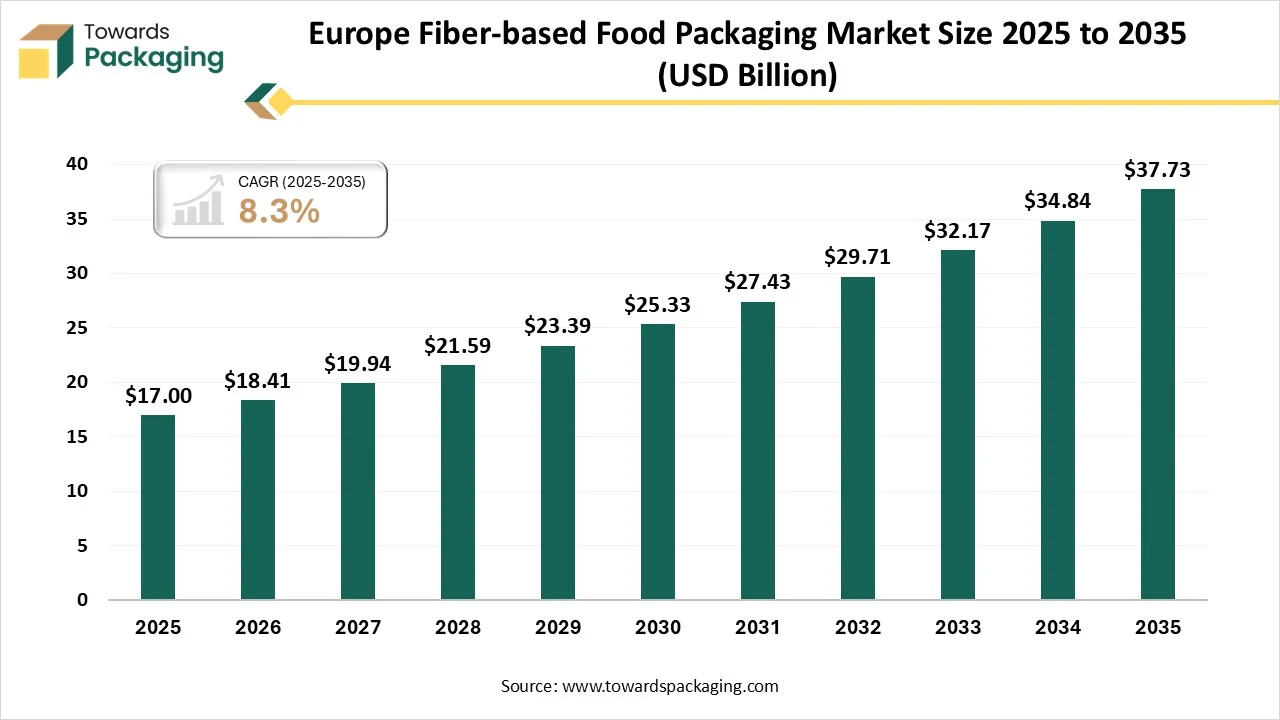
The Europe fiber-based food packaging market is projected to grow from USD 18.41 billion in 2026 to USD 37.73 billion by 2035, expanding at a CAGR of 8.3% during 2026-2035. The report provides detailed market size statistics, segment-wise data by packaging type, material, and application, along with regional demand insights across major European countries. It also includes competitive analysis of leading companies, manufacturers and suppliers, value chain assessment, and trade statistics that highlight import-export dynamics and supply chain developments in the industry.
Fiber-based food packaging uses materials that come from plant fibers, such as paperboard, cardboard, or molded pulp, to include and protect food products. Such materials are frequently recyclable, renewable and sometimes compostable, that serves a more eco-friendly vibrations which is an option to plastic. Such barricade elements and structural integrity changes, accordingly, depending on the fiber source and the processing.
AI is rapidly transforming the market by improving manufacturing efficiency, packaging design, quality control, sustainability management, and supply chain optimization. Packaging manufacturers are using AI-powered systems to optimize pulp molding, paper conversion, coating application, and material usage during production. Companies are using AI-based simulations and digital twins to develop lightweight fiber packaging with better strength, moisture resistance, and food protection properties.
AI is helping companies forecast demand, optimize inventory, and improve transportation efficiency. Companies are integrating digital tracking systems, QR codes, and AI-traceability solutions into fiber-based food packaging to improve supply chain transparency, monitor freshness, and provide sustainability information directly to consumers. Predictive maintenance systems powered by AI help prevent equipment failure and reduce production downtime.
Fiber-dependent packaging is more than a trend, which is an unavoidable update for a circular economy. With constant invention in the molding technologies, PFAS-free barrier recyclability and solutions, fiber packaging is perfectly positioned to substitute plastics in many uses. These packages are excessively classified as one of the choices because of several natural benefits to die to remaining substrates. It’s heavily considered by users for its surrounding credentials, as they are recyclable in huge numbers.
Strict legal frameworks like the EU single-use plastics directive and the European Green Deal, which encourage the use of recyclable and biodegradable materials and reduce plastic waste, have a significant impact on the European fiber-based food packaging market. Single-use plastic bans, extended producer responsibility programs, and incentives for environmentally friendly packaging innovations are all being implemented by governments throughout Europe. By encouraging producers and food service providers to use compliant and environmentally friendly packaging options, these programs are hastening the transition to fiber-based solutions.
In January 2026, Amcor plc partnered with Metsä Group to introduce the AmFiber tray, a molded fiber-based packaging solution designed for food applications using renewable wood materials. Additionally, in the July 2025–2026 expansion phase, Sabert Corporation expanded its fiber-based, PFAS-free foodservice packaging portfolio across Europe following the acquisition of Colpac, strengthening its sustainable packaging capabilities.
The corrugated fiberboard segment dominated the market in 2025, as they are prevalently used as “corrugated,” which is a packaging material created by sticking to a fluted corrugated sheet, or the surface, to one or two sheets of a flat liner. They are not only recyclable but are also renewable. Several corrugated materials are created from 70% to 100% of recycled materials. Another advantage of corrugated packaging is its potential to be reused. Users utilize such material through its overall life cycle, from shifting and shipping packages to using long-time packaging pieces as a floor protector.
The fiberboard segment is expected to experience the fastest CAGR during the forecast period. They are lightweight and sturdy in nature as they are created by sticking to a fluted sheet, which is frequently referred to as the medium, between one or two flat liner surface layers. It is well-known for its big strength-to-weight ratio, as they are greatly used to produce corrugated boxes, which provide perfect durability, protection, and cost-efficiency in logistics and shipping. They are materials designed by cramming corrugated paper between flat linerboards. Necessarily, corrugated paper is a true element of a corrugated fiberboard.
The fruits and vegetables segment dominated the market in 2025, as fiber-based packaging materials for the packing of fruits and vegetables, such as carton containers and corrugated trays, highlight recycling results. Approximately over 80% of board and paper are recycled in Europe, which points to a merger of structure, recycling design, available collection, and user similarity, with the material’s recyclability. They can carry food safety in several privileged produce uses. Furthermore, discoveries in fiber-based solutions have resulted in lighter packaging without offering power, which transforms into low raw material demand.
The meat and poultry segment is projected to witness the fastest CAGR during the forecast period. Lowering the packaging waste is an actual advantage. When food and its respective packaging last for a longer period, less packaging material is required, and the food needs to be avoided. When fibers are utilized in packaging, it further lowers the surrounding effect. Fiber-dependent packaging materials are already recyclable with the remaining fiber-based materials. The changed packaging includes a thermoformed fiber foundation that has a thin barricade surface designed for product protection.
The food and beverages segment dominated the market in 2025, as several companies in the food sector have accepted plant fibre packaging for plates, takeout containers, trays, and drink cups. Many companies have moved to plant-based cups created from bamboo and other sustainable materials. In the same way, several fast-food chains are utilizing biodegradable containers crafted from sugarcane fibers for the packaging of burgers, salads, and sandwiches. Such products are main instances of fiber packaging that are greatly used in the current scenario. Consequently, bagasse, which is fibrous in terms of a product of sugarcane processing, has become one of the most encouraging kinds of molded pulp in current times.
The retail segment is expected to experience the fastest CAGR during the forecast period. The worldwide urge for fiber-based packaging is developing quickly, and bamboo fiber retail packaging is projected to play a major role in upcoming day solutions. Due to its biodegradability and renewable nature, bamboo is recognized as an intelligent alternative to plastic. Local stores and supermarkets utilize bamboo packaging to display bakery products, fresh produce, and ready-to-eat meals. Their natural and lightweight structure and antibacterial properties make them perfect for the food store, as they substitute single-use plastics that are ordinarily used in grocery packaging.
The French market is growing due to strict anti-plastic regulations and rising demand for sustainable foodservice packaging. The county’s Anti-Waste Law has accelerated the replacement of plastic food containers with paper-based and molded fiber alternatives in restaurants, cafes, supermarkets, and takeaway food chains. The country’s bakery and dairy industries are major users of fiber packaging solutions, especially for premium and organic food products. Consumers increasingly prefer packaging that is recyclable, compostable, and made from renewable materials, accelerating the adoption of fiber-based food packaging.
The German Fiber-Based Food Packaging Market is expected to grow notably as the main development drivers include strict Eu regulations on single-use plastics, the developing acceptance of fiber-based alternatives, and governments' investments for an eco-friendly production. The developing possibilities are totally focused on luxury, inventive fiber formulations, and tailored packaging solutions, which encourage shelf life and product safety. The regional insights show that urban states like Munich, Berlin, and Hamburg are in demand, which are driven by user choice for sustainable products and high retail density.
The fiber-based food packaging market is growing in Italy, as it is witnessing significant growth because of the growing user demand for user-friendly and convenient packaging solutions. As current life becomes quick-paced, Italians are urging the packaging that makes application easier, such as resealable pouches or snack or single-serve beverage packaging, particularly in the food and beverage industry. The development is in the on-the-go consumption and consumption of meals in small portions, particularly among the younger group.
By Material Type
By Application
By End-User







Research & Advisory Analyst
Yogesh Kulkarni is an experienced Research Analyst specializing in the packaging sector, with a strong foundation in statistical analysis and market intelligence. He currently contributes his expertise to Towards Packaging.
Learn more about Yogesh Kulkarni

Reviewed By
Aditi Shivarkar, with 14+ years in packaging market research, specializes in food, beverage, and eco-friendly packaging. She ensures accurate, actionable insights, driving Towards Packaging Analytics & Consulting 's excellence in industry trends and sustainability.
Learn more about Aditi Shivarkar

Europe Fiber-Based Food Packaging Market
 Table of Content

 Download Sample
 Schedule a Meeting