


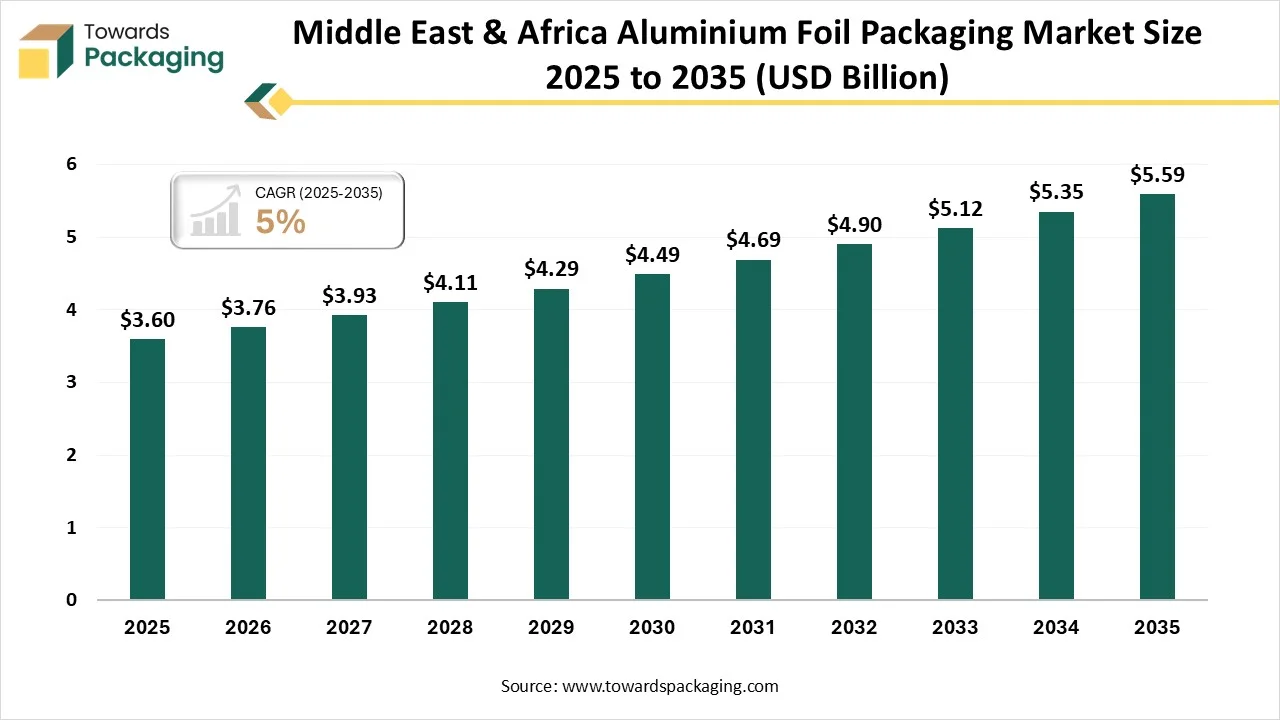
The Middle East & Africa aluminum foil packaging market is projected to grow from USD 3.76 billion in 2026 to USD 5.59 billion by 2035, registering a CAGR of 5% during 2026-2035. The market is expanding due to rapid urbanization, rising disposable incomes, and a growing population across the region. Increasing demand from food, beverage, and pharmaceutical industries for safe, lightweight, and reliable packaging solutions is further driving growth.
Our report covers detailed market size analysis, segment data by product and application, regional insights across NA, EU, APAC, LA, and MEA, along with company profiles, competitive landscape, value chain analysis, trade statistics, and comprehensive manufacturers and suppliers data.
Aluminum foil packaging is well-known for its perfect barricade elements that have protected food products from oxygen, light, contaminants, and moisture. Like paper or plastic, aluminum can smoothly serve as a barrier to the current energy of water vapor and gases, which assists in protecting the flavor, freshness, and nutritional value of packaged goods. For such a reason, aluminum foil is widely used in packaging sensitive products like dairy products, snacks, and ready-to-eat meals.
Sustainability has remained a developing force in the future of aluminum foil packaging. The sector is creating main impressions towards increasing the application of recycled aluminum and developing the effectiveness of the recycling procedure.
Intensified barrier characteristics are also on track, with scientists who discover paths to develop an aluminum foil of opposition to external elements. Further inventions can lead to packaging that delivers even better protection against moisture and oxygen, which has expanded the shelf life of food products.
One of the most exciting areas of growth is the mixing of smart packaging technologies. Tamper-proof seals and the freshness indicators are being included in aluminum foil packaging, which enables users to track food quality more precisely. Such technology is specifically insightful for sensitive goods, as it lowers food waste and ensures that products are consumed at their highest freshness.
The containers segment dominated the Middle East & Africa aluminum foil packaging market in 2025, as they are greatly used in food packaging due to their numerous benefits. It is impermeable to light, moisture, bacteria, and all gases. Due to its potential to avoid moisture and bacteria, it usually helps food remain fresh longer if it is wrapped in plastic. The convenience of sealing and packaging food with aluminum foil is what makes it ideal for the food industry and household products.
The foil wraps segment is projected to witness the fastest CAGR during the forecast period. Aluminum foil wraps are utilized for wrapping food, which are safe to use. Prevalent applications include cooking or cold storage at moderate temperatures. Considerable caution should be maintained while facing highly salty foods or acidic, despite tomatoes, sauces, or vinegar-dependent dishes. They are convenient for several cooking aims in different ways as they can be used for food storage to prevent direct heat.
With an instance of this
The food and beverage segment dominated the Middle East & Africa aluminum foil packaging market as they are mostly used in the food packaging industry to cover, contain, coat, and preserve or to cook food. At the foundation of the comprehensive usage of aluminum foil in food packaging, there is also a rising demand for food trays. In recent years, people’s lifestyles and consumption have updated, which has led to the development of the latest nutritional trends like home meal kits and ready meals, which are specifically in demand.
The pharmaceutical segment is expected to witness the fastest CAGR during the forecast period. Aluminum foil is used in the pharma sector to securely transport and keep medications. They are specifically ideal for this as they ensure complete insulation against gases, light, germs, and moisture. Aluminum is used in blister packaging, Alu Foils, and strip packaging, among other uses. Alu Alu Foil is generally available in 45 to 50 micron aluminum foil, which serves mileage and cost saving to the users. Each of the hard aluminum foil and soft aluminum foil is used as a cover foil for the in-line packaging. Regularly, hard aluminum foil is used. This has only a little expanding force, which has the benefit that we can break off relatively fast and release the drug with likely less force. On the other hand, if soft aluminum is used, more force should be used to reach the drug.
South Africa dominated the Middle East & Africa aluminum foil packaging market in 2025. The growth of the market is increasing with the development of the folk lifestyle, the demand for household aluminum foil is increasing, and the total utilization is increasing year by year. In relation to requirement elements, South African users pay special attention to the surrounding protection that links to the product. Some of the major aluminum food suppliers in South Africa are Wyda, Hulamin, CC Imelmann, Metal and Tool Trade Pvt Ltd.
The UAE Aluminum Foil Packaging market is seen to be the fastest growing market. The market is driven largely by the nation’s expanding food, beverage, pharmaceutical, and consumer goods sectors. The market has shown consistent growth in recent years and is projected to continue expanding at a steady pace, supported by both domestic consumption and regional trade dynamics. This growth reflects strong demand for aluminum foil products such as containers, pouches, and wraps that offer excellent barrier properties, recyclability, and suitability for food preservation and convenience packaging. The food & beverage segment is a key end-user, benefiting from rising consumption of processed, ready-to-eat, and takeaway foods, while sustainability trends and regulatory efforts aimed at reducing plastic waste further support the shift toward recyclable aluminum foil materials.
| Region | Export Volume (%) | Crucial Destination |
| Asia Pacific | 44 | Europe, Middle East |
| Europe | 28 | EU, North Africa |
| Middle East | 13 | Asia, Europe, Africa |
| North America | 11 | Regional, Latin America |
| Rest of World | 4 | Africa, South America |
By Product
By End-Use








Research & Advisory Analyst
Yogesh Kulkarni is an experienced Research Analyst specializing in the packaging sector, with a strong foundation in statistical analysis and market intelligence. He currently contributes his expertise to Towards Packaging.
Learn more about Yogesh Kulkarni

Reviewed By
Aditi Shivarkar, with 14+ years in packaging market research, specializes in food, beverage, and eco-friendly packaging. She ensures accurate, actionable insights, driving Towards Packaging Analytics & Consulting 's excellence in industry trends and sustainability.
Learn more about Aditi Shivarkar


Middle East & Africa Aluminum Foil Packaging Market
 Table of Content

 Download Sample
 Schedule a Meeting