


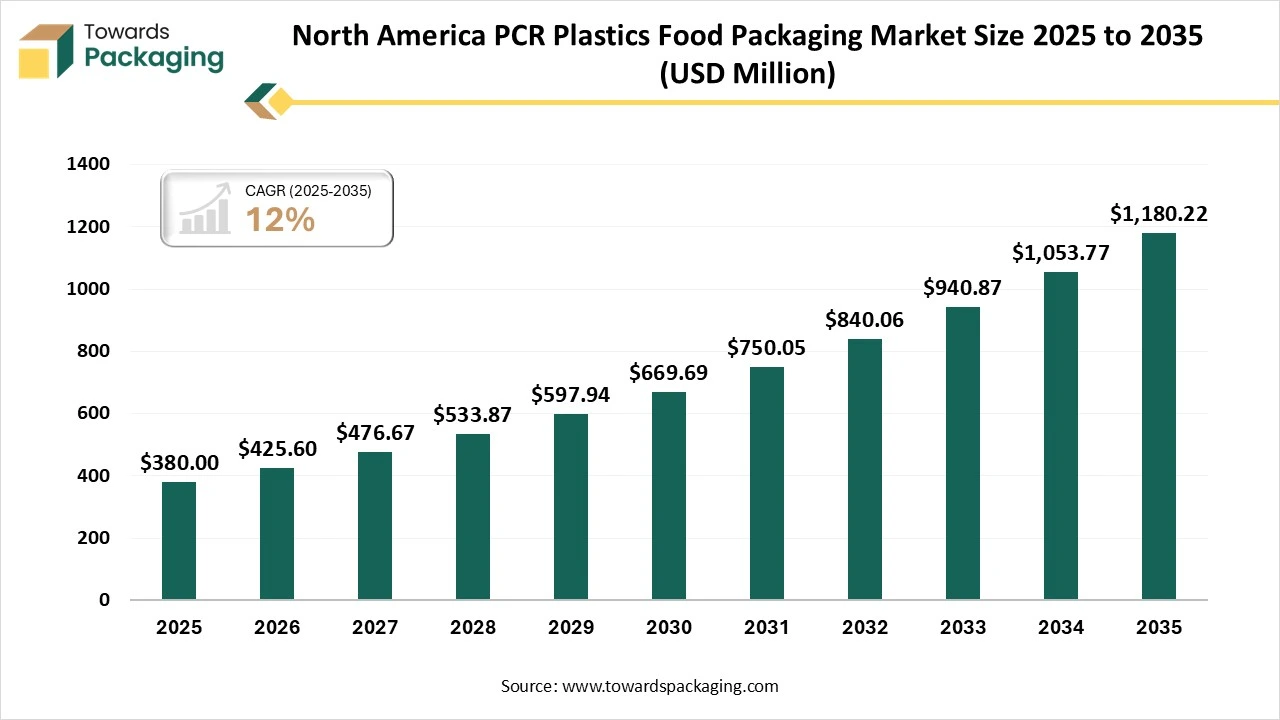
The North America PCR plastics food packaging market is projected to grow from USD 425.6 million in 2026 to USD 1,180.22 million by 2035, registering a CAGR of 12% during 2026–2035. The report covers detailed market size analysis, segment data by material and application, and regional insights across NA, EU, APAC, LA, and MEA.
It also includes company profiling, manufacturers and suppliers data, competitive analysis, value chain assessment, and trade statistics, offering a complete view of industry growth driven by rising corporate sustainability goals and strict state-level regulations.
North America PCR plastics food packaging includes to food-grade films and containers produced from plastic waste like PET bottles, HDPE milk jugs together from businesses and households, then recycled into new packing. This supportable, FDA-regulated substitute to virgin plastic decreases landfill waste and, in few cases, drops greenhouse gas release by up to 70%, helping a circular economy.
Technological transformation in the market plays a significant role by introducing advancement in smart sorting, chemical recycling, and mono-material designing. Such advancement support in maintaining food-grade safety guidelines, and strict sustainability standards. Huge innovation such as depolymerization and pyrolysis support in production of recycled packaging materials. Incorporation of smart and active packaging has fuelled the development of this packaging company.
The major raw materials utilized in this market are Recycled Polyethylene Terephthalate (rPET) and Recycled High-Density Polyethylene (rHDPE).
The component manufacturing in this market comprises mechanical recycling, chemical recycling, and thermoformed containers.
This segment ensures limited recycling substructure for packaging and continuous supply for enhanced quality food-grade resources.
The bottle segment dominated the market with highest share in 2025 due to massive growth in the demand for on-the-go beverage consumption. It generates a reliable flow of superior-quality and uniform feed stock. Rising demand for portable and convenient option to carry has promoted the production of bottles. These can be recycled easily which has enhanced the demand for bottled packaging in food industry. It is majorly utilized for the packaging of carbonated soft drinks, juices, and water due to huge demand among consumers.
The other packaging waste segment is expected to grow at the fastest CAGR during the forecast period. This segment is growing due to flexible, sustainable, and lightweight packaging solution. Advanced technology for sorting and processing of the packaging has raised the demand for this segment. It helps in preserving the quality of frozen food for longer period which appeal major companies to adopt such packaging material. Rising concern for increasing ecological issues plays a significant role in the growth of this segment.
The polyethylene terephthalate (PET) segment dominated the market with highest share in 2025 due to its transparent, lightweight, and durable properties. Presence of advanced recycling infrastructure has enhanced the adoption of these plastics. Such advanced technology offer enhance-quality and consistent post-consumer resin. This segment effectively balances the increasing demand for recycled as well as sustainable packaging solutions.
The polypropylene (PP) segment is expected to grow at the fastest CAGR during the forecast period. This segment is growing majorly due to high-temperature resistance, versatility, and durability. It has chemical resistance properties which raised its adoption in food industry. It is majorly utilized in production of caps, bottles, and tubes which provide strong. The rapidly rising food delivery platforms enhanced the manufacturing of such packaging due to its convenience.
The mechanical segment dominated the market with highest share in 2025 due to well-established infrastructure. Rising concern for ecological issues has pushed the development of this segment. This recycling method made it cost-effective packaging solution which raise the adoption of this method. It plays a significant role in the production of virgin plastic packaging. It supports in meeting strict regulatory guidelines of the food packaging industry.
The chemical segment is expected to grow at the fastest CAGR during the forecast period. This segment is growing majorly due to its safety and superiority quality. It is widely utilized to change plastic to raw monomers. It is extremely useful in recycling mixed material packaging which are contaminated and multi-layered. It is considered to be a fastest method to maintain high-purity guidelines.
The U.S. held the largest share in the market share in 2025, due to strict corporate sustainability goals. Presence of advanced AI recycling technology has fuelled this market with the production of enhanced-quality packaging material. There are several major players investing for enhanced recycling technology to enhance this process. Strong manufacturing infrastructures such as ProAmpac and Sealed Air Corporation has influenced the growth of this food packaging industry. Strict food packaging guidelines has raised the demand for the utilization of this sector.
Canada North America PCR Plastics Food Packaging Market Trends
Continuous innovation in the recycling technology has raised the demand for market in Canada. Innovation in advanced sorting technology raise the quality as well as availability of PCR materials. These are considered safe for packaging of food products. These materials maintain the integrity of food products and also offer hassle-free transportation which raised the adoption of such food packaging industry. Adoption of sustainable packaging option has enhanced the production demand of this packaging sector.
Mexico North America PCR Plastics Food Packaging Market Trends
Huge investment on chemical recycling process have influenced the demand for the mono-material cosmetic tubes market in Mexico. Rigid packaging is highly adopted by the food and beverage industry due to its robust nature. Rapid shift in the direction of recyclable, and mono-material design to meet sustainable packaging goal. Increasing concern for rising ecological issues has enhanced the demand for such packaging among major consumers. There is a presence of huge number of working individuals has influenced the demand for working individual which has raised the high-quality packaging demand.
By Raw Material
By Recycling Method
By Plastic Type









Principal Research Analyst
Vidyesh Swar is a Senior Research Analyst at Towards Packaging, bringing over 4 years of dedicated expertise in market intelligence and strategic analysis across the dynamic world of packaging technologies and solutions.
Learn more about Vidyesh Swar

Reviewed By
Aditi Shivarkar, with 14+ years in packaging market research, specializes in food, beverage, and eco-friendly packaging. She ensures accurate, actionable insights, driving Towards Packaging Analytics & Consulting 's excellence in industry trends and sustainability.
Learn more about Aditi Shivarkar


North America PCR Plastics Food Packaging Market
 Table of Content

 Download Sample
 Schedule a Meeting