


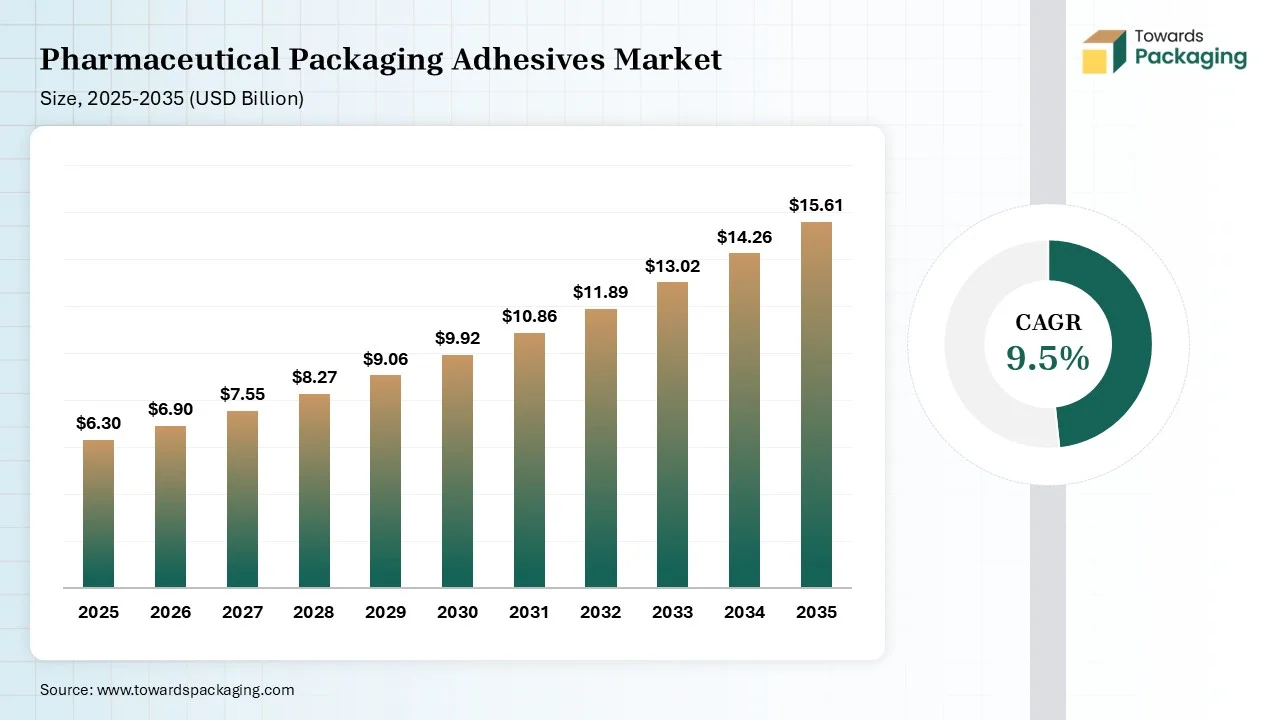
The pharmaceutical packaging adhesives market is projected to grow from USD 6.9 billion in 2026 to USD 15.61 billion by 2035, registering a CAGR of 9.5% during the forecast period. The pharmaceutical packaging adhesives market covers a comprehensive analysis of market size, detailed segmentation by adhesive type, material, application, and end-use, along with complete regional insights across North America, Europe, Asia-Pacific, Latin America, and the Middle East & Africa. The report also includes competitive analysis of leading companies, detailed value chain assessment, trade flow data, and extensive profiling of key manufacturers and suppliers shaping the industry.
AI is popularly famous in this market for its machine vision systems and algorithms, driving spectacular intelligent formulation design and real-time quality control. The AI monitors the forecasting equipment wear and application machinery to help the manufacturer measure the perfect volume of adhesives needed for the packaging. The strict regulatory compliance and frameworks are accelerating for AI intervention in the market for data and address barcodes, tamper-evident seals, and serial numbers. While the sustainability trends are driving the expansion of AI models for halogen-free and solvent-free adhesive alternatives.
Pharmaceutical packaging is growing with laser and digital printing, as well as AI-linked inspection systems and environmentally friendly machinery. Such developments encourage precision, flexibility, and traceability, as well as solvent-free adhesives, carbon-effective, and heat-up systems. Single-use packaging is also being updated with halogen-free, lighter, compostable, recyclable, or biodegradable selections.
Hence, regulatory gaps for the aim of regulatory gaps in terms of green materials are the main industry issues. Additionally, smart packaging technologies count digital characteristics such as temperature indicators, electronic dose counters, and connectivity for instantaneous tracking. Such technologies are crafted to develop patient dependency, serve complicated data, and manage drug usage data to healthcare servers.
The water-based adhesives segment dominated the market in 2025 because they use water as the initial carrier, which avoids the demand for further solvents. Such adhesives are formulated by releasing polymers like ethylene vinyl acetate (EVA) and acrylics in the water, which are integrated with performance additives and surfactants. Water-based adhesives are convenient to use in liquid format, as they ensure strong adhesion and soft use like wood, paper, chosen plastics, and cardboard, which makes them smooth and eco-friendly, responsible for bonding with the solution.
The hot-melt adhesives segment is expected to grow at the fastest CAGR between 2026 and 2035 in the market, as they are thermoplastic materials that turn into liquid when heated and harden after cooling, which makes rigid bonds without any demand for solvents. This feature makes them specifically promising in the pharmaceutical industry, in which reliability and speed are crucial. Hot melt glue has a variety of uses in pharmaceutical production, right from packaging to assembly procedures.
The acrylic segment dominated the market in 2025 as the application of acrylic polymers in the medical sector has been constantly developing over the last few years. This is particularly highlighted in diagnostics, because acrylics are a deep material that does not respond with the reagents utilized in testing. The top uses of acrylic in the pharmaceutical sector currently are available for tubing connectors, but are also used to generate syringes, test kits, drainage wands, and blood filters, as well as blood pumps, fluid silos, and surgical trays.
The polyurethane segment is expected to grow at the fastest CAGR between 2026 and 2035 in the market as these resins integrate strength, flexibility, processability, and biocompatibility, which makes them a milestone in the medical production. These coatings are perfect for drug delivery systems because of their ability and versatility to make controlled-release formulations. It delivers an impactful barrier material, which ensures accurate dosage over a time period and modulates drug diffusion.
The secondary packaging segment dominated the market in 2025 because they are an outer layer that completes the primary packaging. Like primary packaging that directly communicates with the product, secondary packaging serves additional protection, assisting in managing products for convenient handling, and ensures compliance with branding, shipping, and storage regulations. The instances of secondary packaging are boxes and cardboard, which are rigid cardboard boxes used to carry primary packaging such as bottles or blister packs. They deliver product design and prevention as it shifts through the supply chain. On the other hand, shrink wraps are used to carry many products altogether, which serves extra protection against tampering and moisture.
The primary packaging segment is expected to grow at the fastest CAGR between 2026 and 2035 in the market. The word primary packaging refers to the surface of packaging that comes in direct contact with any pharmaceutical product. For instance, a parenteral product kept in a glass vial is totally in direct contact with both the stopper and the vial. Such components are crafted to not only store and prevent but also protect the quality, stability, and, were compulsory, sterility of any product from the source of production throughout the time of its shelf life.
The labels segment dominated the market in 2025 as sterilization labels are tailored adhesive labels crafted to firmly stand with pressure, high temperatures, and chemical exposure during the sterilization procedure. Apart from reliability, they also work as visual indicators, as they indicate whether a product has experienced sterilization. Whether they are ethylene oxide (EtO) sterilization, autoclaving, or gamma irradiation, such labels update display or color, which are associated with signals once the sterilization procedure is completed that assist medical owners quickly determine whether the pack, tool, or tray is convenient for application.
The flexible packaging segment is expected to grow at the fastest CAGR between 2026 and 2035 in the market. Plastic flexible packaging is prevalently used in this industry. They deliver as: protective Suits” for medication purposes, which match external factors such as moisture, oxygen, and light while ensuring the safety, stability, and smoothness of the medicines during the actual time period. Due to the different nature of the medicines, such packaging materials are generally multi-layered in composite designs that should align with a variety of standards, including heat resistance, barrier characteristics, and mechanical properties.
North America dominated the pharmaceutical packaging adhesives market in 2025, as the market development is expected to be driven by pharmaceutical packaging solutions that deliver “developed attention” for sustainability and the application of biodegradable and recyclable materials. Packaging is significant for pharmaceutical products, which are entered and stored securely. The aims of pharmaceutical packaging are various and main. They should be packed to check, protected, and stored, which need to be sold and marketed under different brands, and to make them convenient for users to utilize the medications. Furthermore, oral drugs that carry the main portion of the market serve the convenience of administration and patient compliance.
How is the Pharmaceutical Packaging Adhesives Market Developing in Canada?
Canadian drug producers constantly invest in the development and exploration of technologies. Such investment assists in developing productivity and reveals future economic development. The economic effect of pharmaceutical production also extends to the assistance of suppliers, service providers, and contractors. Such counts tailored packaging organizations, clinical research laboratories, software developers, raw material generators and transportation companies, and several others which advantage from the consistency and power of the sector.
Asia Pacific expects the fastest growth in the market during the forecast period. The pharmaceutical packaging adhesive industry is witnessing main development driven by a convergence of technological growth, growing user demands, and regulatory needs. The growth of smart technologies, which brings real-time monitoring and tamper-evident features, develops user engagement and product safety. Organizations that are successfully investing in designs and advanced materials allow for developed drug stability and expanded shelf life, which can lead to increased soft nature and lower waste. Apart from this, the growing biopharmaceutical industry needs tailored packaging solutions that track the constant stability of biologics.
India Pharmaceutical Packaging Adhesives Market Trends
Pharmaceutical packaging adhesives in India are excessively pushed by compliance with international and domestic regulations. Laws such as Good Manufacturing Practices (GMP) and the Drug and Cosmetics Act have set the foundation line for protective packaging. Export-linked companies should also depend on the rules from the regulatory bodies, such as the European Union and the U.S. FDA. Such principles ensure product integrity, safety, and traceability across the supply chain. Compliance pressure is driving organizations to accept advanced-level packaging technologies with tamper-proof seals, barcoding systems, and serialization.
Europe is expected to grow at a notable CAGR in the foreseeable future, due to its contribution of modern packaging technologies that support the structural integrity and child-resistant packaging. Regulatory stringencies and popular PPWR mandates are sharpening eco-friendly bio-based innovations. The solvent-based adhesives and specialty adhesives are gaining more fame in the sustainability-derived developments.
UK Market Trends
The UK trends in this market are its smart integration perk to the pharmaceutical sector, featuring the potential of digital tracking. While the huge pharmaceutical brands are busy investing in the feather-light designs and mono-material laminates, contributing largely to the environment. The adhesives' compatibility with the new materials encourages innovation for the same. The popular use of specialized adhesives in the primary packaging is setting the bar for safety standards.
The Middle East and Africa region is considered to be a significantly growing area, due to its value-added innovative initiative in the market. MEA’s smart innovation in the market is its great emphasis on the low migration adhesives, promising value to the safety standards. The robust bio-based formulation best suited for the sustainable goals is a two-way success in the regional healthcare and the market. This formulation is a double treat for sustainability approaches, as its compatibility with mono-material packaging adds a spectacular innovation flavor to the market.
Saudi Arabia Market Trends
Saudi Arabia trends in this market are measured by its attentiveness towards the needs in the regional market. The dominance of flexible packaging is highlighting the strength of the adhesives in the bonding of thin flexible films. The water-based adhesives are gaining traction in the regional market.
By Technology
By Resin Type
By Packaging Type
By Application
By Region







Research & Advisory Analyst
Yogesh Kulkarni is an experienced Research Analyst specializing in the packaging sector, with a strong foundation in statistical analysis and market intelligence. He currently contributes his expertise to Towards Packaging.
Learn more about Yogesh Kulkarni

Reviewed By
Aditi Shivarkar, with 14+ years in packaging market research, specializes in food, beverage, and eco-friendly packaging. She ensures accurate, actionable insights, driving Towards Packaging Analytics & Consulting 's excellence in industry trends and sustainability.
Learn more about Aditi Shivarkar

Pharmaceutical Packaging Adhesives Market
 Table of Content

 Download Sample
 Schedule a Meeting