


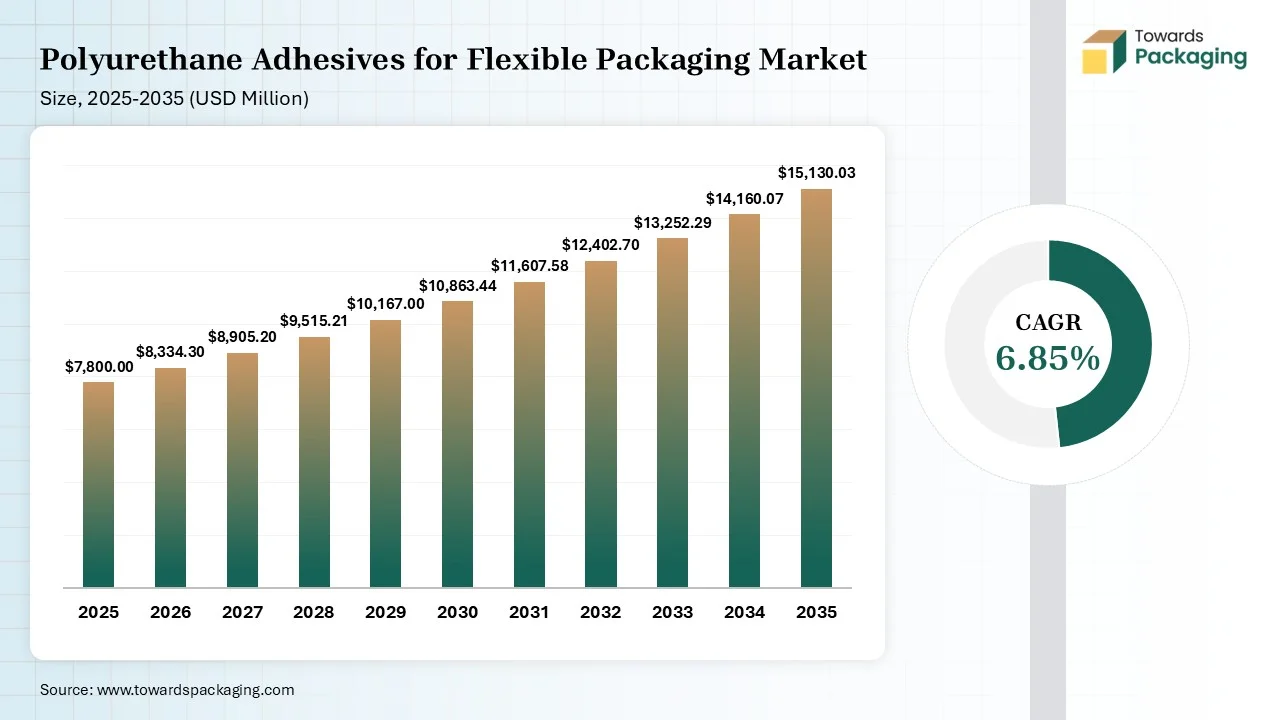
The polyurethane adhesives for flexible packaging market is projected to grow from USD 8,334.3 billion in 2026 to USD 15,130.03 billion by 2035, registering a CAGR of 6.85%. The report provides detailed market size evaluation along with comprehensive segment data based on product type, application, and end-use industries. It includes regional insights across North America, Europe, Asia-Pacific, Latin America, and the Middle East & Africa. The study further covers key company profiles, competitive analysis, value chain assessment, and trade data, along with in-depth information on manufacturers and suppliers operating in the market.
Partnerships between adhesive researchers, producers, and end-users are important for driving inventions. By collaborating, such stakeholders can develop the latest formulations and uses that align with developing demands of various sectors. As disruptive technology develops, environmental and regulatory considerations will play an increasingly crucial role. Producers will demand to make sure that their products meet secure and surrounding standards while aligning with the urges of a quickly updating market. Additionally, digitalization is ready to change the adhesive sector, which allows for more effective manufacturing procedures and product development. Digital technologies and tools, such as machine learning and artificial intelligence, will promote the design of the latest adhesive formulations and update production procedures.
Solvent-based adhesives segment dominated the market with 40% share in 2025 as they are a quick and dependable path to join a variety of plastics such as polycarbonate, PVC, PETG, and ABS. Solvent bonding is a procedure of linking plastics such as acrylic by using a solvent adhesive, which softens the material enabling the two pieces bond at a surface level. As the solvent evaporates, the plastic will get hard again, which leaves behind a clear, permanent, and smooth bond. These adhesives are created from luxury-quality chemical compounds and technologically developed tools under the rules of skilled professionals. It serves adhesives which are available in different packaging options to align with the varied demands of the clients.
Solvent-free adhesives segment held the second largest share of 35% in 2025, and it is also expected to grow at the fastest CAGR of 7.2% during the forecast period. These adhesives have come up as the selected bonding solution in several sectors, specifically in flexible packaging, high-performance composites, and other applications. As eco-friendly regulations become stronger and production procedures shift towards sustainable and safer working, solvent-free polyurethane systems are significantly substituting regular solvent-based adhesives solvent-based adhesives.
The water-based adhesive segment held the third largest share of 25% in 2025 because they are connecting solutions that use water as its crucial carrier instead of pollutant chemical solvents. Such adhesives are formulated with polymers such as acrylic or natural rubber, polyvinyl acetate, which serves as a reliable adhesion for different materials, including wood, paper, cardboard, and textiles. Such adhesives generally are available as ready-to-use dry powders or liquids mixed with water, which, upon evaporation, leave rigid and reliable bonds for everyday and industrial uses.
The food packaging segment dominated the market with 45% share in 2025, as polyurethane (PU) adhesives are the most dominant bonding technology utilized in current food packaging, specifically in multilayer flexible laminates. As the food sector heavily accepts high-performance packaging to develop shelf life, mechanical properties, and barrier properties, polyurethane adhesives have become unavoidable because of their perfect adhesion to various substrates, mechanical durability, and chemical resistance.
The medical & pharmaceutical packaging segment held the second largest share of 20% in 2025, and it is also expected to grow at the fastest CAGR of 7.5% during the forecast period. Wearable medical devices generally integrate several materials, such as thermoplastic polyurethane (TPU), polycarbonate (PC), and polyimide (PI), and high-performance polymers, like polyether block amide and olefin copolymer, and metals like aluminium or titanium. Polyurethane adhesives count two-part and the moisture-curing type that serve moderate flexibility, strength, and perfect adhesion to designing plastics like TPE and TPU, which are prevalent in wearable devices.
The industrial packaging segment held the third largest share of 15% in 2025 as plasticizer PU resins are selected in flexible uses because they provide perfect chemical resistance, flexibility, and adhesion to a variety of substrates. For instance, Trithane-701 is utilized for general layer and reverse printing ink, and Trithane-702 is being updated for freezer using printing inks. The plasticizer-developed formulation ensures that such resins can address stress, rolling, and bending while adjusting their structural integrity, which makes them ideal for flexible packaging and covers in dynamic surroundings.
Consumer goods packaging segment held the fourth largest share of 12% in 2025 as polycot products serve high-level adhesives, binders, composites, and elastomers that deliver safety, strength, and results to consumer goods and reformative products. From sports flooring and playground surfacing to molded wheels, golf balls, and specialty elements, every system is designed for adaptability and durability. With proven chemistries, flexible packaging, and practical technical assistance, polycoat assists producers and the facility workers to make spaces and products that serve comfort, long-term value, and delightful moments.
Food and beverage companies segment dominated the market with 40% share in 2025 because polyurethane materials are valued in this industry because they provide quieter working, corrosion resistance, and perfect non-marking elements as compared to metal. It also has ideal resistance and load capacity for abrasion and chemicals compared to rubber. Due to this, polyurethane elements frequently have a longer service life and more effective capability than rubber, metal, and other polymers. They are reliable with several elements of food packaging and processing use, from table layers and conveyor rollers to inspection tables.
The packaging converters segment held the second largest share of 25% in 2025 as high-performance laminate solutions mark up to 15% of flexible packaging units that have the biggest need. Some prevalent products in such packaging space include laundry detergents that have aggressive content, pet foods, baby meals, and medical uses, which are filled in sterile surroundings. Solvent-based adhesives are a perfect solution for this category, which initially gained popularity towards aligning ever-developing demands in flexibility, function, convenience, and smoothness.
The pharmaceutical manufacturers segment held the third largest share of 20% in 2025 and expects the fastest CAGR of 7.6% during the forecast period. Polyurethane laminating adhesive is a high-performance adhesive composed of polyurethane as the crucial element through a special procedure. In terms of medical soft packaging, polyurethane laminating was initially used for the covering of different substrates, like aluminium and plastic foil, which makes a composite film with exceptional barrier safety and properties.
Consumer goods brands segment held the fourth largest share of 10% in 2025 because one of the main benefits of polyurethane adhesive for shows is its high acceptable bonding power, like other adhesives that can crack or be removed, polyurethane adhesives create a reliable union between various materials like rubber, leather, and synthetic fabrics. Flexibility is significant to footwear outcomes. These adhesives incorporate flex and stress with a material that protects gaps and breaks. This makes them best suited for sports shows, sneakers, and formal footwear.
Asia Pacific dominated market with 40% share and expected to sustain its position with the fastest CAGR of 7.2% during the forecast period. One of the main worldwide trends is the increasing importance of sustainable growth. As sectors concentrate on lowering their carbon footprint, the urge for adhesives that are recyclable, non-pollutant, and composed of renewable feedstock materials has grown. Bio-based polyurethane adhesives are gaining popularity as they assist sectors in aligning with the worldwide push for eco-friendly sustainability. The growth of waterborne polyurethane adhesives, which produce fewer unstable organic compounds (VOCs), is also a complicated trend that encourages the market globally. One of the main worldwide trends is the developing importance of sustainable development.
India Polyurethane Adhesives for Flexible Packaging Market Trends
India's total focus is on sustainability, which has developed inventions in bio-based adhesives. Local startup companies are growing solutions that come from cashew nutshell liquid, starch, and soy protein. Such adhesives serve as a formaldehyde-free choice, biodegradable, and are perfect for food packaging, wood panels, and automotive interiors. There are updated standards by the Bureau of Indian Standards (BIS), and compliance with the India Plastics Pact is predicted to fast-track commercialization.
North America held the second largest share of 25% in 2025 and expects the notable growth with 6.3% CAGR during the forecast period. Main possibilities entering the development of digital stages, as the growth of environment-friendly and smooth systems, and the rising demand for high-level solutions in industries such as automotive, healthcare, and manufacturing.
The ever-developing startups and discovered companies alike are penetrating such possibilities with the help of strategic partnerships and cutting-edge inventions. With developing investment, favorable policy, and developing user demands, the North American polyurethane flexible packaging serves as a versatile ground for development for organizations whose goal is to solve main uses or develop scalability across the continent.
Canada Polyurethane Adhesives for Flexible Packaging Market Trends
Adhesives should align with strong safety standards for food link, e.g., for Canada regulations, as PU adhesives are selected for their chemical ability and resistance to link various substrates like foil and film. There is a developing demand for polyurethane dispersion of (PUD) adhesives. They are water-based and release fewer volatile organic compounds (VOCs) and are excessively used in recyclable and mono-material packaging. Producers favor PU for its high linking flexibility and power, which secures sensitive products like electronics and medical supplies during handling.
By Type
By Application
By End-User Industry
By Region







Principal Research Analyst
Vidyesh Swar is a Senior Research Analyst at Towards Packaging, bringing over 4 years of dedicated expertise in market intelligence and strategic analysis across the dynamic world of packaging technologies and solutions.
Learn more about Vidyesh Swar

Reviewed By
Aditi Shivarkar, with 14+ years in packaging market research, specializes in food, beverage, and eco-friendly packaging. She ensures accurate, actionable insights, driving Towards Packaging Analytics & Consulting 's excellence in industry trends and sustainability.
Learn more about Aditi Shivarkar

Polyurethane Adhesives for Flexible Packaging Market
 Table of Content

 Download Sample
 Schedule a Meeting