


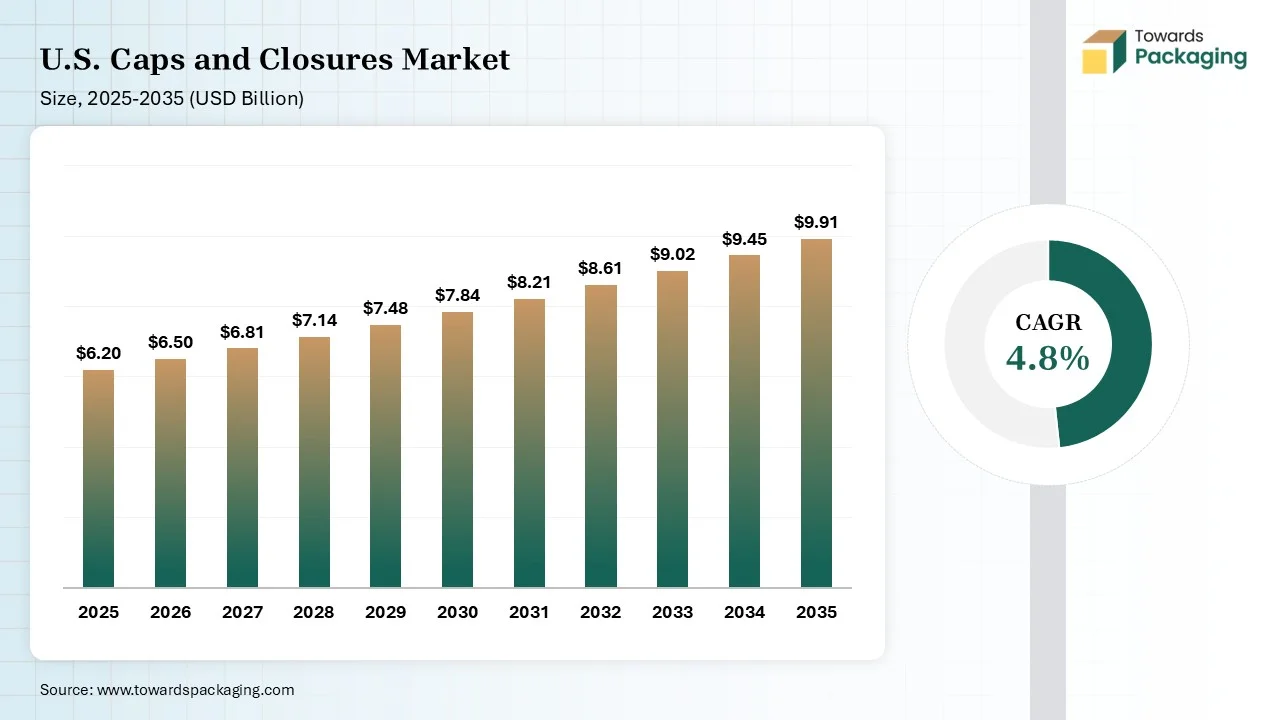
The U.S. caps and closures market is projected to grow from USD 6.5 billion in 2026 to USD 9.91 billion by 2035, registering a CAGR of 4.8% during the forecast period. The report provides comprehensive coverage of market size along with detailed segment data by product type, material, and end-use industries. It also includes regional insights, key company profiles, competitive analysis, value chain evaluation, and trade data, along with detailed information on manufacturers and suppliers shaping the industry landscape.
A cap is a kind of closure that covers the opening of any container. Generally linked and screwed on. They are frequently used to pack jars and bottles, and closures are a huge term which counts any elements that are used to pack, close, or prevent the opening of a container It contains caps but also counts plugs, lids, sprayers, flip-tops and more.
Plastic bottle closures are some of the most widely used because of their lower density and convenience of production, which makes them convenient to mass-generation while staying cost-effective. They are also lightweight in nature to be cost-effective in terms of bulk shipping costs.
Smart caps mix advanced technology, such as Bluetooth sensitivity, built-in sensors, or training smart features, to manage product applications and track freshness. Such sensors and linked apps can deliver real-time data to users or producers. For example, such caps remind consumers to remain hydrated, track the required amount of liquid expended, or remind them when the products are approaching expiration. They serve sustainability and ease. Integrated with developed user engagement, smart caps are one of the most popular selections in healthcare, food and beverages, and wellness sectors.
The plastic segment dominated the market with 72% share in 2025 and is expected to have the fastest CAGR of 5.2% during the forecast period. Tethered caps are a type of plastic closure that is physically linked to the bottle even after opening it. Whether they relate to the assistance of an integrated strap or a flexible hinge, such caps are crafted to remain with the container, within its lifecycle, from recycling application. This protects caps from crafting detached microplastics or litter, which are prevalent contaminants in urban and marine surroundings.
The metal segment held 20% market share in 2025, as one of the important functions of a metal closure is to store the ingredients of the container safely and securely. It makes a tight pack that protects moisture, air, and other contaminants from penetrating in. This is crucially beneficial for products such as pharmaceuticals, food, and beverages. Additionally, it operates to serve as tamper evidence. Several metal closures are crafted in a way that if anyone tries to open the container, they are alerted to signs of tampering.
Screw caps segment dominated the market with 38% share in 2025. They are widely used across beverages and household items. Screw caps are a kind of closure that is crafted to pack containers, which are conveniently jars and bottles. Its basic design depends on a linked mechanism, which has a spiral ridge present inside the cap that gets locked with an aligned thread on the neck of the container. The beverage sector is a main user of screw caps. Their capability is to track and fix sela, which is important for protecting carbonation and preventing leaks in such products.
The dispensing closures segment held 22% market share in 2025, and it is also expected to grow at the fastest CAGR of 6% during the forecast period. It enables the consumer to manage how many products are being released, protect against overuse, and lowers waste. It also assists in tracking product credibility by restricting exposure to contaminants and air.
With users who are placing excessive importance on convenience, brands are shifting to smarter caps and closures to match the growing predictions. The nutraceutical and pharmaceutical sectors depend on closures to serve dosage control and tamper evidence, while in food and beverage, closures such as spurs and flip-tops develop consumer satisfaction by lowering spills.
The snap-on closures segment held 15% market share in 2025 because they are used in dairy packaging and food containers. These are perfect for jars, bottles, and pouch packaging in terms of beverages, food, personal care, and supplements. Such cups utilize threads inside the cap and on the container neck. Screw-on caps are available in several forms as they deliver tamper evidence. Wide mouth dies create scoping and filling convenience. For instance, protein powder jars and supplement bottles use wide-mouth screw closures.
The tamper-evident closures segment held 10% market share in 2025, as they are effectively used in pharma and food safety packaging. Tamper-evident packaging points to secure characteristics that display clear signs of communication when anyone uses a product without checking. Such closures make visible proof of meddling with the assistance of broken seals, irreversible updates, and torn materials that update packaging designs. Sectors that range from food manufacturing to pharmaceuticals depend on such secured measures to protect against counterfeiting, contamination, and liability problems. In actuality, the FDA needs tamper-evident proof in terms of over-the-counter drug products.
The beverages segment dominated the market with a 45% share in 2025 because carbonated soft drinks need closures that can firmly withstand internal pressure while tracking seal integrity over long distribution methods. Bottled water manufacturers frequently give importance to lightweight closure structures that lower the plastic application while tracking reliability with high-speed filling designs. Functional beverages and dairy drinks concentrate more on tamper evidence, hygiene, and soft opening exposure for users. As the beverage profile extends, compatibility between packaging elements becomes excessively crucial.
The pharmaceuticals segment held 15% market share in 2025 and is expected to have the fastest CAGR of 6.2% during the forecast period. Plastic caps and closures are widely used in pharmaceutical packaging, which ensures reliability and safety for commercial items. Their website expands to containers and bottles in cosmetics, healthcare, and food sectors. Extra characteristics count tailored diameters between 13mm and 45mm, selection designed from eco-friendly materials, and multi-color options. Such exceptional caps stand out for their reliable sealing and decorative appeal, which makes them famous among producers and suppliers.
The food segment held the 18% market share in 2025 because they protect the product from getting polluted. Such plastic caps are crafted in such a way that they form an airtight seal, which assists in protecting the product for a longer duration. Freshness is very crucial when it comes to the food and beverages sector. Plastic caps make sure that the product does not deteriorate, track the shelf life of the product, and also make sure that the product reaches the user in its purest form. They are specifically useful for health supplements and beverages so that users can use them for a long time.
The personal care & cosmetics segment held the 12% market share in 2025 because there is a strong urge for aesthetic and dispensing closures. Spray caps are not new to the beauty sector. They have been in use for several years, but their functionality and design have mainly improved. One of the fastest-growing developments in the world of spray caps is the move towards eco-friendly materials.
They are created from plastic, which contributes to worldwide plastic pollution. Inventive brands are now offering sustainable choices like biodegradable materials and recycled plastic. Such eco-friendly spray cups not only lower the environmental footprint of beauty products but also appeal to eco-conscious consumers.
The injection molding segment dominated the market with a 65% share in 2025. It is the procedure of filling the plasticized molten metal from a metering association into an old cavity. This is a crucial and complicated stage, which relies on the streamlining of high-temperature melt into a likely cooler mold cavity. It checks polymer crystallization and orientation, which directly affects product quality. Injection molding has two stages: the injection stage and the holding pressure stage. The injection stage starts with the screw boosting as they melt until the melt completes the mold cavity. The holding pressure begins with a melt filling as the mold cavity is completed with the term “freezing”.
The compression molding segment held the 15% market share in 2025, and it is also expected to grow at the fastest CAGR of 5.8% during the forecast period. They are versatile in nature as producers' procedures, which design materials by using overall force to match them with a two-part mold, and have upper and lower spaces. When they are compressed, such mold halves count on a cavity that accurately turns the material into a desired shape. The mold is designed in such a way that the outcome product can be conveniently avoided after the setting and curing stage.
Technological developments, such as blow molding inventions and injection molding, are developing manufacturing efficiency and allowing tailored designs that match user choices. Additionally, smart packaging technologies that include anti-counterfeiting and QR code highlights are receiving attention, which makes consumer usage and product classification easier. Regulatory elements also play an important role, which develops government compulsions on recycling and plastic waste management that affects product development. Compliance with such regulations involves developing inventions that focus on lowering the eco-friendly footprint.
AI’s powerful vision systems fix incorrect barcodes, misaligned labels, and address the structural disturbance quickly with the intention of alleviating waste and contributing to the environment. The eco-conscious design is possible with the AI refining strength that promotes a lighter solution for sustainable caps without any compromise to structural integrity. The AI intervention enables personalization with the smart support of machine learning for perfect printing of QR codes or custom designs.
Robust AI tools connect with consumer demands for refining the transportation and inventory level model in the market. The sustainability trend is driving careful use of the AI-driven approaches for the market. While the precision inspections and quickness are mitigating the operational cost with fewer defects in the processing.
Different sectors demand different alternatives for their packaging, but sustainability stays at the heart of the brands. The child-resistant features and innovative designs are driving the need for eco-friendly materials. The Pharmaceuticals require safety-focused packaging, while the beverages sector demands convenient ‘easy to open’ caps due to the high dominance of ready-to-drink tea/coffee.
Recyclable closures and materials are serving the best-in-class feather-light sealing solutions. Most of the brands seek an attractive, responsible, and alternative packaging catalogue to have more choices to suit the branding voice. The use of AI is a ‘cherry on top’ for the brand campaigns. This confirms successful commercialization on point, with commendable promotion to the brand (product).
The memorable features are aimed at safety and functionality, keeping sustainability at the top of the list for popular sectors like pharmaceutical, beverage, and food, demanding a robust packaging line for their perishables. The participation of IoT-enabled closures, feather-weight plastic materials, and tamper-evident seals strengthens the features of the overall market, reshaping the future of the wide range of regional packaging lines.
By Material
By Product Type
By End-Use Industry
By Manufacturing Technology








Principal Research Analyst
Vidyesh Swar is a Senior Research Analyst at Towards Packaging, bringing over 4 years of dedicated expertise in market intelligence and strategic analysis across the dynamic world of packaging technologies and solutions.
Learn more about Vidyesh Swar

Reviewed By
Aditi Shivarkar, with 14+ years in packaging market research, specializes in food, beverage, and eco-friendly packaging. She ensures accurate, actionable insights, driving Towards Packaging Analytics & Consulting 's excellence in industry trends and sustainability.
Learn more about Aditi Shivarkar


U.S. Caps and Closures Market
 Table of Content

 Download Sample
 Schedule a Meeting