


Packaging plays a significant role in maintaining the integrity of the products and to confirm safe transportation in the modern society. Majority of food trays, water bottles, food jars, and soft drink containers are made up of PET packaging. It comes with high chemical resistance and safety which is used as non-returnable bottles.
Polyethylene terephthalate packaging is non-reactive, non-toxic and highly recyclable packaging. These are BPA-free which raise their usage in the food and beverages industry. It is generated with the polymerization of terephthalic acid and ethylene glycol all through polycondensation reaction. Polyethylene terephthalate resins have clear, recyclable, and lightweight thermoplastic with enhanced gas and moisture barrier. It is commonly processed into fibre which is used in manufacturing curtains, upholstery, bed sheets, clothing, and carpets.
Polyethylene terephthalate is a robust, transparent, recyclable, and lightweight thermoplastic polyester which is utilized majorly for food packaging, synthetic fibres, and beverages bottles production. It is made up of petrochemicals/ crude oil which is treated to extract ethylene glycol (EG) and purified terephthalic acid (PTA). These are generally known for its versatility and durability. It has become one of the most widely utilized plastic due to its physical as well as chemical properties. These are extremely valued for its recyclability, moisture barrier, and light weight frequently utilized in automotive parts, consumer goods, and electronics.
These are colorless packaging that allow customers to see the packaged products and help in monitoring its condition. Its high tensile strength support in withstanding while transporting products to a longer distance. It has high chemical-resistance that support in maintain the integrity of the products while stored for longer-period. These are shatter-proof packaging option which is highly preferred over glass packaging that comes with a risk of breakage during transit. It is estimated that in 1970s the packaging industry started manufacturing PET bottles.
These are also recognized as transparent polymers that is unbreakable and highly recyclable. Such properties are contributing majorly towards extended distribution of this material.
According to United States Environmental Protection Agency majority of the waste collected are either recycled or composted. High amount of waste gathered from items like bottles and corrugated boxes, grass clippings, food, sofas, refrigerators, computers, and tires. There is a specific order to specify most preferred and least preferred waste management that include source reduction and reuse, recycling/composting, energy recovery, treatment and disposal.
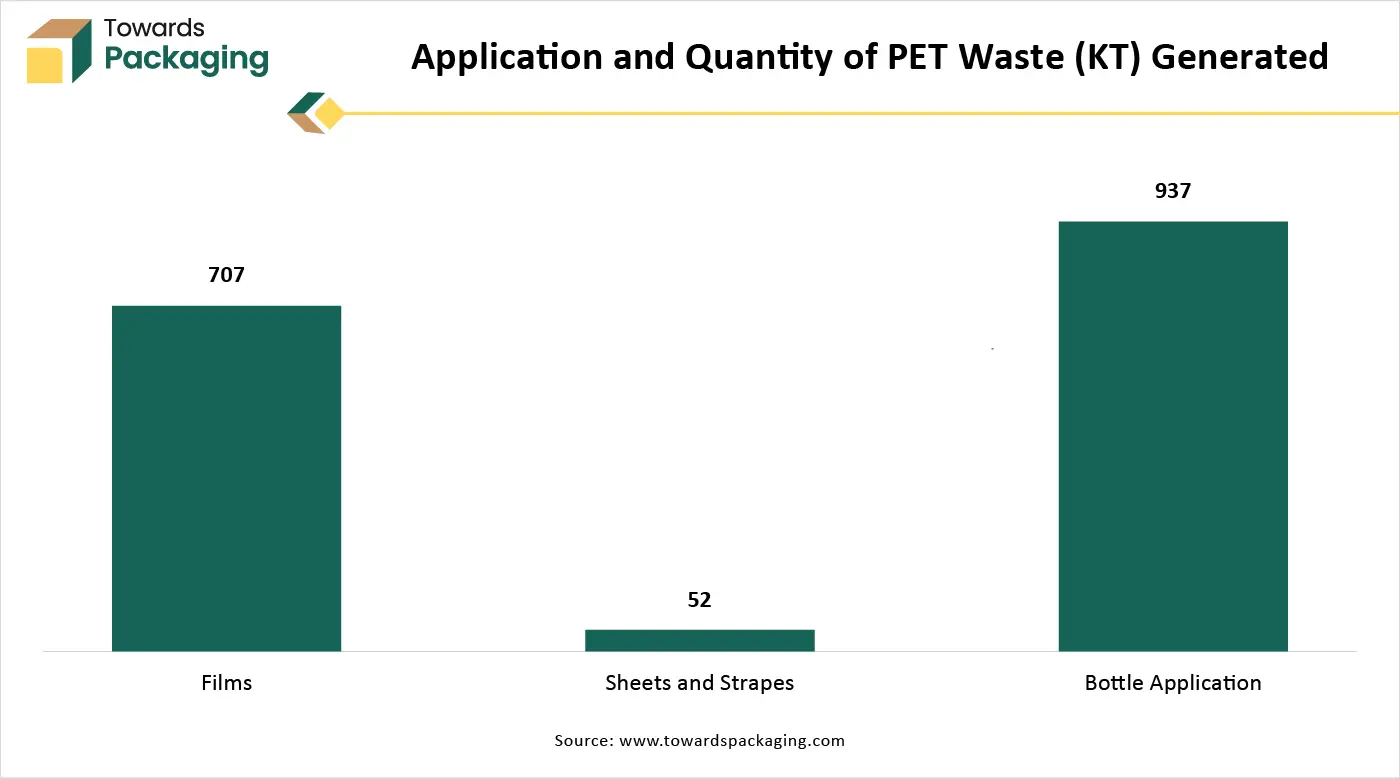
The PET recycling business can be projected to be about Rs 3,000- 4,000 crore in a year in India. Nearly 60 to 70% of rejected PET bottles get recycled by prepared companies in India.
Polyethylene terephthalate is commonly utilized in protective coatings, food as well as medical packaging, plastic wrap, and several other usages. These are generally existing as an outer or middle layer packaging. According to the FSSAI guidelines, only bottles are utilized for food packaging and can be recycled then processed back for food grade rPET.
| Substance | Specific migration limit level |
| Acetaldehyde | 6 mg/l |
| Anthranilamide | 0.05 mg/l |
| Ethylene glycol and diethylene glycol | 30 mg/l |
| Antimony trioxide | 0.04 mg/l |
| Terephthalic acid | 7.5 mg/l |
| Isophthalic acid | 5 mg/l |
Polyethylene Terephthalate (PET) is a kind of plastic that is utilized to generate beverage bottles, packaging for food items, and it is also utilized in textiles such as clothing fabrics. It is estimated that in 2023, total imports of PET were of around 200 million pounds.
It can be recycled easily is the major reason behind the rapid adoption of PET in packaging industry. These recycled products can be used in manufacturing a wide range of products such as bags, clothes, and bottles. These are durable, lightweight and highly convenient to use. These are polyester plastic which is considered as safe material for the packaging of beverages. It has excellent water and gas barrier properties, unbreakability, transparency, UV resistance, light weight, and impact strength. These bottles are planned for one-use packaging and then these are disposed after use. To decrease the ecological influence from packaging waste and to push sustainability goal in plastic packaging, public recycling programs have been introduced to capture recyclable resource streams.
Government of several nation has taken initiatives to avoid the usage of plastic or introducing sustainable solutions for plastic packaging. In various countries there are strict guidelines for the usage of plastic packaging. The Union Ministry of Environment, Forest and Climate Change celebrated World Environment Day 2025 at Bharat Mandapam, under the slogan One Nation, One Mission: End Plastic Pollution.
UN Environment Programme has introduced four major goals to reduce plastic pollution:
The major steps taken by UN Environment Programme to enhance plastic packaging policies and targets by 2030:
Various advancement in recycling technology has introduced to encourage eco-friendly packaging. A group of researchers from IIT Bhilai recently introduced an eco-friendly technique for its recycling. It is used to recycle textiles, bottles, and packaging made up of PET. The research team includes Swarup Maity, Priyank Sinha, Dr. Sanjib Banerjee, and Sudipta Paul who were from the Department of Chemistry, has presented a nanotechnology-based method that proficiently depolymerizes PET into its core monomer which is bis(2-hydroxyethyl) terephthalate (BHET). By means of magnetically recyclable nano zero-valent iron (nZVI) as a catalyst, this process offers high yield and choosiness under mild conditions presenting the shortcomings of current recycling technology.
The increasing trend of westernization, expanding disposable earnings and shifting food designs of customers have raised the demand for packaged beverages, mainly in evolving countries such as China and India. Moreover, hectic routines have allowed customers to choose for on-the-go beverages. The demand for advanced technology and several other products in this field is on the growth. PET packing bottles have extended the area of ketchup, soft drink, hair oil, edible oil, water, and many other liquid edible items packaging. The usage for PET stretch packaging bottles in India is increasing at the rate of 25% per annum in volume.
There is a continuous growth in the demand for Bubble top PET can on account of new consumers being shaped for packed drinking water. The per head utilization of PET is very less in India which is 0.3 kg as compared with the worldwide average that is of 2 kg. This presents that there is a noteworthy development occasion for PET cans in India because of the rapid innovative approach and urbanization of the people. The rapid growth in the demand of PET is also because of the reason that PET Bubble Top Cans is an alternative for glass, polypropylene (PP) and high-density polyethylene (HDPE) bottles.
Polyethylene terephthalate (PET) bottle recycling rates across the United States touched new heights in 2023, as per the National Association for PET Container Resources' (NAPCOR). The United States (US) PET bottle gathering rate was 33% in 2023, up 4% points from 29% in 2022 that is the highest recycling rate in the US since 1996. The usual amount of post-consumer recycled (PCR) PET and also recognized as recycled PET (rPET) which is commonly used in US jars and bottles was 16.2% in 2023, up 3% points from 13.2% in 2022. This is the maximum level ever and validates amplified demand for recycled PET countrywide.
The European Commission encourages the following order in its packaging guidelines: REDUCE, REUSE and RECYCLE. This helps the definitive aim of the EU to be climate unbiased by 2050.
PET is a well-recognized polymer packaging resource worldwide. It has very good mechanical potentials, it also presents noteworthy environmental benefits vs substitute beverage packaging resources. PET creates up to 75% less CO2eq than aluminium or glass one-time use beverage packaging that is per 500ml packaging. LCA studies demonstrated that, reliant on the associated conditions such as energy mix, transport distance, logistics in an exact market one-time use recyclable PET bottle.
Constant emphasis over recycling technologies by companies and government has promoted the usage of these polyethylene terephthalate packaging for a wide range of industries. These are safe and non-reactive which make it highly preferable and its reuse or recycling decreases transportation emission. Such adoption supporting climate to neutralize over the period of time. As EU has targeted for separate collection of PET bottles up to 90% by 2029.
Polyethylene Terephthalate (PET) has emerged as one of the most preferred materials in the food packaging industry due to its lightweight nature, durability, transparency, and excellent barrier properties. These characteristics help protect food quality, extend shelf life, and ensure safe storage and transportation. In addition, PET is highly recyclable, making it a more sustainable option compared to many traditional packaging materials. As consumer demand for convenient, safe, and environmentally responsible packaging continues to grow, the adoption of PET in food packaging is expected to expand further, reinforcing its position as a key material shaping the future of the global food packaging industry.

Aditi serves as Vice President at Towards Packaging, bringing over 15 years of experience in market research, innovation, and business strategy within the packaging industry. She works across segments such as sustainable packaging, flexible materials, and industrial packaging solutions. Aditi studies evolving consumer demands, material advancements, and regulatory changes, then turns those insights into clear strategies for businesses. She helps organizations stay competitive, improve product positioning, and respond effectively to shifting market trends.

Aman Singh has spent more than 13 years working in research and consulting, with a strong focus on the global packaging sector. He tracks developments in areas like eco-friendly materials, smart packaging technologies, and supply chain changes. At Towards Packaging, Aman leads the research team and ensures every study delivers accurate and useful insights. He breaks down complex industry developments and helps companies understand where opportunities lie and how to act on them.

Piyush Pawar works as Senior Manager for Sales and Business Growth at Towards Packaging, bringing over a decade of experience in client-facing roles within the packaging industry. He connects businesses with the right research and helps them apply insights to real-world decisions. Piyush understands market challenges and works closely with clients to provide solutions that support growth. He focuses on building strong partnerships and helping companies turn industry knowledge into practical results.
How PET Became the Leading Choice in Food Packaging Industry


 Request Consultation

