


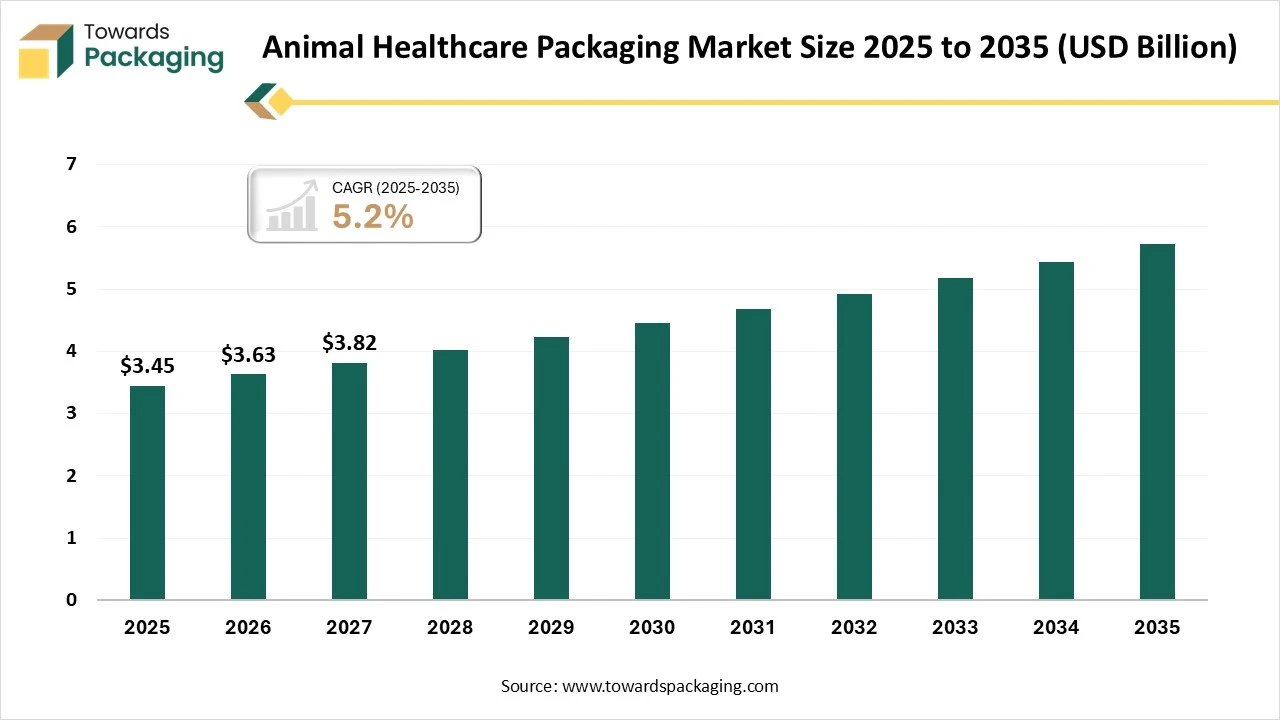
The animal healthcare packaging market was valued at USD 3.45 billion in 2025 and is projected to grow from USD 3.63 billion in 2026 to USD 5.73 billion by 2035, expanding at a CAGR of 5.2% during the forecast period. This report covers detailed segment data by material and product, regional insights with North America leading and Asia Pacific growing fastest, along with competitive analysis, company profiles, value chain insights, and global trade data including veterinary import-export statistics.
Animal health products urge packaging that gives importance to efficacy, safety, and compliance. It doesn’t matter whether any products are perfectly crafted for operating animals or family pets; packaging plays a crucial role in preventing product integrity with the assistance of production, distribution, and their complete shelf life.
Animal caregivers and owners predict packaging that precisely talks about proper usage, safety, and product dependency. Accurate dosing, clear labelling, and protective closures assist and ensure products are utilized intentionally while creating trust in the brand behind the product.
Many factors are driving the move towards sustainable packaging in veterinary medicine. Majorly, livestock farmers and pet owners are becoming more environmentally conscious. They are currently finding the products that show their values and environmentally friendly packaging, which are online and sensitive to the brand’s loyalty.
For the purpose of liquid veterinary medicines, lightweight recyclable bottles are substituting non-recyclable and heavier selections. Labels are traced with a soy-dependent recycled paper, which reduces the chemical effect.
The involvement of digital technologies and AI is updating treatment, diagnostics, and veterinary streamlining. AI-connected telemedicine, diagnostic tools, stages, and accurate management systems are receiving attention, which improves the smoothness and precision of care. At the same time, wearable health tracking machines for companion animals and livestock are allowing real-time tracking and predictive analytics. As the veterinary practices' operational working and mergers become a priority, digital solutions will continue to expand, creating the latest avenues for developing animal health results and data-driven decision-making.
As per the global veterinary medicine import data in India, between the period July 2024 to June 2025, the buyers have globally imported 42,491 shipments of veterinary medicines.
Veterinarians are starting to check the sustainability of their packaging selection in response to both growing client predictions and ethical implementations. They are developing a department of research, which includes a current qualitative study on the veterinary professional point of view, which shows a clear and transparent surrounding for a proper decision-making process.
Smoothly tracking this waste is an important responsibility that directly affects environmental safety, public health, and legal compliance. It needs a complete understanding of regulatory rules fixed by different agencies like the Environmental Protection Agency (EPA) and the Occupational Safety and Health Administration (OSHA), and loyalty to safe and feedback practices.
Veterinary logistics is a tailored field of logistics that concentrates on the secure transportation of animal vaccines, medicines, diagnostic tools, and biological samples. It may seem simple at the primary stage, but when someone thinks about how sensitive such products are, we realize that veterinary logistics are complicated, as with human pharmaceutical shipping.
The plastic segment dominated the animal healthcare packaging market in 2025 as this material is greatly selected for pharmaceutical primary packaging due to its different elements that protect patient safety and product, high barrier properties, and stability. Apart from being reliable and lightweight plastics assistance, there is compliance with strong regulatory needs of the pharmaceutical sector, while creating it as the perfect solution for ensuring both patient well-being and product quality.
The glass segment is projected to witness the fastest CAGR during the forecast period. Moulded glass vials, specifically those created from Type 1 borosilicate glass, are important in parenteral drug packaging solutions for the pharmaceutical sector because of their thermal stability, chemical resistance, and mechanical strength. Type 1 glass is extremely resistant to chemical attack, which has a very low coefficient of thermal expansion, and can firmly stand with high-value drugs that include vaccines, biologics, and blood elements. Similarly, type 11 glass vials have surface diagnosis, which dealkalize the glass, developing its hydrolytic resistance, which is utilized for drugs where cost-effectiveness and chemical resistance are important.
The syringes segment dominated the animal healthcare packaging market in 2025 as veterinary insulin syringes show tailored and single-use insulin syringes, particularly crafted for pet diabetes management and animal insulin injection. Alike their human medical spaces, such professional-studied veterinary medical devices have classified design elements and the technical characteristics personalized to align with various demands of various animal species. Produced from high-grade medical plastics, such as veterinary insulin syringes, which include three complicated elements like plunger, barrel, and ultra-fine needle, as they are perfectly crafted to serve peak results in veterinary uses.
The vials segment is expected to experience the fastest CAGR during the forecast period. A vial filling and the capping machine serve perfectly effectively and seed. It totally relies on the design, as such machines can pack many or even thousands of vials per hour. The veterinary sector concentrates on healthcare and the diagnosis of animals. In the veterinary medicine vial capping and filling, machines are necessary for the manufacturing of perfect medication safety, dosage, and sensitive products. The machine assists in filling and sealing the animal medications accurately, so it ensures a perfect dosage of products.
North America dominated the animal healthcare packaging market in 2025, as current pilot initiatives are intelligent and have environmentally friendly packaging solutions that show a developing acceptance wave. The early acceptors, such as primarily big biotech startups and pharmaceutical firms, are showcasing the developed eagerness to fund inventive packaging in order to align with sustainability standards and regulatory needs. Developments in the manufacturing process, such as material invention and automation, are lowering the unit amount by approximately 15-20%, which makes good-quality packaging more available to mid-level players.
How is the Animal Healthcare Packaging Market Developing in the United States?
The animal healthcare packaging is growing in the United States, as approximately 66% of U.S householders are partnered as of 2024. The partners are excessively treating pets as family members, which has led to a bigger investment in the luxury medications, tailored diagnosis, and supplements that need standard packaging. The growing demand for dairy and meat products complements the demand for heavy-sized and reliable products, which often need fragile packaging for the antibiotics and vaccines utilized in large-scale farming.
Asia Pacific expects the fastest growth in the market during the forecast period. The overall moves in user and company demand are being classified by a developing choice for natural, holistic, and protective health solutions, along with the developed acceptance of digital health stages. Such trends are assisted by growing alertness of animal health and welfare, as well as the mixing of the data-driven tracking insights into a decision-making procedure. The geopolitical and worldwide trade pushes, which include tariffs, trade agreements with regional stability that are affecting the supply chain points and market entry.
India Animal Healthcare Packaging Market Trends
The animal healthcare packaging market in India is evolving steadily alongside the growth of the country’s veterinary and livestock sectors. Increasing demand for animal medicines, vaccines, and nutritional supplements driven by expanding dairy and poultry industries as well as rising pet ownership has created a strong need for reliable, safe, and cost-effective packaging solutions. Packaging formats such as vials, bottles, syringes, blister packs, and flexible pouches are widely used, with a growing emphasis on sterile and tamper-evident designs to maintain product integrity. The market is also influenced by government vaccination programs, improved veterinary services, and greater awareness of animal health and disease prevention.
Europe is expected to grow at a notable CAGR in the foreseeable future, driven by the rising pet ownership, increasing livestock healthcare investments, and strong demand for safe, sustainable, and tamper-evident pharmaceutical packaging solutions. The region’s animal healthcare industry is expanding steadily as pet humanization trends continue to grow, increasing demand for veterinary medicines, vaccines, nutraceuticals, feed additives, and diagnostic products.
Germany Market Trends
Germany has a strong pharmaceutical manufacturing base, an advanced veterinary healthcare infrastructure, and a large livestock sector. The country is a hub to several major veterinary pharmaceutical companies and packaging technology providers, creating high demand for high-barrier, sterile, and temperature-sensitive packaging solutions.
Latin America is considered to be a significantly growing area, due to rising pet ownership, expanding livestock production, and increasing investments in veterinary healthcare across the region. The region is witnessing stronger demand for veterinary medicines, vaccines, nutritional supplements, and animal biologics, increasing the need for secure, hygienic, and temperature-resistant packaging solutions. Demand is especially rising for bottles, blister packs, vials, pouches, syringes, and cold-chain packaging.
Brazil Market Trends
Brazil has one of the world’s largest livestock industries and a rapidly growing pet care sector. The country’s strong poultry, cattle, and swine industries create massive demand for veterinary vaccines, feed additives, and biologics, all of which require high-performance pharmaceutical packaging.
The Middle East and Africa are expected to grow at a considerable CAGR in the upcoming period, due to rising livestock production, increasing pet ownership, and stronger investments in veterinary healthcare infrastructure. Animal healthcare packaging has become increasingly important across the region because veterinary medicines, vaccines, biologics, and nutritional supplements require secure, contamination-resistant, and temperature-sensitive packaging solutions. Governments across the region are strengthening animal disease control programs and food safety standards, further increasing demand for reliable veterinary pharmaceutical packaging.
Saudi Arabia Market Trends
Saudi Arabia is leading the market due to the country’s growing livestock sector, expanding poultry industry, and rising investments in food security initiatives under Vision 2030. Veterinary vaccines, feed additives, and injectable medicines are witnessing increased demand. Pharmaceutical-grade packaging, tamper-evident closures, and temperature-controlled packaging systems are becoming increasingly important.
By Materials
By Product
By Region



Research & Advisory Analyst
Yogesh Kulkarni is an experienced Research Analyst specializing in the packaging sector, with a strong foundation in statistical analysis and market intelligence. He currently contributes his expertise to Towards Packaging.
Learn more about Yogesh Kulkarni

Reviewed By
Aditi Shivarkar, with 14+ years in packaging market research, specializes in food, beverage, and eco-friendly packaging. She ensures accurate, actionable insights, driving Towards Packaging Analytics & Consulting 's excellence in industry trends and sustainability.
Learn more about Aditi Shivarkar


Animal Healthcare Packaging Market
 Table of Content
 sales@towardspackaging.com
 +1 804-441-9344
 Download Sample
 Schedule a Meeting