


The APET-based thermoformed trays market is forecasted to expand from USD 5.66 billion in 2026 to USD 14.48 billion by 2035, growing at a CAGR of 11.0% from 2026 to 2035. The growth is because thermoformed PET is excessively substituting regular packaging materials like aluminum, glass, polystyrene, and foam, too. It serves as the main weight reduction, enhanced barrier elements, developed recyclability, and perfect product visibility.
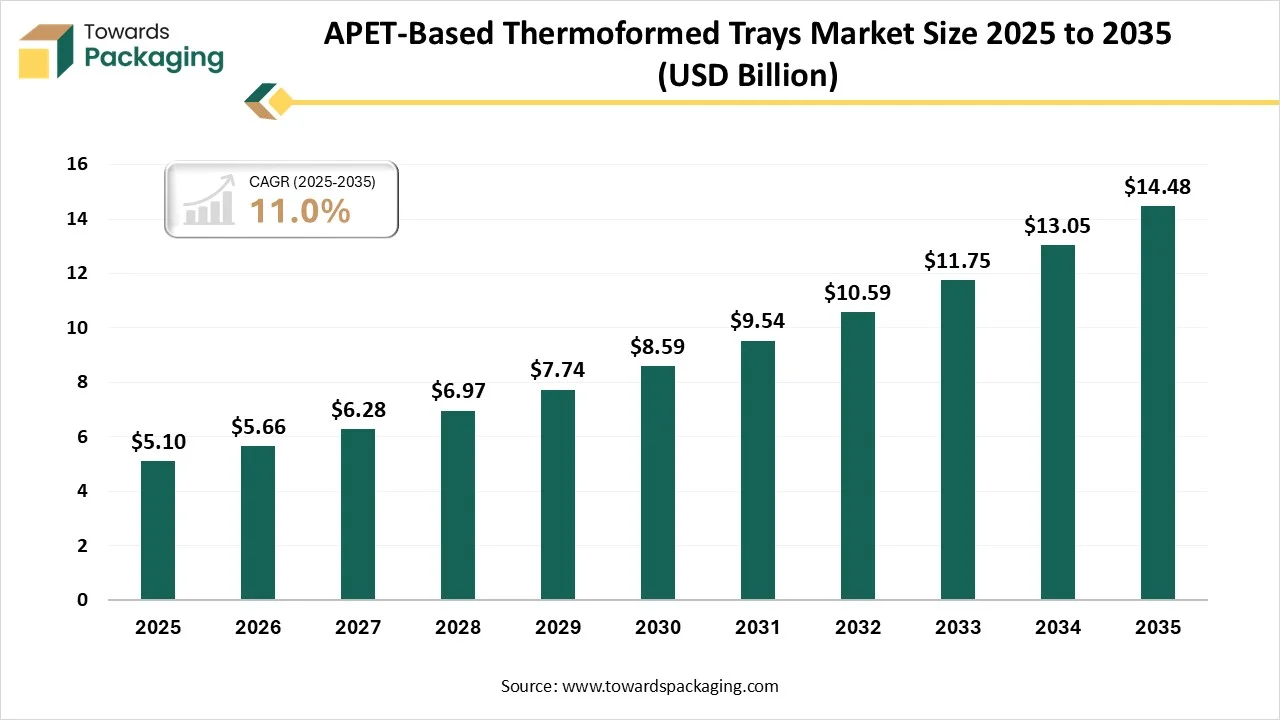
APET-Based thermoformed trays market is a segment of the plastics packaging sector that concentrates on the distribution, production, and application of the rigid or semi-rigid trays created from Amorphous Polyethylene Tetraphthalate with the assistance of a production procedure known as thermoforming. APET is the amorphous or non-crystalline form of PET, which is rigid, clear, and has perfect barrier characteristics against gases and moisture.
To solve several challenges related to APET, the sector is accepting advanced sensor-dependent sorting systems. Modern near-infrared (NIR) systems, such as Tomra’s Autosort, which can classify between monolayer and multi-layer PET trays, are crucial in terms of potential, as only mono-layer trays are perfect for good-quality and closed-loop recycling.
At the fragment level, sorting technologies filled with multi-sensor factors can check flakes by polymer type, material aging, and transparency, too. This accuracy is necessary for avoiding pollutants like PVC, opaque particles, and metals, too.
The food trays segment dominated the APET-Based thermoformed trays market in 2025 as they are greatly used for clamshells and food taurus, particularly for salads, fresh produce, and ready meals, too, but also operates perfectly in the medical and retail sectors. The material is accessible through an integration of recycled and virgin content, which are personalized to align with every user’s particular demands. They serve a relevant balance between sustainability and performance, which makes them a go-to choice for several packaging uses.
The bakery and confectionery tray segment is predicted to witness the fastest CAGR during the forecast period. APET -based thermoformed taurus are prevalently used for uses in which visibility and clarity are highlighted, such as bakery items, fresh produce packaging, and particular ready-to-eat meals. They serve perfect transparency that enables users to precisely watch the ingredients of the packaging. APET’s strong nature, heat capacity factors, and moderate level barriers make it a perfect choice for short-term storage and display.
The fresh food packaging segment dominated the market in 2025, as one of the crucial benefits of a thermoformed taurus for food packaging is a hygiene factor. Such trays are manufactured in a controlled environment, which lowers pollutants and assists in strict food safety regulations. Such sealed edges and constant design make sure that food stays fresh, safe, and visually appealing with the help of the supply chain. The usage of thermoformed plastic taurus assists in preventing bacterial development and protects the quality of sensitive products such as dairy, fruits, ready meals, and meat.
The ready-to-eat and convenience foods are expected to experience the fastest CAGR during the forecast period. Thermoformed packaging has huge uses across different segments of the food sector. In the ready meals and convenience food industry, thermoformed trays serve as packaging, convenient heating in the microwaves and ovens, and a perfect shelf display too. Such taurus are crafted to firmly stand with temperature variations, which makes them perfect for frozen meals, takeout items, and deli products.
Furthermore, uses are oven-ready and microwaveable without changing or losing their structural reliability for frozen foods and oven-ready meals. Such crystalline design serves perfect heat resistance, which allows them to firmly stand with temperatures that range between -40 degrees Celsius to 220 degree celsius without distortion.
The food and beverage manufacturers segment dominated the APET-based thermoformed trays market in 2025, as freshness is an important factor when it comes to frozen foods; thermoformed plastic containers and trays can be packed to assist in managing the texture, color, and flavor. To make sure the product tastes just as ideal when it is packed in packaging.
Trays can be personalized to any shape, size, or number of spaces to fit particular items precisely, which lowers the movement and the physical damage too.
The retail and supermarket sectors are predicted to witness the fastest CAGR during the forecast period. Retailers are excessively using the Modified Atmosphere Packaging (MAP) and a vacuum skin procedure in trays to stretch the shelf life of the fresh items. Food taurus are crafted for the high-speed automatic packaging line and the actual refrigeration footsteps too. Several supermarkets now utilise the pusher taurus inside the coolers to store the products in front-facing automatically, which mainly lowers the labor costs during the restocking time.
North America dominated the APET-based thermoformed trays market in 2025 as it has a rigid demand for the ready-to-eat meals, food delivery, and healthcare packaging, which is mixed with strong food safety and medical regulations that have constant assistance to the market leadership. The United States is being differentiated due to material invention, sustained funding in automation, and pharmaceutical packaging solutions. The developing acceptance of the eco-friendly and recyclable materials has further matched the market’s update towards a sustainability that aligns with global environmental action.
Canada’s technological developments in terms of APET-based thermoforming procedure that develops the product quality and production efficiency, which develops and boosts the market growth. The boost of the e-commerce and retail sectors also fulfills the demand for durable, personalized, and visually attractive packaging, too. There are also strict government regulations whose goal is to lower plastic waste and market recycling initiatives, which positively encourage the market landscape.
The Asia-Pacific region is the fastest -growing region in this industry, as there is a main shift towards using Industry 4.0, robotics, and automation, which are developing the manufacturing precision and efficiency that enables more complicated and tailored tray designs too. Also, using QR codes, antimicrobial coatings, and sensors is becoming a standard for encouraging consumer engagement and product safety, too. Currently, the region continues to dominate the overall scenario of main sectors like healthcare, food processing, and e-commerce, too.
In India, the development of the APET-based thermoformed trays has initially been driven by the stretched retail stores and foodservice that need smooth packaging solutions for sensitive goods. The convenience of durable, lightweight, and cost-effective trays develops the supply chain smoothness and user convenience, too. Furthermore, the growing acceptance of plastic trays in healthcare for the packaging of medical and pharmaceutical devices further develops market development.
The APET-Based thermoformed trays market in the region is growing as it is in Europe. The urge for the thermoformed taurus in Europe is initially experiencing a structural movement. While regular fossil-based plastic tray applications are witnessing regulatory pressure, complete demand stays strong due to the development of ready-to-eat meals, high-barrier packaging, and e-commerce demand in the food and pharmaceutical industries. The urge for regular plastics such as polystyrene and PVC is lowering the taxes on non-recyclable materials.
The growth of the APET-based thermoform trays is initially being driven by the growing urge for smooth packaging solutions across many sectors, such as retail, food, and pharmaceuticals. The importance of eco-friendly and sustainable packaging has led producers to use biodegradable and recyclable plastics that encourage market development. Furthermore, the growing e-commerce industry is driving the demand for space-saving and durable packaging options like stackable trays. Also, strict safety and hygiene standards in the healthcare and food industry increase the acceptance of high-quality plastic trays.
By Product Type
By Application
By End-Use Industry
By Region







Principal Research Analyst
Vidyesh Swar is a Senior Research Analyst at Towards Packaging, bringing over 4 years of dedicated expertise in market intelligence and strategic analysis across the dynamic world of packaging technologies and solutions.
Learn more about Vidyesh Swar

Reviewed By
Aditi Shivarkar, with 14+ years in packaging market research, specializes in food, beverage, and eco-friendly packaging. She ensures accurate, actionable insights, driving Towards Packaging Analytics & Consulting 's excellence in industry trends and sustainability.
Learn more about Aditi Shivarkar


APET-Based Thermoformed Trays Market
 Table of Content

 Download Sample
 Schedule a Meeting