China Food and Beverage Packaging Market Size, Segments, Companies, Competitive Analysis, Value Chain & Trade Analysis 2025-2035

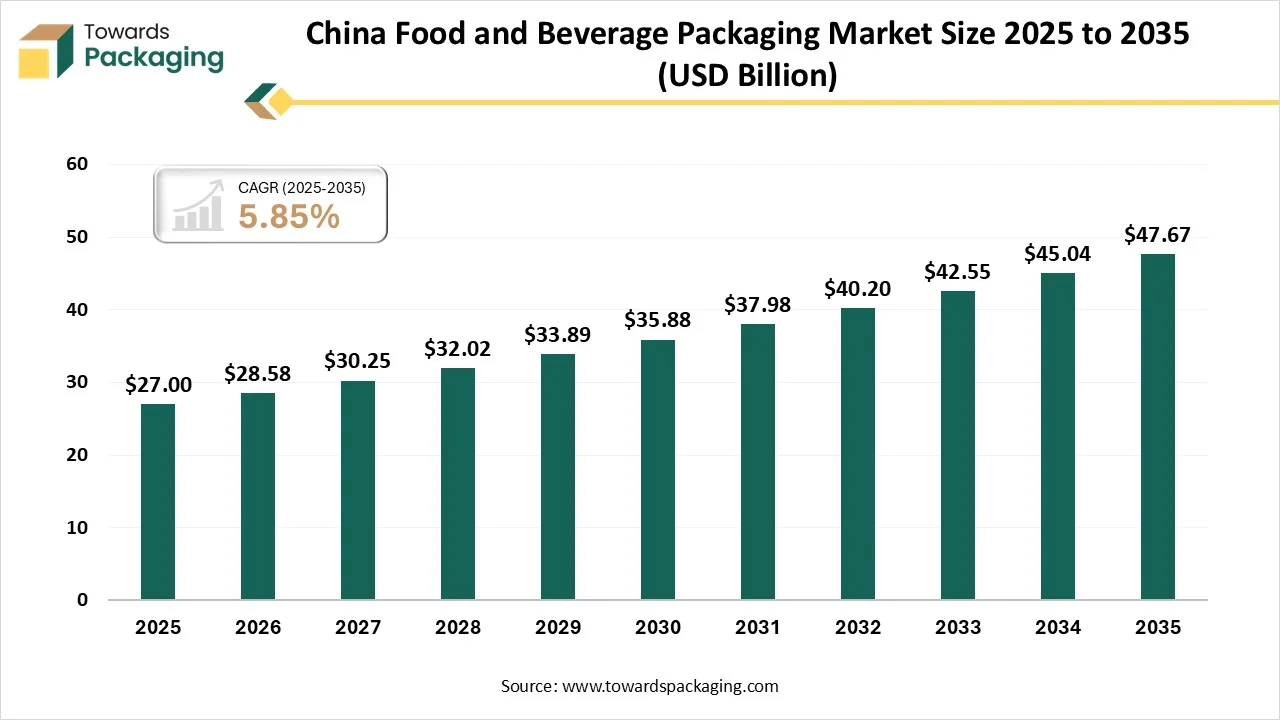
The China food and beverage packaging market is expected to reach USD 47.67 billion by 2035 from USD 28.58 billion in 2026, expanding at a CAGR of 5.85% over the forecast period. The report covers comprehensive market segmentation including materials, packaging formats, and end-use industries such as dairy, beverages, ready-to-eat foods, and snacks. It presents regional market trends across key Chinese economic regions, along with trade statistics and industry supply chain insights. In addition, the study includes detailed company profiles, market share analysis, manufacturer and supplier data, and competitive benchmarking, providing a complete understanding of the industry structure and growth opportunities supported by increasing urban consumption and higher purchasing power.

Last Updated: 11 March 2026 Category: Food Packaging Insight Code: 6031 Format: PDF / PPT / Excel

The China food and beverage packaging market is projected to grow from USD 28.58 billion in 2026 to USD 47.67 billion by 2035, registering a CAGR of 5.85% during 2026-2035. The market study provides comprehensive insights covering detailed segment analysis by material type, packaging format, product type, and end-use applications across the food and beverage industry.

It also includes regional demand analysis across major provinces in China, along with trade data, import-export trends, and supply chain evaluation. The report further highlights key manufacturers, suppliers, company market shares, and competitive strategies, while offering an in-depth value chain analysis and industry structure overview. Rising urbanization, changing consumer lifestyles favoring convenience foods, and increasing disposable income continue to drive packaging demand across the country.
China Food and Beverage Packaging Market Size 2025 to 2035

Major Key Insights of the China Food and Beverages Packaging Market

  • In terms of revenue, the market is valued at USD 27 billion in 2025.
  • The market is projected to reach USD 47.67 billion by 2035.
  • Rapid growth at a CAGR of 5.85% will be observed in the period between 2026 and 2035.
  • In packaging material, the plastic segment dominated the market in 2025.
  • In the packaging material, the paper and paperboard segment will be developed at the main CAGR between 2026 and 2035.
  • By packaging type, the flexible packaging segment dominated the market in 2025.
  • By packaging type, the semi-rigid packaging segment will be growing at a significant CAGR between 2026 and 2035.
  • By product type, the bottles and jars segment dominated the market in 2025.
  • By product type, the cartons segment will be growing at the main CAGR between 2026 and 2035.
  • By application, the beverages segment dominated the market in 2025.
  • By application, the ready-to-eat segment will be developing at a significant CAGR between 2026 and 2035.

What is the Food and Beverage Packaging?

Food and beverage packaging is necessary for current food systems. Without accurate packaging, food spoils quickly, contains pollutant risks that would develop, and the worldwide food supply is impossible to track. Every food link material should align with strong safety standards to protect toxic substances from shifting into the required food products.

  • Smart Packaging: Regularly, food packaging was crafted initially to secure food and extend the shelf life. Currently, packaging is heavily used as a machine for tracking, communication, and supply chain transparency. Enhancements in data connectivity, sensor technology, and digital labelling are enabling packaging to play a more active role in the food system.
  • Paper-Based Packaging that Replaces Plastic: One of the most evident moves in current food packaging trends is the rising acceptance of fiber-based packaging as a choice for regular plastic materials. Paper plates, bowls, paper takeaway boxes, and molded fiber containers are heavily used across food service services.
  • Convenience-Driven Packaging: The fast development of takeaway services, food delivery, and ready-to-eat meals is changing how food packaging is being crafted. Users are heavily predicting that packaging is convenient to operate, simple to use, and convenient to dispose of.
  • Minimalism in Food Packaging Material & Design: Growing material costs, strong recycling regulations, and developing pressure are driving organizations to rethink how much packaging is compulsion.
  • Positive Positioning and Friendly Competition: The growth of the Internet has served users and brands closely enough, and each shift a brand creates has an effect with respect to sales and image. Several brands are meant to accept a merged perspective instead of attacking competitors.
  • Creative and Bold Factors: Beverage brands select imperfect, raw, and human-like aesthetics, which change images and several colors instead of acute minimalism. Irregular shapes, bold colors, and artistic designs appeal to users who want the packaging that shows lifestyle and personality.

Technological Developments in China Food and Beverage Packaging Market

The food & beverage industry is currently the main driver of invention in packaging. Lines should ensure flexibility, food safety, and constant manufacturing, which accepts fast adaptation to the latest formats and has extremely sustainable materials. Bioplastics, compostable solutions, and high-performance papers are sequentially substituting regular options. This discovery is being driven not only by mechanical technologies, but also significantly by the coordination between connectivity, advanced automation, and talented digital systems. Predictive monitoring software is being assisted by real-time data analysis and sensors, which allows organizations to predict failures, lower waste and energy usage, and update performance.

Trade Analysis of China Food and Beverage Packaging Market: Import & Export Statistics

  • As per the food packaging import data recorded in China, between April 2024 and March 2025, the buyers have globally imported 107 shipments of food packaging.
  • Such shipments were being assisted by 20 exporters and bought by 2 official worldwide buyers.
  • Vietnam, the United States, and Switzerland have come up as the leading three food packaging importing countries.
  • The United States, Vietnam, and Colombia are the leading 3 exporting countries.

China Food and Beverage Packaging Market - Supply Chain Analysis

  • Package Design and Prototyping: Packaging design can smoothly affect user behavior and buy decisions in several ways. For instance, a product’s packaging can make a direction of perceived value. Users are more likely to buy products they have received as they have a bigger value, and the packaging design can play a major role in making such a point of view.
  • Recycling and Waste Management: China has highlighted elements for packaging recycling into different action plans, whose goal is to develop circularity while assisting rigid waste governance and stretched recycling machines. In its complete strategy for renewable resource recycling, the National Development and Reform Commission (NDRC) pushes packaging producers to use recycled materials.
  • Logistics and Distribution: The food supply chain is the process of every activity linked with the transportation of food logistics to users. It has everything that gets covered, like production, processing, transportation, packaging, and retail. Smooth supply chain management is crucial to serving people around the globe with safe and high-quality food.

Segmental Insights

Packaging Material Insights

How the Plastic Packaging Segment Dominated the China Food and Beverage Packaging Market in 2025?

The plastic packaging segment dominated the market in 2025 as they have become an integral material in the packaging of food and drinks due to its lower cost, durability, and lightweight nature. The most routine types of plastic utilized in food packaging are high-density (HDPE), polyethylene terephthalate (PET), polypropylene (PP), and polyvinyl chloride (PVC). PET is prevalently used to package regular drinks such as soda and water because of its high tensile strength and clarity. Additionally, the manufacturing of such plastics generally involves the polymerization of petrochemical monomers, which can have a major effect on the environment.

The paper and paperboard segment is expected to witness the fastest CAGR during the forecast period. Paper food packaging is a kind of material created from paper or paperboard that is secured for direct or indirect contact with food. Kraft paper is a reliable and rigid paper that is created from the kraft pulping procedure, which involves chemically transforming wood into a pulp with the help of sodium sulfide and sodium hydroxide. Such a strategy protects the long cellulose fibers, resulting in a material that has perfect tensile power and tear resistance as compared to regular paper.

Packaging Type Insights

How Will The Flexible Packaging Segment Dominate The China Food And Beverage Packaging Market In 2025?

The flexible packaging segment dominated the market in 2025, as it has mainly developed in the food and beverage sector. Because of its several advantages, it is frequently the packaging of choice for different food products on a domestic and worldwide level. By utilizing non-rigid materials in order to pack food, producers can tailor the container to match the brand and product. Flexible packaging is available in a variety of sizes, shapes, and materials that can be made in either formed or unformed patterns.

The semi-rigid packaging segment is expected to witness the fastest CAGR during the forecast period. Semi-rigid packaging points to containers and materials that integrate elements of both flexible and rigid packaging designs. Such containers carry their shape under normal conditions, which can be leveraged smoothly under certain pressure without breaking. Such different characteristics are created specifically for perfectly suited food products, which demand step-by-step assistance during display and transport while staying economical and lightweight to manufacture. The most prevalent semi-rigid packaging materials in the food sector include lined crayons, folding cartons, thermoformed containers, and aseptic cartons. Every kind delivers a particular aim that relies on the food product’s needs for shelf life, barricade prevention, and user convenience.

Product Type Insights

How Bottles & Jars Segment Dominated the China Food and Beverage Packaging Market in 2025?

The bottles & jars segment dominated the market in 2025 as various product types urge various glass designs, and the selection frequently comes down to balancing branding, working, and user expectations. For condiments and sauces, packaging demands to be feasible for the purpose of dispensing or pouring while constantly preventing flavor integrity. Spread and jams advantage from wide-mouth jars, which give importance to reusability and freshness.

The carton packaging segment is expected to witness the fastest CAGR during the forecast period. The Design for Recycling Guidelines from the Food and Beverage Carton Alliance (FBCA) are an important link for making sure that liquid packaging cartons are crafted with recyclability. Such updated rules assist recyclers, producers, waste management, policymakers, and the professionals who match perfect practices, which assist a circular economy.

Application Insights

How the Beverage Segment Dominated the China Food and Beverage Packaging Market in 2025?

The beverage segment dominated the market in 2025 as aluminum is the go-to packaging material for several carbonated beverages, energy drinks, and beers. Their famous roots come from their excellent recyclability, lightweight nature, and potential to firmly stand with heavy pressure surroundings, which is found in carbonated beverage filling surfaces and hot filling for constant beverages. On the other hand, glass bottles show luxury quality for several soda, beer, and juice brands. They serve ideal barricade characteristics and online clarity, which have a sensitive nature with careful attention.

  • In September 2025, WALOVI, a China-based herbal tea brand, disclosed its latest cans for sugar-free and sparkling formats, which are ready for worldwide rollout with distribution and marketing partners.
  • In May 2025, Tetra Pak displayed its ready-to-drink (RTD) protein product solutions, which proved to be a fast-developing category, fueled by the growth of fitness culture beyond gyms to the huge public at the current FBIF 2025 Food and Beverage Innovation Forum in Shanghai.

The ready-to-eat segment is projected to experience the fastest CAGR during the forecast period. Packaging design is important for such products. The bulk quantity of purchase decisions is created in-store at the moment, and currently, such packaging plays a crucial role in the decision-making procedure. One point that convinces users to buy a ready-to-eat meal product is its presentation. Organizations can use exceptional packaging designs to sell textures and push freshness cues to protect the product’s shelf life.

Country Level Analysis

The China food and Beverage Packaging market is expected to develop rapidly as the development of this region is initially being driven by fast urbanization, developing user choice, and increasing disposable incomes for safety and convenience. The growing food processing sector and developing demand for packaged food and beverages have further fueled market development. Furthermore, strict government regulations on food safety and packaging standards push the acceptance of high-quality and cutting-edge packaging solutions.

Technological developments in terms of packaging materials, such as eco-friendly and biodegradable selections, also encourage the market scenario. The growth of the retail industry and e-commerce creates a need for groundbreaking packaging to establish product integrity during transit. In addition to that, growing alertness about sustainability among users and producers is encouraging a move towards eco-friendly packaging materials, which has further proposed market growth.
Crucial Regulations in China on Packaging Materials within Food Safety Law:

  • Article 20 (Food Safety Standard): The restriction for pesticide residues, pathogens, heavy metals, toxins, and veterinary drug residues and remaining health pollutants in food and food-linked products.
  • Article 38: The producers of food additives, food products, and food-related products must check their own products in line with food safety standards. The release for security should be checked when checks are passed.
  • Article 36: Food manufacturers must analyze the production licences of certificates and suppliers for the products while buying raw food materials, food related, and food additives products.

Recent Developments

  • In January 2026, top Chinese aseptic packaging producers are taking deep interest in Russian brands that manufacture cardboard food packaging, likely with a Russian acquisition of Lambumiz, which is a leading dairy packaging manufacturer, that has the capability of 25% stake, as per the Russian sector link.
  • In February 2026, Coca-Cola marked the Lunar New Year with a range of culturally encouraged packaging designs across regions in Southeast Asia and China, which mixes traditions with its perfect brand storytelling.

Top Companies in the China Food and Beverage Packaging Market

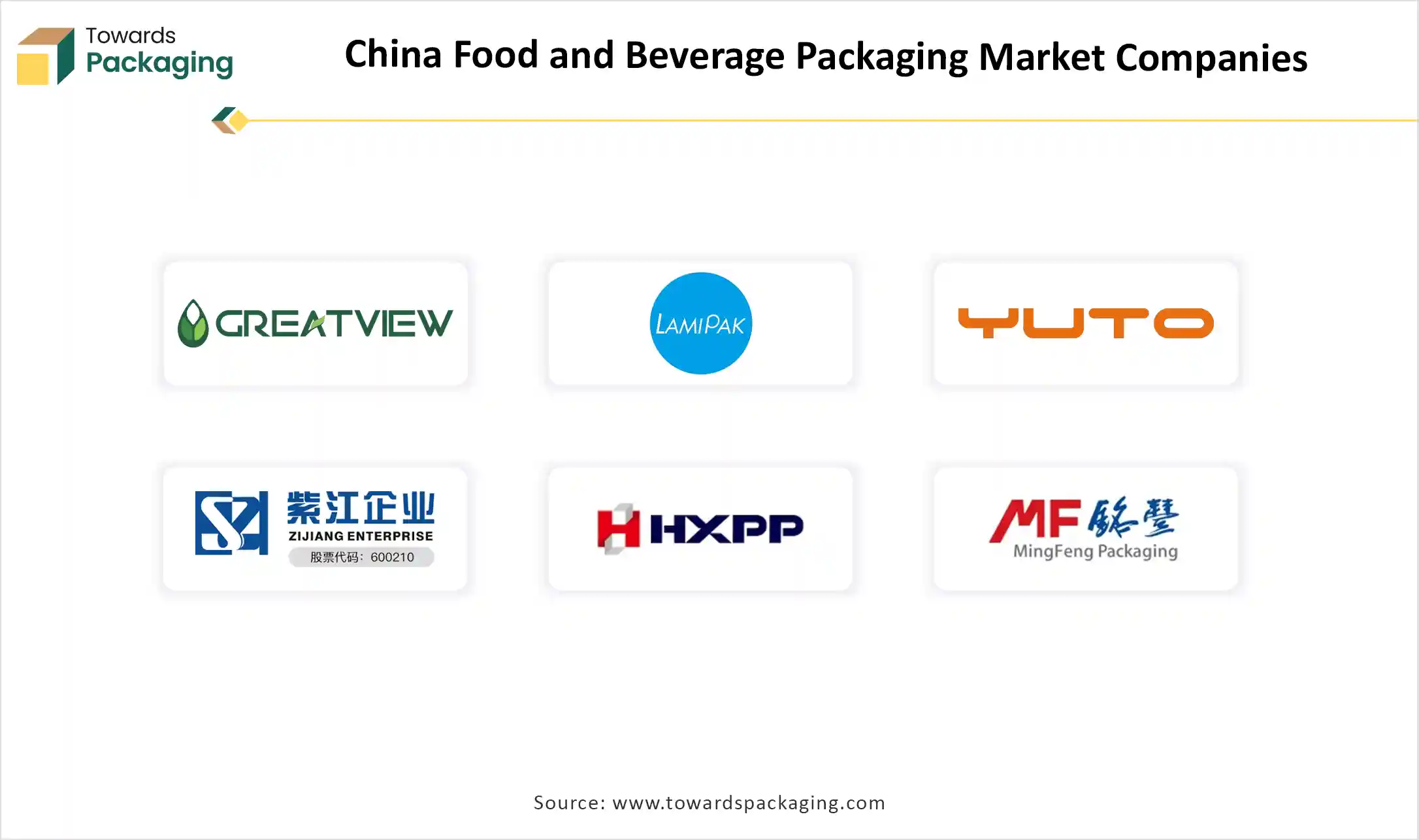
China Food and Beverage Packaging Market Companies 2025 - 2035

  • Greatview Aseptic Packaging
  • Lamipak
  • Zhuhai Zhongfu Enterprise
  • Yuto Packaging Technology
  • Zijiang Enterprise
  • Prince New Materials
  • Hexing Packaging Printing
  • MingFeng Packaging

China Food and Beverage Packaging Market Segmentation

By Packaging Material

  • Plastic Packaging
  • Paper & Paperboard Packaging
  • Glass Packaging
  • Metal Packaging
  • Flexible Packaging Materials

By Packaging Type

  • Flexible Packaging
  • Rigid Packaging
  • Semi-Rigid Packaging

By Product Type

  • Bottles & Jars
  • Pouches
  • Cartons
  • Cans
  • Trays & Containers

By Application

  • Beverages
  • Dairy Products
  • Bakery & Confectionery
  • Ready-to-Eat / Convenience Foods
  • Fruits & Vegetables
  • Meat, Poultry & Seafood

Tags

FAQ's

Clarification : The plastic packaging segment has dominated the China food and beverage packaging market in 2025 as they have become a crucial material in the packaging of food and drinks due to its lower cost, durability, and lightweight nature.

Clarification : The beverage segment dominated the market in 2025 as aluminum is the go-to packaging material for many carbonated beverages, energy drinks, and beers.

Meet the Team

Yogesh Kulkarni is an experienced Research Analyst specializing in the packaging sector, with a strong foundation in statistical analysis and market intelligence. He currently contributes his expertise to Towards Packaging.

Learn more about Yogesh Kulkarni


Aditi Shivarkar, with 14+ years in packaging market research, specializes in food, beverage, and eco-friendly packaging. She ensures accurate, actionable insights, driving Towards Packaging 's excellence in industry trends and sustainability.

Learn more about Aditi Shivarkar

Related Insights

China Food and Beverage Packaging Market
Updated Date : 11 March 2026   |   Report Code : 6031
WhatsApp