


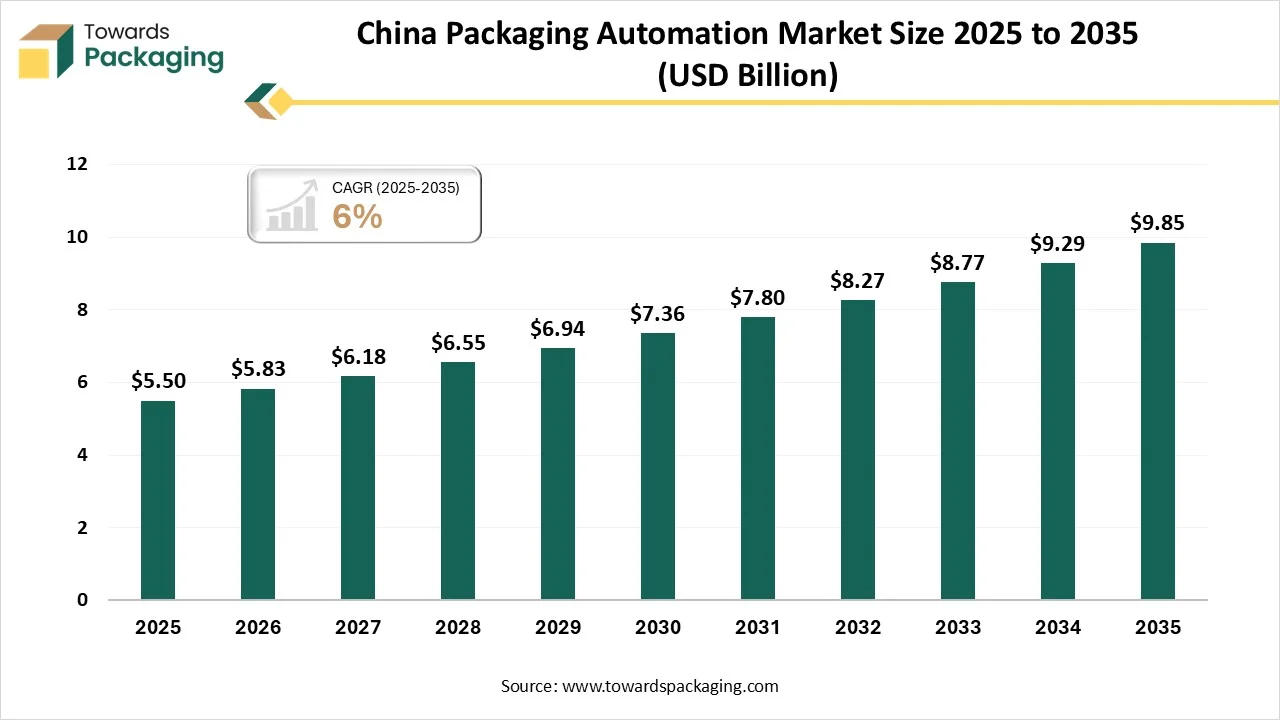
The China packaging automation market is projected to grow from USD 5.83 billion in 2026 to USD 9.85 billion by 2035, registering a CAGR of 6% during 2026–2035. The report provides detailed analysis of market size, segment-wise data by automation type, equipment, and end-use industries such as food & beverage, pharmaceuticals, and e-commerce. It also includes regional demand insights across major Chinese provinces, along with trade statistics, value chain analysis, competitive landscape, and comprehensive profiles of leading manufacturers and suppliers.
China packaging automation states to the fast acceptance of progressive, AI-influenced, and robotic structures in Chinese workshops to automate, accelerate, and improve the exactness of packing, filling, sealing, and palletizing procedures. It influences technologies such as 5G and IoT to decrease labor, enhance quality, and lesser charges for businesses such as cosmetics, food, and pharma. It includes flexible transmission structures, intelligent and high-speed robots, and AI-driven quality review. Increasing demand for e-commerce sector, severe hygienic ideals, and the requirement to decrease labor charges.
Technological transformation in the China packaging automation market plays a significant role with the integration of robotics system to enhance the production speed of the packaging. Rising adoption for smart packaging technology has fuelled the adoption of advanced packaging infrastructures. Innovative technologies are widely focusing towards development of eco-friendly packaging with the rising concern towards ecological issues. Increasing demand for 3D printing has raised the adoption of smart manufacturing technology.
The major raw materials utilized in this market are plastics, polymers, paper, cardboard, metals, components, and special chemicals. Huge demand for robotics and high-speed system has fuelled the development of this sector.
The component manufacturing in this market comprises conveyors, servo motors, sensors, and cartooning. These are useful in offering customization of the packaging with cost-efficient solution.
This segment ensures advancement in the warehouse technologies such as robotic picking. It supports in maintaining hygiene during the transportation of products which raise investment in the growth of this supply chain process.
The China Packaging Automation Market is benefiting from strong government support through policies such as Made in China 2025, which promotes smart manufacturing and automation across industries. Manufacturers are investing in advanced packaging systems due to incentives for industrial upgrading tax benefits and funding for the adoption of robotics and artificial intelligence. Additionally, businesses are being pushed toward automated and environmentally friendly packaging solutions by sustainability regulations that aim to reduce packaging waste and improve efficiency.
In July 2025, ABB Ltd. launched new robot families in China to support mid-sized manufacturers with automated packaging and production capabilities, aligning with rising demand for automation. Additionally, in 2025, Feiyu Packaging Machinery showcased advanced high-speed packaging automation solutions at major industry exhibitions in Shanghai, highlighting the growing integration of efficient and intelligent packaging systems.
The fully automated packaging systems segment dominated the market with highest share in 2025 due to rising concern to decrease human error and reducing labour charges. The necessity for, dependable, high-speed, and steady packaging for huge order volumes in e-commerce industry. The structures severely decrease dependence on human labour and related charges, addressing labour scarcities. Incorporation of manufacturing and AI-influenced structures for better exactness, flexibility, and superiority control. Robust acceptance in the food and beverage sector for speed and safety.
The robotic packaging systems segment is expected to grow at the fastest CAGR during the forecast period. This segment is growing due to its multifunctional capabilities, speed, and flexibility. These structures are effortlessly reconfigurable to billet a wider range of package types and sizes, which is crucial for meeting the rising demand for personalized packaging. Increasing wage charges and labor scarcities have enhanced the change from manual labour to automated options to preserve cost attractiveness. Rising reliability for precise, hygienic, and high-speed packaging has fuelled the demand for this segment.
The filling machines segment dominated the market with highest share in 2025 due to significant role of high-volume packaging in pharmaceuticals, food and beverages. Rapid shift towards urban areas and increasing consumption of packed products require automated filling for liquids, high-speed, pastes and powders. With increasing labour charges, producers have progressively changed to completely automatic filling structures. This segment is influenced majorly due to its efficiency, high-volume packaging options.
The form-fill-seal (FFS) machines segment is expected to grow at the fastest CAGR during the forecast period. This segment is growing due to rising concern to reduce operational timing. The rising pharmaceutical, food, and beverage sectors needed fast and hygienic packaging which is influencing the acceptance of this segment. These machines have the capability to work with biodegradable resources and decrease plastic waste united with green production initiatives. It offered better efficacy and real-time monitoring.
The food & beverage segment dominated the market with highest share in 2025 due to rising safety and hygiene standards. It allows food industry to handle varied packaging types and sizes. Strict food safety guidelines have raised the adoption for touch-free and automated packaging. It plays a significant role in consistent and high-volume production which decrease labour charges. Increasing consumption of ready-to-eat or frozen food products has fuelled the integration of automated packaging process. It decreases human contact with food which reduce contamination risk as well.
The healthcare / pharmaceuticals segment is expected to grow at the fastest CAGR during the forecast period. This segment is growing due to traceability and serialization. Strict hygiene guidelines have pushed the adoption of this automation packaging sector. Automation is utilized to fulfil high sterility needs, mainly for liquid filling systems and aseptic packaging utilized in injectable and vaccine production. Rapid expansion of pharmaceutical industry has pushed the demand for high-quality packaging to avoid any risk during transportation.
The primary packaging automation segment dominated the market with highest share in 2025 due to its high-speed and precision in packaging. It is widely utilized in pharmaceutical, food and beverages industry to maintain the safety and regulatory guidelines for packaging. It helped in reducing labour charges which make the product cost-effective for consumers. It has the capacity to manage complex primary tasks which enhance its adoption and raised investment for the development of this sector.
The end-of-line / tertiary packaging automation segment is expected to grow at the fastest CAGR during the forecast period. This segment is growing due to rapid growth in e-commerce sector and concern for accuracy in sealing. The increasing requirement for efficacy in packaging has pushed this segment to grow rapidly. The upsurge in online shopping needed flexible, fast, and automated packaging options to manage high volumes. It has the potential to manage a wide range of shapes, sizes, and types of packaging which raised its demand in several industries.
China witnessing the rapid growth in the market, due to special production ecosystem. Rapid acceptance of automation in several industries has pushed packaging sector for innovation. This sector is developing significantly due to rising demand for quality packaging with enhanced speed. A strong, inclusive, and vertically combined supply chain allows high-volume, cost-operative production. The strong necessity for effective, high-speed, as well as flexible packaging options to help the huge domestic e-commerce sector influences innovation. The capability to manufacture complex components and enhanced-quality, specialized resources has raised the demand for this sector.
By Automation Type
By Product / Equipment Type
By End-Use Industry
By Packaging Type



Research & Advisory Analyst
Yogesh Kulkarni is an experienced Research Analyst specializing in the packaging sector, with a strong foundation in statistical analysis and market intelligence. He currently contributes his expertise to Towards Packaging.
Learn more about Yogesh Kulkarni

Reviewed By
Aditi Shivarkar, with 14+ years in packaging market research, specializes in food, beverage, and eco-friendly packaging. She ensures accurate, actionable insights, driving Towards Packaging Analytics & Consulting 's excellence in industry trends and sustainability.
Learn more about Aditi Shivarkar

China Packaging Automation Market
 Table of Content
 sales@towardspackaging.com
 +1 804-441-9344
 Download Sample
 Schedule a Meeting