


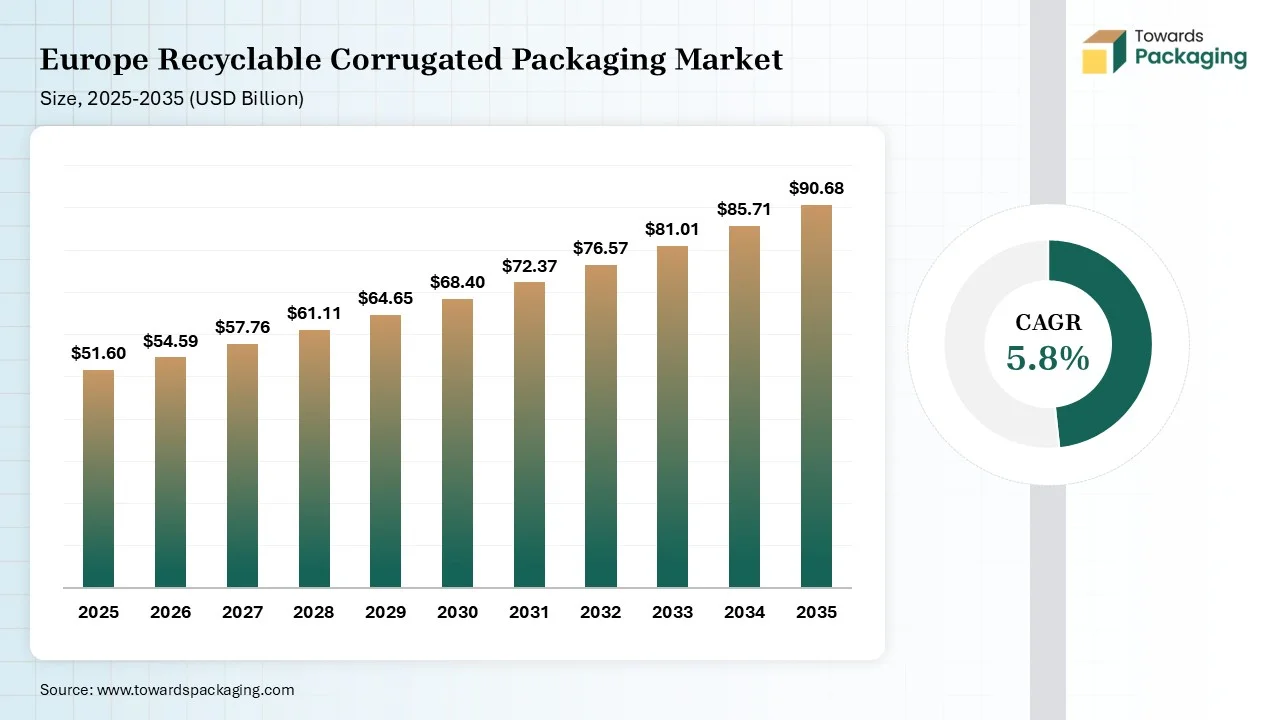
The Europe recyclable corrugated packaging market is projected to grow from USD 54.59 billion in 2026 to USD 90.68 billion by 2035, registering a CAGR of 5.8% during the forecast period. The report covers detailed market size analysis, segment-wise data, regional insights across Europe, and an in-depth study of key companies, manufacturers, and suppliers. It also includes competitive analysis, value chain evaluation, and trade data, highlighting the impact of rising e-commerce activities, demand for cost-efficient shipping solutions, and increasing consumer preference for sustainable packaging.
The recyclable corrugated packaging cardboard is a multi-layered paperboard created of flat linerboards that have a flute sheet fixed between them, which delivers rigidity, strength, and shock absorption. The linerboards serve smooth surfaces that are ideal for load bearing and printing; on the other hand, fluted core cushions affect and resist bending. Corrugated cardboard completely balances lightweight handling with a step-by-step durability that is perfect for storage, shipping, industrial uses, and retail packaging. Its versatile nature enables personalization of wall thickness, board grades, flute type to align with prevention, branding demands, and stacking while staying constant and fully cost-effective and recyclable.
Market Size (2025): USD 51.6 Billion
CAGR (2025–2035): 5.8%
Market Volume (2025): 43.4 million Tons
Market Volume CAGR (2025–2035): 4.9%
The official move from regular printing methods to digital printing has been a breakthrough for the corrugated packaging sector. Digital printing enables full-color graphics and high-quality graphics that are officially printed directly onto the corrugated material, which has higher speed and flexibility.
Such inventions are specifically advantageous for tailored packaging solutions and short-run manufacturing. Inventions in materials science have pointed to the growth of lighter, stronger, and more sustainable corrugated materials. For instance, the exploration of bio-based and recycled fibers has created corrugated packaging that is more environmentally friendly without compromising durability and strength.
One of the most crucial technological developments in corrugated packaging manufacturing is the merger of robotics and automation. Automated systems now have the potential to manage everything from box creation, quality checking, and gluing.
| Rank | Company Name | Headquarters | Country | Why Relevant to This Packaging Market | Key Packaging Products/Services |
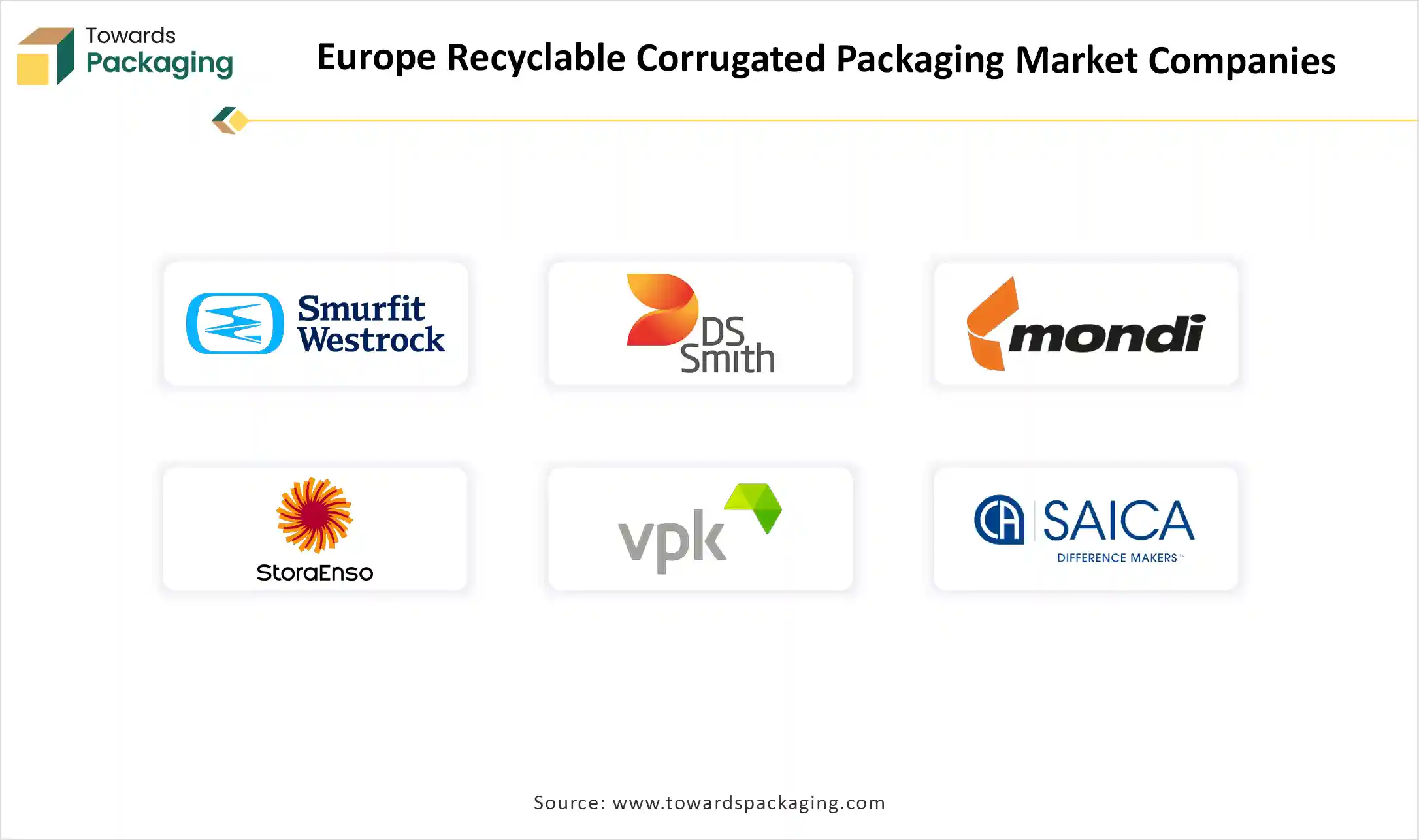
| 1 | Smurfit Westrock | Dublin | Ireland | Europe's largest corrugated packaging producer with integrated recycling operations | Corrugated boxes, transit packaging, retail-ready packaging |
| 2 | DS Smith | London, England | United Kingdom | Major European leader in recyclable corrugated packaging and circular design | Corrugated packaging, e-commerce solutions |
| 3 | Mondi | Weybridge, England | United Kingdom | Integrated paper and corrugated packaging manufacturer with strong sustainability focus | Corrugated packaging and containerboard |
| 4 | Saica Group | Zaragoza, Aragon | Spain | Leading recycled-paper-based corrugated packaging producer | Corrugated boxes and industrial packaging |
| 5 | International Paper | Memphis, Tennessee | USA | Major corrugated packaging producer with extensive European operations | Corrugated packaging and containerboard |
| Rank | Company Name | Headquarters | Country | Why Relevant to This Packaging Market | Key Packaging Products/Services |
| 1 | Klingele Paper & Packaging Group | Remshalden, Baden-Württemberg | Germany | Strong European corrugated packaging footprint | Corrugated packaging and displays |
| 2 | Model Group | Weinfelden, Thurgau | Switzerland | Significant corrugated packaging producer in Europe | Corrugated boxes and displays |
| 3 | VPK Group | Aalst, East Flanders | Belgium | Major recycled-paper corrugated packaging specialist | Corrugated transport packaging |
| 4 | Rengo Co., Ltd. | Osaka | Japan | Growing European corrugated packaging presence through acquisitions | Corrugated packaging solutions |
| 5 | THIMM Group | Northeim, Lower Saxony | Germany | Well-established corrugated packaging producer | Retail-ready and transport packaging |
| Rank | Company Name | Headquarters | Country | Why Relevant to This Packaging Market | Key Packaging Products/Services |
|---|---|---|---|---|---|
| 1 | Packhelp | Warsaw | Poland | Innovative sustainable corrugated packaging supplier | Custom recyclable corrugated packaging |
| 2 | Macfarlane Group | Glasgow, Scotland | United Kingdom | Sustainable corrugated and transit packaging provider | Corrugated packaging solutions |
| 3 | Cepac | Rotherham, England | United Kingdom | Independent corrugated packaging specialist | Shelf-ready and transit packaging |
| 4 | Schumacher Packaging | Ebersdorf bei Coburg, Bavaria | Germany | Strong focus on sustainable corrugated packaging | Corrugated boxes and e-commerce packaging |
| 5 | Palm Packaging | Aalen, Baden-Württemberg | Germany | Integrated recycled paper and corrugated packaging producer | Corrugated transport packaging |
The recycled fiber segment dominated the market with a 58% share in 2025. Corrugated packaging is initially made from paper-based materials, which come from renewable resources. Trees that are used in manufacturing are frequently developed and harvested with the assistance of tracked forestry rules. They are one of the most recycled materials in the world. Several corrugated shipping boxes are created with a larger percentage of recycled fibers, which are reused several times.
The virgin fiber segment held the market with a 42% share in 2025 because they are produced only from fresh wood pulp, which is mostly sourced from trees. It looks more constant and cleaner, though it requires lots of energy and natural resources. They totally rely on harvesting trees and using restricted natural resources. More pollution comes from the manufacturing stage as they use tree pulp for paper, which counts as a linear supply instead of a circular one.
The boxes segment dominated the market with 64% share in 2025 as recyclable corrugated packaging boxes have been updating the e-commerce scenario, which delivers them a latest appearance. They are becoming a much more relevant option when it comes to the security of products, whether they are for transportation or storage. Corrugated boxes have played a significant role in delivering a cost-effective and versatile solution for a variety of products. They protect the items during the shipping procedure, which are lightweight in nature, saves the complete cost, and conveniently recycled as well.
The trays segment held 14% market share in 2025 because recyclable corrugated trays deliver adaptable packaging solutions for the purposes of cans, fresh produce, pouches, and bottles on every manual and automatic packing line. With the correct structural and print, both packaging styles can assist in developing sales in-store. Ventilated manufactured trays for vegetables, fruits, and berries are filled with moisture-resistant material. They are crafted for cold storage, field packing, and retail displays that have optimal air circulation to manage freshness.
The sheets & pads segment held 12% market share in 2025 because corrugated cardboard sheets or pads are created from thick paper stock or an excessive paper-pulp that delivers secured cushioning for materials or products during transportation. They are necessarily a surface of paper, which is just a single sheet. Corrugated pads are generally used for storing, packing, and shipping items to different locations like warehouses, factories, and stores.
The single wall segment dominated the market with a 55% share in 2025 because these corrugated cartons or boxes serve as an optimal solution for packing, storage, and shipping with a huge variety of items. They are created from cardboard that has a single flute layer and a recycled kraft outer, which has single-wall cartons that are rigid and sturdy in nature, which frequently retain their actual shape even when they are tightly sealed together or completely loaded. They are created from 1005 recycled materials, which are 100% biodegradable and recyclable, as boxes are being supplied flat.
Double wall segment held 30% market share in 2025 because such a design adds an additional surface of liners and fluting to generate a box that has enough potential to manage bulkier, heavier, or sensitive products. Double-wall recyclable corrugated boxes deliver developed security against punctures and crushing, which makes them perfect for electronics shipping, industrial packaging, and long-haul logistics. Double-walled corrugated boxes make thicker packaging for any products that are allowed to stand firmly during handling.
Triple wall segment held 15% market share in 2025 as its triple wall corrugated cardboard’s strong design delivers pushed puncture resistance, cushioning, and stacking power, which has smoothly mixed such risks. Its power and inflexibility make it suitable for packaging large appliances, automotive parts, and industrial machinery. Gaylord boxes (meaning bulk cargo boxes) are pallet-sized containers and are big in size, making them perfect for shipping several elements or oversized products in one protective unit.
The C-Flute segment dominated the market with a 28% share in 2025, as they are among the most prevalently used, which measures around 3/16 inches. They mix stacking strength, cushioning, and versatility, which makes them ideal for consumer products, general transportation, and a huge range of packaging uses. Their adaptable nature assists in single as well as multi-product logistics. In the retail industry, c-flute recyclable corrugated is a prevalent choice for point-of-purchase (POP) displays because of its power and durability. They are one of the most famous packaging materials for user items like appliances, electronics, and home goods.
The B-Flute segment held 22% market share in 2025 because they are smaller and thinner compared to A-flute. They have a middle series of the thickness of approx 3.2mm, which is 1.8 inches, and has about 47 to 49 flutes, with a single liner foot. This type of flute is one of the most prevalently used types of flutes, particularly in mailer boxes, e-commerce, and regular shipping, because of its versatile nature. Such a flute delivers an ideal balance between cushioning properties, strength, and a smooth layer for high-resolution printing.
The E-Flute segment held 20% market share in 2025 because it measures about 1.5 mm to 2.0 mm in terms of thickness and has 90 to 95 flutes per linear foot. Such thin-profile E-flute has a medium level that delivers good-quality printability and resolution, which makes it perfect for skincare packaging, premium retail, high-definition branding, and die-cut boxes. As the number of flutes per linear foot is high, such a deep design delivers an exceptionally smooth layer, which makes them ideal for offset printing, UV finishes, and visual effects.
The flexographic printing segment dominated the market with 61% share in 2025, as this printing is the latest and has a constantly developing version of regular relief printing, in which the printing factors are developed above the non-printing spaces. Flexographic printing allows for packaging that goes beyond security, as it has become a medium of the actual brand expression. It is due to current technological developments, gradients, and color transformation that can be regenerated with accuracy, while manufacturing stays fast, sustainable, and economical.
The digital printing segment held 21% market share in 2025 because this printing streamlines the demand for printing plates, which mainly lowers the setup amount and time. Such transformation into quick manufacturing enables producers to align with fixed deadlines and effectively manage shorter print periods. Such print quality is also unique, with bright colors and in-depth details that were once challenging for regular ones. Additionally, digital printing is eco-friendly, which lowers waste and energy usage.
The lithographic lamination segment held 18% market share in 2025 because this technology is a tailored procedure in which high-resolution offset printed sheets are laminated onto a corrugated board. This procedure enables brands to receive vibrant colors, sharp graphics, and fine detailing, while still managing the reliability of corrugated packaging.
Litho laminated boxes are greatly chosen in the packaging sector as they serve the ideal balance between brand presentation and product security. The corrugated foundation makes sure the box is rigid enough for handling, shipping, and storage, while the laminated printed layer delivers a high-end appearance for a retail display.
The food & beverage segment dominated the market with 36% share in 2025, as accurately diagnosed, paper-sourced and paper packaging, such as corrugated, behaves as a barrier against water and oxygen vapor, two classified elements that cause the spoilage of food. Corrugated displays and packaging can be printed and designed to showcase food and beverage products. Furthermore, tailored corrugated boxes are crafted to be of the correct size for several products, as there is no demand for fillers such as packing peanuts. This load serves constant quality to transport more boxes, which is per truckload, which lessens the freight amount.
The e-commerce and retail segment held 28% market share in 2025, as recyclable corrugated packaging has remained the most widely used material because of its perfectly designed recycling design and rigid performance-to-weight ratio. They are even paper-based products that have protective materials, which are excessively substituting plastic greetings, which have assisted in developing recyclability across the supply chains. Corrugated packaging has stayed the dominant raw material in e-commerce logistics due to its lightweight design, strength, and recyclability. Due to this, durability relies not only on material selection but also on packaging designs.
The electronics segment held 14% market share in 2025 as recyclable corrugated boxes deliver unavoidable security against external elements such as moisture, impact, and dust. Electronics that are fragile to eco-friendly updates, and even a minor effect can result in crucial damage. They are even reusable in nature, as brands frequently reuse such strong boxes several times before recycling them. Such benefits are eco-friendly in nature. Such recyclable containers initially have reused materials and renewable sources, such as kraft paper, which comes from wood pulp. For such a reason, their manufacturing needs likely require less water and energy than other materials, such as the application of foam or plastic.
Germany has dominated the market in 2025. due to technological inventions such as blockchain technology and artificial intelligence, which are crucial. AI developed personalization and operational effectiveness, which enables businesses to personalize different experiences to meet user demands. At the current time, blockchain has pushed for protection and transparency, which is compulsory in sectors like supply chain management and finance. Furthermore, the growth of IoT and smart devices is to develop connectivity, which has driven user predictions for smooth consumer experiences.
The United Kingdom is expected to experience the fastest growth in the market during the forecast period. The rising urge for sustainable packaging solutions and e-commerce development in Europe can positively affect the recyclable corrugated boxes industry. There is a developed awareness of eco-friendly issues that has driven organizations to accept environmental packaging, which has further stretched the industry's scope. Furthermore, inventions in functionality and design can point towards a developed consumer experience, which has ultimately contributed to the sustained development of the United Kingdom's recyclable corrugated packaging market.
By Material Type:
By Product Type:
By Board Grade:
By Flute Type:
By Printing Technology:
By End-Use Industry








Research & Advisory Analyst
Yogesh Kulkarni is an experienced Research Analyst specializing in the packaging sector, with a strong foundation in statistical analysis and market intelligence. He currently contributes his expertise to Towards Packaging.
Learn more about Yogesh Kulkarni

Reviewed By
Aditi Shivarkar, with 14+ years in packaging market research, specializes in food, beverage, and eco-friendly packaging. She ensures accurate, actionable insights, driving Towards Packaging Analytics & Consulting 's excellence in industry trends and sustainability.
Learn more about Aditi Shivarkar

Europe Recyclable Corrugated Packaging Market
 Table of Content

 Download Sample
 Schedule a Meeting