


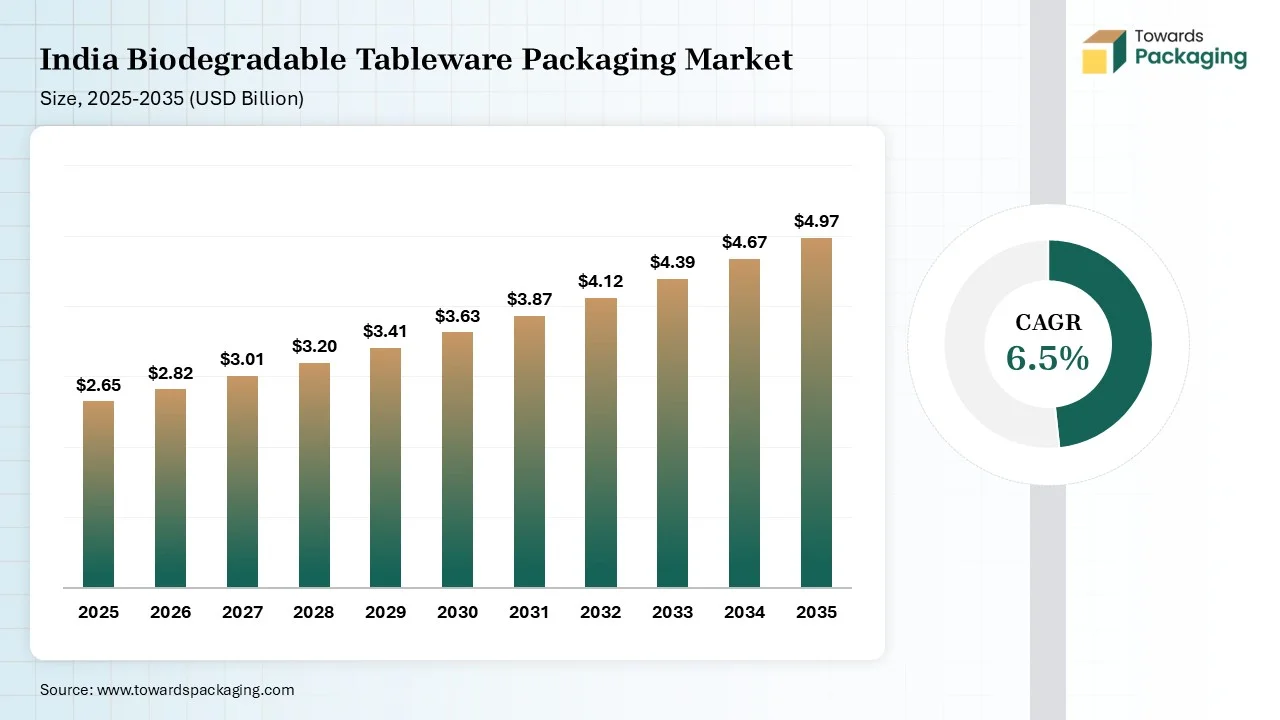
The India biodegradable tableware packaging market is projected to grow from USD 2.82 billion in 2026 to USD 4.97 billion by 2035, registering a CAGR of 6.5% during the forecast period. The report provides detailed insights into market size, segment-wise data by material type, product type, and end-use, along with regional analysis across key Indian states. It also includes company profiles, competitive analysis, value chain assessment, trade data, and comprehensive information on manufacturers and suppliers, helping stakeholders understand the evolving market dynamics.
Biodegradable tableware packaging points to disposable food service products such as cups, plates, and cutlery, which are crafted to decompose naturally into an organic substance. Like regular plastics which can persist in the surrounding environment for several years, biodegradable product packaging is designed from plant-based and renewable materials that decompose over a period, which leave eco-friendly impact.
Apart from recyclability, biodegradable materials are crafted to securely return nutrients to the soil. The most optimistic; latest feedstocks come from starch, seaweed, and polyhydroxyalkanoate (PHA) and polymers, which are naturally manufactured by micro-organisms. Seaweed-based packaging forms, such as Loilware (U.S) and Notpla (U.K), have marketed edible or home-compostable films that dissolve in water and decompose within weeks. Additionally, mycelium is a deep root network of mushrooms that is available in industrial feedstock for packaging goals. It develops inside agricultural waste like rice husk or hemp hurd to create preventive and foam-like shapes.
The tableware segment dominated the market with a 58% share in 2025 as biodegradable tableware points to single-use dining items crafted to decompose naturally through microbial activity. Like conventional plastic, which can last for centuries, biodegradable materials decompose into carbon dioxide, water, and biomass, which are perfect for leaving no toxic residue behind. The main thing in this procedure is the process of microbial degradation, in which fungi and bacteria use organic material under eco-friendly conditions. Elements like moisture, temperature, material composition, and oxygen are all encouraged for speed and comprehensiveness of breakdown. Edible cutlery has both qualities, such as biodegradable and eco-friendly characteristics, with further benefits, which include being healthy and nutritious with no health risks.
The packaging products segment held the second largest share of 42% in 2025 and is also expected to grow at the fastest CAGR of 6.4% during the forecast period. Biodegradable packaging materials are substances that decompose naturally into carbon dioxide, water, and organic matter with the help of microbial activity. With respect to product, starch-based packing peanuts are totally designed from renewable, natural crops such as wheat or corn. Such materials stretch into potable, cushioning shapes that get connected to lower product shift inside a box. Their water-soluble nature avoids disposable issues, which makes them easier for consumers.
The wood segment dominated the market with a 26% share in 2025 because single-use products like biodegradable spoons are made from birchwood, which is resistant to plastic or synthetic materials. They are accurate for every age group as they are secure for food, children, and pollutants and do not respond with cold or hot food because they don’t include any kind of toxic chemicals or coatings as well. Due to this, biodegradable wooden dessert spoons are specifically perfect for pudding, ice cream, and other foods that are ready to consume. Birchwood is being sourced as one of the biggest materials accessible for good-quality wooden cutlery that is appreciated for its power, neutral flavor, and smooth texture.
Paper segment held the second largest share of 24% in 2025 as they are prevalently created from wood pulp or recycled paper. Paper manufacturing generally involves referencing wood pulp, which can have eco-friendly effects like deforestation. They are inexpensive, lightweight, and convenient to dispose of, that makes them an easy choice for casual collection. Paper plates are usually more cost-effective than bagasse plates, which can make them perfect for budget-sensitive users. Several paper plates are not perfect for extremely hot foods, as they can transform into flimsy or soft products.
The bagasse segment held the third largest share of 20% in 2025 because it pertains to the fibrous material left behind sugarcane juice extraction. Bamboo pulp appreciates sugarcane fiber ideally. It grows quickly without complicated irrigation or chemical fertilizers. Its natural power develops rigidity while managing composability. When they are mixed, sugarcane bagasse and bamboo pulp make a plant-based material that results in a food service atmosphere while staying fully biodegradable. Rather than discarding or burning bagasse, manufacturers clean, pulp, and configure the fibers into lightweight and flexible plates.
The bioplastic segment held the fourth largest share of 15% in 2025 and expects the fastest CAGR of 7.0% during the forecast period, because biodegradable bioplastics are the plastics constructed from renewable, natural materials, as most materials are received from sugarcane, corn, or potato starch that decompose in a precise format of composting environment into organic material, water, and carbon dioxide, which are not toxic to the organic compost pile itself. They move from the compost stack to a broken-down compostable product in months after passing into a biodegradable surrounding.
The food service segment dominated the market with 50% share in 2025 because food businesses that give importance to biodegradable packaging for restaurants are matching themselves with such demand, which makes a strong bond with their customers. Eco-friendly diners are more likely to select cafes and restaurants that display loyalty to sustainability. It serves biodegradable and compostable solutions that not only lower environmental impact but also align with user expectations. Items like Kraft salad boxes and biodegradable takeaway boxes are perfect options to match this developing demand.
The retail segment held the second largest share of 22% in 2025 because biodegradable packaging utilizes renewable plant materials, which break down more conveniently than regular plastics. Such materials assist in more sustainable manufacturing and reduce the long-term environmental impact.
They also deliver practical business advantages, which include quick decomposition, fewer releases in production, and a rigid look to eco-conscious surfaces. Instances of biodegradable packaging solutions include hemp fiber wraps or pouches, bamboo-based trays and containers, straw-based packaging materials, cotton bags, and textile-based gift packaging.
The institutional segment held the third largest share of 15% in 2025 as biodegradable cutlery and utensils are developing as sustainable choices, which shifts the worldwide market for eco-friendly tableware for this industry. International regulators and buyers are excessively interested in such solutions to align with plastic ban compliance and user demand for sustainable disposable flatware. This type of white paper serves as an overview of the biodegradable compostable cutlery sector. It mixes official data and manages main materials like bagasse, PLA, PHS, PBS, and star-based biopolymers.
The other segment held fourth largest share of 10% in 2025 and expects the fastest CAGR of 6.5% during the forecast period, because they are used in travel and transportation, such as railway services and airlines, that heavily use biodegradable tableware and meal trays to tackle waste during travel time. These plates are suitable for large-scale functions and events where fast disposal is compulsory. Additionally, areca leaf plates are designed by pressing fallen areca palm leaves, as such plates are strong and fully biodegradable, which are only sought in geographical locations that affect the carbon footprint while carrying such plates from one place to another.
Offline segment dominated the market with 60% share In 2025 as convenience-driven usage is developing for one of the most practical food packaging urges. Smaller households, updating lifestyles, and on-the-go habits are updating biodegradable packaging needs. Packaging is now updated to assist convenient handling, repeat mode use, and effective storage. Such predictions directly encouraging biodegradable cutlery packaging designs across dry foods, snacks, and ready-to-eat levels. This move describes the developing urge for regular pouches like spout pouches and zipper lock pouches, which refine storage, ease of use, and repeat usage.
The online segment held the second largest share of 40% in 2025, and it is also expected to grow at the fastest CAGR of 7.2% during the forecast period. Perfect packaging can shift an accurate delivery into a memorable thing. Factors like specialized messages, easy-to-open boxes, and environmentally friendly materials can highlight users. Several brands now concentrate on “unboxing experiences” to create a positive emotional link. In the current landscape, users are more aware of environmental problems. They choose brands that use biodegradable and recyclable materials by using eco-friendly packaging, which not only lessens the environmental impact but also develops brand reputation.
Country-Level Analysis:
India biodegradable tableware packaging market is seen to grow notably as India has the capability to come up as a worldwide leader in terms of biodegradable packaging by developing its huge links, rising user awareness, and skilled workforce. By solving the issues and highlighting the possibilities, the country can make a sustainable packaging ecosystem that advantages both the economy and the environment. The long-term aim for India’s biodegradable packaging sector is to achieve a circular economy in which packaging materials are used and manufactured smoothly without adding to environmental impact. This needs a focused effort from all investors, which includes the industry, governments, and suppliers to make a sustainable packaging value chain.
By Product Type
By Raw Material
By Application
By Distribution Channel








Principal Research Analyst
Vidyesh Swar is a Senior Research Analyst at Towards Packaging, bringing over 4 years of dedicated expertise in market intelligence and strategic analysis across the dynamic world of packaging technologies and solutions.
Learn more about Vidyesh Swar

Reviewed By
Aditi Shivarkar, with 14+ years in packaging market research, specializes in food, beverage, and eco-friendly packaging. She ensures accurate, actionable insights, driving Towards Packaging Analytics & Consulting 's excellence in industry trends and sustainability.
Learn more about Aditi Shivarkar


India Biodegradable Tableware Packaging Market
 Table of Content

 Download Sample
 Schedule a Meeting