


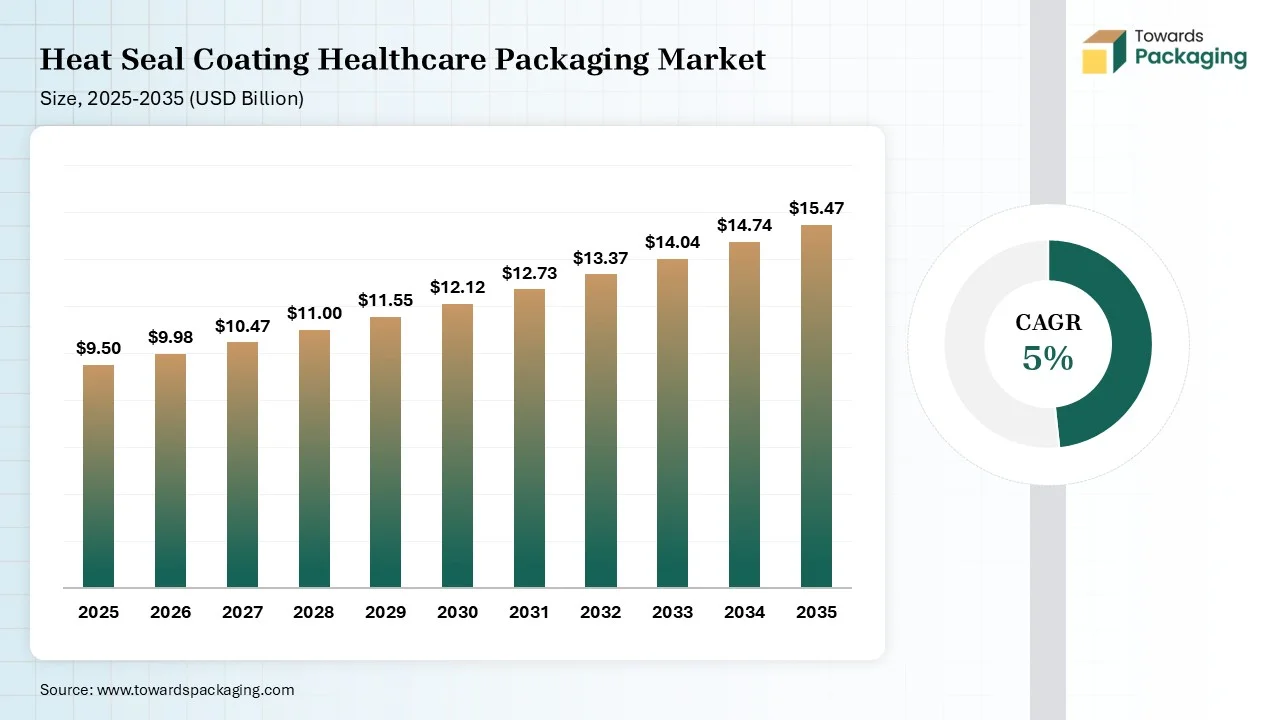
The heat seal coating healthcare packaging market is projected to grow from USD 9.98 billion in 2026 to USD 15.47 billion by 2035, at a CAGR of 5%. The report provides detailed insights into market size, segment-wise data by coating type, substrate, and application, along with regional analysis across North America, Europe, Asia-Pacific, and other regions. It also covers company profiles, competitive landscape, value chain analysis, and trade data, offering a complete view of manufacturers and suppliers operating in the market.
Heat seal coating healthcare packaging is specialised, pre-applied adhesive layers frequently water-based that generate tamper-evident, secure, and sterile seals on medical equipment, pharmaceutical blisters, and sterilisation pouches. Activated by pressure and heat, these coatings confirm strong barrier properties while permitting clean and fibre-free peeling. It provides a high seal asset to confirm packaging quality through supply, protecting products from contamination.
AI has surely been the backbone of the market, as the lengthy process and existing mechanisms require little tech to take the lead in the packaging sector. The commendable SafeSeal-AI system uses deep learning algorithms and thermal imaging to validate the integrity of over 300 packages in just a minute each. The system has the potential to detect disorganized material, improper sealing, and wrinkles in the packaging.
This famous technology also serves as a quantum leap for identifying any issues quickly to secure precision in the packaging. The healthcare goods are precious, as they're a health-based solution for one’s extreme condition. Also, the AI algorithms scan for the on-time variables featuring the suitability of the temperatures and changes in the material thickness.
Technological transformation in the heat seal coating healthcare packaging market plays a significant role by developing sustainable coating materials. The rapid development of smart coatings that prevent contamination from microbes. These smart coatings protect healthcare products from temperature fluctuation. Adoption of AI in this sector supports real-time monitoring of the packaged products. It supports the reduction of energy consumption during the production process.
The major raw materials utilised in this market are Ethylene-vinyl acetate (EVA), PVC/vinyl copolymers, acrylic copolymers, water-based dispersions, and modified polyolefins. It supports creating permanent bonds with enhanced reliability and chemical resistance.
The component manufacturing in this market comprises papers and films. These have excellent sterilisation resistance and confirm fibre-free seals.
This segment ensures strong peelable seals that support protecting products from moisture, contamination, and oxygen. It offers reliable sterilisation to meet the demand of the consumers.
The water-based coatings segment dominated the market with 34% share in 2025 and is expected to be the fastest growing in the market with 6.2% CAGR during the forecast period. Due to the increasing shift towards sustainability in the packaging industry has pushed the demand for this segment. These are widely used to meet the stringent healthcare guidelines associated with VOC emissions. There is a huge demand for sterile medical packaging, which has pushed the growth of water-based coatings significantly.
The solvent-based coatings segment held the second-largest share of 28% in 2025. Due to the rising demand for strong adhesives for the protection of complex substrates. These coatings have high durability that ensures the sterilised packaging of healthcare products. These are used for the packaging of products required high-performance packaging.
The hot melt coatings segment held the third largest share of 18% in 2025. Due to the adoption of high sustainability and efficiency in packaging has raised the demand for this segment. This segment supports fast packaging processing with high safety of the products. These are commonly used for the packaging of high-volume healthcare products that need to be transported safely.
The UV-curable coatings segment held the fourth largest share of 10% in 2025. Due to the huge adoption of radiation-curable coatings in a wider range of companies. It highly supports the advanced packaging formats. The rising expansion of the healthcare sector has enhanced the demand for such segments. It has enhanced productivity and rapid curing potential that has fuelled the demand for this segment.
The blister packaging segment dominated the market with 28% share in 2025. Due to its superior protection, cost-efficiency, and high efficacy for tablets. These are widely used for personalised treatment where there is a huge demand for precise doses. These packages are considered suitable for solid oral drugs. Continuous innovation for the advancement of this sector has raised the demand for this segment.
The medical device packaging segment is expected to experience the fastest growth in the market with 6.4% CAGR during the forecast period. Due to the huge demand for sterile barrier packaging systems. The increasing demand for enhanced quality control of healthcare products has raised the production of these coatings. Enhanced emphasis towards biodegradable resources for coatings has pushed the development of this sector.
The sterile barrier systems segment held the third largest share of 18% in 2025. Due to the huge requirement for sterility in healthcare packaging. Rising awareness towards the necessity of healthcare products has pushed the demand for this industry significantly. Huge concern towards the prevention of infectious diseases has fuelled the demand for such packaging coatings.
The lidding & tray sealing segment held the fourth largest share of 16% in 2025. Due to the huge demand for easy peelable packaging, it has fuelled the adoption of the coating sector. These packages ensure safe packaging while transporting or storing for a longer period. The rapid expansion of the surgical packaging sector has raised the adoption of lidding and trays to ensure the safety of the healthcare products.
The pharmaceuticals segment dominated the market with 36% share in 2025. Due to the enhanced demand for moisture-resistant packaging. The rising demand for durable and reliable packaging has encouraged the demand for this packaging. With the expansion of production of drugs, the demand for enhanced-quality packaging has also increased. It has a high demand for tamper-evident packaging that pushed the adoption of this sector.
The medical devices segment is expected to experience the fastest growth in the market with 6.6% CAGR during the forecast period. Due to an upsurge in demand for sterile packaging, the adoption of these coatings has increased. The increasing need for sterile packaging has pushed this sector to grow rapidly. These coating packages are high-performance, which has raised their adoption for medical devices.
The biotechnology products segment held the third largest share of 18% in 2025. Due to its demand for high-barrier packaging solutions, it has enhanced the demand for this coating sector. These coatings ensure the safety of the products for a longer period of transportation and storage. Huge expansion of the biotechnological sector raised the demand for high production of these coatings.
The others segment held the fourth largest share of 16% in 2025. Due to rising concerns towards safe packaging and bio-based packaging demand. There is a huge demand for customisation in the healthcare sector that influences the adoption of such coatings. Its tamper-evident properties and capacity to protect sensitive products raised its adoption.
The water-based technology segment dominated the market with 35% share in 2025 and is expected to be the fastest-growing in the market with 6.4% CAGR during the forecast period. Due to the rising demand for non-toxic and eco-friendly coated packaging for sensitive drugs. The presence of strict packaging guidelines in the healthcare sector has pushed this technology to grow rapidly. There is a huge demand for the reduction of carbon emissions, which has raised the demand for this segment.
The solvent-based technology segment held the second-largest share of 27% in 2025. Due to huge demand for strong adhesives in the healthcare sector has fuelled the adoption of this industry. It has enhanced moisture-resistance that ensures the high-end safety of the packaged products. It decreases the VOC emission during the production process, fueling its adoption for a wide range of packaging.
The hot melt technology segment held the third largest share of 20% in 2025. Due to its high-speed automated packaging production facilities, this segment fuels profoundly. This technology confirms the safety and integrity of the product, which has raised its adoption. The rapid growth in the pharmaceutical production process has enhanced the demand for this segment.
The UV-curable technology segment held the fourth largest share of 18% in 2025. Due to high production suitability and enhanced reliability. This is considered sustainable and enhanced performance packaging technology. These coatings are used in flexible packaging in the healthcare sector, which offers contamination-free packaging.
North America dominated the heat seal coating healthcare packaging market with 32% share in 2025, driven by the presence of strict regulatory guidelines. The presence of strong pharmaceutical industries has also raised the demand for high-quality packaging. The continuous advancement in the healthcare infrastructure has fuelled the demand for this packaging sector. The huge investment towards research and development in this industry fuelled its expansion.
The U.S. Heat Seal Coating Healthcare Packaging Market Trends
Enhanced barrier properties for sterilisation have fuelled the demand for the heat seal coating healthcare packaging market in the U.S. There is a rapid shift towards bio-based solvent-free packaging, which has boosted the adoption of this market. These are biodegradable and recyclable packaging that have raised the demand for such coatings in the healthcare sector. It confirms the stability and integrity of the packaged products and reduces carbon emissions while manufactured.
Asia Pacific expects the fastest growth in the market with 7.2% CAGR during the forecast period. Rising spending for the healthcare industry has pushed the demand for this packaging sector. These coatings confirm sterility, safety, and stability of the drugs with a wide range of customisation options. The rapid growth of pharmaceutical exports has pushed the demand for this sector.
China Heat Seal Coating Healthcare Packaging Market Trends
Rising demand for sustainable and eco-friendly packaging choices has fuelled the demand for the heat seal coating healthcare packaging market in China. There is a rapid shift towards water-based coating technology to promote eco-friendly packaging options. The presence of a large-scale manufacturing ecosystem has pushed the demand for this sector. Continuous innovation to meet the demand of consumers has also led to the expansion of this sector.
Europe is expected to grow at a notable CAGR in the foreseeable future, with its perfect and robust design for recycling, promoting the use of advanced coatings. The initiatives for serving the popular sustainable approaches in the market include water-related barriers to cut the use of any multi-layer composites or traditional plastics. The data-fuelled process validation brings a sincere contribution to the apt packaging in healthcare. The sealing has been a resolution as materials are going through certain valuable shifts promoting the perk of medical paper formats and modern Tyvek coatings.
Germany Market Trends
Germany trends in this market are its modern protection packaging for medical devices, which has pushed the need for blister packs and thermoformed packaging towards the rising demand. Following this, the sustainable blister becomes the first and best choice for pharmaceutical packagers to serve best oxygen and moisture shield to the product packaging.
The Middle East and Africa region is expected to grow at a considerable CAGR in the upcoming period, with its smart approaches. Its eco-friendly formulations and capacity for ultra-low temperature sealing justify a commendable combo of promising sustainable packaging that also alleviates energy consumption. The traceable and intelligent packaging adoption highlights the impeccable presence of the responsible packaging, mainly represented by health-sealed pouches. The local packaging infrastructure is a spacious platform for high revenue in the market.
Saudi Arabia Market Trends
Saudi Arabia’s trends in the market are led by the low-temperature sealing technologies supporting the tech influence approaches in the market for a better future of the overall healthcare packaging. While the low-temperature sealing adhesives are the robust choice of pharmaceuticals for safeguarding the fragile medical devices, featuring the best-in-class performance of hermetic seals.
By Coating Type
By Substrate
By Application
By End-Use
By Performance Characteristics
By Technology
By Regions









Principal Research Analyst
Vidyesh Swar is a Senior Research Analyst at Towards Packaging, bringing over 4 years of dedicated expertise in market intelligence and strategic analysis across the dynamic world of packaging technologies and solutions.
Learn more about Vidyesh Swar

Reviewed By
Aditi Shivarkar, with 14+ years in packaging market research, specializes in food, beverage, and eco-friendly packaging. She ensures accurate, actionable insights, driving Towards Packaging Analytics & Consulting 's excellence in industry trends and sustainability.
Learn more about Aditi Shivarkar

Heat Seal Coating Healthcare Packaging Market
 Table of Content

 Download Sample
 Schedule a Meeting