


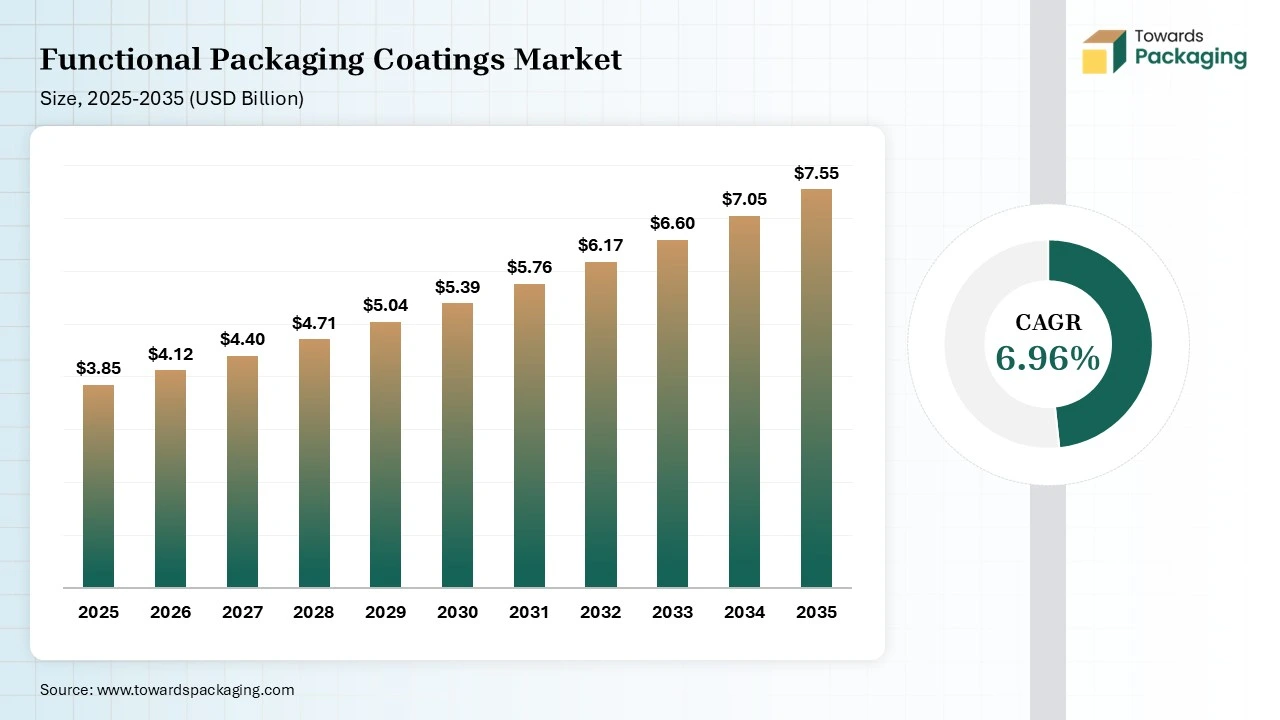
The functional packaging coatings market is projected to grow from USD 4.12 billion in 2026 to USD 7.55 billion by 2035, registering a CAGR of 6.96% during the forecast period. The report provides detailed insights into market size, segment data by coating type and substrate, and regional performance across key markets. It includes comprehensive analysis of leading companies, competitive landscape, value chain evaluation, and trade data along with extensive information on manufacturers and suppliers. The study highlights the rising demand for sustainable alternatives to plastics, enhanced food safety, and improved shelf life supported by barrier properties such as resistance to water, oil, and moisture.
Functional coatings point to high-level layer diagnosis that are used for materials to serve particular advantageous elements apart from basic aesthetic or preventive features. Such coatings deliver a variety of purposes, which develop the foundation material’s result by adding functionalities such as corrosion resistance, hydrophobicity, which means water repellent, electrical conductivity, and anti-microbial properties.
For brands that focus on sustainability, functional coatings meet with environmentally friendly inventions, which serve a purpose to develop product performance sustainably. Such coatings are important in various industries, including electronics, automotive, and consumer goods, that develop lifespan, improve efficiency, and lower the environmental impact.
Sustainable packaging is marketed mainly through encouraging what users predict and how they behave. Eco-friendly issues are now higher on users' minds than in the past. More and more, people need supply chains to be transparent and are buying from brands that accept green rules. For such reasons, companies are realizing that being sustainable develops their competitive nature in the industry. Companies that select eco-friendly packaging are more likely to be remembered and trusted by users.
Several regulatory institutions and governments are creating development in this category. More locations are using bans on single-use plastics, which accept EPR laws, and by using eco-labeling standards. Such policies encourage the packaging sector and develop inventions.
The barrier coatings segment dominated the market with 42% share in 2025 because barrier coatings are protective surfaces that are added to packaging materials to store products secured from oxygen, moisture, and other external factors. They assist in managing product freshness, preventing pollutants and providing a long shelf life. Such coatings can be used by using gravure, offset procedure & flexo that can be either solvent-based or water-based. Barrier coatings also assist in the growth of mono-material packaging, which is convenient to recycle and perfect for the environment. They are ideal for chilled food, dry food, and frozen food.
The antimicrobial coatings segment held the 12% market share in 2025 and expects the fastest CAGR of 8.2% during the forecast period. They use materials or coatings that have agents that protect microbial development on products or in the interior of the package. It's groundbreaking for sectors like food, in which 600 million annual foodborne illness cases are being registered for industries that have perfect safety measures, and healthcare, in which sterility is non-negotiable. The technology operates through methods like direct contact implementation (ex, silver nanoparticles that break down microbial cell walls) or a managed release of an agent. Such procedures store products clean, which reduces infection risk and spoilage.
The heat seal coatings segment held the 18% market share in 2025 because they are tailored materials that make a rigid blend when exposed to heat, which makes them unavoidable in flexible packaging. They behave as an barrier that not only packs product but also protects them from external environment factors from external factors like as contamination and moisture. By using contact adhesives inside such coatings, producers can receive relevant sealing while tracking product integrity.
The release coatings segment held 15% market share in 2025 as they operate by suddenly lowering the substrate's layer energy. It updates the substrate’s chemical design and the physical morphology, which makes them wettabilly bad, so the adhesives or resin cannot create a strong link. In manufacturing, they make a release coating which involves an accurate coating procedure, such as roll-to-roll coating. A liquid release agent is smoothly applied to the substrate, such as polyester film (PET). Then, they pass through a curing procedure, as they can be UV-cured to make a stable release layer.
The water-based coatings segment dominated the market with 38% share in 2025 as they develop oil, water, and heat resistance in packaging materials. They assist in protecting the ingredients from pollutants and maintain their actual scent. Such coatings are differentiated into two types as one type is utilized in paper packaging to add moisture opposition and develop sealing properties. The other type expands mono-material designs by adding an oxygen barrier to polyolefin materials, which helps to protect product quality.
The bio-based coatings segment held the 21% market share in 2025 and expects the fastest CAGR of 7.2% during the forecast period. These are beneficial because of their biodegradable nature and renewable sourcing. They can be produced from bacterial-generated cellulose, algae, nano-cellulose, carbon, chitosan, and starch. They deliver an ideal solution for substituting eco-friendly toxic coatings and or non-renewable oil-dependent coatings in the upcoming days. Biobased coatings develop a product’s sustainability. Additionally, substituting fossil-based content with bio-based and sustainable raw materials can mainly lower the product’s carbon footprint.
Solvent-based coatings segment held the 27% market share in 2025 as they make films that are different than waterborne. They are totally dependent on drowning the panel, which makes a particular wet film that lets metallic and pearl flakes begin themselves naturally as the material is constantly liquid in nature. The paint demands to come on the layer with enough solvent that still flows, merge into a soft film and link with parallel droplets.
UV-Curable coatings segment held the 14% market share in 2025 because they are clear liquids that are coated on different printed materials, which include business cards, brochures, or packaging. It will develop their look and protect lawyers from scuffs, scratches, and moisture. When we use UV coating, we should cure it with ultraviolet light to shift it to a rigid and soft layer quickly. The procedure of UV coating involves the coating being applied with the assistance of a blanket, roller, or screen on the print sheet. The basic formula of UV coating has monomers, oligomers, and photoinitiators.
The paper & paperboard segment dominated the market with 46% in 2025, and it is expected to sustain its position with the CAGR of 7.3% during the forecast period. Paper-based substrates include glassine paper, which is well known for its soft surface and translucency. Glassine is frequently used in applications that need visual checking of the adhesive surface. Claycoated kraft(CCK) is also used in S1S release liners. CCK serves a complete balance between softness and power, which makes them perfect for different adhesive items. Filmic release liner substrates are utilized in S1S release liners that include polypropylene (PP) films and polyethylene terephthalate (PET) films. These films serve a perfect dimensional constant line and are opposite to chemicals and moisture, which makes them suitable for high-performance uses.
The plastics segment held the 32% market share in 2025 because plastic coatings are commonly made by using a synthetic layer on a substrate, frequently metal, to develop their layer properties. Such coatings deliver an aesthetic and functional aim. They can be used through different procedures, which include the technique and fluidised bed dipping. They have several benefits, such as in toxic industrial surroundings, where the discovery of solvents, acids, and cleaners is prevalent. Plastic coating opposes such agents, which makes them perfect for labs, food processing plants, and factories. This resistance makes sure that layers stay intact and secure over longer periods.
The metal segment held the 12% market share in 2025 as metallized films are being covered with a thin surface of metal, predominantly aluminium. Such coatings are used via a procedure known as vacuum metallization, which assists in making an extremely functional and reflective layer. Such films play an important role in current packaging that pushes not only the aesthetic request but also the barrier properties and reliability of products. Biaxially Oriented Polypropylene film (BOPP) is metallized with the assistance of a vacuum deposition procedure.
Glass segment held the 10% market share in 2025 as they deliver the primary in-depth analysis which is focused on the fast-developing glass materials industry across several packaging stages that include glass core substrates, glass carriers, glass-based emerging technologies, and TGVs. Such an overall report serves an overall scenario of market dynamics, supply chain methods, and technology evolution that designs glass acceptance in high-level packaging. Glass substrates are also known as glass wafers that are thin and flat sheets of high-accuracy glass that are used across several sectors that include optics, electronics, and solar.
The food packaging segment dominated the market with 48% share in 2025 because OGR coatings are barrier coatings particularly crafted to prevent grease, oil, and moisture from entering packaging materials such as paper and paperboard. Such coatings are popularly utilized in food packaging to track structural power and hygiene. Such coatings deliver effective resistance against grease and oil, which makes them important for food packaging while assisting sustainability through environmentally friendly and recyclable materials. As the urge for sustainable packaging is on a high note, oil and grease-resistant coatings have become important.
The pharmaceutical packaging segment held the 17% market share in 2025 and expects the fastest CAGR of 7% during the forecast period. Tablet coating plays an important role in pharmaceutical production and industrial biomedical engineering, delivering several functional and regulatory benefits. They make sure to constantly look at and color across dosage units, which develop identification, patient point of view, and branding too. It also protects active pharmaceutical ingredients (API) from oxygen, moisture, light, and temperature changes. Additionally, it develops tablet flowability, lowers dust generation, and promotes subsequent packaging operations.
Consumer goods packaging segment held the 21% market share in 2025 because there are several ways to make a soft-touch effect. These include water-based coating, spray coating, soft-touch, UV coating, and soft-touch varnish. Every procedure serves a different appearance and feel. Soft-touch lamination applies to a film-based strategy for a smooth layer. Liquid finishing uses materials such as polyurethane dispersions. They also use polyacrylate emulsion as an option to boost stain resistance and fingerprint resistance.
The coatings and paint sector delivers to users and a variety of other industries, such as aerospace and automobiles. Relying on the product’s application and composition, coating and paint products are meant to meet specific safety and quality regulations. Some of the prevalent products that particularly demand rigid industrial packaging solutions are sealants, paints, adhesives, resins, and pigments. Industrial rigid packaging is utilized in the coatings and paint sector, which is generally chosen for function and reliability over aesthetics.
Food & Beverage segment dominated the market with 44% share in 2025 as polyethylene coating serves necessary grease-resistant and waterproof performance, which gives reliable security when the package consists of a hot water and steam connection. Its general uses include instant noodle bowls, which track design stability while cooking and protect against leakage under long-term exposure to a boiling atmosphere. On the other hand, single-layer PLA serves as a renewable and biodegradable moisture barrier that is perfect for uses that find a complete balance between practical results and sustainability.
The pharmaceuticals segment held 18% market share in 2025 and expects the fastest CAGR of 7.05% during the forecast period. These machines run under urgent conditions. Apart from regulatory demands to cover, there are expandable for good reason, such machines get exposed to chemicals, as well as high temperatures and excessive heat, and are often complete with cleaning routines. Without any correct prevention, machinery can get affected, that leads to malfunctions, costly repairs and lastly risks of being out of compliance. Without any chemical coatings, the amount to repair, maintain, and substitute such machines can grow.
The personal care & cosmetics segment held the 16% market share in 2025 because one of the crucial reasons why cosmetic brands select UV varnish is its potential to provide an exceptional visual effect. The UV coating facilitates a high-gloss finish which develops surface uniformity and color vibrancy. Such a level of shine adds a luxurious touch to any of the packaging products, which makes it more promising on store shelves and in the hands of users. UV varnish delivers a rigid barrier that prevents the product from daily damage. The coating makes a reliable layer which mainly increases the opposition of the packaging to physical tension, such as abrasion, scratching, and often handling.
The chemicals segment held 12% market share in 2025, as barrier coatings prevent external pollutants, so anyone can use fewer chemical preservatives. This assists us in storing food more safely and freshly. Several coatings, like those created from PHA, are available from renewable resources and are completely biobased. They deliver rigid barriers against grease, oil, moisture, and water, and they do not require any recycling procedures. One can use them on a huge series of packaging designs, and they deliver good sealing characteristics.
Asia Pacific dominated market with 41% share in 2025, because they deliver an authorized, data-driven base for step-by-step decision-making as it's one of the fastest-delivering worldwide sectors. They are crafted for investors, CEOs, and senior executives as they provide an overall check of current industry scenarios. Barrier and functional coatings with assistance of in-depth quantitative analysis have strong further design and expert predictions that feature a main development, technological growth, regional results, regulatory moves, and the regional performance classifications, which are complicated for long-term planning.
India Functional Packaging Coatings Market Trends:
The future of Indian functional packaging coatings is being driven by infrastructure development, sustainability regulations, EV growth, and growing demand for high-level coatings such as self-healing, nano, and water-based systems. The sector is moving towards eco-friendly formulations, with the automotive and infrastructure industries that behave as the main growth drivers. Compliance, sustainability, and research & development are becoming necessary, and organizations that develop in their current status will top the industry in the upcoming days.
North America held 22% market share in 2025 and is expected to experience the fastest growth in the market with 7.4% CAGR during the forecast period. This country is witnessing updates that are driven by developing user choice, sustainability initiatives, and technological developments. As the urge for eco-friendly packaging, advanced-quality and printing materials grows, producers are developing to align with such demands with the assistance of developed coating formulations and sustainable practices. The industry is classified by an exceptional scenario which balances regular coating procedures with growing environmentally and digitally conscious solutions.
United States Functional Packaging Coatings Market Trends:
The United States is rapidly developing in the current year as well as going into the next year, as development is being driven by growing demand for more sustainable, safer, and reliable packaging across complicated industries like beverages, food, personal care, and pharmaceuticals. As worldwide regulations get strong and consumer choices move towards recyclable and non-toxic materials, the coatings are used in various product packaging that are experiencing an updated shift, as both in application and formulation.
By Functionality
By Material Type
By Substrate
By Application
By End Use Industry
By Regions:








Research & Advisory Analyst
Yogesh Kulkarni is an experienced Research Analyst specializing in the packaging sector, with a strong foundation in statistical analysis and market intelligence. He currently contributes his expertise to Towards Packaging.
Learn more about Yogesh Kulkarni

Reviewed By
Aditi Shivarkar, with 14+ years in packaging market research, specializes in food, beverage, and eco-friendly packaging. She ensures accurate, actionable insights, driving Towards Packaging Analytics & Consulting 's excellence in industry trends and sustainability.
Learn more about Aditi Shivarkar


Functional Packaging Coatings Market
 Table of Content

 Download Sample
 Schedule a Meeting