


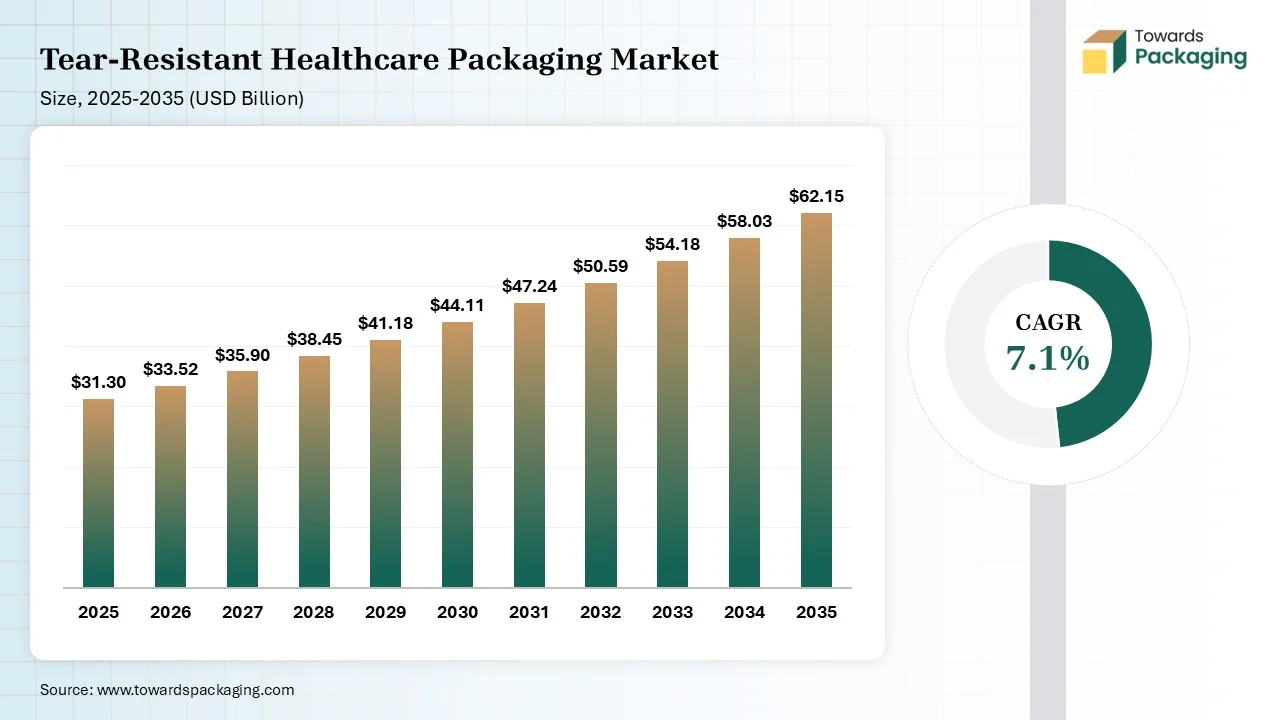
The tear-resistant healthcare packaging market is projected to grow from USD 33.52 billion in 2026 to USD 62.15 billion by 2035, registering a CAGR of 7.1% during the forecast period. The report provides detailed insights into market size, segment data by material type, product type, and application, along with regional analysis across North America, Europe, Asia-Pacific, and Rest of the World. It also includes company profiles, competitive landscape, value chain analysis, trade data, and comprehensive manufacturer and supplier evaluation, highlighting the increasing adoption of durable materials such as specialized paper grades and Tyvek to ensure product safety and sterility.
The tear-resistant testing of paper counts on internal fiber that stretches the link power instead of layer properties. Alike tensile testing, which measures opposition to pulling, tearing resistance, shows how perfectly fibers oppose crack frequency once their tear has begun.
This classification, particularly ASTM D689, is insightful for uses in which paper experiences sudden cutting, stress, or snagging. Sectors depend on such expertise to make available durability while packaging and converting, assist material selection and product development, and compare paper quality across manufacturing batches.
Smart packaging, which includes technology in packaging materials, is predicted to play a major role in 2025. Such trends are filled by the developing demand for patient engagement, traceability, and the potential to track the status of medical products in real time. Temperature-fragile products, particularly biologics, demand strong conditions during storage and transport. High-level sensors integrated in packaging can track and showcase humidity and temperature data, which ensures product integrity from producer to consumer. Technologies such as RFID (Radio Frequency Identification) and QR codes are being used to develop supply chain visibility. Such additions enable healthcare manufacturers and patients to check product authenticity and manage information about the product that includes expiry data, instructions, and batch number.
Package Design and Prototyping: Tamper-evident nags are particularly crafted packaging bags that disclose visible symbols of tampering once they are opened. They are created from durable, strong materials such as polyethylene and feature irreplaceable closures such as permanent adhesive closures, void tapes, and security seals.
Recycling and Waste Management: Biohazard bags are officially red bags that are needed whenever regulated medical waste (RMW) is being packaged for logistics and transport. Such bags deliver as the interior packaging that is totally responsible for having the biohazardous waste, which is securely placed in an outer packaging like a reusable container or fiberboard box.
Logistics and Distribution: Effective route planning involves managing weather conditions, traffic designs, and potential obstacles to ensure the perfect paths for transporting medical devices. Using high-level transportation software that can manage dynamic routing, which accepts the actual time to update conditions. Such practice not only lowers the transportation period but also lowers costs linked with fuel usage and vehicle wear & tear. Smooth route planning is necessary for ensuring precise serving while updating the resource usage.
The pouches & bags segment dominated the market with a 35% share in 2025 and is expected to have the fastest CAGR of 8.0% during the forecast period. Header bags are tailored to sterile barrier pouches that are crafted for heavy or voluminous medical products. They include a polyethylene film pouch that is packed to a header strip, which is frequently printed with ETO process indicators.
In terms of healthcare packaging, header bags are utilized to sterilize and package a large number of instruments like scopes, implants, sterile surgical tools, process kits, and more. They justify ingredients during storage and sterilization at the current time, which allows medical staff to watch the ingredients without any issue.
Films & sheets segment held the 30% market share in 2025 as high barrier films receive their results with integration of functional coatings and substrate selection. Polyester (PET) delivers as the foundation due to its dimensional stability, power, and clarity, while covering acrylic, PVDC, or ALox develops its chemical and protective opposition elements. Performance and sustainability are no longer opposing aims as they are pillars of growth.
Rigid containers with tear-resistant seals segment held the 20% market share in 2025 because these containers are solid in nature, have non-flexible enclosures that are created from materials such as metals, plastics, or composites. They are crafted to firmly withstand pressure, impacts, and eco-friendly factors. Like flexible packaging, these containers track their integrity and shape over time. Prevalent designs count drums, bottles, crates, and tubes. They are utilized across industries like pharmaceuticals, food and beverages, industrial manufacturing, and chemicals, too.
Blister packs (tearresistant) segment held the 15% market share in 2025, as healthcare blister packs are packed units in which doses of capsules, tablets, or pills are sealed inside developed cavities, which are created from plastic laminates or films and supported by lidding material or foil. Such packages are prevalently used because they organize, protect, and showcase doses precisely while making sure every unit stays integrated until they are demanded.
The plastics segment dominated the market with a 50% share in 2025 and is expected to have the fastest CAGR of 8.0% during the forecast period. Healthcare facilities manage a huge variety of materials each day, including instruments, medications, documents, and waste. Every product needs accurate contamination to manage traceability, hygiene, and safety. Medical plastic bags are crafted to align with such demands by serving clarity, reliability, and tailored closure systems. Like adaptable packaging, healthcare plastic bags are produced to match pharmaceutical standards, which ensure they can firmly withstand contamination, handling, and assist in smooth medical possession.
The paper & paperboard (reinforced) segment held the 25% market share in 2025, as child-resistant (CR) healthcare packaging should result in constant use on several surfaces to ensure compliance and secure medication availability. For users, CR packaging should protect accidental availability by children while staying intrinsic and practical for adults, including patients and seniors with restricted abilities. For healthcare products, packaging should operate smoothly at scale, to manage regulatory compliance and assist profitability without disturbing current packaging lines.
The aluminum & foil laminates segment held 25% market share in 2025 because it consists of long-term as the actual standard for greater barricade prevention in flexible packaging. Such designs are not a single film but a mixture, in which a layer of aluminium foil is linked to one or more other polymer films, such as polyethylene (PE), PET, or an adhesive. The foil layer itself is a constant and solid sheet of metal that has a very thin gauge, which specifically ranges from 6 to 9 microns for the healthcare packaging industry.
The pharmaceuticals segment dominated the market with 60% share in 2025 and is expected to have the fastest CAGR of 7.5% during the forecast period. Bottles and vials are more commonly used for vaccines, liquid medications, and oral suspensions, which make them specifically reliable for pollutants and simulating. Tamper-proof solutions for such formats count induction seals that are heat-sealed foil liners that have sealed bottle openings that make an airtight barrier. Such packs break down when the cap is being removed, that protects indicating and resealing with any tampering attempts. Plastic bands that cover the bottle's neck and cap need to be torn to open. Such bands frequently highlight punctures that show and reseal any kind of tampering requests.
The medical device segment held the 40% market share in 2025, as its shelf life points to the time during which the medical device and its packaging systems can track their designed sterility and result. During the Thai time, the packaging will prevent the medical device from external elements such as humidity, microbial contamination, physical damage, and temperature fluctuations. The shelf life is affected by many factors linked to the packaging itself, the device, and storage conditions. If the packaging totally fails, the device inside will become damaged or unsterilized.
The laminated barrier technology segment dominated the market with 40% share in 2025, as the healthcare products that excessively count tablets and injectables, and the packaging films of medical devices have a bigger and fixed control surrounding as they demand. Barrier films in the healthcare industry are not only about an expanded shelf life but also about having molecular reliability, pausing pollutants, and ensuring smooth service. Thermal lamination films have several advantages in this urgent environment. Such films prevent medical-grade paper, paperboard, and plastic films. They deliver a long-lasting seal that develops the barrier properties of the foundation material when they are heated and completely under pressure.
The sterilization-ready packaging segment held 30% market share in 2025 and expects the fastest growth in the market with 8.2% CAGR during the forecast period. Sterility is crucial in terms of medical packaging. The smallest adjustment can pollute healthcare and patient servers. Thermal Lamanites cause sterility in several ways. Primarily, their homogenous and deep layer opposes spores, airborne bacteria, and viruses. When they are used, the film closes issues and minute pores as infections penetrate. After sterilization, film seal integrity is important as many materials are opposite, stretched, or changed under sterilization. Thermal lamination films include high-dimensional constant film and mechanical power that allows heat closures and seals to withstand a harsh sterilization environment.
Easyopen/tearresistant seal tech segment held the 30% market share in 2025 as peelable seals play a complicated role in serving protective and conveniently peelable force simultaneously in both directions of the seal. This delivers a managed, constant means of force distribution and lessens the possibility of inconsistent peeling. Peelable seals are particularly valuable in clinical surroundings where ease of availability and aseptic presentation are of great value.
North America dominated the market with 30% share in 2025, because this industry is investing mainly in the economy by driving and fostering innovation and effectiveness in the supply chain. Growing trends such as the implementation of smart packaging, sustainable materials, and developments in technology are predicted to further complete market growth. The market is expected to change through improved safety features, customization, and a rigid focus on regulatory compliance, which aligns with a developing demand for eco-friendly and sustainable responsibility in the tear-resistant healthcare packaging solutions.
United States Tear-Resistant Healthcare Packaging Market Trends:
The usage of space of the U.S. to tear-resistant healthcare packaging is crucially designed by the demands of the medical device and pharmaceutical industry. The initial term-back making uses is the packaging of pharmaceuticals and biologics, which need barrier-prevented paper to ensure sterility, safety, and compliance with stringent regulatory standards. This segment has dominated the market, which is being driven by the growing importance of tracking product reliability during storage and transportation, making it unavoidable for healthcare servers and producers on the same level.
Asia Pacific is expected to experience the fastest growth in the market with 8.1% CAGR during the forecast period. India and China are the main worldwide manufacturers of generic vaccines, drugs, and biologics. China’s healthcare sector remains the biggest in this region, as India is the largest producer of actual medicine manufacturing that supplies over 20% of the globe’s generics. There are rising government initiatives and disposable incomes, such as “Ayushman Bharat” and “Healthy China 2030” which are increasing access to medical services.
India Tear-Resistant Healthcare Packaging Market Trends:
As the residential healthcare usage grows and the country’s place sits as the globe luxury exporter of good-quality biologics and generics, packaging will continue to be the unwanted feature of the supply chain. From sustainable bioplastics to NFC-allowed intelligent vials, the future of this industry is present in its potential to protect the patient, product, and planet. For the investors, producers, and stakeholders, the complete journey of the year 2030 will deliver a landscape growth with possibilities, which urges in-depth technological integration, operational agility, and a persistent quality to quality.
In January 2026, SmartSolve announced the launch of a plastic-free, water-soluble, and bio-based film, PureNil O. This has a "worldwide uses”, as the industry looks for crafted solutions for single-use plastic in user-packaged goods. PureNil O is a water-soluble packaging substitute that is crafted for powdered or dry product designs and can operate on the fill, seal, and actual form machine.
By Product Type
By Material
By End Use:
By Technology:
By Regions








Principal Research Analyst
Vidyesh Swar is a Senior Research Analyst at Towards Packaging, bringing over 4 years of dedicated expertise in market intelligence and strategic analysis across the dynamic world of packaging technologies and solutions.
Learn more about Vidyesh Swar

Reviewed By
Aditi Shivarkar, with 14+ years in packaging market research, specializes in food, beverage, and eco-friendly packaging. She ensures accurate, actionable insights, driving Towards Packaging Analytics & Consulting 's excellence in industry trends and sustainability.
Learn more about Aditi Shivarkar

Tear-Resistant Healthcare Packaging Market
 Table of Content

 Download Sample
 Schedule a Meeting