


The UK plastic-free barrier coating market is projected to grow from USD 461.16 million in 2026 to USD 1,069.73 million by 2035, registering a strong CAGR of 9.8% during the forecast period. The report provides detailed insights into market size, segment-wise performance, and regional distribution across the UK, along with comprehensive company profiles, competitive benchmarking, and strategic developments. It further includes value chain analysis, trade flow data, and in-depth information on manufacturers and suppliers, offering a complete industry perspective.
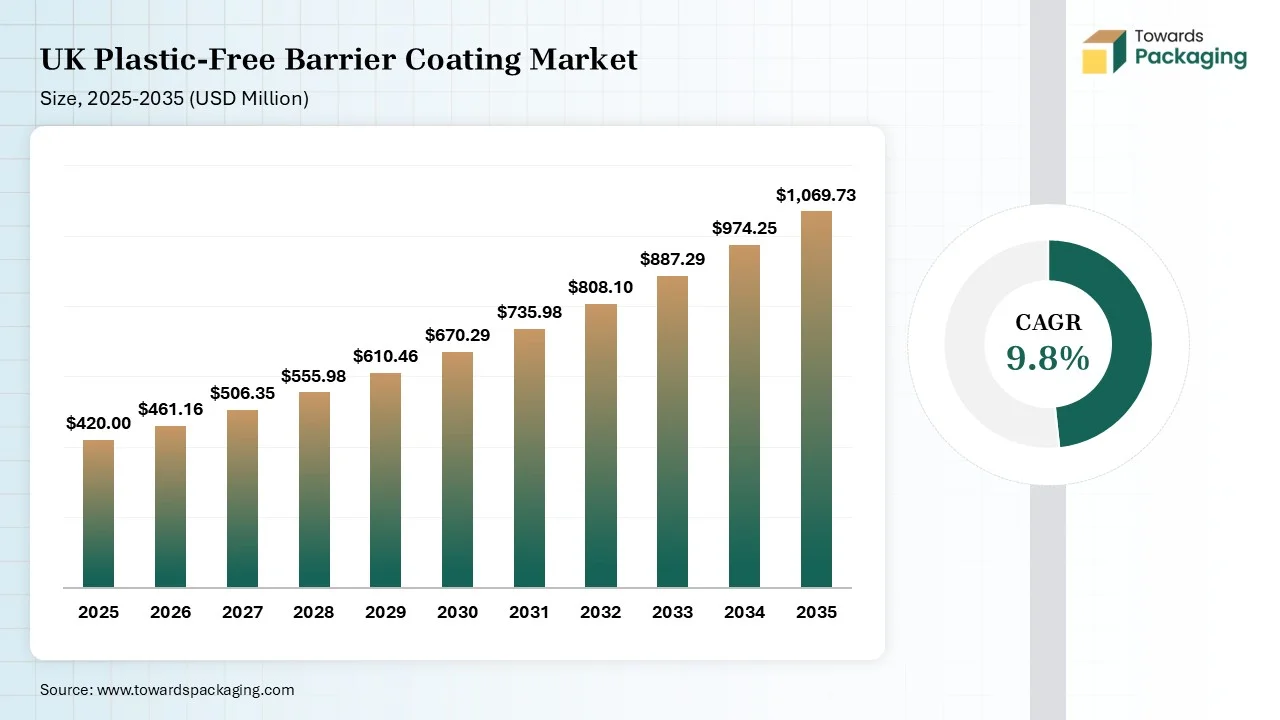
Market Size (2025): USD 420 Million
CAGR (2025–2035): 9.8%
Market Volume (2025): 185 thousand Tons
Volume CAGR (2025–2035): 8.9%
Pricing Data (2025):
Plastic-free barrier coatings are environmentally friendly materials that are crafted to substitute plastic-based coatings for packaging uses. Such coatings are sourced from renewables like cellulose, starch, and plant gums that deliver a non-toxic, biodegradable choice that offers oxygen, moisture, and grease resistance. Their acceptance is developing because of strong environmental regulations and developing user demand for sustainable packaging solutions, specifically for fields like e-commerce and food & beverages.
Nanotechnology revealed the latest possibilities in terms of coating results by adjusting materials at a molecular level. Nanocoating serve as perfect elements like anti-bacterial, self-cleaning, and developed mechanical power. Self-cleaning coatings repel dirt and water, which lessens cleaning frequency and maintenance. Wear-resistant coatings have nanomaterials that develop strength and abrasion resistance, which extend the service capacity of the factors. Additionally, anti-bacterial coatings that have nanoparticles such as copper or silver have coatings that inhibit microbial development, which are necessary for food industries and healthcare.
Package Design and Prototyping: Effective barrier-free coating packaging has a holistic packaging design method. This points out that it has enough possibilities for avoidance or reduction, by just analyzing sourcing procedures, and by updating transport and efficiency, and operating towards material health. It is also subject to redesigning the packaging to solve some of the crucial urgent drivers of climate change, for instance, food waste in user and retail homes.
Recycling and Waste Management: Sustainable barrier coatings without any PFAS can be utilized in different levels of packaging and include polylactic acid (PLA), polyhydroxy alkenoates, waxes and wax mixtures, and further elements like cellulose, proteins, starch, polyvinyl alcohol (PVOH), and plant-based coatings.
Logistics and Distribution: The logistics and distribution of barrier-free coatings are initially being driven by growing digital stages and direct supply agreements to align with the demands of pharmaceuticals, food, and e-commerce industries.
Water-based coatings segment dominated the market with 38% share in 2025 as they utilize water as a crucial carrier instead of n organic solvents. In terms of industrial uses, such coatings create a functional and secure layer on cores, metal molds, and castings, which push surface quality while lowering emissions. Current waterborne coatings, which are crafted through a high-level polymer crafting and updated resin architecture, have matched the clarity, chemical resistance, and non-yellowing results.
The bio-based coatings segment held the 27% market share in 2025. These coatings are cutting-edge, environmentally friendly layer coatings created from plant-based and renewable materials. They are crafted to substitute traditional petrochemical-dependent coatings in sectors like marine, rail, aerospace, and automotive. Instead of fossil fuels, bio-coating depends on raw materials that come from biological sources. Such counts resins, oils, and the polymers that come from extracted sustainably from natural resources and plants.
The mineral-based coatings segment held the 19% market share in 2025. Mineral stains and paints are necessarily created from exact raw materials which add to the substrates, whatever they are used, which begins with the binder itself, as the potassium silicate is also known as “liquid glass”. To such binders that are added to the mineral fillers, which give the pain its respective layer quantity, which are compulsorily used to secure layers from the factors.
The moisture barrier segment dominated the market with a 34% share in 2025 because this material should also prevent aromas and gases, which can affect the quality and freshness of stored items. This is specifically important for food packaging uses and the pharmaceutical sector, with a smooth gas barrier necessary for tracking flavors and expanding the shelf life. Another main element of moisture barrier material is its collaboration with special additives and coatings.
The grease & oil barrier segment held the 28% market share in 2025. This packaging is of crucial importance for different food products, right from meat to any fried food and dressings. Regularly, polyolefins such as polyethylene and polypropylene have been utilized, but they can be softened or plasticized by oil and grease. By expanding a paperboard through a developed fiber density, it can be an alternative that opposes both oil and grease. Paper chemistry grabs like a changing cellulose with a rigid acid and the wetting agents, making a water-and grease-resistant barrier.
The oxygen barrier segment held the 26% market share in 2025. Oxygen barrier films are complicated inventions in food protection, which assist in expanding the shelf life, lowering food waste, and tracking quality. When they are utilized in flexible packaging films, such as snacks or food packaging pouches for meat and dairy, such high-performance materials continue to design the future of food packaging. Nuts, crisps, and chocolates are excessively sensitive to oxygen exposure. Barrier films protect against oxidation, which tracks crunchiness and flavor.
Food packaging segment dominated the market with a 41% share in 2025, as OGR coatings are barrier coatings that are specifically tailored to prevent oil, grease, and moisture from entering packaging materials like paper and paperboard. Such coatings are popularly utilized in food packaging to track structural strength and hygiene. Such coatings serve effective resistance against oil and grease, which makes them crucial for food packaging while assisting sustainability through eco-friendly and recyclable materials.
The food service packaging segment held the 18% market share in 2025. Edible packaging is made from biodegradable, natural contents that are safe for use. It is counted as a sustainable option in the sector of active food packaging and serves to develop food quality as compared to regular packaging procedures. The advantages of edible packaging include expanding shelf life, tracking food quality, developing economic stability, and extending the shelf life of packaging materials.
The beverage packaging segment held the 16% market share in 2025. Spout pouches are updating the beverage sector. From plant-based drinks to cold-pressed juices, the packaging enables convenient usage and reliability. The lightweight nature of the pouches also lowers transportation costs, which allows brands to reach remote markets effectively. Furthermore, spout pouches need less material than regular rigid packaging, which leads to lower carbon emissions in transport and manufacturing.
The paper & paperboard segment dominated the market with 46% share in 2025. Paper label substrates are most widely utilized and are the easiest to operate with. It has accepted perfect ink across digital and offset print procedures, as it is cost-effective for large volumes, and is available in a wider range of completeness, like gloss, matte, uncoated, and textured.
The flexible paper packaging segment held the 21% market share in 2025. Current compostable bioplastics, which are utilized as a coating for paper bags, can be obtained from waste materials or renewable resources. Coating paper bags with biopolymers shows a promising method for a sustainable invention in the packaging system sector. Specifically, the solutions were created as a capable choice to regular paper bags that have polyethylene liners or fluorinated compounds, specifically in the food products industry. Accordingly, the recycling of such paper bags with the assistance of industrial composting creates an eco-friendly and attractive solution.
The molded fiber segment held the 18% market share in 2025. Disposable tray plates are accessible in various materials, such as compostable, paper-based, like those made from bagasse (sugarcane pulp). Most of these have been designed to keep food different and orderly. Disposable lunch trays result perfectly in particular areas, and outcomes as per them. They have a lid system that has ideal logistics potential compared to plastic plates, which store food classified and maintain the temperature, as they avoid spillages while serving or travelling.
The food and beverage segment dominated the market with a 48% share in 2025. PLA coating delivers a renewable and biodegradable moisture barrier that is ideal for uses that find a perfect balance between practical results and sustainability.
They are used for compostable salad bowls to serve a precise surface quality and protect against chilled foods and liquid absorption from vegetables. It develops tolerance to oils and high temperatures, as it enables huge applications in bakery packaging, in which resistance to heat and fat is necessary.
The retail and e-commerce segment held the 19% market share in 2025. Powder coating has quickly received attention in the retail and e-commerce sector, which offers benefits that make it a preferred choice for product completion. One of the initial advantages is its unmatched durability. Retail items, specifically those pointed to higher levels of wear and tear, demand a coating that can firmly stand up to consumption without any fading or chipping. Powder coating serves as a strong layer that protects and manages its aesthetic appeal over a period.
The healthcare & pharmaceuticals segment held the 12% market share in 2025. Specialty material producer company Solvay has revealed the latest coating solution, as Diofan Ultra 736 polyvinylidene chloride (PVDC), that has an ultra-high water vapour barrier. The manufacturing of pharmaceutical blister films with lower carbon footprints is possible. The aqueous dispersions are fluorine-free, which completes useful regulations for a direct link with pharmaceuticals that assist with the design of more sustainable films with thinner coatings.
Country Level Analysis:
The UK plastic-free barrier coating market in the is witnessing major development, which is driven by strong eco-friendly regulations, developing user alertness, and stable sustainability goals. Green building certifications that require regulations such as LEED and BREEAM in the construction industry need the application of low-VOC and environmentally friendly architectural coatings. There is a developing demand for coatings, which makes the lifetime of complicated designs, such as bridges and wind turbines, serve long-period, eco-friendly, and economic advantages.
By Material Type
By Barrier Type:
By Application:
By Substate
By End-Use Industry







Research & Advisory Analyst
Yogesh Kulkarni is an experienced Research Analyst specializing in the packaging sector, with a strong foundation in statistical analysis and market intelligence. He currently contributes his expertise to Towards Packaging.
Learn more about Yogesh Kulkarni

Reviewed By
Aditi Shivarkar, with 14+ years in packaging market research, specializes in food, beverage, and eco-friendly packaging. She ensures accurate, actionable insights, driving Towards Packaging Analytics & Consulting 's excellence in industry trends and sustainability.
Learn more about Aditi Shivarkar

UK Plastic-Free Barrier Coating Market
 Table of Content

 Download Sample
 Schedule a Meeting