


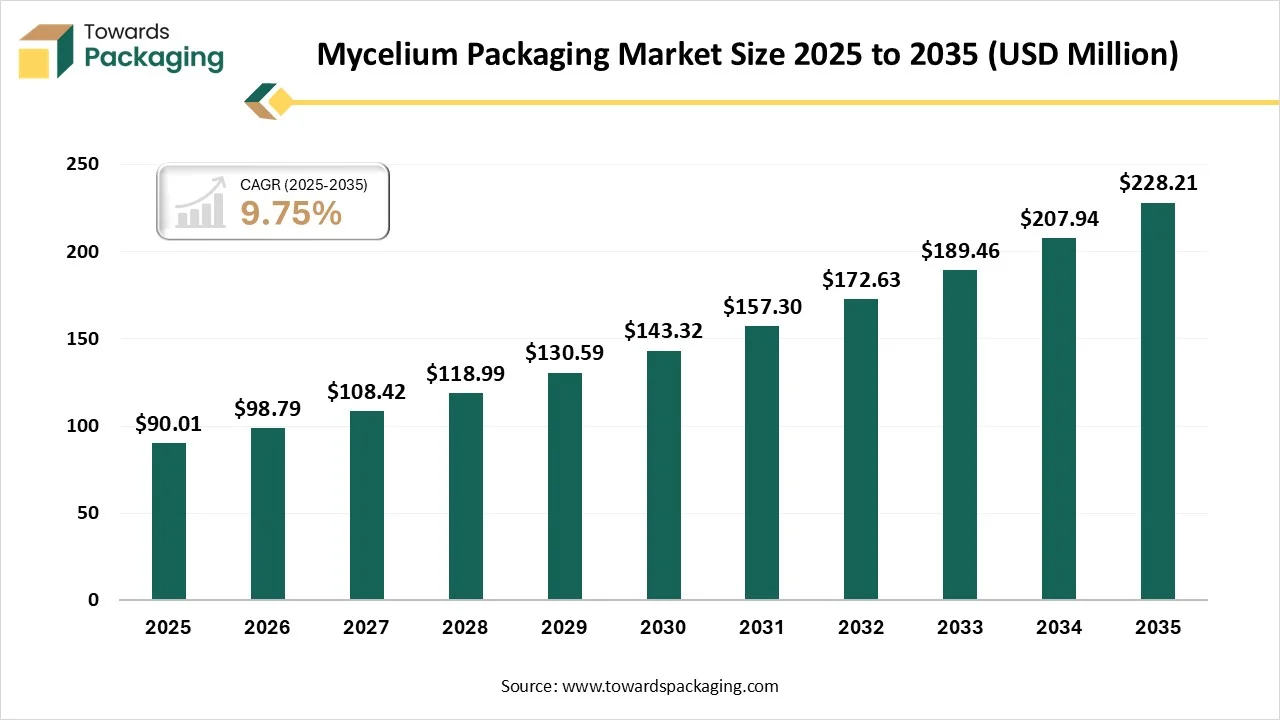
The mycelium packaging market is forecasted to expand from USD 98.79 million in 2026 to USD 228.21 million by 2035, growing at a CAGR of 9.75% from 2026 to 2035. The growth of the market is predicted to develop quickly due to expanding factors such as a higher urge for biodegradable and sustainable alternatives to regular materials like leather, plastic, and traditional meat products.
Mycelium is the latest sustainable packaging, which can substitute less environmentally friendly options, like polystyrene and plastic. It is an overall farm-developed and organic material created from the roots of a mushroom. The roots are grown around a mould to make a tailored design that carries products safely and proactively in transportation. As it is a completely natural product, mycelium decomposes any organic product, which leads to a toxic nature in the surrounding environment.
AI plays an important role in sustainable mycelium packaging, replacing plastic foams such as Styrofoam. The AI helps to refine the plastic foams’ well-shaped design, as mycelium packaging highly contains agricultural waste with fungal roots. The AI suggest the apt material fusion and predicts environmental conditions for more growth in the industry.
Most of the mycelium packaging designers utilise generative AI to execute complicated shapes. Alongside, the experimental mycelium packaging adds AI-fuelled sensors to keep a check on product integrity and freshness to prevent spoilage.
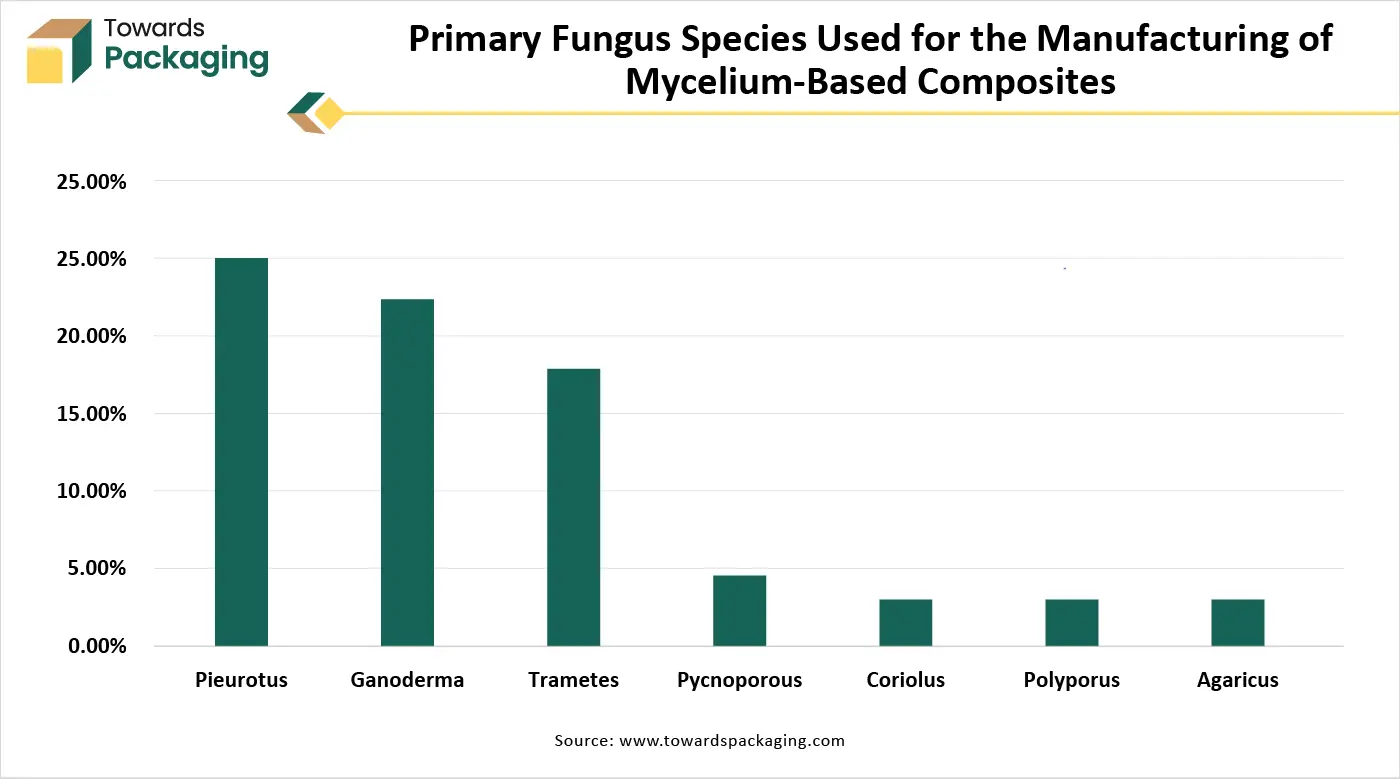
Mycelium -dependent materials are usually created from organic substrates, which are inexpensive, abundant, and frequently chosen as problematic waste. The studies have shown that development on cardboard, sawdust and paper waste, hay and coconut water, and agro-industrial residues like coffee chaff, coffee grubs, and cereal by-products, too.
Pure mycelium packaging has dominated the market in 2025, as it is the vegetative body of a filamentous fungi. It includes a dark three-dimensional link of microscopic tubes named a hyphae that fuse, branch, and weave with the help of organic substrates. As such, hyphae develop, they release enzymes like ligninases and cellulases, they broke down complicated biopolymers such as lignin and cellulose into simpler nutrients.
The mycelium composite packaging segment is predicted to witness the fastest CAGR during the forecast period. This packaging has been used for many eco-friendly advantages. It is a biodegradable solution and can be composted in a home setting, which avoids the demand for industrial composting design. The manufacturing procedure uses agricultural waste as a raw material, which is capable of lowering the amount of trash material and promoting circularity.
The cushioning function has dominated the market in 2025, as eco-mushroom cushioning is the ideal sustainable alternative to regular packaging. It is made from renewable fungal mycelium and recycled materials, which are environmentally friendly materials, and are home compostable and eco-friendly too. They are durable and compatible, which protects the product surfaces from damage and scratches.
The bracing segment is predicted to witness the fastest CAGR during the forecast period. Mycelium packaging can conveniently be brought into various forms during the production procedure and hence can be used for transporting electronic devices as well as perfume bottles. The manufacturing is currently C02 -neutral at the time of shipping, as it provides maximum protection for the products. It is perfect, water-opposite at a shock absorption and even fire-opposite.
The blocks segment has dominated the market in 2025 as organization that generates bio-blocks for construction applications use industrial presses in order to heat and compress their bricks, making them as rigid as concrete. Companies present around the globe are joining the mycelial movement, which develops the latest uses for fungi that point to synthetic leathers, biodegradable packaging materials, batteries, vegan bacon, and more.
The sheets segment is expected to witness the fastest CAGR during the forecast period. Myceen is a sustainable design and research object that concentrates on the growth of mushroom mycelium-based materials. Such compostable and carbon-negative materials are developed by integrating organic by-products and mycelium. Myco-material can capably substitute plastics, and it has issues with composites while updating other sectors left behind.
The consumer goods segment has dominated the market in 2025 as mycelium packaging startup goal is to substitute the highly polluting polystyrene and the recycling procedure is excessively costly and ineffective-those outcomes in the material which is being trashed in the landfills in which it is decomposed into an toxic microplastics. Additionally, they are sued to pack several consumer goods during logistics and in the sector.
The healthcare segment is expected to witness the fastest CAGR during the forecast period. Mushroom-dependent packaging materials are derived from mycelium networks that serve exceptional preventive elements for healthcare shipping uses. Such materials serve as perfect cushioning elements while they decompose completely within a week of disposal. The cultivation procedure needs fewer resources and can use agricultural waste as a development medium, which provides additional environmental benefits.
Asia Pacific has dominated the mycelium packaging market as it grows its huge agricultural industry, such as hemp, corn stalks, and rice husks, etc., as low-cost raw materials in order to develop mycelium packaging, which makes the business design highly revenue -smooth. In this region, there are strict bans on single -use plastics in countries such as India, China, and Japan, which are forcing a move towards biodegradable solutions.
India is using mycelium packaging market crucially, as growing government compulsions and bans on single-use plastics and non-biodegradable creations are forcing sectors to accept compostable alternatives. There is even high demand from millennial users and Gen Z users for environmentally friendly shipping, which is encouraging e-commerce giants to mix sustainable logistics.
North America expects the fastest growth in the market during the forecast period, because this region is witnessing a notable demand, which is driven by growing consumer awareness of health-conscious and sustainable products, expanded uses across different industries, and technological developments, too. Mycelium, which is the root-like structure of fungi, has gained importance as an evergreen biomaterial that has uses in construction, packaging, the food sector, and textiles. Besides, industry development is further fueled by assistive regulatory frameworks, by developing funding in terms of sustainable materials, and further acceptance of mycelium-based products among users and organizations.
The mycelium packaging market is growing in Canada, as this strong growth is associated with the developing focus on avoiding non-biodegradable packaging waste and aligns with government compulsion for sustainable alternative options. In Canada, mycelium packaging acceptance is gaining attention in e-commerce, consumer goods, and the food service industry. This classified potential of mycelium packaging in order to biodegrade naturally in weeks is a rigid differentiator as compared to plastics, which take centuries.
South America’s Advancement in the Mycelium Packaging Industry
South America’s advancement in this industry comes from the mixed involvement of Chile as an innovator, Argentina as a popular contributor, and Brazil, holding a massive amount of mycelium product sales. The agricultural unification via innovation expands agricultural engagement. The more agricultural integration more circularity there will be. The replacement for expanded polystyrene promotes the sustainable advancement of mycelium-related cushions. These cushions can be composted within weeks.
Europe’s promising investments are tied to intelligent corporate alliances, EU programs and private venture capital initiatives. The investments focus on introducing biodegradable alternatives. The Horizon Europe program alone has secured billions to deliver financial help to circular bioeconomy projects. Alongside, the venture capital and private funding stimulate additional support for the industry. The giants like Myco, Biomyc and GROWN bio, with the help of regulatory intervention, introduced new innovations and technology to spur the industry growth.
Package Design and Prototyping
Recycling and Waste Management
Logistics and Distribution
By Product Type
By Function Type
By Packaging Formats
By End Use
By Region








Research & Advisory Analyst
Yogesh Kulkarni is an experienced Research Analyst specializing in the packaging sector, with a strong foundation in statistical analysis and market intelligence. He currently contributes his expertise to Towards Packaging.
Learn more about Yogesh Kulkarni

Reviewed By
Aditi Shivarkar, with 14+ years in packaging market research, specializes in food, beverage, and eco-friendly packaging. She ensures accurate, actionable insights, driving Towards Packaging Analytics & Consulting 's excellence in industry trends and sustainability.
Learn more about Aditi Shivarkar

Mycelium Packaging Market
 Table of Content

 Download Sample
 Schedule a Meeting