


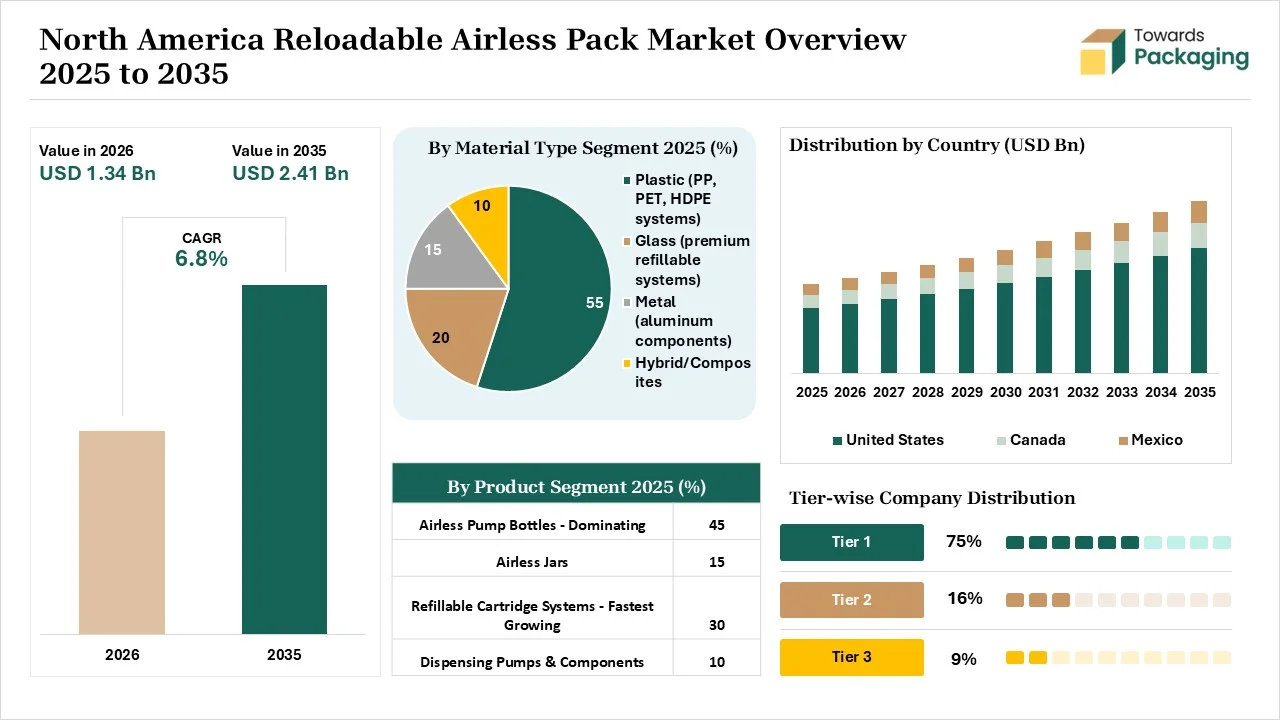
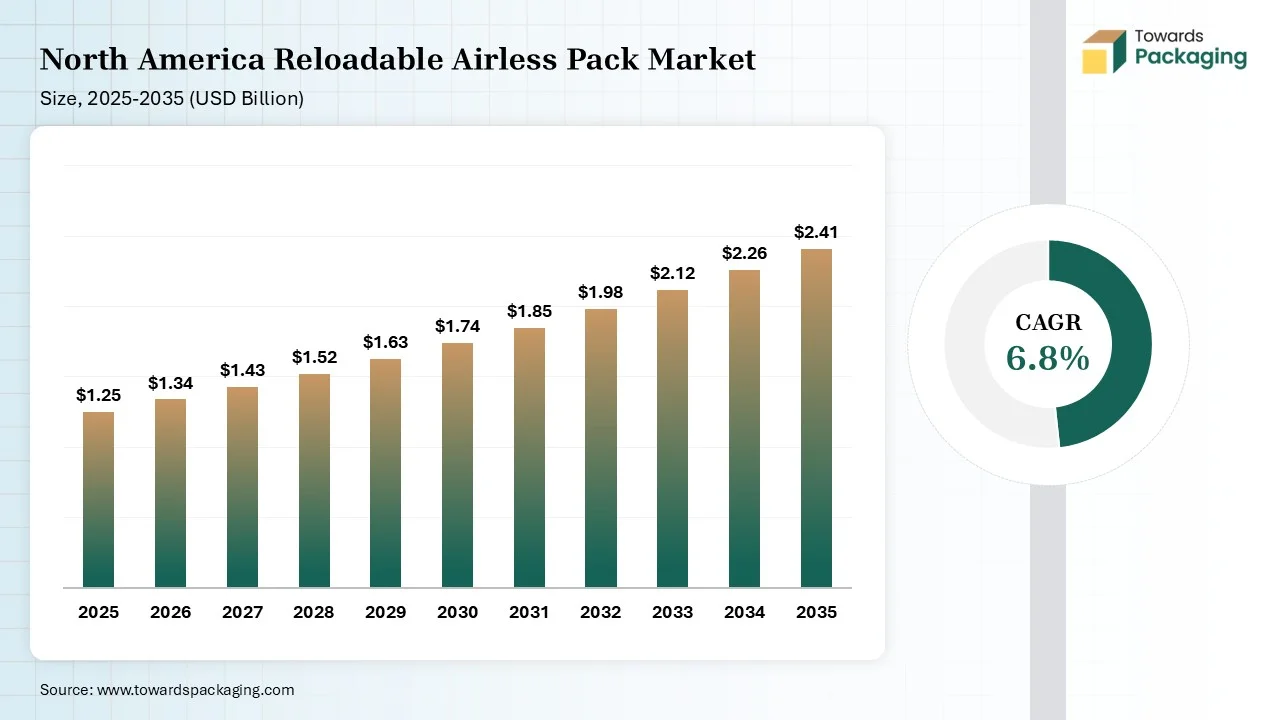
The North America reloadable airless pack market is projected to grow from USD 1.34 billion in 2026 to USD 2.41 billion by 2035, registering a CAGR of 6.8% during the forecast period. The market report provides comprehensive coverage of market size, share, growth drivers, segment analysis, regional performance, competitive landscape, company profiles, manufacturers and suppliers assessment, value chain analysis, trade statistics, pricing trends, innovation developments, and future opportunities. The increasing preference for clean beauty products, rising demand for circular packaging solutions, and reduced reliance on artificial preservatives are supporting market expansion across North America.
The reloadable airless pack is a kind of cosmetic dispenser integrated with a replaceable pouch. The pack features a reloadable design, airless technology, and no air exposure. The pack features components like the inner cartridge, reload mechanism, outer casing, actuator, double temper seal, and one-way valve. It possesses characteristics like 360-degree dispensing, controlled dosing, tamper-evident refills, premium aesthetics, vacuum piston mechanism, high evacuation rate, and zero-air exposure. It offers benefits like oxidation prevention, maximum product evacuation, eco-friendliness, travel safety, longer shelf life, and enhanced hygiene. Reloadable airless pack is widely used in applications like eye creams, travel-friendly products, anti-aging products, color cosmetics, and other products.
The North America reloadable airless pack market growth is driven by the move towards low-waste packaging, focus on protecting volatile ingredients, high demand for precision dosing, presence of major cosmetic companies, need for mess-free dispensing, burgeoning organic skincare, interest in premium-priced serums, focus on travel convenience, and the expansion of OTC treatments.
Technological developments like smart packaging, CAD, IoT integration, blockchain-enabled tracking, 3D prototyping, and RFID chips integration are happening in the North America reloadable airless pack market. Technological developments support e-commerce optimization, formula preservation, and the development of high-end aesthetic appeal. The most prominent development in the market is that AI technology helps in streamlining complex production.
AI helps in selecting lightweight plastics and optimizes the dimensions of packaging. AI supports flawless assembly in manufacturing and continuously monitors filling machinery health. AI helps in tracking the usage of the product and analyzing the buying habits of consumers. AI automates the sourcing of resins and identifies product requirements. AI performs material separation tasks in recycling facilities. AI maintains product freshness and understands packaging durability. Overall, AI supports enhancing smart consumer engagement and optimizing design.
The stage acquires raw materials like polypropylene, PCR plastics, polyethylene, bio-based resins, polyethylene terephthalate, and acrylic.
Material processing includes methods like injection molding, extrusion blow molding, and springless assembly. The conversion includes component molding, pump engine assembly, vacuum integration, and filling.
Package design focuses on the outer shell, refill cartridge, mechanism, and double tamper seals. Prototyping focuses on leak prevention, flawless dispensing, and seamless refill mechanics.
| Rank | Company Name | Headquarters | Country | Why Relevant to This Packaging Market | Key Packaging Products and Services |
| 1. | AptarGroup, Inc. | Crystal Lake, Illinois | United States | The company manufactures reloadable airless packaging for preserving product formulas. | Gaia, Serumony Refill, Astrea |
| 2. | Silgan Holdings Inc. | Stamford, Connecticut | United States | The company produces high-engineered dispensing solutions and pumps under its Silgan Dispensing part. | DNA 35ERA, Piroutte Technology, Prodigio, Pearl 2, DNA Series |
| 3. | Berry Global Group, Inc. | Evansville, Indiana | United States | The company develops sustainable airless packaging solutions and focuses on mono-material engineering. | Exclusive Stick & Refill Range, Magic Star Light Dispenser Range, Prima Refill Jars |
| 4. | APackaging Group | Azusa, California | United States | The company develops environmentally friendly reloadable, and refillable airless pump systems for the beauty industry. | Glass Airless Pump Systems and The Revitalize AIR Collection |
| 5. | FusionPKG | Dallas, Texas | United States | The company offers customizable airless packaging with functional standards and premium aesthetics. | Gaia Reloadable Platform, Airless-One, and Verve Airless FreeForm |
The plastic (PP, PET, HDPE systems) segment dominated the market with 55% share in 2025 due to the growing personal care packaging. The protection of sensitive formulations and focus on lowering the use of artificial preservatives increases the use of plastic materials. The growing daily use of products and the focus on preventing degradation of pharmaceutical formulas increase the use of plastic materials. The mechanical flexibility, dispensing versatility, cost-effectiveness, and formulation integrity of plastic material drive the segment growth.
The glass (premium refillable airless systems) segment held the 20% market share in 2025 due to the increasing premiumization trend in cosmetics. The focus on reducing Scope 3 emissions and stopping oxidation in skincare products increases the adoption of glass materials. The focus on maintaining the highest purity in formulations and the demand for visually appealing packaging increase the adoption of glass materials. The eco-friendly ethos and the growing refill culture increase the use of glass materials, supporting the overall segment growth.
The metal (aluminum-based dispensing components) segment held the 15% market share in 2025 due to the growing utilization in durable dispensing components. The growing regulatory pressure and the focus on high-impact resistance during shipping increase the adoption of metal. The protection of oxygen-sensitive actives and the focus on luxury brand positioning increase the adoption of metal. The sustainable circularity, refill compatibility, and exceptional product integrity of metal boost the segment growth.
The airless pump bottles segment dominated the market with 45% share in 2025 due to the higher demand for hygienic applications. The focus on near-zero product wastage and the need for eco-friendly refillability increases the adoption of airless pump bottles. The higher demand for contamination-free dispensing in the skincare industry and the need to prevent overuse of products increase the adoption of airless pump bottles. The excellent formula protection, maximized product yield, precise dosing, and unmatched preservation of airless pump bottles drive the segment growth.
The refillable cartridge systems segment held the 30% market share in 2025 due to the transition to circular packaging models. The focus on minimizing material costs and the need to protect the potency of active skincare ingredients increases the use of refillable cartridge systems. The preservation of sensitive skincare formulations and the increased buying of premium-looking products increase the use of refillable cartridge systems. The excellent user convenience of refillable cartridge systems supports the segment growth.
The airless jars segment held the 15% market share in 2025 due to the growing use of dermatology ointments. The focus on reducing single-use waste and the premium pricing of beauty products increases the adoption of airless jars. The strong focus on luxurious outer casing and the interest in dermatologist-approved skincare increase the adoption of airless jars. The focus on maximizing hygiene and the availability of the piston mechanism in airless jars supports the segment growth.
The cosmetics & personal care segment dominated the market with 60% share in 2025 due to the massive demand for haircare products. The focus on maintaining the freshness of skincare products and the well-established luxury beauty industry increases demand for reloadable airless packs. The increased buying of high-end serums and the development of expensive foundations increase the use of reloadable airless packs. The high utilization of anti-aging creams and the focus on lowering preservative use in personal care products increase the adoption of reloadable airless packs, driving the overall segment growth.
The pharmaceuticals segment held the 25% market share in 2025 due to the focus on contamination-free drug delivery. The focus on stringent drug efficacy and the need for metered dispensing in medicated topicals increases the use of reloadable airless packs. The focus on preserving the purity of medications and the rise in dermal medications increase the adoption of reloadable airless packs. The focus on preventing product backflow and the presence of healthcare companies boost the segment growth.
The others segment held the 15% market share in 2025 due to the rise in niche applications. The growing use of cleaning formulations and the home care brands' shift to monomaterials increases demand for reloadable airless packs. The preservation of home care products' ingredient efficacy and the rise in natural home care products increase the adoption of reloadable airless packs. The growth in air-sensitive veterinary products and the demand for highly consistent dosing in animals enhance the use of reloadable airless packs. The pet owners' focus on the easy application of ointments boosts the segment growth.
The 15-30 ml segment dominated the market with 40% share in 2025 due to the high rate of buying standard format skincare. The interest in premium eye creams and the focus on airline liquid allowances increase the adoption of 15-30ml packs. The surge in clean beauty products and the growing demand for trial sizes increase the adoption of 15-30ml packs. The rise in targeted spot treatments and the expansion of premium manufacturing increase the adoption of 15-30 ml packs, driving the segment growth.
The 0-15 ml segment held the 25% market share in 2025 due to the surge in sampling campaigns. The increased testing of luxury brands' products and the focus on e-commerce convenience increase the adoption of 0-15 ml packs. The growing expense of formulations and the focus on product compatibility with gym bags increase the adoption of 0-15 ml packs. The expansion of on-the-go beauty consumers and the surging premium formulations increase the adoption of 0-15 ml packs, supporting the segment growth.
The 30-50 ml segment held the 20% market share in 2025 due to the rise in mid-volume cosmetics. The increasing use of concentrated moisturizers & airline liquid restrictions accelerate the adoption of 30-50 ml packs. The increased use of expensive creams and the focus on meeting airline travel rules increase the use of 30-50ml packs. The growing high-end cosmetic packaging boosts the segment growth.
The United States held a major share of the market due to the presence of a massive skincare industry. The strong advanced R&D and the higher demand for travel-friendly products increase the production of reloadable airless packs. The increased online beauty sales and the heavy consumption of premium beauty products increase the adoption of reloadable airless packs. The stringent safety protocols for dermatological treatments and advancements in packaging design drive the market growth.
Canada is robustly growing in the market due to the focus on minimizing environmental footprints. The focus on the preservation of organic skincare products and the burgeoning cosmetics shopping through online platforms increases demand for reloadable airless packs. The transition to zero-waste design and the Canadian skincare brands' preference for environmentally friendly packaging increase the adoption of reloadable airless packs, supporting the market growth.
Mexico is substantially growing in the market. The exploding e-commerce and the growing demand for medical-grade skincare increase the adoption of reloadable airless packs. The focus on shipping the integrity of beauty formulations and the huge demand for preservative-free cosmetics increases the adoption of reloadable airless packs. The growing relocation of global FMCG manufacturing in Mexico boosts the market growth.
By Material Type
By Product Type
By Application
By Capacity









Principal Research Analyst
Vidyesh Swar is a Senior Research Analyst at Towards Packaging, bringing over 4 years of dedicated expertise in market intelligence and strategic analysis across the dynamic world of packaging technologies and solutions.
Learn more about Vidyesh Swar

Reviewed By
Aditi Shivarkar, with 14+ years in packaging market research, specializes in food, beverage, and eco-friendly packaging. She ensures accurate, actionable insights, driving Towards Packaging Analytics & Consulting 's excellence in industry trends and sustainability.
Learn more about Aditi Shivarkar

North America Reloadable Airless Pack Market
 Table of Content

 Download Sample
 Schedule a Meeting