


The sustainable food storage market is projected to grow from USD 121.5 billion in 2026 to USD 240.85 billion by 2035, registering a CAGR of 7.9% during the forecast period. This report provides detailed segmentation analysis by material type, product formats, and end-use applications, along with comprehensive regional data covering North America, Europe, Asia-Pacific, and other key regions. It includes in-depth company profiles, manufacturers and suppliers data, competitive landscape assessment, and value chain analysis. Additionally, the study evaluates trade data, import-export trends, and key growth drivers such as rising concerns over food waste reduction, decreasing reliance on single-use plastics, and efforts to minimize plastic pollution globally.
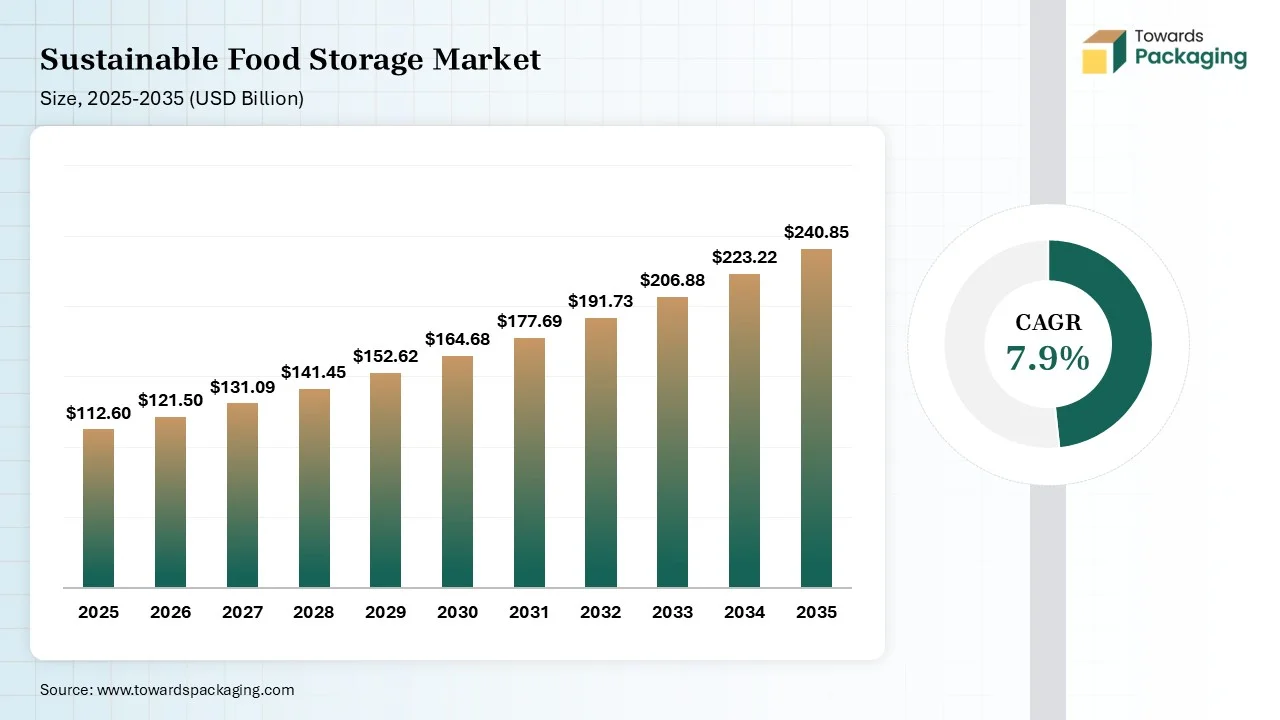
Sustainable food storage protects and assists in the smooth usage and manufacturing of food while protecting natural resources, which lowers local greenhouse gas emissions and develops a healthy diet within any region. It has each element in the complete supply chain right from farm to table, which merges towards developed eco-friendly protection, economic productivity, and social responsibility. Developed climate and economic persistence while using agricultural practices that secure biodiversity with the assistance of higher availability to health foods, increased community, and lesser waste or empowerment through developing sociological diversity.
The bioplastics segment dominated the market with 32% share in 2025, as polylactic acid (PLA) is a kind of biodegradable plastic that comes from renewable plant-based sources like sugarcane, corn starch, and cassava. Like regular plastics created from petroleum, PLA is manufactured with the assistance of fermentation of such natural elements, resulting in a polymer that is both sustainable and eco-friendly. Governments are marketing biodegradable choices, and brands are heavily funding bio-based polymers. Their exceptional properties make them perfect for food packaging uses.
The paper & paperboard segment held the 28% market share in 2025 because paper-based packaging uses recycled fibers, virgin kraft fibers, or molded pulp to make flexible or structural formats. When they are used without any synthetic laminations, such materials are recyclable in perfectly discovered paper progress streamlines and are also biodegradable in nature. They can be developed with bio-based polymer films, dispersion coatings, or grease-resistant coatings to expand application to moisture or oil-holding foods.
The glass segment held the 14% market share in 2025 because these material food containers stand out from plastic in many crucial ways. Like plastic, glass is non-porous and does not absorb food flavors, odors, or stains. The molecular design of glass makes it an irreplaceable barrier that protects chemicals from moving into food, a prevalent issue with some of the plastic containers. Glass can maintain that clarity over a time, without making the cloudy outcome that several plastics gain after multiple washings.
The containers segment dominated the market with 30% share in 2025, as regular containers are combined with cupboards. Collapsible choices, however, shrink to a portion of their standard size when they are empty, freezing insightful storage space in dorms, small kitchens, or RVs. Disposable containers are shifting to reusable takeaway containers that lower single-use waste and assist in a more sustainable lifestyle.
The bags & wraps segment held 22% market share in 2025 because one of the main harmful effects of plastic bag pollution is its impact on marine ecosystems. Reusable bags safeguard marine life by lowering the number of plastic bags that end up in the oceans. The acceptance of reusable bags has a cascade effect in communities. As several people use such sustainable choices, it pushes others to follow them, which then leads to huge eco-friendly actions and awareness.
The bottles & jars segment held the 18% market share in 2025, as reusable bottles are created to be used in a repeat mode and are easy to clean. They are classifiable from disposable bottles, which are used several times, as bacteria are developed inside them. Reusable bottles are dishwasher safe and manufactured from materials that do not promote bacterial growth. Manufacturing disposable plastic bottles requires the application of huge amounts of water and fossil fuels.
The reusable segment dominated the market with 64% share in 2025 because commercial-grade food storage containers are designed to align with regulations for storing food hygienically and safely. Using productive food storage containers helps ensure that food is kept clean, which prevents pollutants and the development of food-borne illness and bacteria. Superior food storage containers include food contents from discovery to moisture and air, which helps to extend the shelf life of ingredients that are utilized in high-demand kitchen surroundings.
The disposable/compostable segment held the 36% market share in 2025, as modern restaurants frequently tailor their disposable packaging to showcase their brand identity. The disposable boxes for food that have logo-printed on them, or environmentally friendly bags make a memorable user experience. This not only markets the restaurant but also talks about care for presentation and quality. With rising awareness about sustainability, several restaurants are moving to eco-friendly food packaging. By accepting green practices, restaurants attract eco-friendly users and invest in lowering plastic waste.
The offline retail segment dominated the market with 58% share in 2025 because supermarkets that are finding sustainable solutions can conveniently select from a variety of eco-storage bags crafted particularly for produce demands and retail. Biodegradable grocery totes are manufactured from plant-based materials like PLA or cornstarch, as bags decompose naturally without toxic residues, which are ideal for stores whose goals are to match green packaging compliance.
The online retail segment held the 42% market share in 2025, as managing enough frozen and chilled products inside a single order is one of the defining complications of sustainable food storage e-commerce. Warehouses should maintain strong temperature control while still allowing effective selection. This frequently needs physical classification, a tailored machine, and a precisely timed workstream. Online series meant to be more extensive than store ranges, which deliver a long tail of less-moving products. At the exact time, quick movers must be kept for fast availability. Slotting energy and warehouse layout are, therefore, complicated.
The household segment dominated the market with 48% share in 2025, as beeswax wraps are a type of fabric cloth covered with a mix of beeswax, tree resin, and oil. They are reusable for several years. To store them in perfect condition, they must be cleaned with mild soap and cold water. Additionally, stainless steel containers are also a perfect option for keeping food, as they are available in various sizes and shapes. Furthermore, soy wax paper is an environmentally friendly choice to regular wax paper, which is not recyclable. They are optimal for cheese, ham, and baked goods.
The food service industry segment held the 32% market share in 2025 as cornstarch packaging is an in-demand, eco-friendly choice to Styrofoam, which is ideal for packing food items like noodles, curries, and salads. Mushroom packaging are another perfect choice, which are overall compostable and biodegradable in nature. At the same time, cardboard and paper are also recyclable for dry food packaging. We can even utilize them for less-moisture foods such as sandwiches and pastries.
The retail & packaging industry segment held the 20% market share in 2025 as plant-based plastics such as polylactic acid are gaining attention in biodegradable retail food packaging. Such materials break down in a natural way and lower landfill waste, making them ideal for compostable storage chains and eco-friendly grocery storage containers. Moreover, reusable plastics are crafted without BPA, which are ideal for shoppers and food alike.
The food storage segment dominated the market with 46% share in 2025 as biomass-based packaging has come up as an innovative strategy to lower the eco-friendly effect, which serves solutions that shift agricultural waste into actual storage solutions. As per the current developments, recent growth has mainly stretched the capability of biomass-sourced materials, which include advanced fibers, bioplastics, and high-performance films. The most impactful sustainable food storage solutions completely balance practical results with actual sustainability in food protection through an action of eco-friendly management.
The meal preparation & transport segment held the 32% market share in 2025 because meal delivery brands lower complete carbon releases by smoothing content sourcing and lowering unwanted distributors. One of the huge benefits of meal delivery services is their potential to lower food waste. Alike grocery shopping, which frequently results in unutilized contents, deteriorating in refrigerators, as meal kits deliver pre-portioned ingredients, which ensure that everything bought gets used.
The beverage storage segment held the 22% market share in 2025, as recycled paperboard, which comes from post-consumer waste, invests in a closed-loop machine that can point to perfect protection of natural resources. The materials are acceptable and versatile, which makes them an ideal choice for sustainable beverage packaging. Beverage cartons are created from accountable linked plant-based and paperboard as they have a water-based coating, which delivers a sustainable choice to plastic bottles. Such cartons are recyclable, lightweight, and frequently available with high renewable ingredients.
Asia Pacific dominated the market with 34% share in 2025 because they are witnessing a crucial shift, which is driven by fast urbanization and updated user lifestyles. As the urban centers grow and disposable income grows, there is a developing urge for hygienic, convenient, and sustainable food storage packaging solutions. This move is further developed by the expansion of the online food delivery stage, which makes a compulsion for lightweight and durable containers that can track food integrity during transport.
Trend of Sustainable Food Storage in India:
As eco-friendly recognition develops worldwide, India is experiencing a major move in how food packaging is evolving. The food sector and users alike are shifting towards sustainable food wrap options. Materials such as compostable containers, biodegradable wraps, and butter paper are receiving attention for their less eco-unfriendly effect. Butter paper has become favorable because of its eco-friendliness and versatile nature. The environmentally friendly composition of butter paper is compostable and biodegradable, making it perfect for plastic wraps.
North America held the second-largest market share of 26% in 2025 as this market is being driven by user demand for sustainability and convenience, along with growing awareness of food waste. Inventions in materials like eco-friendly choices and BPA-free plastics develop product requests. Intelligent storage solutions mixed with IoT technologies match with tech-savvy users by serving factors like freshness tracking. To solve such issues, brands should fund research and development for advanced materials that market the advantages of reusability.
Trend of Sustainable Food Storage in the United States:
The U.S. sustainable food storage sector is experiencing a sudden move, which is driven by growing user demand for safe, sustainable, and convenience-focused packaging solutions. FDA rules, regulatory frameworks, and eco-friendly plastics are convincing producers to update with barricade materials that expand shelf life while lowering the environmental impact.
By Material Type:
By Product Type:
By Usage Type:
By Distribution Channel:
By End User:
By Application:
By Regions:



Principal Research Analyst
Vidyesh Swar is a Senior Research Analyst at Towards Packaging, bringing over 4 years of dedicated expertise in market intelligence and strategic analysis across the dynamic world of packaging technologies and solutions.
Learn more about Vidyesh Swar

Reviewed By
Aditi Shivarkar, with 14+ years in packaging market research, specializes in food, beverage, and eco-friendly packaging. She ensures accurate, actionable insights, driving Towards Packaging Analytics & Consulting 's excellence in industry trends and sustainability.
Learn more about Aditi Shivarkar


Sustainable Food Storage Market
 Table of Content
 sales@towardspackaging.com
 +1 804-441-9344
 Download Sample
 Schedule a Meeting