


The uncoated printing paper market is projected to grow from USD 65.42 billion in 2026 to USD 77.5 billion by 2035, registering a CAGR of 1.9% during the forecast period. The report provides detailed insights into market size, segment-wise performance by product type and application, and regional data across major markets. It also covers competitive analysis, profiling leading companies, and examines the value chain from raw material suppliers to end-users. Additionally, trade data, manufacturer and supplier landscape, and industry structure are analyzed to offer a complete market overview.
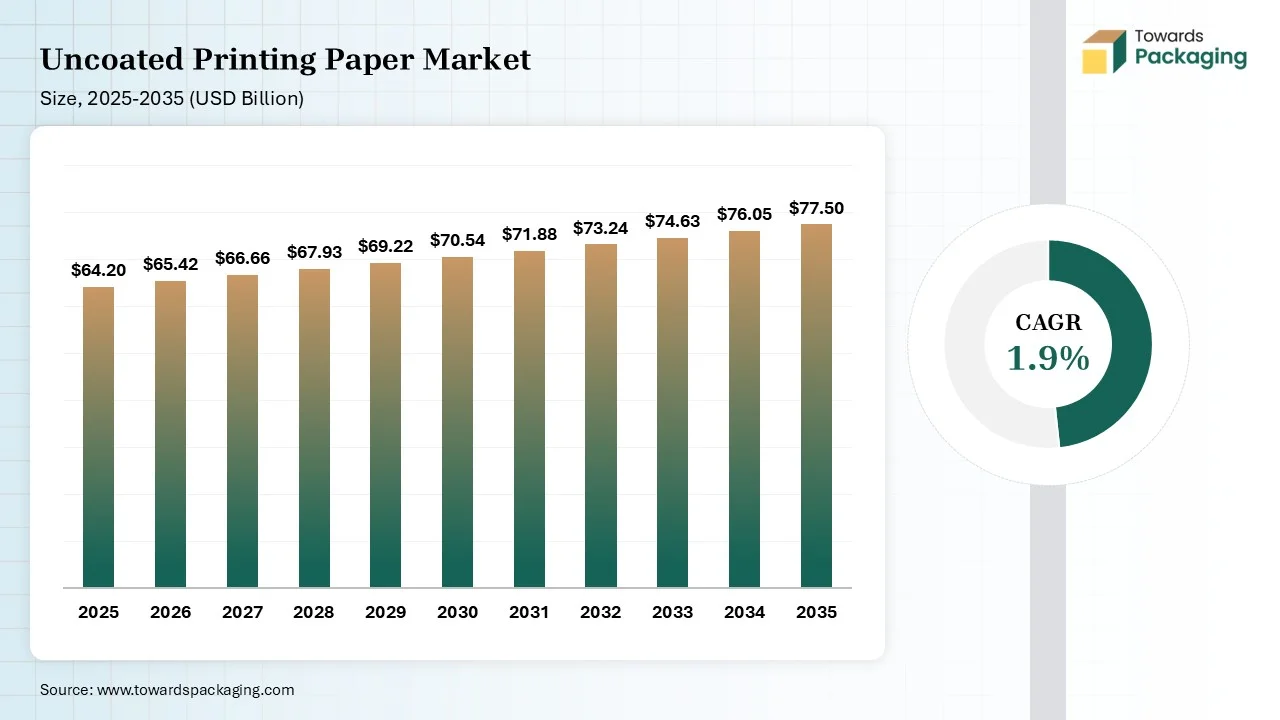
Market Size (2025): USD 64.20 Billion | CAGR (2025–2035): 1.9%
Market Volume (2025): 92.5 million Tons | Volume CAGR (2025–2035): 1.2%
Pricing Data (2025):
Uncoated paper is a kind of paper that has a backing and a further coating layer on its surface, which makes it more absorbent and porous compared to coated paper. Alike coated paper, which has a smooth, matte finish and glossy appearance because of polymer coating or clay, uncoated paper retains its natural texture, which delivers a softer and more organic look.
The time off a coating enables uncoated paper to absorb the ink more smoothly, which results in minutely muted print quality as compared to coated paper.
In the current scenario, brands are increasingly finding ways to create their print pieces that are more eco-friendly. Selecting an uncoated media can assist in avoiding several of the chemicals specifically used in matte or gloss coatings. By avoiding the demand for lamination, they are no longer considered necessary for enhancing uncoated sheets, as this strategy serves as a more sustainable solution that aligns with the developing eco-friendly importance to current end-users.
Several designers are diverting towards uncoated stock as it provides them to protect the natural texture and the tangible quality of the paper. Like coated sheets, in which ink has particularly fitted the layer, uncoated media has matched the water-based ink to communicate directly with the fibers, which creates standard effects and subtle effects that push the actual sense of luxury.
The uncoated woodfree paper segment dominated the market with a 58% share in 2025, as woodfree papers are subjected to papers manufactured from chemical pulp instead of mechanical pulp. Chemical pulp is created from pulpwood, which involves the extraction of cellulose from wood by dissolving the lignin that binds the cellulose fibers together. This results in a paper which is totally free from lignin, making it reliable and opposite to yellowing over time.
They are widely used for everyday office stationery, such as envelopes, letterheads, and notebooks. They are in a writable layer and reliable, which makes them accurate for ideas, jotting down notes, and daily tasks.
The uncoated mechanical paper segment held the 27% market share in 2025 because newsprint paper is a cost-effective thin paper that has been utilized by publishers for many years to generate magazines, newspapers, and other similar marketing uses. An uncoated paper solution, newsprint, is generated by using chemical and mechanical processes on wood fibers. Such papers are generally very thin, which points to producers who can generate them more economically in a more economical format. Newsprints are frequently available in off-white or grey but can be dyed in any type of color to match the user's needs.
The specialty uncoated paper segment held the 15% market share in 2025 as they are crafted for high-end uses, which deliver unique durability, textures, or archival qualities. Such papers are used for historical document protection, artwork, and luxury stationery. Cotton paper is created from cotton fibers, which are frequently used for luxury stationery and legal documents. Additionally, archival paper is acid-free paper that is crafted to protect against aging over time, which is used in the protection of historical documents.
The 50-80 GSM segment dominated the market with 36% share in 2025, as thermal paper is also known as heat-sensitive paper, which is classified as a kind of paper coated with a chemical that gives feedback to heat. The chemicals that are invisible in nature are generally produced by developers and dyes, which totally react at high temperatures, and turn black when they are exposed to heat. They are prevalently used in point-of-sale (POS) systems, such as credit cards and terminals, as well as thermal label printers and fax machines.
The 80–120 GSM segment held the 29% market share in 2025 because it is used in luxury printing and corporate applications. Also, it pushes the durability and print quality that receives attention in professional documentation. Furthermore, they are an exotic foundation for each day's office operation, internal drafts, and high-speed photocopying. It has been given with the assistance of huge commercial copiers without any jamming, but a minute ink display while heavy double-sided printing.
The below 50 GSM segment held the 18% market share in 2025, as papers that weigh below 50 GSM are recognized as thin, ultra-lightweight, and frequently have translucent paper. They are crafted for uses in which lower load, higher flexibility, and lower mailing costs are required. The most common types of papers below 50 GSM are pamphlets, newsprint, tissue paper, typewriter and bank paper, and tracing & vellum paper.
The printing segment dominated the market with a 49% share in 2025 because commercial printers generally serve a huge variety of paper selections for covers and pages of books, each of which is perfectly aligned for a specific aim. Uncoated paper maintains its textured and natural look. Ink has conveniently absorbed into the paper fibers, which delivers the book’s ingredient into a lighter look. As the uncoated paper does not contain luster, which is proven to glow. This enables developed readability in very light conditions.
The writing segment held the 28% market share in 2025 as writing and printing wood-free paper are uncoated paper and of high-quality, which are perfect for soft printing and writing. It has a clean look and bright appearance as it delivers perfect readability and a professional look for printed material. This paper enables relevant results for high-speed photocopying, printing, and a huge variety of stationery demands. They are perfect for books, documents, brochures, and educational materials.
The packaging segment held the 15% market share in 2025, as uncoated cup stock base paper is a tailored paperboard that is crafted for disposable cups. They are created from 100% virgin wood pulp, which ensures food security and delivers a natural feel without any kind of surface coating. It is rigid and has ideal resistance, which is perfect for direct contact for both cold and hot beverages. Like coated paper, the layers of such paper are naturally matte and porous, which gives it more exceptional ink absorbency and an organic look.
Publishing segment dominated the market with 34% market share in 2025, as ink absorption is one of the primary factors that analyze print quality. Various papers absorb ink in different ways. When the layers are highly absorbent, the ink deeps into the fibers. This is due to blurred edges, low contrast, and dull colors. Glossy paper has barely absorbed ink, which enables it to remain constant and generate vivid visuals. The paper texture shows how light has hit the printed surface when the light communicates with the soft paper.
The education segment held the 26% market share in 2025 as the natural surface of uncoated printing paper serves a classified soft experience, which can be requested for projects. Uncoated paper has arrived in different weights and grades, which delivers flexibility for various printing demands. The thicker uncoated paper can deliver a book that gives a more considerable feel, which pushes its actual value. They are receiving popularity in the space of cookbooks, art books, and photography books whose aim is to classify appearance and feel.
The corporate/offices segment held the 18% market share in 2025, as uncoated paper has a more textured and natural appearance, which is convenient to write on. They are often utilized for notebooks, letterheads, and forms. Such a delivery delivers a more organic and impactful look that matches communication styles and personalities. Brochures have given an advantage from soft results, which develop imagery. Flyers frequently need lighter stock for purposes of cost-efficient distribution.
The direct sales (B2B) segment dominated the market with a 42% share in 2025 as sustainability has played a developing role in labeling and packaging decisions. Uncoated paper had a smaller eco-friendly effect because of fewer processing procedures and suitable recyclability. Several uncoated varieties are created from recycled fibers, which require brands that are adopting circular economy methods. This makes an uncoated paper a rigid competitor for eco-minded companies.
The distributors & wholesalers segment held the 27% market share in 2025, it plays vital role in filling the gap between the wholesaler & supplier that ensure an effective & smooth flow of paper in the industry. Additionally, retailers in Mombasa have catered to the demands of minute businesses and particular users who have frequently set a huge range of paper products, which include paper boards in different specifications and sizes. This has attracted suppliers and wholesalers in the same location to match the growing choices of users and brands.
Retail stores segment held the 18% market share in 2025 as kraft brown bag paper has natural-toned unbleached paper, which talks about details of craft, sustainability, and authenticity. They are excessively famous for retail bags, artisan food packaging, and eco-conscious brand materials, where a “natural” space is a huge part of the brand presence and positioning.
Asia Pacific segment dominated the market with 41% in 2025 and is expected to have the fastest growth in the market with 2.5% CAGR during the forecast period. Future possibilities in the Uncoated printing paper are being designed by updating industry needs and fast technological changes. As businesses find faster, smarter, and more mixed solutions, the urge for advanced services is predicted to develop. The growing funds in the digital ecosystems and infrastructure are creating favorable conditions for market growth. Additionally, the development of the latest uses and business designs is growing in the scope of the market.
Trend of Uncoated Printing Paper Market in India:
India’s paper exports have developed mainly in recent years because of rising demand for eco-friendly and affordable paper products around the globe. India has become a major player in the worldwide paper trade, which is due to a strong production base, rising acceptance of sustainable manufacturing methods, and technological advancements. Paper production in India is a crucial industry with several mills, which are mostly driven by the packaging sector.
Europe held the market share of 24% in 2025 because of technological changes, such as blockchain, artificial intelligence, and the Internet of Things (IoT), which are updating the sectors. AI develops personalization and effectiveness in services, on the other hand, blockchain ensures security and transparency in transactions, making it simple to work in supply chain management and cryptocurrencies. Furthermore, IoT is developing smart machines that update user communication with products, which drives demand for connected solutions.
Trend of Uncoated Printing Paper Market in Germany:
The German uncoated paper industry is meant for average development in the long-term growth, which is being driven by growing demand from the packaging and publishing sectors. Due to this, a move towards sustainability trends and digital options may disturb regular paper usage designs. Inventions in environmentally friendly manufacturing and materials can redefine market scenarios. Stakeholders must concentrate on growing sustainable items and developing operational workings while using risks which are linked with raw material sourcing.
By Product Type:
By Basis Weight:
By Application:
By End-Use Industry:
By Distribution Channel:
By Regions:








Principal Research Analyst
Vidyesh Swar is a Senior Research Analyst at Towards Packaging, bringing over 4 years of dedicated expertise in market intelligence and strategic analysis across the dynamic world of packaging technologies and solutions.
Learn more about Vidyesh Swar

Reviewed By
Aditi Shivarkar, with 14+ years in packaging market research, specializes in food, beverage, and eco-friendly packaging. She ensures accurate, actionable insights, driving Towards Packaging Analytics & Consulting 's excellence in industry trends and sustainability.
Learn more about Aditi Shivarkar


Uncoated Printing Paper Market
 Table of Content

 Download Sample
 Schedule a Meeting