


Fibre-based packaging like corrugated boxes, molded fiber trays, kraft paper, and cartonboard cartons is considered the backbone of the process of shifting products via the worldwide economy, from e-commerce delivery to grocery-shelf cartons. A pure “full range” fibre packaging distributor must provide capacity across all four of these groups, a level that was only reached by a few companies. That shifted drastically in 2024 and 2025: Smurfit Kappa’s association with WestRock and International Paper’s acquisition of DS Smith, finished just seven months apart, developed two new worldwide market leaders and redesigned the competitive map overnight. Meanwhile, fibre packaging patterns benefit from various other resource-recycling charges that reach 83% in Europe and up to 74% for US cardboard, supported by hundreds of millions of hectares of certified forestry, which has made it the default profit as brand owners face tightening packaging-waste supervision globally. This report relies on individual companies’ own SEC and supervisory filings, official business, linked information, and main forest-certification sources to map who the complete-range players actually are, how they got there, and what’s reshaping the market next.
Visual intelligence and data-driven perceptions are redesigning fiber-based packaging by enhancing material effectiveness, switching from single-use plastics, and enhancing end-of-life recycling processes. Major trends show how advanced information metrics and visual structure unite to influence sustainable production and consumer appeal. The vigorous expansion of technology, paired with a constant rise in industrial manufacturing levels, has notably transformed human daily life, offering new options and an elevated level of comfort. Unfortunately, technological development is not indifferent to the natural environment. Negative penalties of certain sectors of human activity include, among others, climate change, global warming, species destruction, and an upsurge in pollution levels. Variations in the natural situation have also driven the way modern markets function. In society, awareness of the intimidations stopping from the extreme manipulation of natural resources has significantly increased, and several social movements have shown interest in responsible consumption. The paper offers an extensive review of moulded pulp manufacturing, properties, and benefits compared with single-use plastics and bioplastics for food packaging. Bagasse, bamboo, and wheat are being considered as alternatives to wood as fiber sources due to their cost-effectiveness, wide accessibility, and fast renewability. Non-wood pulping and thermoforming procedures have also proceeded greatly, leading to enhanced fiber recovery, manufacturing efficiency, and product integrity.
The world's largest fibre-based packaging companies by revenue are Smurfit Westrock with around $31 billion in yearly sales, followed closely by International Paper at approximately $23.6 billion. The universal paper-based and corrugated board packaging industry is not just a business of making boxes. It is a massive industrial arrangement built across containerboard, recycling, consumer packaging, corrugated packaging, logistics, automation, and long-term consumer agreements. Different research companies scale the market in separate ways. Some emphasize corrugated boxes, while others focus on corrugated board packaging, and wider calculations comprise the wider corrugated packaging industry. Due to these variations, published approximations differ. Modern market approximations place the universal corrugated industry at nearly $180 billion to more than $220 billion in 2025, depending on whether the estimate covers boxes, board packaging, or the comprehensive corrugated packaging industry. Their linked informed revenue is nearly $123 billion, though this is not a pure corrugated board industry-share estimate. It involves wider category revenue from paper-based packaging, paperboard, containerboard, consumer packaging, and correlated fibre-based establishments. Smurfit Kappa investors will have 50.4% ownership of the fresh corporation.
Smurfit Kappa has closed its operation to acquire WestRock. The company now becomes one of the world’s largest packaging firms. Smurfit WestRock's headquarters are in Dublin, where Smurfit Kappa was previously based, and the North and South American headquarters are in Atlanta, where WestRock was previously based. Smurfit Kappa investors will have 50.4% ownership of the new firm. The last deal was valued at around $12.7 billion, creäted on exchange ratios at the time. Smurfit WestRock shares started trading on the New York Stock Exchange; stocks also started trading on the LSE. Smurfit WestRock managers saw the opening bell at the NYSE, their initial full corporate day as the additional corporation. In defence filings, the corporation envisioned a linked income of over $32 billion with 100,000 employees. Smurfit Westrock will have more than 500 sites and 63 paper mills, traversing 40 countries and six continents.
Earlier, Smurfit Kappa managers filled the lion’s split of top management positions at the new corporation. Tony Smurfit, formerly the CEO of Smurfit Kappa, assumed the top place. Likewise, Smurfit Kappa’s CFO Ken Bowles accepted the same position at the new corporation. CEO of WestRock David Sewell will leave. Sewell told Packaging Dive in a recent interview that he is dedicated to not revealing his next endeavour until after the pact is restricted. The Boards of Smurfit Kappa and WestRock observe a convincing plan and commercial and economic reasoning for merging Smurfit Kappa and WestRock’s substantially harmonizing paper-based packaging firms to construct an international leader in sustainable packaging. Smurfit Kappa stockholders will receive one New Share for every usual stake in Smurfit Kappa. Instantly following the conclusion of the Combination, Smurfit Kappa stakeholders and WestRock stockholders are anticipated to own around 50.4% and 49.6% of Smurfit WestRock, correspondingly, based on the existing number of portions outstanding of both Smurfit Kappa and WestRock as of the date of this declaration.
International Paper has accomplished its acquisition of DS Smith, in an agreement that is projected to be value $7.2 billion. The new business’s headquarters is in Memphis, Tennessee, IP’s hometown. It will also create a European headquarters in London, DS Smith’s prior home base. The firms anticipate attaining at least $514 million in interactions, according to an International Paper safeties filing. Legacy International Paper stakeholders will own 65.9% of the company’s collection, and heritage DS Smith stakeholders will own around 34.1%. The company will mainly list on the New York Stock Exchange and secondarily on the London Stock Exchange. Silvernail will lead the new corporation, and much of IP’s existing leadership team will continue in place, according to proxy filings. DS Smith CEO Miles Roberts will stay with the firm in a consulting capacity for up to two years. IP and DS Smith first announced the conventional deal in April 2024 and predicted it would close the previous year, but it got pushed to this quarter because of current supervisory reviews. The European Commission accepted the deal in January 2025, as long as IP agreed to separate five box plants in Europe to improve competition.
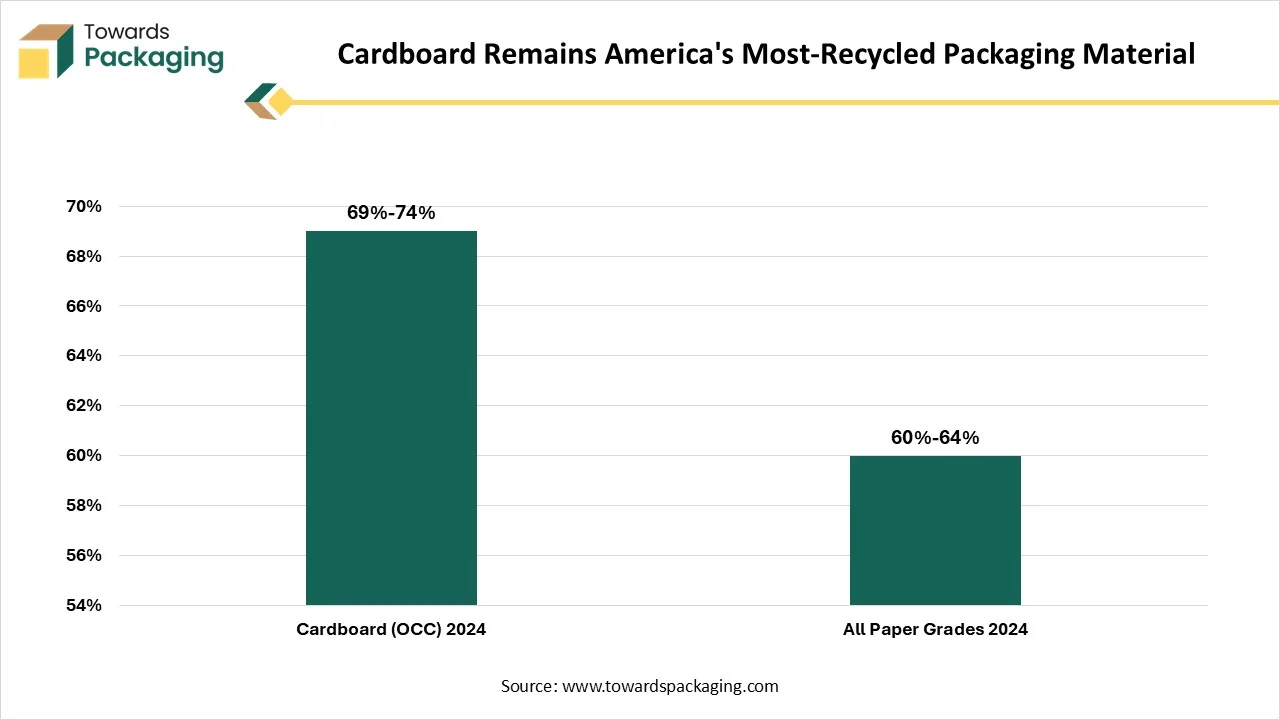
Cardboard remains America's top recycled packaging material, with current information from the American Forest & Paper Association reflecting a robust recovery rate of nearly 69% to 74%, translating to nearly 33 million tons of corrugated material kept out of landfills yearly. Cardboard is one of the most recycled resources in the U.S. It is composed of commercial, residential, industrial, and institutional sources. From the transporting box at the doorstep to huge machine packaging and yield bins at the grocery store, cardboard recycling plays an important role in the paper market. In 2024, more than 33 million tons of cardboard were recycled, leading to a cardboard recycling rate of 69% to 74%. That’s about 90,000 tons every day an incredible number of resources being diverted from landfills. Cardboard is gathered from residential, industrial, commercial, and institutional sources. Collected cardboard is first organized, and non-cardboard resources are removed. After it is processed, the materials are sent to paper mills. Recycled cardboard is utilized at paper mills to manufacture new packaging resources.
Across half of all recycled paper went into forming containerboard, the material used to make cardboard boxes, in 2024. Moreover, about 80% of U.S. paper mills utilize some recycled paper to produce new products. Actually, 79% of Americans have evaluated to a community residential curbside recycling program. This makes it simpler to recycle paper and cardboard at home. At paper mills across the country, recycled paper is utilized to make the important products millions of people depend on daily. More than 2/3 of all paper recycled in the U.S. is transformed into new goods Americans depend on at mills nationally. In 2024, almost half of recycled paper went into producing containerboard, the resource utilized to make cardboard boxes. Recycled paper makes boxes for medicine and food, tissue goods such as paper towels and toilet paper, and newspapers. Recycled paper is also distributed. It's utilized in paper mills throughout the globe to produce new products.
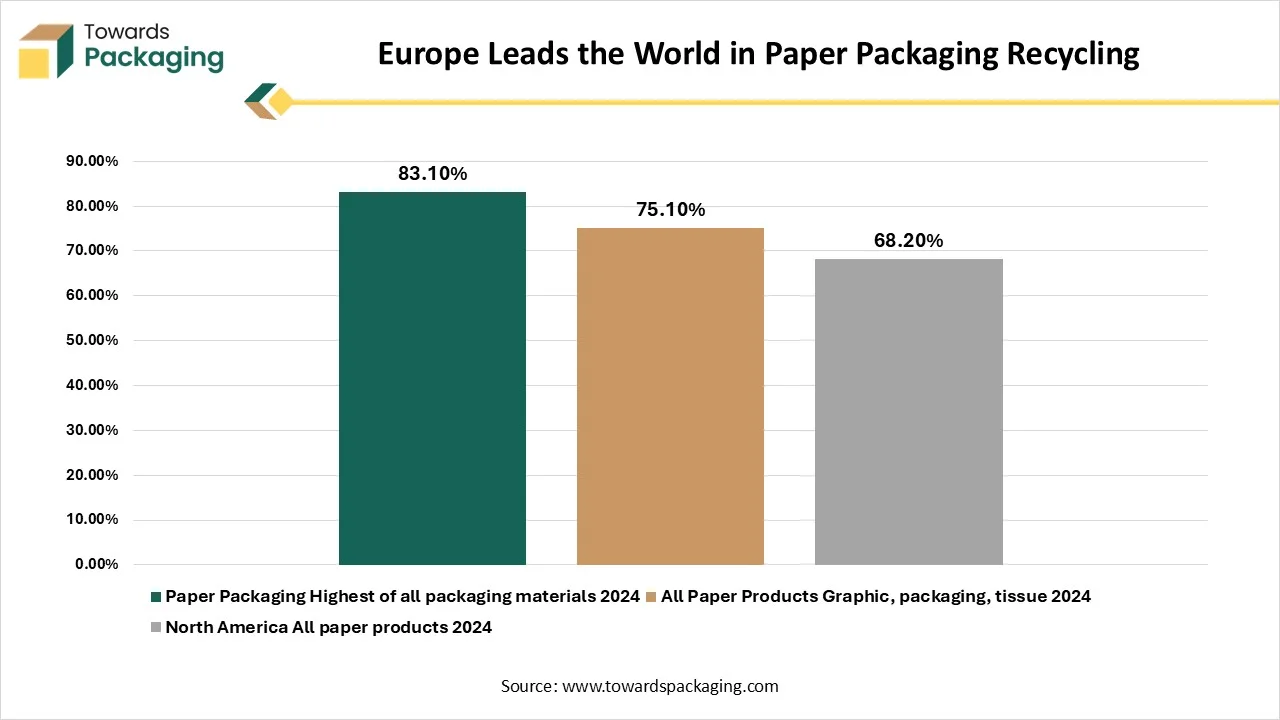
Europe leads universal paper packaging recycling with a remarkable recovery rate of roughly 87% across the European Union, surpassing all other packaging resources and regions. This milestone is influenced by mature collection practices, strong industry guidelines, and forward-thinking ecological legislation. The changeover to a circular economy is a major priority of the European Union in response to the improving ecological challenges linked to climate change, natural resources, and waste generation. Packaging resources, which creäte a substantial part of municipal waste, play a significant role in this shift. The document emphasizes the shift from fossil-based plastics to more recyclable paper packaging, improvements in recycling rates, and coordinated sector efforts to fund harmonised recycling models under changing EU regulatory structures. Paper and board packaging is extensively utilized across markets and has shown itself as a major contributor to recycling industries. In Europe, the recycling rate for paper packaging platforms is about 87%, exceptional legal EU aims for the end of the decade and overtaking recycling rates in several other regions.
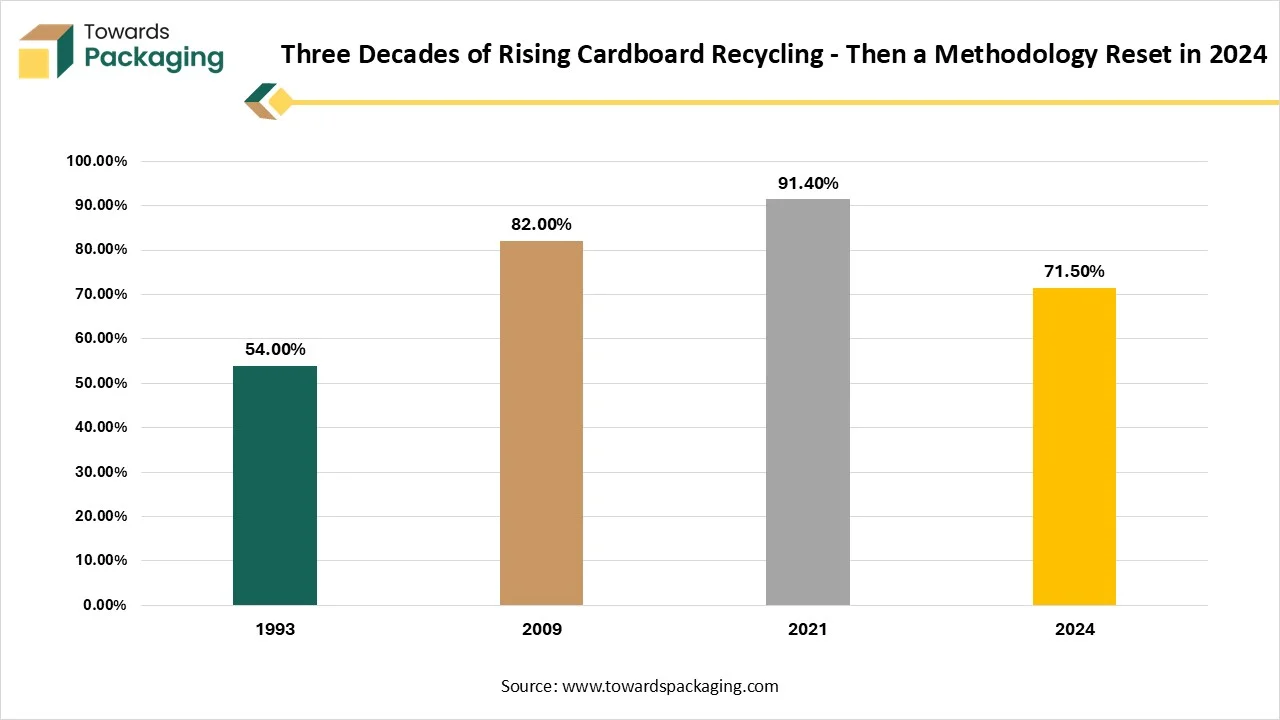
For three decades, stated cardboard and paper recovery rates rose steadily across the world, influenced by extended curbside approach and viable collection. In 2024, data procedures were reset to account for changing e-commerce flows, lightweight packaging, and accurate post-consumer tracking, placing the revised U.S. cardboard recycling rate at nearly 69% to 74%. By 1995, the Environmental Protection Agency stated that 64% 64.2% of weighted boxes were collected for the recycling process, which was considered one of the highest recovery rates among major municipal solid waste-based resources. The wider trajectory remained robust. As per the American Forest and Paper Association, the US paper sector now recycles around 60% more paper than it did in 1990. Cardboard is a major component of the recycling flow, backed by residential, institutional, industrial, and commercial collection channels. Under the revised methodology, AF&PA stated job long term cargo recycling progress is substantial, but scaling that probe is precisely new approaches that evolve alongside the packaging market itself.
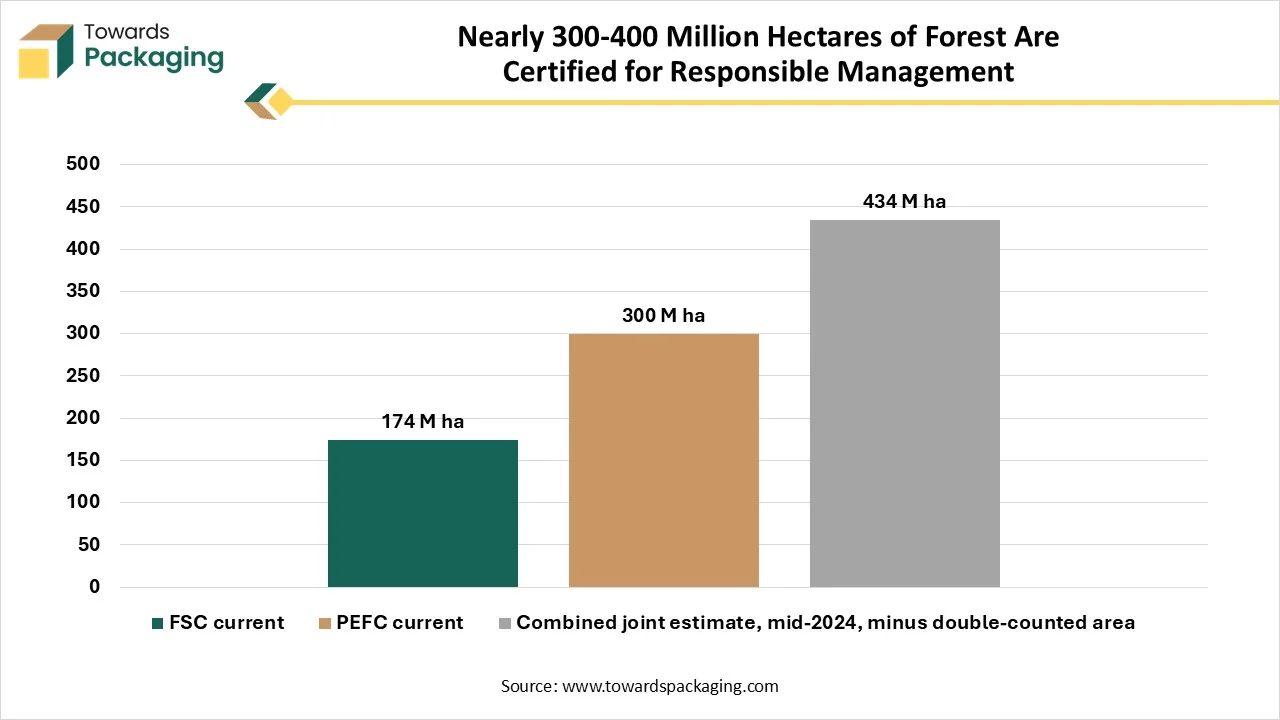
Forest certification has become a significant mechanism for representing that forests are being handled according to the defined ecological, economic, and social standards. The scale of this process is now substantial; according to the Food and Agriculture Organization of the United Nations (FAO), 397 million hectares of forest were certified worldwide in 2024. That shows a 15.5% rise, or 53 million hectares, since 2010. The major international certification processes, PEFC and FSC, are responsible for a substantial share of certified forests globally. In March 2025, PEFC stated that there are around 294 million hectares of PEFC-certified forest. PEFC also calculates that around three-quarters of certified forests worldwide are certified via PEFC. The development of around 400 million certified hectares demonstrates how forest certification has shifted from a niche sustainability initiative towards a significant element of modern forest governance and accountable resource sourcing.
Fiber-based packaging covers far more than the familiar cardboard transporting box. At its widest, the group comprises packaging manufactured mainly from paperboard, paper, and various other fibrous resources, spanning formats utilized for shipping, food and beverage, retail, industrial, and e-commerce applications. U.S. Environmental Protection Agency (EPA) classifications offer a useful outline for understanding this variety. Corrugated packaging forms a huge segment. It utilizes linerboard and a fluted corrugating medium to generate the layered design utilized in the transportation cartons, shifting boxes, and various other protective vessels. Corrugated board can also be changed into inserts and shielding packaging elements. Folding cartons shows another significant group. These lightweight paperboard packs are folded and glued into formats generally utilized for frozen foods, household products, cereals, and various other customer products. Rigid or set-up boxes offer a sturdier paperboard format and are utilized for products necessitating extra presentation and protection. EPA mainly recognizes kraft bags, carrier board, padded mailers, and wrapping paper among paperboard and packaging products.
For food and beverages, fiber-based packaging extends to juice and milk cartons, aseptic cartons, and gable-top cartons, although these formats can contain polymer or various other barrier layers relying on their construction. EPA also recognizes these as paperboard and paper packaging categories. At last, the category comprises industrial paperboard products, such as drums, cores, tubes, and cans, as well as mailing tubes and various other protective formats.
Graphic Packaging International is extending its U.S. paperboard platform as demand grows for packaging manufactured mainly from renewable and recycled resources. The company is a major manufacturer of cartons and paperboard-based foodservice packaging in the United States and Europe, with potential spanning recycled, bleached, and unbleached paperboard. Its portfolio facilitates food, household, healthcare, beverages, foodservice, and beauty industries. A major part of this capacity build-out is Waco, Texas, where Graphic Packaging Manufactured a new recycled paperboard production facility. In 2023, this project was announced to fulfill the rising demand for sustainable consumer packaging. The construction process progressed to equipment installation by October 2024. Food service is highly significant to Graphic Packaging’s strategy to leverage its paper boat potential to expand beyond conventional folding cartons to products like trays, carriers, bowls, and cups, providing the company a wider platform for replacing chosen plastic packaging uses with fiber-based substitutes. The extension also fits within Graphic Packaging's longer-term 2030 plan, which focuses on innovation, growth, and sustainability across food, beverage, food service, and various other consumer industries.
Packaging Corporation of America is a huge force in North America's containerboard and formulated packaging sector. The company recognises itself as the 3rd largest manufacturer of containerboard products in North America, based on industry sources and its own calculations. Its functions extend across container board production and conversion of that resource into populated packaging for a wider variety of end markets. Container board is the paperboard utilised to produce corrugated packaging. These resources are substantially transformed into transporting boxes, retail displays, and various other shielding packaging.
PCA also manufactures honeycomb protective packaging and specific formats for agriculture, consumer goods, food, industrial products, and beverages. PCA’s measurement expanded to be found in 2025 following its $1.8 billion acquisition of containerboard business. Completed on September 2, 2025, the transaction increased containerboard mills to nearly 800,000 tons of yearly manufacturing potential, along with 8 sheet feeders and plants across the United States. With nearly $9 billion in 2025 net sales and approx. 16,800 employees, PCA demonstrates a substantial part of North America's fibre packaging organization. Its association of containerboard manufacturing, transforming potential, and various end markets positions the industry as a significant link between recovered and renewable fibre resources and the polluted packaging utilised during modern supply chains.
The fibre-based packaging value chain is best understood as a circular process instead of a one-way journey. It starts with sustainably managed forests and ends, suitably, with recovered fiber returning to paper and packaging manufacturing. The Food and Agriculture Organization of the United Nations (FAO) designates forest-based sectors as interlinked value chains in which material effectiveness and circularity can expand the utilization of wood fiber. Forest management, transportation, and harvesting show how this renewable resource reaches paper mills and pulp, which is then produced into paperboard and containerboard.
The U.S. Environmental Protection Agency recognises corrugated vessels, paperboard packaging, and many carton formats within the fiber-and-paperboard recycling stream. Recovered fiber is processed and distributed back to paperboard and paper producers, where it can become new packaging. EPA information shows the scale, which was nearly 32.1 million tons of corrugated boxes recycled in the United States in 2018. However, the loop is not suitable. Food contamination, composite materials, fiber degradation, coatings, and collection gaps can restrict recovery. EPA advises that cardboard should be clean and flattened for recycling, whereas contaminated packaging may need other waste-handling routes. Complete circularity relies on each stage working together, from responsible forest handling and effective production to packaging processes, customer participation, and efficient recycling organization.
The worldwide fiber-based packaging sector has been reshaped by two changes mixtures: International Paper’s acquisition of DS Smith and the creation of Smurfit WestRock through the combination of Smurfit WestRock during the combination of Smurfit Kappa and WestRock. Both transactions generated huge packaging synergies, but their geographic footprints and planned priorities differed. International Paper finished its acquisition of DS Smith, in a transaction valued at around $9.9 billion. The association brought together International Paper’s recognized North American packaging trades with DS Smith’s notable European and North American footprint.
The companies also differ in their product combination. International Paper remains highly placed in their corrugated and containerboard packaging, where as retaining a worldwide cellulose-fiber trade. Its 2025 evolution comprises portfolio enhancement and redesign as it incorporates DS Smith and concentrates materials on its core packaging industries. The company therefore emphasizes two distinct routes to scale. International Paper is utilizing the DS Smith acquisition to reinforce a concentrated North American-European packaging platform, while Smurfit WestRock has generated a more geographically diversified worldwide packaging giant.
Europe’s paper and board sector works at a substantial industrial scale, distribution resources for packaging, hygiene products, printing, publishing, and various other usages. As per the Confederation of European Paper Industries (Cepi), the industry manufactured 78.7 million tonnes of paper and board in 2024, demonstrating a 5.9% raise from 2023. This shows the significance of European producers and forest-based bioeconomy. The industry’s measurement also expand into universal trade and recycling. Cepi states that paper and board exports raised 4.6% in 2024. Paper for recycling utilisation also recovered throughout 2024, raising 4.1% after two continuous years of decline. The current figures therefore portray a huge but transforming sector.

Aditi serves as Vice President at Towards Packaging, bringing over 15 years of experience in market research, innovation, and business strategy within the packaging industry. She works across segments such as sustainable packaging, flexible materials, and industrial packaging solutions. Aditi studies evolving consumer demands, material advancements, and regulatory changes, then turns those insights into clear strategies for businesses. She helps organizations stay competitive, improve product positioning, and respond effectively to shifting market trends.

Aman Singh has spent more than 13 years working in research and consulting, with a strong focus on the global packaging sector. He tracks developments in areas like eco-friendly materials, smart packaging technologies, and supply chain changes. At Towards Packaging, Aman leads the research team and ensures every study delivers accurate and useful insights. He breaks down complex industry developments and helps companies understand where opportunities lie and how to act on them.

Piyush Pawar works as Senior Manager for Sales and Business Growth at Towards Packaging, bringing over a decade of experience in client-facing roles within the packaging industry. He connects businesses with the right research and helps them apply insights to real-world decisions. Piyush understands market challenges and works closely with clients to provide solutions that support growth. He focuses on building strong partnerships and helping companies turn industry knowledge into practical results.
Which Companies Offer a Full Range of Fibre Based Packaging


 Request Consultation

