





In 2026, global sourcing teams are under more pressure than ever. It is no longer enough to find a supplier that can simply produce compostable plates, trays, bowls, cups, or cutlery at an acceptable price. Buyers now operate in a market shaped by tighter packaging scrutiny, more demanding food-contact expectations, rising skepticism around vague sustainability claims, and growing pressure to reduce procurement risk across every shipment.
For importers, distributors, foodservice brands, wholesalers, and private-label packaging companies, the question has changed. The issue is not whether a factory can make biodegradable tableware. The issue is whether that supplier can support a commercially stable, compliant, and scalable business relationship.
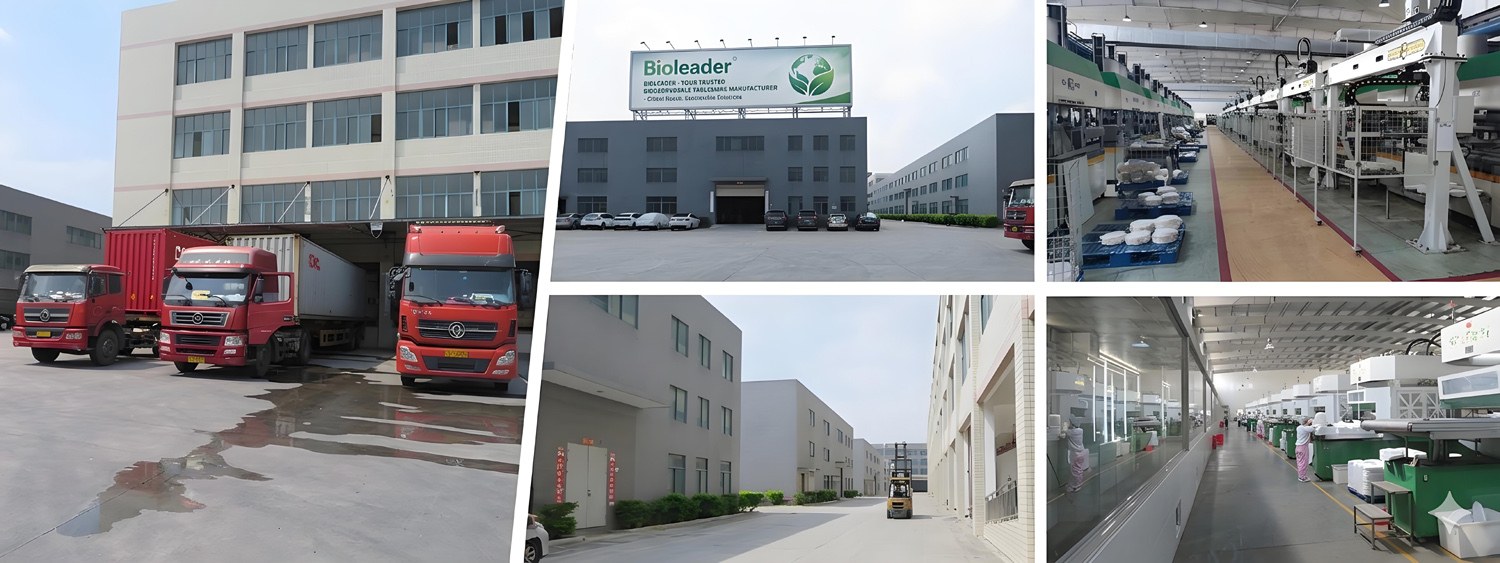
A reliable manufacturing base supports not only production volume, but also packaging consistency, shipment preparation, and repeat-order stability.
That is why choosing a qualified supply partner such as Bioleader, a biodegradable tableware manufacturer, has become a strategic sourcing decision rather than a routine purchase. The strongest suppliers in 2026 are not defined only by catalog size or low pricing. They are defined by document discipline, material expertise, export readiness, communication clarity, and consistent execution under real market conditions.
This guide outlines seven critical checks global buyers should use before shortlisting a manufacturing partner.
The biodegradable tableware category has matured. Buyers are no longer impressed by generic labels such as “green,” “eco,” or “biodegradable” without deeper technical support. End customers, regulators, distributors, and procurement teams increasingly expect evidence, not adjectives.
This shift has major implications. A supplier that appears competitive in a quotation sheet may still create serious downstream problems if it cannot support product-specific compliance documentation, explain material limitations honestly, maintain stable production quality, or prepare export orders professionally. The cost of supplier failure is no longer limited to one delayed shipment. It can affect customer trust, distributor relationships, retail approvals, and brand credibility.
In practical terms, manufacturer selection now influences far more than product cost. It affects compliance confidence, complaint rates, speed of replenishment, packaging consistency, and the buyer’s ability to expand across markets without requalifying suppliers every few months.
For serious buyers, the right supplier is no longer just a vendor. It is a risk-control asset.
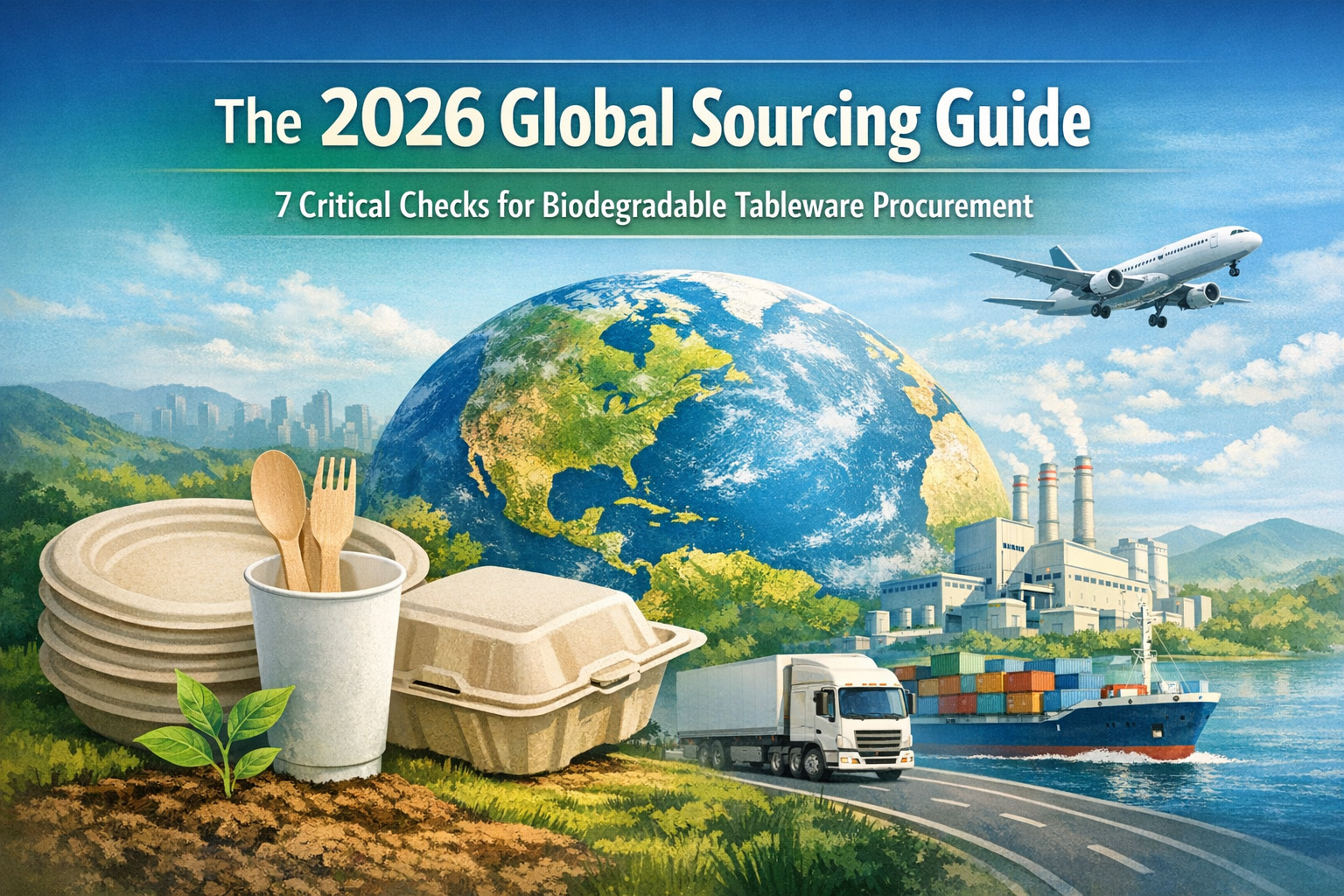
A visual summary of the 2026 sourcing landscape for biodegradable tableware, covering manufacturing credibility, sustainable materials, and global supply chain readiness.
The first sourcing check is simple: never buy the claim before reviewing the evidence.
Many biodegradable tableware suppliers use similar language in their sales materials. Terms such as compostable, biodegradable, food safe, PFAS-free, recyclable, or plastic-free are widely used, but professional buyers know these claims do not all mean the same thing. More importantly, not every claim is automatically supported by documentation that matches the actual finished product.
A reliable manufacturer should be able to provide clear and timely supporting files relevant to the material, product format, and destination market. Buyers should check whether the documentation is current, whether it applies to the exact item being quoted, and whether the supplier can explain the scope of each document without hesitation.
This is where weak suppliers often get exposed. Some present a certificate for one product line while quoting another. Some rely on outdated test reports. Others provide raw-material documents that do not fully represent the finished item sold to the customer. In a more scrutinized 2026 packaging environment, those gaps are not minor administrative issues. They are commercial warning signs.
Reputable manufacturers should also be able to provide certificate references, validity dates, and supporting test documentation without delay. For global buyers, document transparency is no longer optional; it is part of supplier credibility.
One of the most common procurement errors in sustainable packaging is assuming that all eco-materials are commercially interchangeable. They are not.
A reliable biodegradable tableware manufacturer should be able to explain, in practical terms, which materials are most suitable for which applications. That means going beyond broad sustainability positioning and discussing real use-case fit.
Bagasse molded fiber, for example, is often selected for hot meals, takeaway containers, plates, clamshells, and trays where rigidity and natural fiber appearance are commercially valued. PLA is widely associated with cold beverage cups, clear lids, and transparent food packaging where visual presentation matters. Paper-based formats may perform well in soup, salad, or takeaway categories, but barrier structure and disposal expectations must be evaluated carefully. Cornstarch-based compounds may support certain cost-sensitive disposable formats, but buyers should understand composition and performance before treating them as equivalent alternatives.
Some export-oriented manufacturers, including Bioleader, have also expanded into advanced aqueous-based barrier solutions as buyers look for alternatives to conventional plastic-lined foodservice packaging. This reflects a broader market shift: sustainability procurement is moving away from one-size-fits-all claims and toward more application-specific material decisions.
If a supplier cannot clearly explain why one material suits hot food better than another, or why a barrier choice affects recyclability, oil resistance, or end-market acceptance, that is not a technical detail to ignore. It is a sign that the supplier may be selling products without fully understanding the commercial consequences.
| Material Type | Best-Fit Applications | Main Advantage | Main Buyer Risk |
| Bagasse Molded Fiber | Hot meals, trays, clamshells, takeaway boxes, plates | Strong rigidity, natural fiber positioning, broad foodservice appeal | Performance can vary depending on barrier design and food type |
| PLA | Cold cups, transparent lids, cold beverage and deli packaging | High clarity, clean appearance, compostable positioning in suitable channels | Heat sensitivity and confusion around disposal expectations |
| Paper with Barrier | Soup bowls, salad bowls, takeaway cups and branded packaging | Good printability, versatile converting options, strong brand presentation | Barrier choice must match food use, disposal route, and market expectations |
| Cornstarch-Based Compounds | Cutlery, trays, selected cost-sensitive disposable formats | Competitive cost and scalable supply in some categories | Material formulation and end-use performance must be understood clearly |
This comparison does not replace technical validation, but it highlights an essential procurement truth: material choice should be driven by foodservice reality, not just by product appearance or unit price.
The third check is often overlooked because buyers focus too quickly on the quoted price. In reality, production logic matters just as much as the quotation itself.
A manufacturer can only be considered reliable if its operating model is aligned with your purchasing model. Some factories are structured for export-scale production, container optimization, repeat runs, and high-volume consistency. Others may be flexible on small orders but struggle with stable output, efficient carton planning, or repeatability over time.
This is why MOQ should not be seen purely as a sales barrier. It is often a direct reflection of production economics. A professional manufacturer should be able to explain how minimum order quantities relate to mold utilization, raw material planning, print setup, packaging efficiency, and freight structure. That explanation is valuable because it shows whether the supplier is managing the business rationally rather than improvising with each new inquiry.
In 2026, buyers should be cautious of two extremes. The first is the supplier that insists on rigid volume without explaining why. The second is the supplier that promises unrealistic flexibility just to secure the first order. Neither behavior signals stable long-term cooperation. The strongest manufacturers are commercially transparent from the beginning. They explain what is efficient, what is possible, and what would create cost distortion later.
A stable sourcing relationship depends on predictable production logic. If MOQ, lead time, and loading assumptions change constantly, the problem is usually not the inquiry. It is the supplier’s internal control.
In international packaging supply, manufacturing capability and export capability are not the same thing.
A factory may produce acceptable biodegradable tableware for domestic use and still perform poorly when serving overseas accounts. Export readiness requires a different level of operational discipline. It includes carton marking consistency, labeling accuracy, shipment planning, document preparation, packaging protection, delivery timing, and clear communication throughout the order cycle.
For global buyers, this distinction matters. A supplier that understands export business will think beyond production. It will prepare the goods for transit, account for destination expectations, and manage order details in a way that reduces friction after dispatch. That usually leads to fewer surprises and smoother repeat ordering.
This becomes even more important when a buyer serves multiple countries. Different markets may prioritize different packaging standards, product declarations, or documentation expectations. A reliable manufacturer should recognize that export support is not a generic process. It must be adapted to the commercial reality of the customer’s target market.
A useful sourcing question is therefore this: does the supplier behave like an exporter, or simply like a factory willing to ship abroad? The answer often shows up early in the communication stage. Export-ready partners tend to think in systems. Non-export-ready suppliers tend to think only in products.
Customization is frequently misunderstood in biodegradable tableware sourcing. Many buyers use the term to mean simple logo printing, but strong suppliers understand that real customization is broader and more strategic.
The first level of customization is product fit. This includes dimensions, lid matching, stackability, food category suitability, and case-pack efficiency. The second level is visual branding, such as print, embossing, labeling, or retail-ready presentation. The third level is commercial adaptation: choosing the right structure, packing method, or material solution to suit the buyer’s market positioning and operational model.
This is where reliable manufacturers create real value. They do not approve every request automatically. They explain when an existing mold is more efficient than a custom one. They point out when a design change may weaken nesting efficiency, increase freight cost, complicate production, or slow down lead time. In other words, they treat customization as a business decision, not just a design service.
That mindset matters because many expensive sourcing mistakes begin with the wrong kind of customization. A feature that looks attractive in sample approval may become commercially inefficient when converted into palletized export quantities. The best suppliers understand this and guide buyers toward scalable choices.
In 2026, intelligent standardization is often just as important as customization. A reliable partner knows when to offer both.
Photos do not reveal operational performance. Samples tell only part of the story. Claims alone are not enough.
A dependable biodegradable tableware manufacturer should be able to discuss how its products perform under realistic foodservice conditions. Buyers need practical answers, not abstract eco-language. Does the bowl remain stable with hot soup? Can the tray support oily meals without early softening? Is the lid fit secure enough for takeaway delivery? How does the product behave in chilled storage, short microwave use, or fast-turn restaurant service?
These are not minor technical questions. They are the difference between a successful supply program and an expensive complaint cycle.
Real product performance should be reviewed from the perspective of the buyer’s actual end use. A product that works in a controlled test environment may not perform well in a high-volume takeaway chain, a catering operation, or a supermarket deli setting. That is why reliable manufacturers speak in operational terms. They understand food type, temperature exposure, holding time, transport conditions, and packaging interaction.
Buyers should also pay attention to how confidently and precisely a supplier answers these questions. Vague reassurance is not a substitute for product understanding. The manufacturers worth shortlisting are those that discuss limitations as clearly as advantages.
Communication quality is one of the most underrated sourcing indicators in the packaging business. It is also one of the most predictive.
If a supplier is slow, vague, inconsistent, or evasive during the quotation stage, those weaknesses rarely disappear after the purchase order is placed. In most cases, they become more expensive.
A reliable manufacturer communicates in a commercially structured way. It confirms specifications clearly, highlights assumptions, distinguishes standard items from custom ones, explains quotation scope, and raises potential issues before they become disputes. That level of communication reflects internal control.
Strong communication also includes the ability to set realistic expectations. Serious suppliers should be willing to say when a requested quantity is too low for efficient production, when a material is not ideal for the intended use, or when a design choice may increase cost or reduce performance. Buyers should see that honesty as a strategic advantage.
Transparent communication is not just about professionalism. It is a working sign of future order stability. In 2026, it is one of the clearest signals that a supplier can support a long-term export relationship rather than a one-time transaction.
Even experienced procurement teams continue to repeat several avoidable mistakes.
The first is over-prioritizing unit price while underestimating total supply cost. A slightly cheaper tray, bowl, or cup may become far more expensive once delays, complaints, poor fit, unstable documentation, or damaged customer relationships are included in the equation.
The second is treating all biodegradable materials as if they deliver the same performance. They do not. Material mismatch remains one of the most common reasons buyers switch suppliers after the first program cycle.
The third is assuming that an approved sample guarantees production consistency. A clean sample is useful, but it does not prove long-run quality stability, disciplined packaging, export readiness, or reliable replenishment. Procurement decisions should be based on manufacturing capability, not sample appearance alone.
Document transparency comes first. Sustainability claims only create commercial value when they are backed by relevant, current, and product-specific supporting files. Without that, claims create exposure rather than confidence.
No. Material suitability depends on food type, temperature, oil content, holding time, transport conditions, and intended disposal route. Buyers should validate application fit rather than rely on broad category labels.
Because international orders require more than manufacturing. They require packaging discipline, shipment readiness, documentation control, responsive communication, and the ability to deliver consistency across repeat purchase cycles.
By 2026, the global market for biodegradable tableware is no longer defined by simple catalog competition. It is defined by execution quality.
The suppliers that deserve serious buyer attention are not merely the ones with broad product ranges or attractive opening prices. They are the ones that can combine verified compliance, material expertise, commercially realistic production logic, export readiness, practical customization support, dependable product performance, and transparent communication.
That is the real sourcing standard.
For buyers building long-term packaging programs, the objective should not be to identify the cheapest available supplier. It should be to identify the most dependable one under real commercial conditions.
Reliability is not a soft advantage. It is a sourcing asset.
21 August 2026
20 August 2026
19 August 2026
19 August 2026